
Why should you know what claws do? They are small, but they show off your stone and protect it from damage and loss 3. Each claw is a narrow strip of metal that rises from the base of the setting and bends over the edge of the stone 1. A setter (the person who fixes stones in place) cuts a small seat into each claw. They then push the tips down so the metal hugs the stone with no gaps 4.
How a claw holds a stone
Step through the three stages that take a plain strip of metal to a claw gripping the edge of a stone.

- A narrow strip of metal
- Each claw is a narrow strip of metal that rises from the base of the setting. The claws are ready to receive the stone.
- A seat in each claw
- A setter, the person who fixes stones in place, cuts a small seat into each claw. The edge of the stone rests in these seats.
- Metal hugging the stone
- The setter pushes the tips down so the metal bends over the edge of the stone and hugs it with no gaps. Each claw then shows off the stone and protects it from damage and loss.
The pictures show one round stone in a six-claw head and simplify the setter's work. Real claws vary in number and shape. Pictures: AI-generated illustrations, checked for accuracy. They are not photographs of a real piece.
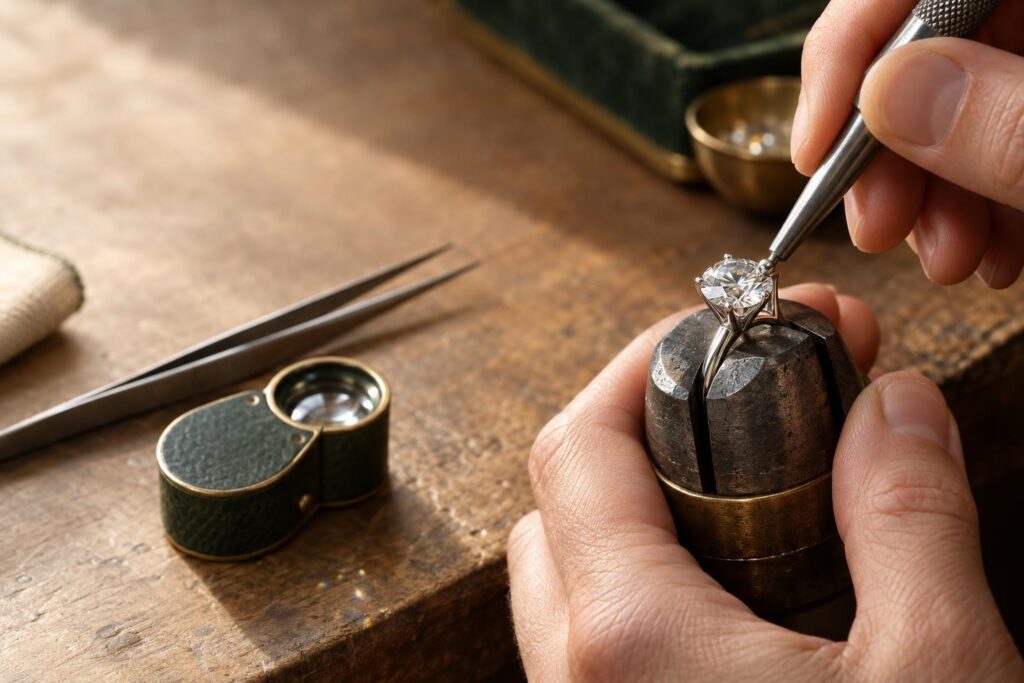
Why does the number of claws matter? Most round diamond rings use four or six, and larger stones need more. Fewer claws show more of the stone, while more claws add security 1. With six claws, if one breaks, the other five will probably hold the stone 2. You can compare both in Four claws vs six claws.
Why do claws need checking over time? Exercise, gardening, snagging on clothes and knocks can shift and loosen them. A check every six months is a good idea 2, and our Jewellery Care and Safety Guide explains how to look after your ring. Worn tips can be rebuilt by adding metal, which is called re-tipping. A loose stone can be tightened by adjusting the claws 1.
Example: Your solitaire (a ring with one main stone) keeps catching on a jumper. You gently push the stone and it moves, which means it is loose. Through a 10× loupe, a small magnifying glass, you also see a gap between the stone and one claw 2. Both are warning signs, so a jeweller can check whether the claws need tightening or re-tipping.