
The decision in brief
- If your partner has strong, specific taste, GIA's advice is that buying something similar to what they already wear is the safe choice, and choosing together lets them say what they want.
- If keeping the ring secret matters most to you, look closely at the jewellery they already wear and plan how you will find their size.
- If you can't be sure of the size, bear in mind that solitaires are easy to resize, while pavé and channel settings generally are not and eternity rings can be very difficult.
- If you are unsure of the size, buy larger, because removing metal from a ring is easier than adding it.
- If you want a surprise moment but a measured fit, proposing with a simple placeholder ring and having a fitting later is one route to consider.
- If you buy as a surprise, find out the jeweller's return policy, and ask what it covers before you pay.
- If budget is a worry, deciding which of the 4Cs matters most can help you work within it, whoever does the choosing.
Editorial guidance — context changes what is right for you.
Start with the wearer and the ring
Start with the person who will wear the ring, not with tradition. Ask yourself whether they would rather see the ring for the first time at the proposal, or help choose something they will wear every day.
Think about their hands and habits too. An everyday ring needs to go with everything from jeans to evening wear, and an active person may suit a lower, more secure setting that is less likely to get knocked or caught. Then be honest about yourself: how sure are you of their size and their style?
Quick checklist
- What jewellery do they already wear: classic or modern, white or yellow metal, delicate or chunky?
- Do they enjoy surprises, or do they prefer to plan things?
- Have they mentioned shapes, styles or rings they admire?
- Have they been measured for a ring before, or can you borrow one they wear on a ring finger?
- Does their daily life involve sport, manual work or the outdoors?
- Do you have a price range in mind, and have you talked about it together?
- How sure are you, honestly, about their size and taste?
The criteria that matter
Fit
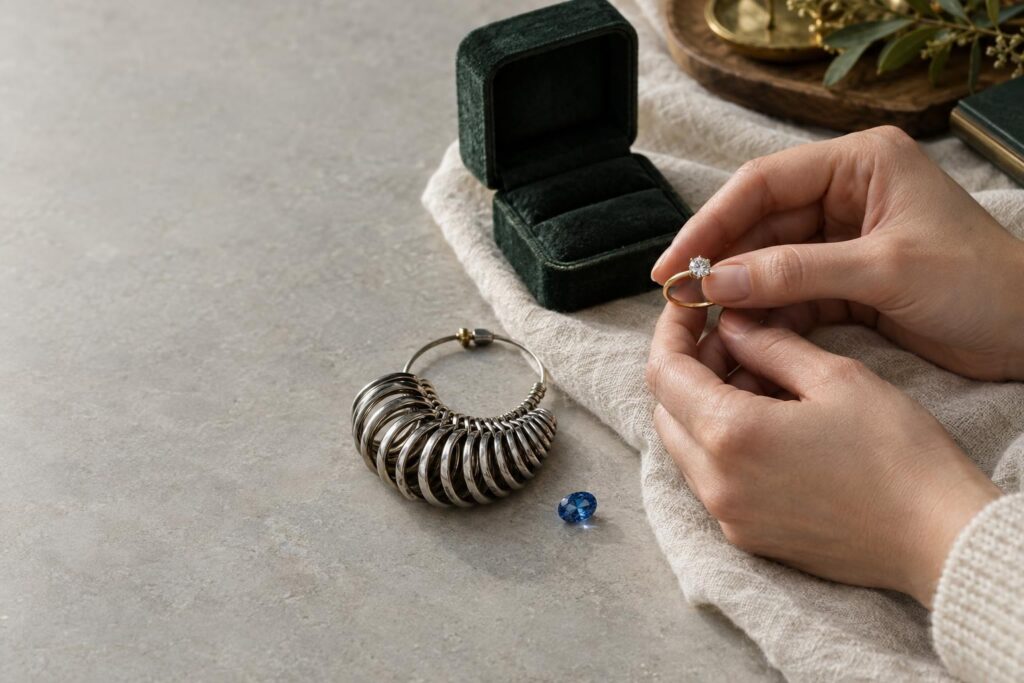
A jeweller can measure your partner's finger with finger gauges, a set of sample rings in known sizes. A borrowed ring gives only an approximation, and the ring's design affects how easily it can be resized later.
Why size matters: how to find ring size secretlyTaste
Look at the jewellery your partner already wears for clues. Classic round or square shapes appeal to most people, and metal colour is personal preference.
Why your diamond shape matters: choosing a diamond shape that suits youRomance and the moment
No source can say how your partner feels about an unseen ring. That judgement is yours, and you can ask yourself which part of the experience matters more to them.
Why a proposal planning timeline works backwards from the dateRisk and how easily it can be fixed
Solitaires are easy to resize, while pavé, channel and eternity designs are not. Find out the jeweller's return policy before you buy.
Why can’t every ring be resized? How ring resizing worksCost
Have a price range in mind before you shop. Choosing which of the 4Cs matters most helps you work within a budget.
Why salary rules don’t fit: how to set an engagement ring budgetCompare your options
| Area | What changes visibly | When to prioritise | Reasonable compromise |
|---|---|---|---|
| Fit | Together, your partner can be measured with finger gauges at a jeweller. As a surprise, unless they have been measured before, you work from clues such as a borrowed ring, which is only an approximation. | When the design is hard to resize, such as pavé, channel or eternity bands. | Borrow a ring for size, or propose with a placeholder and have the final ring fitted later. |
| Taste | Together, your partner can choose their own style. As a surprise, you read it from what they already wear, which GIA calls the safe choice. | When your partner has strong, specific preferences. | Pick up on hints, or choose the setting together and keep the stone unknown to them. |
| Romance | A surprise keeps the ring unseen until the moment. Choosing together makes the choosing a shared step. | When an unseen ring matters to one of you. | Choose the ring together, and plan the time and place of the proposal on your own. |
| Risk | With a surprise, fit and style rest on the clues you gather. Together, the wearer is measured and gives their view on style. | When a poor fit or style would be hard to put right. | Ask about resizing and the return policy before buying a surprise ring. |
| Cost | Alone, you make the budget trade-offs yourself unless you agreed a range first. Together, you make them as a pair. | When your budget means some compromise among the 4Cs. | Agree a price range and the C that matters most, even loosely, before shopping. |
A practical decision process
- Write down what you know about their taste from the jewellery they already wear.
- Decide how much an unseen ring matters, to you and to them.
- Set a price range before you look at rings.
- Compare a full surprise, choosing together and the middle routes on fit, taste, romance, risk and cost.
- Shortlist designs, noting which are easy and which are hard to resize.
- Confirm the size as well as you can: finger gauges at a jeweller, or a borrowed ring as a fallback.
- Ask the jeweller about resizing and what their return policy covers.
- Check whether the diamond comes with an independent grading report.
- Choose your route, with a back-up plan such as a later fitting.
Numbers indicate order, not saved progress.
Common buying mistakes
- Measuring the finger with string or paper String stretches, paper can curl, and neither allows for the knuckle. Finger gauges at a jeweller, or a borrowed ring, give a better guide. Why size matters: how to find ring size secretly
- Treating a borrowed ring as an exact size Ring size varies from finger to finger, so a borrowed ring is only an approximation. Plan for a fitting after the proposal. Why size matters: how to find ring size secretly
- Choosing a hard-to-resize design when the size is a guess Pavé and channel settings generally cannot be resized easily, and eternity rings can be very difficult. With a guessed size, that matters more. Why can’t every ring be resized? How ring resizing works
- Guessing small when unsure Removing metal from a ring is easier than adding it, so buy larger if you are unsure. Why can’t every ring be resized? How ring resizing works
- Choosing for your taste instead of theirs The jewellery they already wear is a good guide to style and metal colour, and buying something similar is the safe choice. Why your diamond shape matters: choosing a diamond shape that suits you
- Not asking about returns before a surprise purchase Find out the jeweller's return policy. Ask what it covers for the ring you are buying before you pay.
- Shopping without a price range Have a range in mind first. Knowing your preferences is the first step in deciding where to compromise among the 4Cs. Why salary rules don’t fit: how to set an engagement ring budget
Questions to ask
Size and fit
- Can you size a ring from one my partner already wears, and how accurate is that?
- How easily can this design be resized later?
- Can my partner come in for a fitting after the proposal?
Changes and returns
- What does your return policy cover for this ring?
- Can the stone or the setting be changed after the proposal?
- If I choose the setting and my partner chooses the stone, will they fit together?
- Can a simple proposal ring be followed by a ring we design together?
Quality
- Does this diamond come with an independent grading report?
- How will the metal colour affect the look of the stone?
Frequently asked questions
Why is size hard to get right for a surprise ring?
A jeweller can measure the finger with finger gauges, a set of sample rings in known sizes, and a surprise usually means working without them. A borrowed ring gives only an approximation, because ring size varies from finger to finger.
Can a surprise ring be resized if it doesn't fit?
Many can. Solitaires are easy to resize, but pavé and channel settings generally cannot be resized easily, and eternity rings can be very difficult. Sizing down is much easier than sizing up.
Why do some people propose with a placeholder ring?
A placeholder is a simple ring used for the proposal. The final ring is then chosen or designed later, so the wearer can give their view and be measured with finger gauges.
Does choosing together mean the proposal can't be a surprise?
Not necessarily. Choosing the ring together does not decide when or where you propose. You can still plan the time and place on your own.
Why does metal colour matter when guessing their taste?
Metal colour reflects through a diamond, so yellow claws can make a colourless diamond look more yellow. GIA calls metal colour personal preference, so the jewellery they already wear is a useful clue.
Why this choice shapes the whole ring experience
Why does it matter who picks the ring? Because it changes how you handle fit, taste and the moment itself. With a surprise, you work from clues, unless you agreed some details beforehand. Choosing together lets the wearer give their view directly.
How do the two routes differ in practice? They differ on five things: fit, taste, romance, risk and cost. An engagement ring is worn every day, so it has to go with everything from jeans to evening wear 3. That is why a small mismatch in size or style can matter more than it first seems.
What can you take from this? Neither route suits everyone. The sections below give the facts on each point, so you can weigh them against your partner and your relationship.
Why fit is the hardest thing to get right as a surprise
Why is size such a practical worry? Your partner can visit a jeweller with you and be measured with finger gauges, a set of sample rings in known sizes 1. Unless your partner has been measured before, a surprise means working from clues instead.
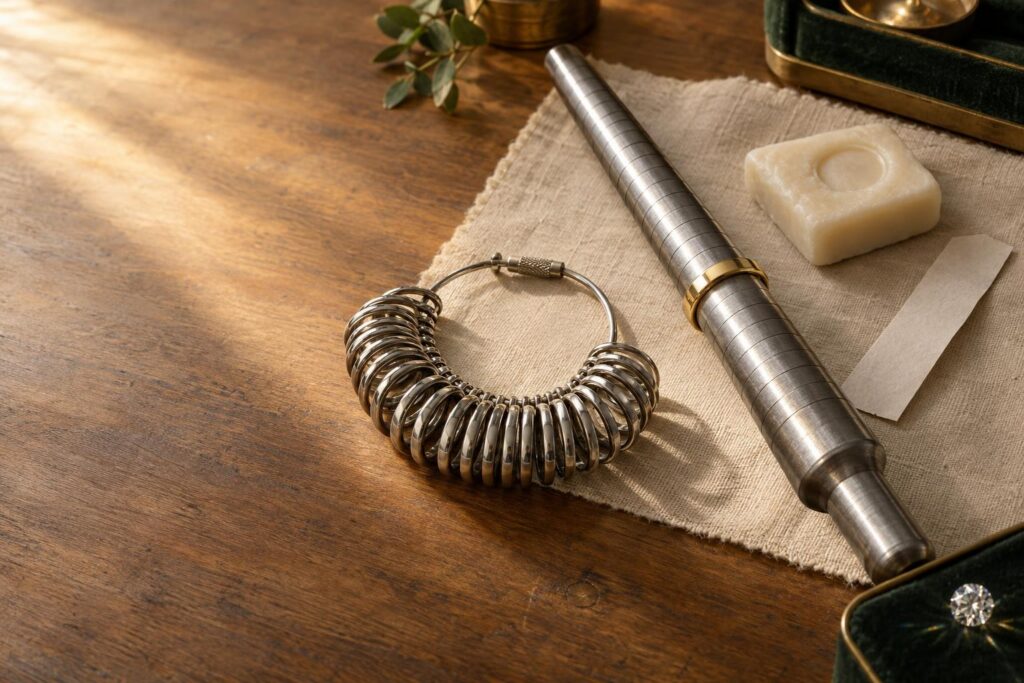
How can you find a size secretly? You can borrow a ring they wear on a ring finger and take it to a jeweller, press it into a bar of soap, or trace its inside on paper. Avoid measuring the finger itself with string or paper: string stretches, paper can curl, and neither allows for the knuckle, which for most people is larger than the rest of the finger 1. Even a borrowed ring gives only an approximation, because ring size varies from finger to finger 2.
What if your guess is a little off? Fingers shrink in the cold and swell in the heat, and humidity, altitude and time of day change them too. If you are unsure, buy larger, because it is easier to remove metal than to add it 1. Sizing a ring down is much easier than sizing it up 3. For more quiet ways to measure, see how to find a ring size secretly.
Why does the design change the risk? Most rings can be resized, and solitaires (rings with a single stone) are easy to resize 2. The setting is the metal that holds the stones. Pavé settings (many small stones set close together across the band) and channel settings (stones held in a groove between two metal walls) generally cannot be resized easily, and eternity rings, with stones all the way round, can be very difficult 1. Read more on why not every ring can be resized.
Why taste is harder to guess than it looks
Why is style a risk even if you know your partner well? Which diamond quality matters most depends on your taste and budget, and on what you and your partner think is most important 4. When you choose alone, you are judging both halves of that sentence.
How can you read their taste? Look at the jewellery they already wear: classic or modern, white or yellow metal, delicate or chunky. GIA calls buying something similar to what they already like the safe choice, and notes that classic round or square shapes appeal to most people most of the time 3. Anything they have said about rings they admire is a clue too.
What details are easy to miss? Metal colour reflects through a diamond, so yellow claws (the small metal prongs that hold the stone) can make a colourless diamond look more yellow 2. Some people like a diamond with a little colour, such as J or K on the colour scale, for its warmth 4. GIA calls metal colour personal preference, and points active or outdoorsy people to lower, more secure settings that are less likely to get knocked or caught 3. See ring settings explained for the main styles.
Why romance and risk pull in different directions
Why does the surprise matter so much? No source can tell you how your partner feels about it. Would they rather see the ring for the first time at the proposal? Or would they rather help choose something they will wear every day? Only you can judge that.
How does each route handle risk? With a surprise, fit and style rest on the clues you gather. If you choose the whole ring together, the wearer is measured and gives their view, but the ring is no longer a secret. A split choice, covered below, keeps part of it unknown. Either way, when and where you propose is still yours to plan.
What protects you if a surprise ring isn’t right? Before you buy, find out the jeweller’s return policy 3. Ask what it covers for the ring you have in mind. Some checks matter whoever chooses. An independent grading report (a document from a gem laboratory describing the stone) tells you whether a diamond is natural and whether it has been treated 2. As GIA puts it, choosing a diamond may be a matter of preference, but evaluating one is a matter of precision 5.
Why cost can look different in each route
Why does the route affect cost? If you buy alone without talking first, you make the budget trade-offs yourself. If you choose together, or agree a range beforehand, you make them as a pair. Either way, have a price range in mind before you start shopping 3.
How do the trade-offs work? There will be compromises, and knowing your preferences is the first step in deciding where to make them 4. The 4Cs (colour, clarity, cut and carat weight) are GIA’s global standard for assessing diamond quality, and choosing which C matters most can help you work within a budget 2. Learn more in the 4 Cs of diamonds.
What facts can help a budget go further? Long fancy shapes such as ovals and marquises tend to look bigger for their carat weight, carat being the unit of diamond weight. Once a diamond is set and worn, the difference between D and G colour is less likely to be easy to see 4. If a surprise ring later needs resizing, twisted, triple-band and bead-set bands (stones held by tiny raised beads of metal) take more work 1.
Why middle routes are worth considering
Why look beyond the two extremes? A full surprise and a fully shared choice are not the only options. Middle routes try to keep some of the surprise while gathering more information on size and style. None of them is certain, so each one still needs checking with a jeweller.
- Hints: talk about styles loosely, notice which rings they comment on, or ask a close friend. This may tell you more about their taste, although there is no guarantee your plan stays secret.
- A borrowed ring for size: take one they wear on a ring finger to a jeweller, then put it back 1.
- A placeholder ring: propose with a simple ring, then choose or design the final ring later, with a proper fitting. See how the custom jewellery process works.
- A later change: buy as a surprise, but first ask the jeweller what their return policy covers and whether a size or style change is possible.
- A split choice: choose the setting together and keep the stone unknown to them, or the other way round. Check with the jeweller that the two will fit together.
If you’d like to talk these routes through, Ralph Jacobs offers a free consultation, online from anywhere at bookings.ralphjacobs.org.
The downsides: when each route isn’t the right choice
Why look at the downsides? Every route gives something up, and knowing what helps you choose deliberately rather than by default.
- A full surprise means guessing their taste. If your partner has strong, specific preferences, or dislikes surprises, ask yourself how comfortable you are with that guess.
- A surprise usually means sizing from clues, and a borrowed ring is only an approximation 2.
- A guessed size is harder to put right with pavé, channel or eternity designs, because these are difficult to resize 1.
- Choosing the whole ring together means the ring itself is no longer a secret, and you both need to agree on a design and a budget.
- Middle routes add steps. A placeholder still leaves a final ring to choose, and any later change depends on what the jeweller’s policy allows.
Tools that can help
Why use a tool? Tools can help you compare and plan, though they don’t replace a proper measurement. Different countries use different ring-size scales, and the Ring Size Converter compares them 1. The Carat to Millimetre Estimator gives an estimate of how big a stone may look, and the Engagement Ring Budget Planner helps you set a range before you shop.
Sources and methodology
This guide draws on GIA guidance on ring sizing, resizing, choosing a style and the 4Cs of diamond quality. Points about romance and middle routes are described as options to consider, not as proven ways to lower risk, because no source can say how a particular person feels about surprises. It gives no verdict, so the decision stays with you.
- How to Determine Ring Size: Tips and Ring Size Chart
- 10 Tips for Buying a Diamond Engagement Ring
- How to Purchase a Diamond Engagement Ring
- Which C is the most important?
- Understanding the 4Cs of Diamond Quality (“Why the 4Cs?”)