Why morganite has a soft pink glow
Why do so many people look at morganite for a romantic ring? Pink has long been linked with love, romance and tenderness, and morganite carries that colour in a soft, warm way 4. If you want a pink stone instead of a diamond, it helps to know how morganite wears and what to look for.
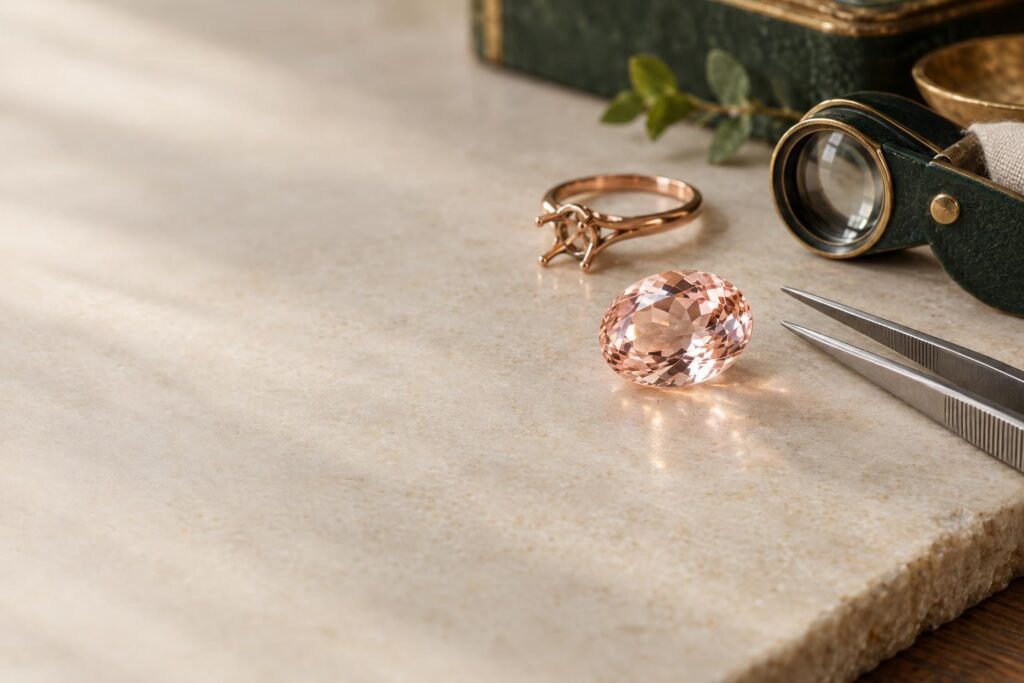
Morganite is the pink to orange-pink variety of beryl. Beryl is the same mineral that includes emerald and aquamarine. Morganite’s gentle colour comes from tiny traces of manganese, and the stone was named after the financier J.P. Morgan 1.
Why morganite ranges from pink to peach
Why does one morganite look pink and another look peach? Its colour comes from manganese, and heating can remove orangey hues from the stone 6. Morganite is known mainly as a pastel gem in light pink, purplish pink and orangy pink, with a range that runs through rose, peach and salmon. Larger stones are more likely to show strong colour 2.
The morganite colour range
Morganite is not one pink. Step through the shades the page describes, from purplish pink to salmon.
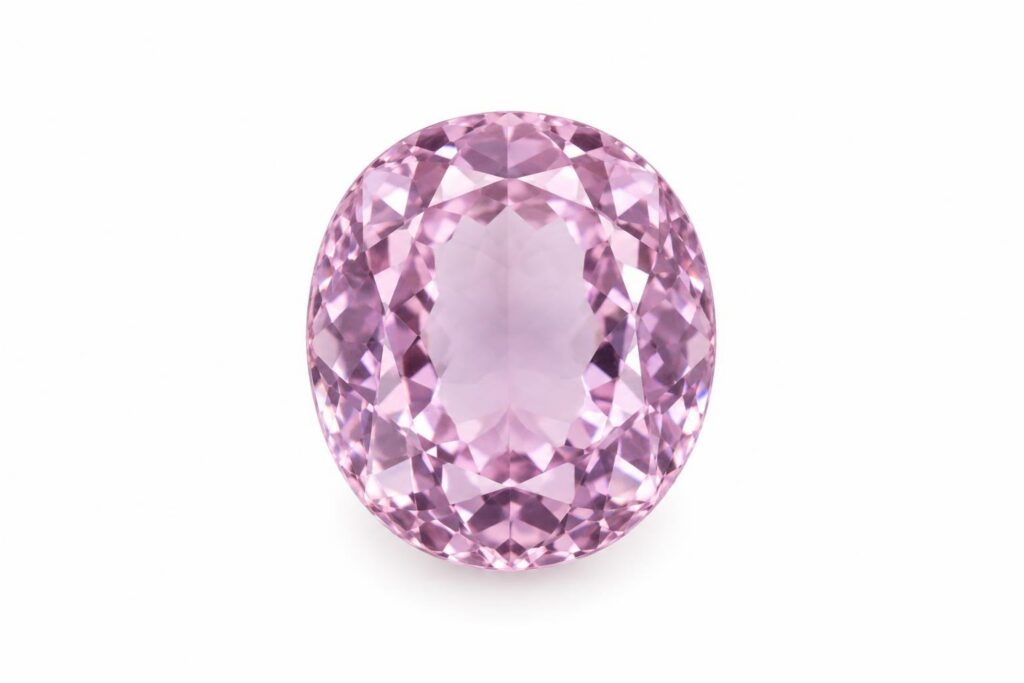
- Purplish pink
- Purplish pink is one of the pastel shades morganite is known for, and it sits at the cooler end of the range.
- Light pink
- Light pink is the soft pastel colour most people picture when they think of morganite. Heated stones are often this pink, and the colour is stable and will not fade.
- Rose
- Rose is one of the shades the morganite range runs through. Larger stones are more likely to show strong colour.
- Orangy pink
- Orangy pink is another pastel shade morganite is known for. Heating can remove orangey hues, which is why many stones are treated to look pinker.
- Peach
- Peach lies further along the range. Some collectors value untreated peach material more highly than heat-treated pink stones.
- Salmon
- Salmon is the warmest shade in the range. Untreated morganite often has a strong orange element, which gives it a salmon colour.
Screens and printing change colour, and real stones vary from one to the next. Treat these pictures as a guide to the order of shades, not a colour match. Pictures: AI-generated illustrations, checked for accuracy. They are not photographs of a real piece.

Morganite also shows pleochroism, which means it shows different colours from different angles. In morganite these are pale pink and a deeper bluish pink. Strong colour is rare, so the cutter must turn the rough crystal carefully before cutting 1.
Clarity is usually less of a worry. Faceted morganite usually has no inclusions (tiny features trapped inside a gem) that you can see with the eye 2. For more on how colour is described, see hue, tone and saturation in gemstones.
Why treatment matters when you buy morganite
Why ask about treatment? Most pink morganite has been changed after mining. It is almost always heat-treated to improve its pink. Heating removes the yellow or orange tinge, and the pink that results is stable and will not fade. This treatment is not detectable 2.
Because heating cannot be detected, it is worth asking the seller what is known about a stone’s treatments. Untreated morganite often has a strong orange element, which gives it a salmon colour 1. Not everyone prefers the treated pink: some collectors value untreated peach material more highly than heat-treated pink stones 2.
Irradiation is a second treatment. It can strongly deepen the colour of colourless to pale pink beryl that contains manganese. Stones that contain iron may turn orangey-pink to brown, then be heated to give a pure pink. A laboratory test can find signs of irradiation, but it is not expected to work on morganite from old stock 6.
Rarely, morganite is fracture-filled, meaning fine cracks are filled to make them harder to see 3. You can read more about heat treatment in gemstones and how gemstone treatments should be disclosed.
Why morganite needs more care than a diamond
Why compare morganite with diamond? If you plan to wear a ring every day, it helps to know how its stone handles knocks and scratches. Gemmologists judge durability on three things: hardness, toughness and stability. Hardness is resistance to scratches, and toughness is resistance to chipping and breaking 5.
Morganite measures 7.5 to 8 on the Mohs scale, a scale of scratch resistance. Its steps are not evenly spaced: diamond is many times harder than the gems just below it 3.
At this hardness, a morganite engagement ring is suitable for everyday wear. It is still not as durable as diamond, ruby or sapphire, and it is more likely than diamond to chip or break 4. Diamond is not unbreakable either: it is the hardest gem, but a hard blow can still split or fracture it 5.
Stability is the third factor. Morganite’s colour holds up in light, but heat is best avoided and hydrofluoric acid can attack it 3. Its heat-treated colour stays stable unless the stone is exposed to temperatures over 400°C 4. For the wider picture, see why the Mohs scale is not the whole durability story.
Why colour and cut deserve a close look when buying
Why look closely before you buy? Morganite’s colour varies from stone to stone, and it comes in all standard shapes as well as designer cuts 2. These points can help you compare stones side by side.
- Colour: the range runs through pink, rose, peach and salmon, and some collectors value untreated peach above heated pink, so the tone is a personal choice. Larger stones are more likely to show strong colour 2.
- Depth of cut: light-coloured stones may be cut slightly deep to strengthen the colour 4.
- Viewing angle: morganite can look pale pink from one direction and a deeper bluish pink from another, so it helps to look at the stone face-up and from the side 1.
- Treatment: some morganite is irradiated to deepen its colour, and the laboratory test for this is not expected to work on old stock 6. Heating cannot be detected at all, so you can ask the seller what is known about a stone’s treatments.
For a broader view of quality, see how coloured gemstones are evaluated.
Why the setting and metal change how morganite looks and wears
Why does the setting matter so much? Morganite is more likely than diamond to chip, so the metal around it does part of the protecting. A bezel setting (a metal rim around the stone) protects morganite more than four- and six-prong settings do 4. Prongs are also called claws.
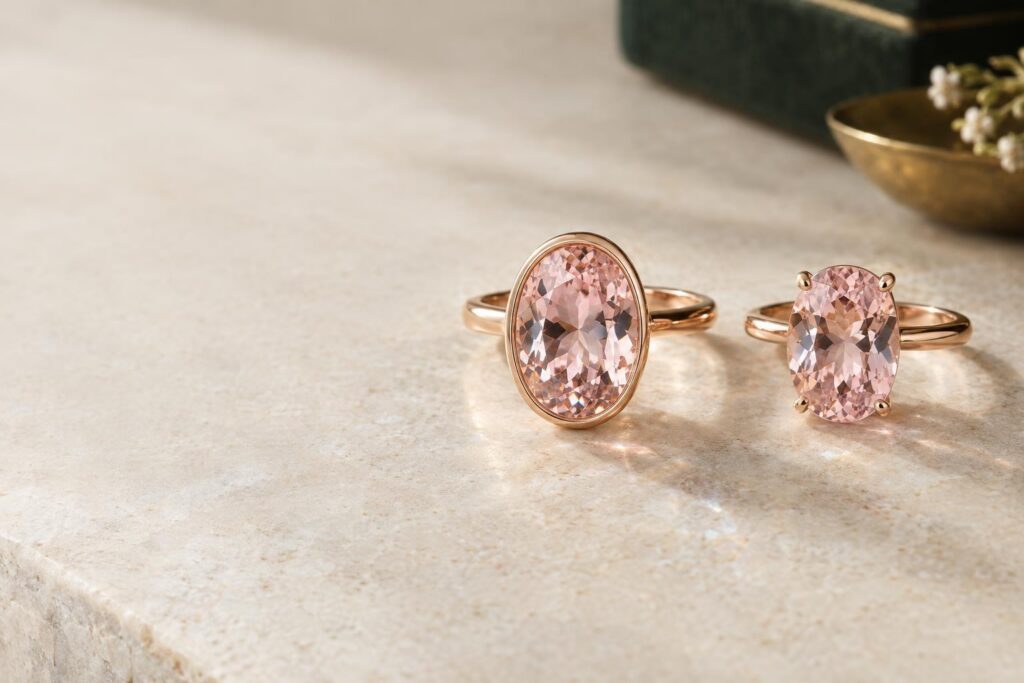
Pointed shapes and corners are better protected by bezels, partial bezels or V-shaped prongs. Bent or broken prongs can leave parts of a gem exposed to chipping 5. You can compare styles in ring settings explained and four claws vs six claws.
Metal colour changes the look too. Rose gold brings out the pink, yellow gold brings out any yellow, and white metal gives a bolder contrast. In a halo (a ring of small diamonds around the centre stone), the diamonds may pick up a pinkish look. Slightly yellow diamonds soften this effect, while colourless diamonds contrast with the morganite 4.
Why this entry is a starting point
This entry describes morganite in general, not any one stone. Inclusion in this guide does not confirm that Ralph Jacobs stocks this gemstone. If you would like to talk through a coloured centre stone, we offer a free consultation, online at bookings.ralphjacobs.org from any country.
Frequently asked questions
Morganite is 7.5 to 8 on the Mohs scale, so it is suitable for everyday wear. It is less durable than diamond, ruby or sapphire and more likely than diamond to chip. A bezel setting protects it more than prongs, and removing the ring for hard work can help 4.
Heat-treated morganite’s colour is stable and does not fade in light. It can change if the stone is exposed to temperatures over 400°C, so keep it away from high heat 4.
Untreated morganite often has an orange element that gives a salmon or peach colour, and heating removes it. Some collectors value untreated peach material more highly than heat-treated pink stones 2.