
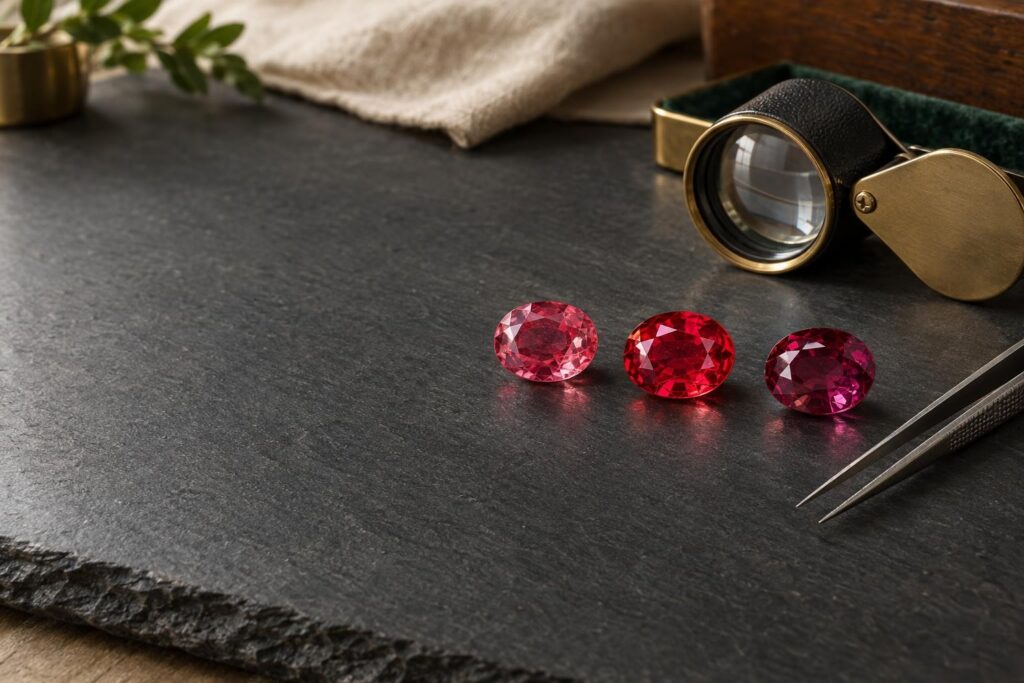
The decision in brief
- If a strong, vivid red matters most to you, compare colour first, because it is the most significant factor in a ruby's value.
- If you like lighter, pinker stones, know that a stone that is too light may be called pink sapphire rather than ruby.
- If you hoped for a stone with no inclusions, know that such rubies are practically nonexistent, so look at whether inclusions reduce brightness or durability.
- If simple everyday care matters to you, ask whether the ruby is untreated or heated only, since these are very durable.
- If a ruby looks unusually clean, ask whether it has been glass-filled, because lead glass makes fractures much less visible.
- If origin is part of the appeal, remember that origin is not the same as quality, and a laboratory can only give an opinion on it.
- If you want written proof of what you are buying, ask for treatment details in writing and a report from an independent laboratory.
Editorial guidance — context changes what is right for you.
Start with the wearer and the ring
Start with the person who will wear the ruby and how often. If the ring will be worn every day, think about how it will be cleaned and what it may touch. Untreated and heat-treated rubies are very durable, while a glass-filled ruby can be etched by ammonia, bleach or even concentrated lemon juice.
Then think about the ring’s future. If it may ever need resizing or repairs, a glass-filled ruby should come out of its setting first, because heat can damage the glass. Finally, think about colour: some people love a deep red, others a lighter pinkish red, and a stone that is too light may not be called ruby at all.
Quick checklist
- Will the ring be worn every day, or only for special occasions?
- Does the wearer often use household cleaners or other chemicals while wearing rings?
- Which reds does the wearer like: purplish red, pure red or orangy red?
- Would a lighter, pinker stone be welcome, even if it may be called pink sapphire?
- Does the wearer mind visible inclusions or a soft, silky look?
- Is a star ruby, cut as a smooth dome, of interest?
- Might the ring need resizing or repairs later?
- Does the buyer want an independent laboratory report on treatment?
The criteria that matter
Colour
Colour is the most significant factor in value. Ruby ranges from orangy red to purplish red. Too dark loses brightness, and too light may be called pink sapphire.
Why hue, tone and saturation matter in gemstonesClarity and inclusions
Inclusion-free rubies are practically nonexistent. Obvious inclusions, or ones that dull the stone, lower value a great deal. Significant fractures that reach the surface can threaten durability.
Cut and orientation
Ovals and cushions are the most common shapes. Ruby shows different colours from different directions, which affects how cutters orient it. Shallow cuts can show a see-through window.
Treatment
Most rubies are heated. Some have colour diffused into the surface or fractures filled with glass, and those are worth less than heated rubies. Diffused colour may be shallow, and glass-filled stones need gentle cleaning and care during repairs.
Why gemstone treatment disclosure matters, and how it’s doneDurability and care
Corundum, the mineral ruby belongs to, is 9 on the Mohs scale with excellent toughness. Untreated and heated rubies are very durable, but glass filler can be damaged by chemicals and heat.
Why the Mohs scale is not the whole gemstone durability storyLaboratory report and origin
An independent report can confirm the ruby is natural, name detectable treatments and sometimes give an opinion on origin. Origin is not the same as quality.
Compare your options
| Area | What changes visibly | When to prioritise | Reasonable compromise |
|---|---|---|---|
| Colour (hue and darkness) | Red can lean orangy or purplish. More chromium gives a stronger red; more iron can make it darker. | When the look of the stone matters most to you, since colour is the most significant factor in value. | Very dark stones lose brightness; very light stones may be called pink sapphire. |
| Clarity and silk | Inclusions are expected. Fine needles called silk can soften and spread colour, and crossing needles can form a star in a domed stone. | When brightness and transparency matter to you, or you would like a star ruby. | Obvious inclusions lower value; significant fractures that reach the surface can threaten durability. |
| Cut and shape | Ovals and cushions are most common. Cutters orient the stone with its direction-dependent colour in mind. | When you want colour across the whole face of the stone. | A stone cut shallow to save weight can show a see-through window. |
| Untreated or heated | Most rubies have been heated. Both untreated and heated rubies are very durable. | When everyday wear and simple care matter to you. | Because most rubies are heated, ask for treatment details in writing and consider an independent report to confirm them. |
| Lattice diffused | Colour is diffused into the surface and may be shallow. | When the treatment is disclosed in writing and you have weighed the look against the lower value. | Worth less than heated rubies; if the colour is shallow, surface damage or re-cutting can remove it. |
| Glass-filled | Glass fills fractures; lead glass makes them much less visible. Some laboratory reports grade the filling as minor, moderate or significant. | When you have read the report's description of the filling and accept the extra care. | Worth less than heated rubies; chemicals and torch heat can damage the glass, and some heavily fractured stones may fall apart if the glass is altered. |
A practical decision process
- Decide how the ring will be worn: every day, or for occasions only.
- Note which reds the wearer likes, and whether lighter pinkish stones would be welcome.
- Look at several rubies side by side, in daylight and indoors, and compare colour first.
- Compare clarity and cut: look for obvious inclusions, cloudiness and a see-through window in the centre.
- Ask for all treatment information in writing.
- Ask for an independent laboratory report and read what it says about treatment, any glass filling and origin.
- Ask how this stone should be cleaned, and how setting and later repairs will be handled for its treatment type.
- Weigh colour, treatment and durability against how the ring will be worn, then make your choice.
Numbers indicate order, not saved progress.
Common buying mistakes
- Buying on origin alone Even the best mines produce low-quality material, so a famous origin does not promise a fine stone. Compare colour, clarity and treatment instead, and treat any origin statement as an opinion. What makes one stone better? How to evaluate coloured gemstones
- Assuming a very clean ruby is untreated Lead-glass filling makes fractures much less visible. Ask for a laboratory report that states whether there is evidence of treatment.
- Accepting treatment details by word of mouth Diffused and glass-filled rubies are worth less than heated ones and need different care. Ask for the details in writing so you know what you are buying. Why gemstone treatment disclosure matters, and how it’s done
- Picking the darkest stone you can find A ruby that is too dark loses brightness. Compare stones in different light and look for colour that stays bright. Why hue, tone and saturation matter in gemstones
- Cleaning a glass-filled ruby with household products Ammonia, bleach, oven cleaner and even concentrated lemon juice etched the glass in testing. Clean fracture-filled stones only with a damp cloth.
- Forgetting about future repairs Glass-filled rubies should come out of their setting before torch work, and shallow diffused colour can be lost if a stone is re-cut. Ask how resizing or repairs would be handled before you buy. Why can’t every ring be resized? How ring resizing works
- Reading the Mohs number as the whole story Diamond is only one step above corundum on the Mohs scale but is many times harder. Look at toughness, inclusions and treatment as well. Why the Mohs scale is not the whole gemstone durability story
Questions to ask
Colour and quality
- Is red the dominant colour, or could this stone be described as pink sapphire?
- Does the stone stay bright in both daylight and indoor light?
- Are there any significant fractures that reach the surface?
- Is the stone cut shallow, and does it show a see-through window?
Treatment and reports
- Has this ruby been treated, and how? Can I have that in writing?
- Is there a report from an independent laboratory, and what does it say about treatment?
- If the stone is glass-filled, how does the report describe the extent of the filling and the type of glass?
- Does the report give an opinion on origin?
Setting, care and repairs
- How should I clean this particular ruby?
- Would the stone need to come out of its setting for resizing or repairs?
- Could re-polishing or re-cutting change the colour of this stone?
Frequently asked questions
Why do some rubies look pink and others deep red?
Chromium causes ruby’s red, and more chromium gives a stronger red. Extra iron can make a ruby darker. A stone that is too light may be called pink sapphire, and GIA calls a stone ruby only if red is the dominant hue.
Is it normal for a ruby to be heated?
Yes. Most rubies have been heated, and heat-treated rubies are very durable. Ask for treatment information in writing, so you know what you are buying and how to look after it.
How can I tell if a ruby is glass-filled?
It is hard to see by eye, because lead glass makes fractures much less visible. Under magnification, signs can include coloured flashes and gas bubbles in the glass. Some laboratory reports name the glass and grade the filling as minor, moderate or significant.
Is a ruby hard enough for an everyday ring?
Ruby is a variety of corundum, which is 9 on the Mohs scale, with excellent toughness and no cleavage. Untreated and heated rubies are very durable. Diamond is still many times harder, and fracture-filled rubies need more care.
Does a ruby's origin tell me its quality?
No. Even the best mines produce low-quality material. A laboratory can sometimes give an opinion on origin, but colour, clarity, cut and treatment describe the stone in front of you.
Why colour matters most when you buy a ruby
Why start with colour when you compare rubies? Because colour is the most significant factor in a ruby’s value. The finest rubies are a pure, vibrant red to slightly purplish red 1.
The ruby colour range
Colour is the biggest factor in a ruby's value. Look at the same stone in different shades to see where the finest colour sits.
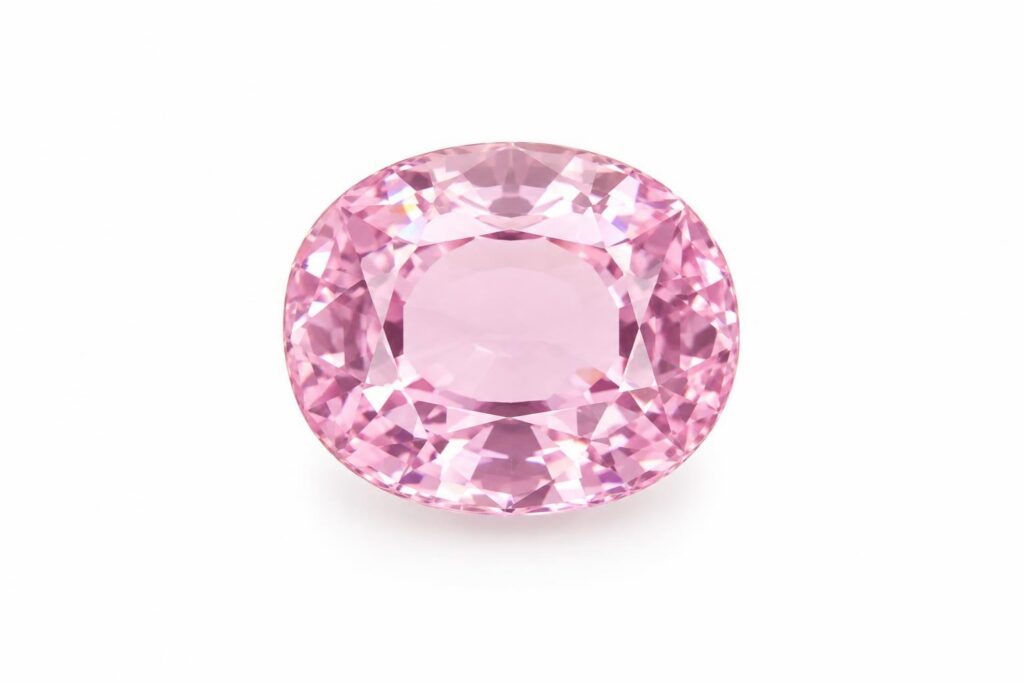
- Close to pink sapphire
- A ruby that is too light may be called a pink sapphire. Dealers debate where that line falls, and it differs between cultures.
- The orangy end of the range
- A trace of chromium causes ruby's red, and the red ranges from orangy red to purplish red. This is the orangy end.
- Pure, vibrant red
- The finest rubies are a pure, vibrant red to slightly purplish red. This stone sits in the heart of that range.
- Slightly purplish red
- Red with a slight purple tone is still among the finest colours. More chromium means a stronger red.
- Loses brightness
- A ruby that is too dark loses brightness, even when the red is strong.
Screens cannot show colour exactly, so treat these pictures as a guide to the range rather than a grading chart. Real stones also show different colours from different directions. Pictures: AI-generated illustrations, checked for accuracy. They are not photographs of a real piece.
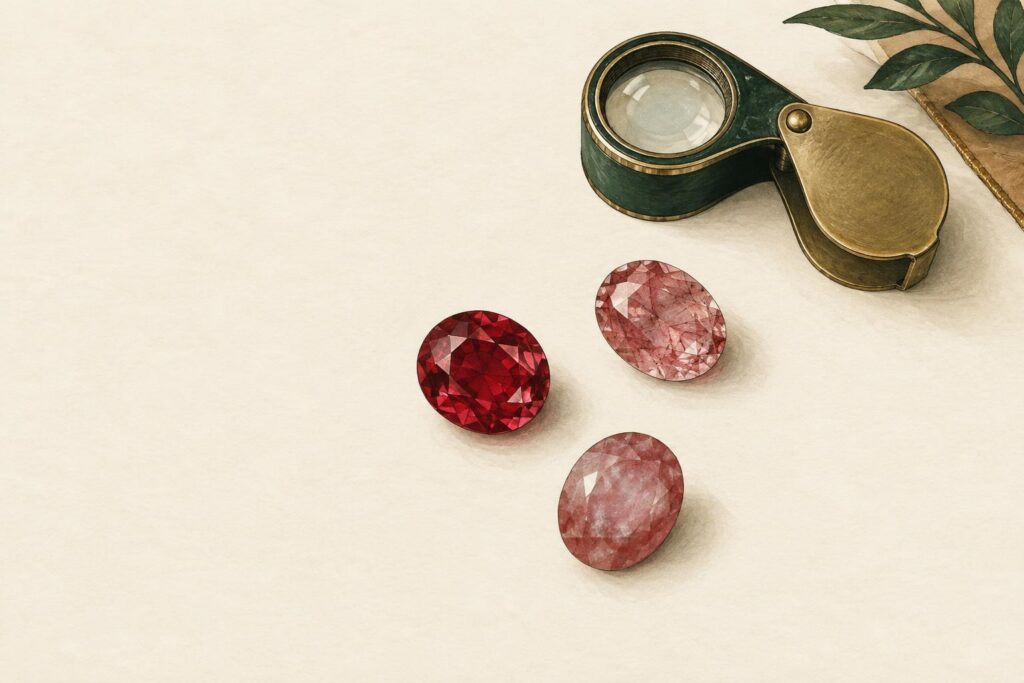
How does a ruby get its red? Ruby is a variety of corundum, the same mineral as sapphire, and pure corundum has no colour. A trace of chromium causes the red, which ranges from orangy red to purplish red. More chromium means a stronger red 3.
Why does darkness matter? A ruby that is too dark loses brightness, and one that is too light may be called a pink sapphire. Dealers debate where that line falls, and it differs between cultures. The GIA laboratory compares stones with reference stones called masterstones, and calls a stone ruby only if red is the dominant hue 1. Jewellers describe these differences as hue, tone and saturation.
Why can one ruby glow while another looks flat? Chromium can also cause fluorescence, a glow under ultraviolet (UV) light that makes the red look more intense. Rubies formed in marble contain little iron, so many have an intense red and glow red even under the UV in sunlight. Rubies found in basalt can contain more iron, which can make them darker and hide that glow 3.
Why clarity is judged differently in a ruby
Why not simply look for a flawless ruby? Because you are very unlikely to find one. Inclusions are tiny crystals, needles or cracks inside a stone, and rubies without them are practically nonexistent. What counts is how they affect the stone: obvious inclusions, or ones that reduce transparency or brightness, lower value dramatically 1.
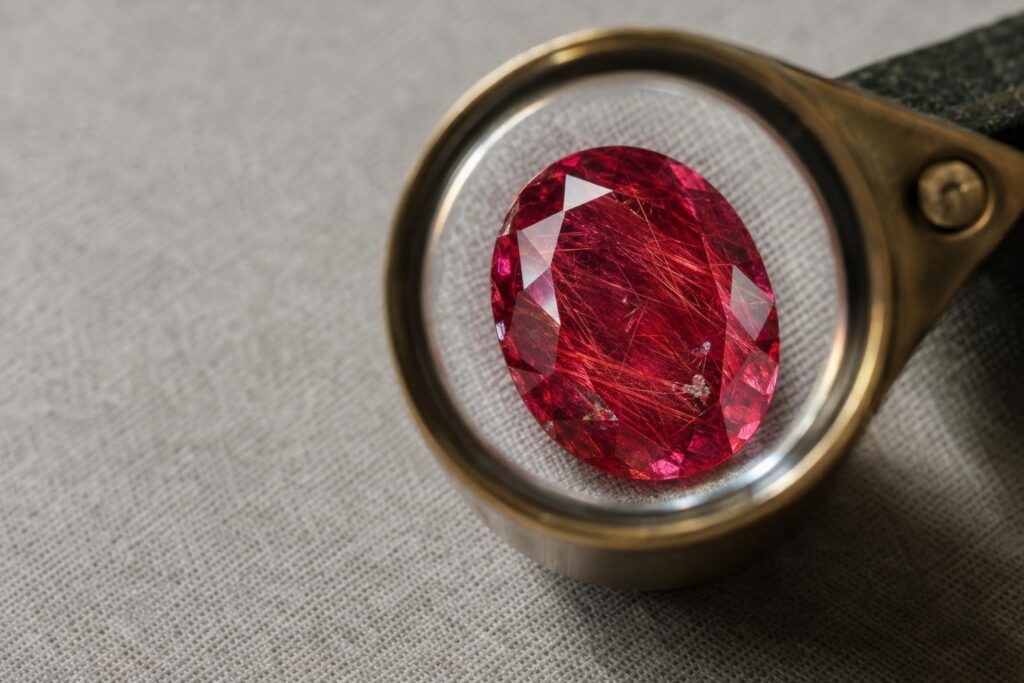
How can an inclusion help? Fine needles of a mineral called rutile, known as silk, can scatter light. This softens the colour and spreads it more evenly. When the needles cross and the stone is cut as a cabochon (a smooth dome with no facets), they can create a star effect called asterism 1.
Why ask about cracks? Inclusions can limit durability, and significant fractures that reach the surface can be a durability threat 1. That is worth knowing before you choose a ring setting.
Why cut and shape change how the colour looks
Why can two rubies of similar colour look different once cut? Because of how the cutter shapes the rough crystal. Rubies are most often cut as ovals and cushions. A shallow stone cut to save weight can show a window, a see-through patch in the stone 1.
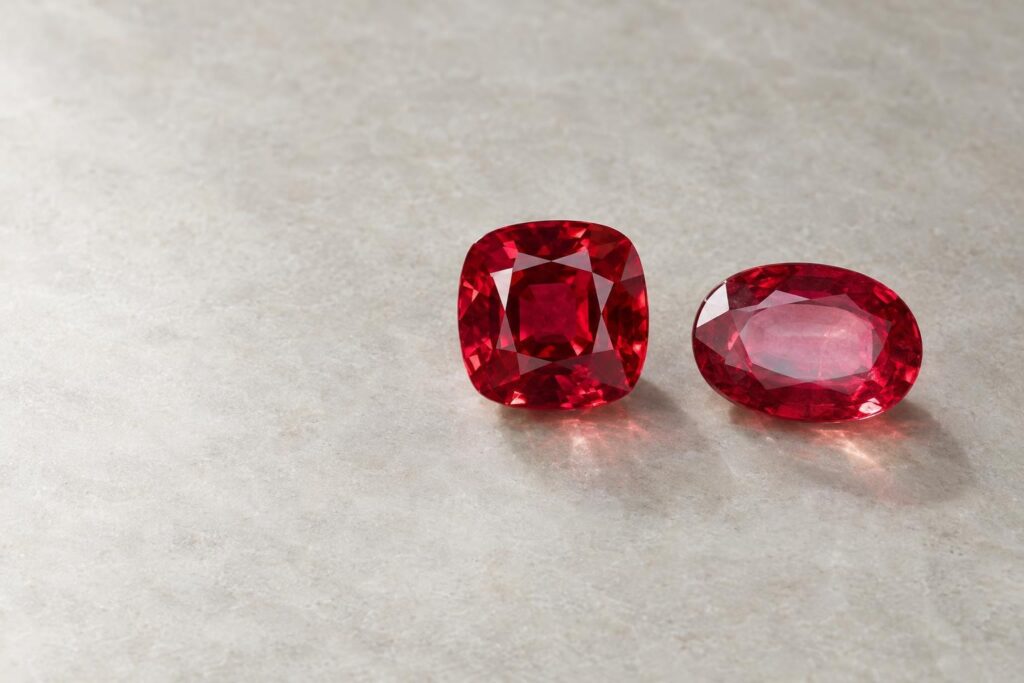
How does direction change colour? Ruby shows pleochroism, meaning it shows different colours from different directions. It looks red to purplish red one way and orangy red the other, and this affects how cutters orient the stone 1. For the wider picture, see how coloured gemstones are evaluated.
Why treatment matters more than you might think
Why ask about treatment at all? Because some treatments change both value and care. Most ruby has been heated. Some has had colour diffused into its surface or fractures filled with lead glass, and these stones are worth less than heated rubies 2.
How are rubies treated? Treatments used on ruby include heating, fracture healing, glass filling, diffusion, dyeing and coating 5. Heat treatment has its own guide.
Lattice diffusion adds colour by diffusing it into the stone’s surface. In lattice-diffused stones the colour may be shallow, so surface damage or re-cutting can remove it 4.
Fracture filling with lead glass works because the glass closely matches ruby’s refractive index, which is how strongly a material bends light. Fractures then become much less visible 5. Glass filling usually applies to low-quality stones. Some "ruby with glass" is a manufactured product made from heavily fractured rough, and if the glass is altered, the stone may fall into pieces 6.
Why a laboratory report helps with treatment and origin
Why is glass filling hard to judge by eye? Because the signs are small. Under magnification, they include coloured flash effects and gas bubbles in the glass 5.
How does a report help? A report from an independent laboratory can confirm the ruby is natural and say whether there is evidence of treatment. GIA evaluates ruby but does not grade it. Its report names detectable treatments and can give an opinion on origin when possible and when the client asks. Ask for the treatment information in writing, too 2.
Labs that belong to the Laboratory Manual Harmonisation Committee use standard wording for glass-filled corundum. They grade the extent as minor (F1), moderate (F2) or significant (F3), and may name the glass, such as lead glass or silica glass 6. Read more on how gemstone treatments should be disclosed.
Why not buy on origin alone? GIA warns against confusing origin with quality, because even the best mines produce low-quality material 2. An origin statement is a laboratory’s opinion, given only when possible.
Why a ruby can suit an everyday ring, and how care changes with treatment
Why do rubies hold up well on the hand? Corundum is 9 on the Mohs scale, a scale of scratch resistance. It also has excellent toughness (resistance to chipping) and no cleavage (a tendency to split along flat planes). That makes ruby well suited to rings worn daily, and both untreated and heat-treated rubies are very durable 4.
How does that compare with diamond? The Mohs numbers can mislead. Diamond is only one step higher, but it is many times harder than corundum 4. Our article on why the Mohs scale is not the whole durability story explains more.
What care does each type need? Warm soapy water is always safe for ruby. Fracture-filled, cavity-filled or dyed rubies should be cleaned only with a damp cloth 4. For general cleaning and safety advice, see the Jewellery Care and Safety Guide.
Why does treatment matter for repairs? In testing, the glass filler reacted readily with solvents, including a common jeweller’s pickling solution. Oven cleaner, ammonia, bleach and even concentrated lemon juice etched the glass. Too much heat from a jeweller’s torch could also damage it, so it is prudent to remove these stones from their settings before repairs 5. That matters if the ring may need ring resizing later.
When a ruby may not be the right choice: the downsides
Why look at the downsides? Because a ruby that suits one person can frustrate another. These are the facts most likely to matter:
- If you want a completely clean stone, or a very pale pink one: inclusion-free rubies are practically nonexistent, and a stone that is too light may be called pink sapphire 1.
- If you want to rely on your eyes alone: lead-glass filling makes fractures much less visible, and its signs are found under magnification 5.
- If you want easy repairs: labs recommend removing glass-filled stones from their settings for repair 6.
Care and hardness bring three more trade-offs. Fracture-filled rubies should be cleaned only with a damp cloth. In lattice-diffused stones the colour may be shallow, so surface damage or re-cutting can remove it. And diamond is many times harder than corundum 4.
None of these rule a ruby out. They show which facts matter for your situation, so you can weigh them against the colour you love.
Why tools can help you plan the rest of the ring
Why plan beyond the stone? Because the ruby is only one part of the ring. The Engagement Ring Budget Planner helps you plan the complete ring. If you need to compare ring sizes between sizing systems, the Ring Size Converter can help. If you would like to look at rubies with someone, Ralph Jacobs offers a free consultation, online from anywhere at bookings.ralphjacobs.org.
Sources and methodology
This guide draws on guidance and research from the Gemological Institute of America (GIA), including a peer-reviewed Gems & Gemology study, and on standard report wording from the Laboratory Manual Harmonisation Committee. It explains how ruby quality and treatments are assessed, but it does not grade, value or identify any specific stone, and it gives no prices.
- Ruby Quality Factors
- Ruby Gemstone: Buyer’s Guide
- Ruby Description
- Ruby Care and Cleaning Guide
- Identification and Durability of Lead Glass–Filled Rubies
- LMHC Information Sheet #3: Corundum with glass-filled fissures and cavities (version 10)