
The decision in brief
- If the wearer works with their hands or leads an active life, consider a protective setting such as a bezel, which snags less and protects the stone's edge from knocks.
- If sparkle is what the wearer notices most, consider giving cut real weight, since a well-cut diamond is brighter than a poorly cut one of the same size, colour and clarity.
- If visible size matters most, remember that carat measures weight, not size, and that a halo can make the centre stone look larger.
- If the wearer wants low upkeep, consider which parts need ongoing care, such as rhodium replating on white gold and regular prong checks.
- If the stone has points or sharp corners, consider asking how the setting will protect them, because these shapes are more likely to chip.
- If the wearer's finger size may change, consider that pavé and channel-set bands can be harder to resize.
- If prong strength matters to you, consider that platinum is denser and stronger than gold, and platinum prongs are less likely to break.
Editorial guidance — context changes what is right for you.
Start with the wearer and the ring
Start with the person who will wear the ring, not the stone in the tray. Think about their hands: what they do each day, what knocks a ring might take, and whether it could catch on gloves, knitwear or hair.
Then think about what they notice. Some people see size first, some see sparkle, and some care most about the shape and detail of the band.
Finally, think about care. Some wearers are happy to bring a ring in for regular checks and replating. Others want as little upkeep as possible.
Quick checklist
- How does the wearer use their hands day to day?
- Do they notice size, sparkle or design detail first?
- Are they happy with regular check-ups and upkeep, or do they want as little as possible?
- Do they have a known metal allergy, such as to nickel?
- Which stone shape do they like, and does it have points or corners?
- Is their finger size likely to change, so the ring may need resizing?
- Will the ring often brush against fabric, gloves or hair?
The criteria that matter
Lifestyle and daily wear
How the wearer uses their hands affects how much protection the setting needs. Bezel settings resist chips and snag less, while prong settings let in more light but can catch on fabric.
Why the setting matters: how to choose an engagement ring settingWhat the wearer notices
If size matters most, remember that carat is weight, not size, and a halo can make the centre stone look larger. If sparkle matters most, cut matters, because a well-cut diamond is brighter than a poorly cut one of the same size, colour and clarity.
Why light performance matters: diamond cut explainedMetal and long-term care
The metal affects strength and care. White gold is usually plated with rhodium, which wears away and needs replating. Platinum is denser and stronger than gold.
Why white gold vs platinum differ in colour, wear and weightStone security
The setting keeps the stone in place. More prongs add security, a six-prong setting makes it more likely the stone stays in place if one prong breaks, and prongs need regular checks.
Why claw count matters: 4 claw vs 6 claw ring settingFuture changes
Pavé and channel-set bands can be harder to resize, which matters if the wearer's finger size may change.
Why can’t every ring be resized? How ring resizing worksCompare your options
| Area | What changes visibly | When to prioritise | Reasonable compromise |
|---|---|---|---|
| Stone: carat weight | A heavier stone. Carat measures weight, not size. | If carat weight itself, or a 'magic size' such as 1.00 ct, matters most to the wearer. | Two diamonds of the same carat weight are not necessarily equal, and a 0.99 ct and a 1.00 ct diamond are hard to tell apart by eye. |
| Stone: cut quality | More light comes back to the eye, so a well-cut diamond looks brighter than a poorly cut one of the same size, colour and clarity. | If sparkle is what the wearer notices most. | GIA's cut grade covers the standard round brilliant, and there is no single set of proportions that makes a perfect cut. |
| Metal | Colour, durability, strength and the upkeep the ring needs. | If daily wear, colour or low upkeep matter most. | White gold needs rhodium replating from time to time, and white gold made with nickel does not suit people allergic to nickel. |
| Setting: protective style | A bezel protects the stone's edge from knocks and snags less. A six-prong setting makes it more likely the stone stays in place if a prong breaks. | If the wearer works with their hands, or the stone has points or corners. | A bezel covers more of the stone's edge and lets in slightly less light than prongs. |
| Setting: added detail | A halo can make the centre stone look larger, and pavé adds small stones along the band. | If the wearer loves detail or wants the centre stone to look bigger. | Pavé may need occasional maintenance, and pavé and channel-set bands can be harder to resize. |
A practical decision process
- Set your total budget first, then treat the stone, metal and setting as shares of that total.
- Write down how the wearer uses their hands, what they notice in a ring and how much upkeep they accept.
- Compare stones by cut and carat weight side by side, not by carat weight alone.
- Compare metals for strength, colour and the upkeep each needs over time.
- Compare setting styles for security, light and how likely they are to snag.
- Check how the setting protects any points or corners on the stone's shape.
- Ask which parts will need ongoing care and whether the band can be resized later.
- Ask whether the stone comes with an independent grading report. For a standard round brilliant, check the cut grade it gives.
- Adjust the split until each part meets the wearer's needs, then choose the compromise you are most comfortable with.
Numbers indicate order, not saved progress.
Common buying mistakes
- Buying on carat weight alone Carat measures weight, not size, and two diamonds of the same weight are not necessarily equal. Look at cut and the other Cs before deciding a heavier stone is worth it. Why diamond carat weight and visible size don’t always match
- Leaving too little for the setting The setting holds the stone and shapes how the ring looks, handles light and wears. Make sure the setting you can afford still suits the wearer's daily life. Why the setting matters: how to choose an engagement ring setting
- Forgetting the wearer's lifestyle Raised prongs can catch on fabric, while bezel settings snag less and are practical for active hands. Match the setting to how the ring will be worn. Why the setting matters: ring settings explained
- Ignoring the upkeep of the metal White gold's rhodium plating wears away and needs replating from time to time. Factor that ongoing care into your choice of metal. Why white gold vs platinum differ in colour, wear and weight
- Choosing a pointed shape without protection Princess, marquise, pear and heart shapes are more likely to chip. Ask how the setting protects their points and corners. Why your diamond shape matters: choosing a diamond shape that suits you
- Not thinking about resizing Pavé and channel-set bands can be harder to resize. If finger size may change, ask about resizing before choosing a detailed band. Why can’t every ring be resized? How ring resizing works
- Assuming a hard stone cannot be damaged Diamond ranks 10 on the Mohs hardness scale but can still be damaged, and prongs can loosen over time. Plan for regular checks. Why the Mohs scale is not the whole gemstone durability story
Questions to ask
About the stone
- Does this diamond come with an independent grading report, and if it is a round brilliant, what cut grade does it show?
- How does this stone compare in brightness with a slightly lighter one that has a better cut?
- Does this shape have points or corners that need extra protection?
About the metal
- What is this white gold mixed with, and does the alloy contain nickel?
- How often is this ring likely to need rhodium replating?
- How does platinum compare with gold for the prongs on this ring?
About the setting and care
- How many prongs hold the stone, and how often should they be checked?
- Can this band be resized later, given its style?
- How much light does this setting let in compared with a prong setting?
- What maintenance will the halo or pavé stones need?
Frequently asked questions
Does most of an engagement ring budget have to go on the stone?
This guide gives no fixed share. Each part does a different job: cut affects how bright a diamond looks, the setting holds the stone and shapes the ring’s look and wear, and the metal affects strength and upkeep. Weigh them against how the wearer lives and what they notice.
Is a higher carat weight always more impressive?
Not necessarily, because carat measures weight, not size. Two diamonds of the same weight are not necessarily equal. A well-cut diamond is brighter than a poorly cut one of the same size, colour and clarity.
Why does the setting matter if a diamond is so hard?
Because hard does not mean unbreakable. Diamond ranks 10 on the Mohs hardness scale but can still be damaged, and pointed shapes are more likely to chip. A bezel protects the edge from knocks. Prongs can loosen, so have them checked every six months.
Is platinum stronger than white gold?
Platinum is denser and stronger than gold, and platinum prongs are less likely to break. White gold is usually plated with rhodium, which wears away and needs replating. Which matters more depends on the wearer’s habits and the upkeep they accept.
Can a detailed band be resized later?
Sometimes, but pavé and channel-set bands can be harder to resize. If the wearer’s finger size may change, ask about resizing before you choose the band style.
Why the way you split your budget matters
You have a fixed amount, and you want it to buy the right ring for the person who will wear it. Should more go to the stone, the metal or the setting? There is no single answer. But each part does a different job, and knowing those jobs makes the choice clearer.
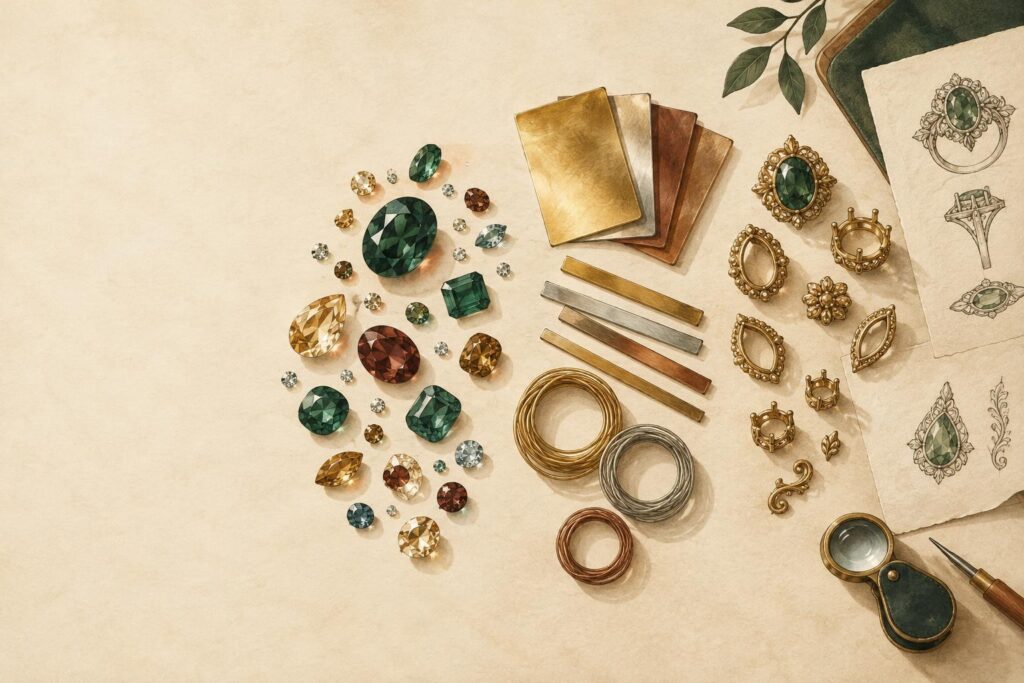
Why think of the ring as three parts? Because each one changes something different. The setting holds the gemstone securely, and it also shapes the ring’s overall look, light performance and wearability 3. The stone’s cut and weight change how it looks. The metal changes strength, colour and upkeep, as the sections below explain.
This guide does not say which part deserves the most. It shows what each part changes, so you can match the split to the wearer. If you have not set the total yet, start with how to set an engagement ring budget without salary rules.
Why the stone is about more than carat weight
Why look past carat weight? Because two diamonds of the same carat weight are not necessarily equal. A diamond’s value and quality reflect all of the 4Cs, which are cut, colour, clarity and carat, not carat weight alone 2.
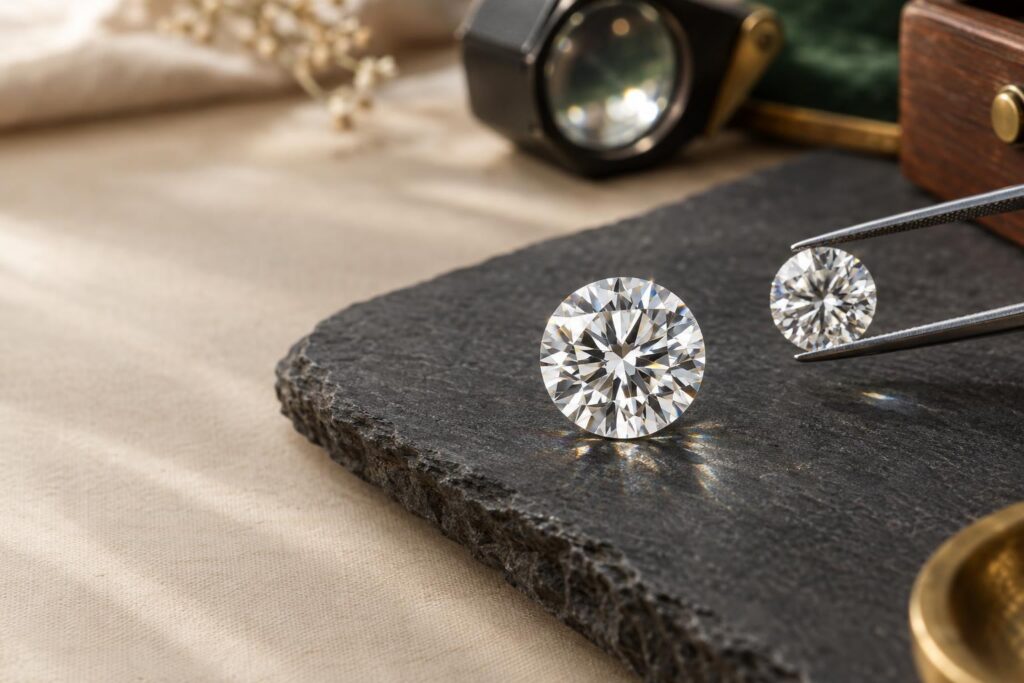
How does carat work? Carat measures weight, not size. One metric carat is 200 milligrams, split into 100 points. Weights such as 1.00, 1.50 and 2.00 ct are seen as ‘magic sizes’, yet a 0.99 ct diamond is hard to tell apart from a 1.00 ct diamond by eye 2. For how weight relates to what you see, read diamond carat weight vs visible size.
Why does cut matter for sparkle? Cut is how a diamond’s facets (its small, flat, polished surfaces) and angles are shaped. Each facet and angle affects how much light comes back to your eye. A well-cut diamond is brighter than a poorly cut one, even at the same size, colour and clarity. That brightness, often called brilliance, comes from all the light reflected inside and off the diamond 1.
How can you check cut? For many people, cut is the most important of the 4Cs. GIA’s cut grading system covers the standard round brilliant and has five grades: Excellent, Very Good, Good, Fair and Poor. There is no single set of proportions that makes a perfectly cut diamond 1. Ask whether the stone comes with an independent report, and see how to read a GIA diamond grading report.
The choice between a natural diamond, a laboratory-grown diamond or moissanite is covered in its own guide: natural diamond, lab-grown diamond or moissanite.
Why the metal shapes the ring’s long-term care
Why does the metal matter? Because different metals behave differently and need different care. Pure 24ct gold is soft, so other metals are mixed in to make an alloy (a blend of metals). This makes it more durable and can change its colour. Copper, for example, gives rose gold its pink colour 6.
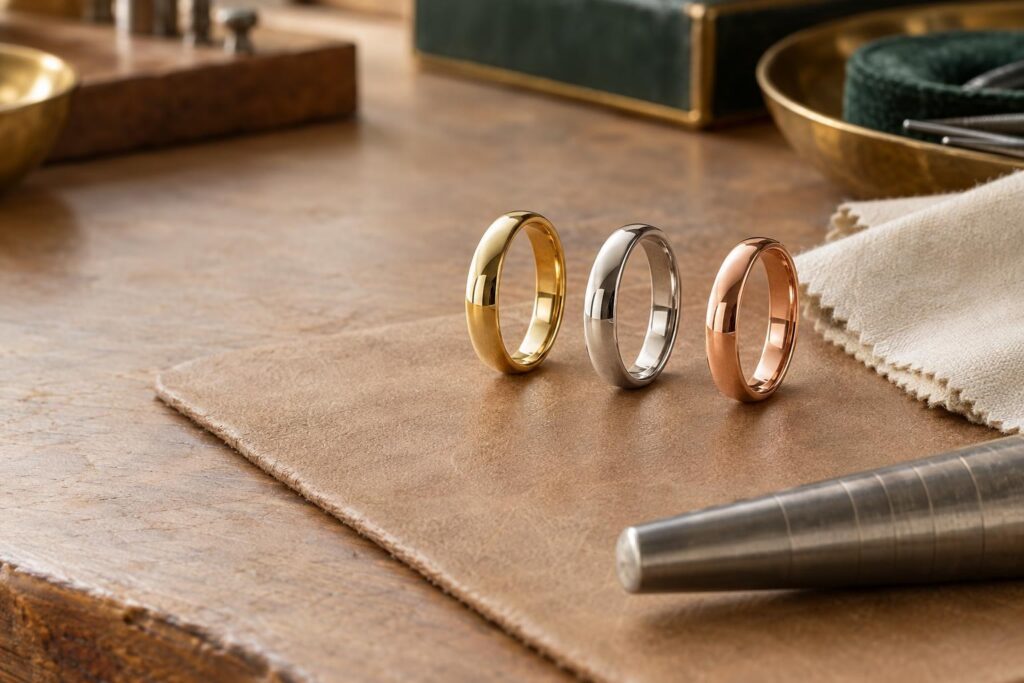
How is gold purity measured? With the word carat again, but for gold it means purity, not weight. 24ct (24K) is pure gold, and 18ct (18K) is 75% gold and 25% other metals. Fineness gives the gold content in parts per thousand, and is usually stamped without the decimal point 6. See 9ct vs 14ct vs 18ct gold for what purity changes.
What upkeep does white gold need? White gold is gold mixed with white metals, usually plated with rhodium for a harder, brighter surface 6. That plating wears away gradually, so the ring needs replating from time to time 5.
Some white gold is made with nickel, and people allergic to nickel should avoid that alloy 5. If this applies to the wearer, ask what the alloy contains.
Platinum is denser and stronger than gold. Its prongs (the small metal claws that grip a stone) are less likely to break 5. If you are weighing these two metals, see white gold vs platinum.
Why the setting protects everything else
Why spend on the part that holds the stone? Because even the hardest stone needs protecting. Diamond ranks 10 on the Mohs hardness scale, but it can still be damaged 4.
How do prongs compare? Prong settings, also called claw settings, let in as much light as possible. Fewer prongs show more of the stone, and more prongs add security. Their raised edges can catch on fabric, and they should be checked from time to time 3.
A six-prong setting can protect better than a four-prong one, because the stone is more likely to stay in place if a prong breaks. Prongs can also shift and loosen over time, so it is worth having them checked every six months 4. Compare the two in four claws vs six claws.
What about a bezel? A bezel is a metal rim that wraps around the stone’s edge. It resists chips and everyday wear, is less likely to catch on clothing, and lets in slightly less light than prongs. Flush settings, where the stone sits level with the metal, are very durable but let in less light, so the stone sparkles somewhat less 3.
Extra detail changes the picture too. A halo, a ring of small stones around the centre stone, can make the centre stone look larger. Pavé, where many tiny stones line the band, may need occasional maintenance. Pavé and channel-set bands (stones held in a groove between two metal walls) can also be harder to resize 3. See ring settings explained and how ring resizing works.
Why the wearer should shape the split
Why start with the person rather than the ring? Because the setting shapes how a ring wears, not only how it looks. GIA calls bezel settings practical for people who work with their hands or lead active lives 3. Three questions help: how the wearer uses their hands, what they notice in a ring, and how much upkeep they will accept.
Shape matters too. Shapes with points or sharp corners, such as princess, marquise, pear and heart, are more likely to chip. A bezel setting helps stop the centre stone falling out and protects its edge from knocks 4. For more on shapes, see choosing a diamond shape.
If the wearer notices sparkle most, both the cut and the setting’s light matter. If they notice size most, remember that carat is weight, not size, and that a halo can make the centre stone look larger. If they dislike upkeep, note which parts need care, such as rhodium replating and prong checks.
The downsides: when leaning on one part isn’t the right choice
Why look at the downsides? Because every split gives something up, and it helps to see the cost before you buy.
Leaning on carat weight: bigger isn’t always better, because two diamonds of the same carat weight aren’t necessarily equal 2. Leaning on cut: GIA’s cut grading system covers the standard round brilliant, so ask how cut is judged for other shapes 1.
Leaning on white gold: the rhodium plating still wears away and needs replating, and alloys made with nickel do not suit people with a nickel allergy 5.
Leaning on detail or security: pavé may need occasional maintenance, and pavé and channel-set bands can be harder to resize. Bezels let in slightly less light than prongs, and flush settings let in less light, so the stone sparkles somewhat less 3.
A tension setting holds the stone with pressure from the band. It may be a riskier choice for an engagement ring 4. None of these makes a split wrong. They are the trade-offs to weigh against what the wearer values most.
Why a few tools can make the trade-offs clearer
Why test the split before you shop? Because seeing options side by side makes the trade-offs easier to judge. The Engagement Ring Budget Planner helps you divide a total between the parts. The Carat to Millimetre Estimator helps you see how carat weight relates to size in millimetres. The Ring Size Converter helps when sizes are given in another country’s system.
If you would like to talk the trade-offs through with a jeweller, Ralph Jacobs offers a free consultation, online from anywhere at bookings.ralphjacobs.org.
Sources and methodology
This guide draws on gemmological guidance from the Gemological Institute of America (GIA) on diamond cut, carat weight, ring settings, ring care and white metals, and on the World Gold Council’s explanation of gold purity and alloys. It describes trade-offs rather than ranking options, and it gives no prices in any currency.
- Diamond Cut: The Wow Factor
- Diamond Carat Weight
- Complete Guide to Engagement Ring Settings: Types vs. Styles
- How to Protect Your Diamond Engagement Ring
- Choosing Between White Gold, Platinum, Palladium, and Silver
- Gold Jewellery (page heading: “Is Gold Jewellery A Good Investment?”)