
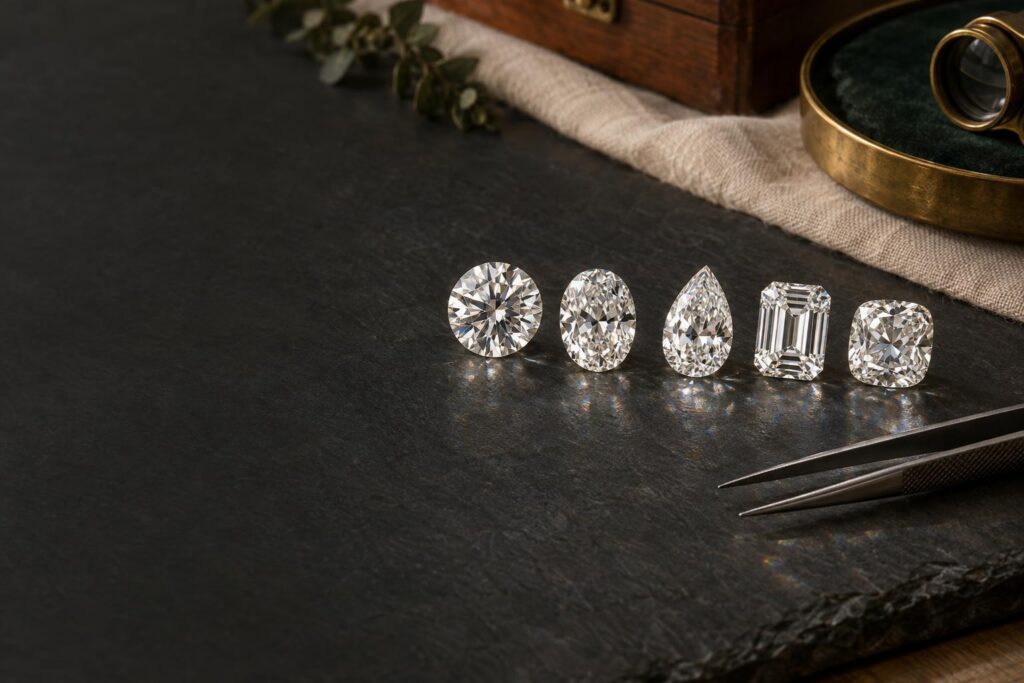
The decision in brief
- If lively sparkle matters most to you, look closely at brilliant-cut shapes. Their many small facets also help hide inclusions and colour.
- If you prefer a calm, mirror-like gleam, consider step cuts such as emerald and Asscher. Keep in mind that they show colour and clarity more.
- If you want more visible size for the carat weight, note that elongated shapes such as oval, pear and marquise can look larger than a round of the same weight.
- If you would like fingers to look longer and slimmer, oval, pear, marquise, emerald and rectangular radiant shapes have that effect.
- If your hands are busy or you often knock your rings, weigh the points and sharp corners on pear, marquise and princess shapes, which can chip without a protective setting.
- If an official cut grade helps you compare stones, note that GIA gives one only to the round brilliant. For fancy shapes, GIA reports assess polish and symmetry but do not grade overall proportions.
- If you are still unsure, it may help to know that research found real personal and regional differences in which shapes people prefer, and IGI calls the choice a matter of personal preference.
Editorial guidance — context changes what is right for you.
Start with the wearer and the ring
Why start with the wearer? Because a ring goes through work, sport and everyday knocks, and some shapes are more exposed than others. The points on pears and marquises and the sharp corners on princess cuts can chip, so claws, V-shaped claws or a metal rim are used to protect them.
Then think about taste and the hand. Brilliant cuts give lively sparkle, while step cuts give a mirror-like gleam. Elongated shapes can flatter shorter fingers, while round diamonds suit most hands. Research has found real personal and regional differences in which shapes people prefer.
Quick checklist
- How often will the ring be knocked during work, sport or hobbies?
- Does the wearer prefer lively sparkle or a calm, mirror-like gleam?
- Would the wearer like the finger to look longer and slimmer?
- How much does visible size matter compared with carat weight?
- Is the wearer comfortable with claws or a metal rim covering points and corners?
- Does the wearer have a strong liking for a classic or a more unusual outline?
The criteria that matter
Sparkle character
Brilliant cuts have many small facets that help hide inclusions and colour. Step cuts give a mirror-like gleam and show colour and clarity more. Fancy shapes' light patterns change more with movement than a round's do.
Why does a diamond sparkle? Brilliance, fire and scintillationApparent size
Elongated shapes can look larger than a round of the same carat weight. Princess and cushion cuts can look smaller because they are deeper. A heart needs to be about 0.50 ct or larger for the shape to be clear.
Why diamond carat weight and visible size don’t always matchHow it looks on the hand
Oval, pear, marquise, emerald and rectangular radiant shapes make fingers look longer. Elongated shapes can flatter shorter fingers, and round diamonds suit most hands. Preferences differ between people.
Vulnerable points and corners
Pear and marquise points and princess corners can chip. A fancy cut that is too shallow may be more likely to chip, and a marquise cut too long may be less durable.
Why the setting matters: ring settings explainedEase of setting
Points and sharp corners rely on the setting for protection: claws, V-shaped claws or a metal rim. The radiant cut's cropped corners help prevent chipping.
Why the setting matters: how to choose an engagement ring settingCut consistency and grading
Only the round brilliant gets an official GIA cut grade. Fancy shapes are often cut by hand and vary more in proportions. GIA reports assess their polish and symmetry.
Why a GIA report matters: how to read a GIA diamond reportCompare your options
| Area | What changes visibly | When to prioritise | Reasonable compromise |
|---|---|---|---|
| Round brilliant | The most popular shape, known for brilliance and fire. It is the only shape with an official GIA cut grade, and it suits most hands. | If bright sparkle and an easy-to-compare cut grade matter to you. | An elongated shape of the same carat weight can look larger. |
| Oval, pear and marquise | Elongated outlines that can look larger for their weight and make fingers look longer. | If visible size and a slimming look on the finger matter to you. | They can show a dark bowtie. Pear and marquise points can chip without protective claws, and a marquise cut too long may be less durable. |
| Princess and cushion | Both are deeper cuts. A princess is square or rectangular with sharp corners and a modern, geometric look. | If you prefer these outlines to rounded or elongated ones. | They can look smaller than other shapes of the same weight. Princess corners can chip without protection. |
| Emerald and Asscher (step cuts) | Large facets give a mirror-like gleam rather than brilliance. The emerald cut is rectangular with cropped corners and makes fingers look longer. | If you prefer a calm, mirror-like look to lively sparkle. | They show colour and clarity more. |
| Radiant, heart and trillion | Radiant corners are cropped, which helps prevent chipping. Hearts need about 0.50 ct or more for the shape to be clear. Trillions are triangles with sharp points. | If one of these outlines appeals to you. | Small hearts may not show their shape clearly. Trillion points need protective prongs, and even small inclusions can show more in shallow trillions. |
A practical decision process
- Write down how the ring will be worn day to day, including work, sport and hobbies.
- Decide whether you are drawn to lively sparkle or a calm, mirror-like gleam.
- Compare how different outlines look on the hand, including which ones make the finger look longer.
- Compare how large each shape looks at the same carat weight, and ask for measurements in millimetres as well as weight.
- Note which shapes have points or sharp corners, and which settings would protect them.
- For a round, check the cut grade. For a fancy shape, check polish and symmetry on the report and look at how balanced the stone appears.
- Look at each fancy-shaped stone as it moves, since its light pattern changes with movement. Note any bowtie or window, where the centre looks washed out or dark.
- Ask whether a fancy-shaped stone is cut too shallow or too deep.
- Weigh what you have learned against your notes on wear and taste, and make your own choice.
Numbers indicate order, not saved progress.
Common buying mistakes
- Treating shape and cut as the same thing Shape is the outline, while cut style is how the facets are arranged, which drives sparkle. Look at cut separately once you have chosen a shape. Why light performance matters: diamond cut explained
- Judging size by carat weight alone Carat is a weight. Elongated shapes can look bigger than a round of the same weight, while princess and cushion cuts can look smaller. Ask for the measurements in millimetres too. Why diamond carat weight and visible size don’t always match
- Leaving points and corners unprotected Pear and marquise points and princess corners can chip. Ask how the setting covers them, for example with V-shaped claws or a metal rim. Why the setting matters: ring settings explained
- Expecting a cut grade for a fancy shape Only the round brilliant gets an official GIA cut grade. For other shapes, look at polish, symmetry and how balanced the stone looks. Why a GIA report matters: how to read a GIA diamond report
- Not checking for a bowtie or windowing Ovals, pears and marquises can show a dark bowtie. In a GIA study, observers consistently disliked prominent windowing, a centre that looks washed out or dark (agreement was strongest against dark windows), but were divided on bowties. Look at the stone as it moves. Why does a diamond sparkle? Brilliance, fire and scintillation
- Choosing a step cut without checking colour and clarity Emerald and Asscher cuts show colour and clarity more than brilliant cuts. Check those grades closely if a step cut appeals to you. Why the 4 Cs of diamonds matter: what each grade really changes
- Choosing a very small heart shape A heart needs to be about 0.50 ct or larger for its shape to be clear. Why diamond carat weight and visible size don’t always match
Questions to ask
About the look
- Can I see this stone moving under different lights to check for a bowtie or a window?
- What are this stone's measurements in millimetres?
- How does this shape compare on the hand with a round of the same weight?
About the cut and report
- Does this stone come with an independent laboratory report, and what does it say about polish and symmetry?
- Is this fancy-shaped stone cut too shallow or too deep?
- For a round stone, what cut grade does the report give?
About the setting
- How will the setting protect the points or corners of this shape?
- Would V-shaped claws or a metal rim suit this shape?
- How will this setting suit the way the ring will be worn?
Frequently asked questions
Is there a best diamond shape for an engagement ring?
Why is there no single answer? Because taste differs. The round brilliant is the most popular shape, but a well-cut diamond of any shape will sparkle beautifully, and the best shape is the one you personally prefer. A GIA study also found significant personal and regional differences in which shapes people like.
Which diamond shapes look biggest for their weight?
Why can weight mislead? Because carat measures weight, not size. Elongated shapes such as oval, pear and marquise can look larger than a round of the same weight. Princess and cushion cuts can look smaller, because they are deeper.
Which diamond shapes are most likely to chip?
Why do some shapes chip? Because they have points or sharp corners. The points on pears and marquises and the corners on princess cuts can chip. Claws, V-shaped claws or a metal rim protect them. The radiant cut’s cropped corners help prevent chipping.
What is a bowtie in a diamond?
Why might you see a dark band? Ovals, pears and marquises can show a bowtie, a dark shadow across the centre. Well-cut stones keep it small. In a GIA study, observers were divided on whether they minded it.
Why doesn't my fancy-shaped diamond have a cut grade?
Why is the round different? GIA gives an official cut grade only to the round brilliant. For fancy shapes, GIA reports do not grade overall proportions, but they do assess polish and symmetry.
Why does diamond shape change both style and value?
Why think about shape early? Because it changes more than the outline. Shape and cut style affect how a diamond reflects light, how big it looks, and how it suits your style or setting. That is where value comes in: two diamonds of the same weight can look different in size and sparkle because of their shape 1.
How are shape and cut style different? Shape is the outline you see when you look down on the stone. Cut style is how the facets, the small flat polished surfaces, are arranged. It drives sparkle and brilliance, the white light a diamond returns to your eye 1. Any shape other than round is called a fancy shape 5.
Why are there so many shapes? Rough diamond crystals are usually octahedrons, which look like two pyramids joined at the base. When a crystal is not this typical shape, it is cut into a fancy shape to get the most out of it 5. GIA, the Gemological Institute of America, recognises more than 40 distinct categories of fancy-shaped diamond 3.
Why do some shapes sparkle and others gleam?
Why does the kind of light matter? Because it is what you see every time you look at the ring. Brilliant cuts have many small facets, which help hide colour and inclusions, features inside a diamond that can affect its clarity. Step cuts, such as emerald and Asscher, give a "hall of mirrors" gleam rather than brilliance, and they show colour and clarity more 1.
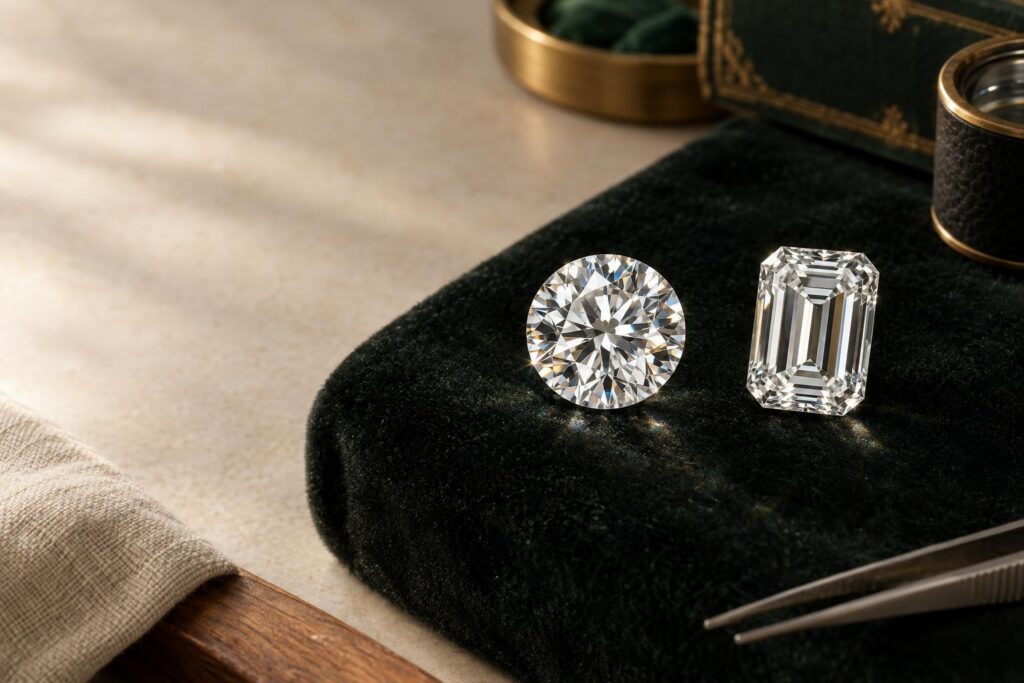
How does the round compare with fancy shapes? The round brilliant is the most popular shape and is known for its brilliance and fire, the flashes of rainbow colour in a diamond 4. Fancy shapes show more complex patterns of light and dark. These patterns change more with movement than a round’s do, which creates scintillation: sparkle and liveliness as the stone moves 3.
What patterns should you look for? Ovals, pears and marquises can show a "bowtie", a dark shadow across the centre of the stone, and well-cut stones keep it small 1. In a GIA study, observers consistently disliked prominent windowing, where part of the centre looks washed out or dark, and agreement was strongest against dark windows. They were divided on bowtie and "crushed ice" patterns 3. Brilliance, Fire and Scintillation Explained goes deeper.
Why do some shapes look bigger than others of the same weight?
Why does this matter? Because carat measures weight, not size, so two stones of the same weight can look different on the hand. Elongated shapes such as oval, marquise and pear can look larger than a round of the same carat weight 1. IGI, the International Gemological Institute, notes that fancy shapes can sometimes look larger for their carat weight 4.
How can a shape look smaller? Princess and cushion cuts can look smaller than other shapes of the same carat weight, because they are deeper. Size also affects whether a shape shows clearly at all. A heart needs to be about 0.50 ct or larger for its shape to be clear 1.
What can you ask for? Since carat is a weight, the measurements in millimetres are the figures that describe size across the top. You can ask for them alongside the weight. Diamond Carat Weight vs Visible Size explains why the two can differ.
Why does shape change how your hand looks?
Why think about the hand? Because the stone’s outline changes how the finger around it looks. Oval, pear, marquise, emerald and rectangular radiant cuts make fingers look longer and more slender 1. Elongated shapes can flatter shorter fingers, while round diamonds suit most hands 4.
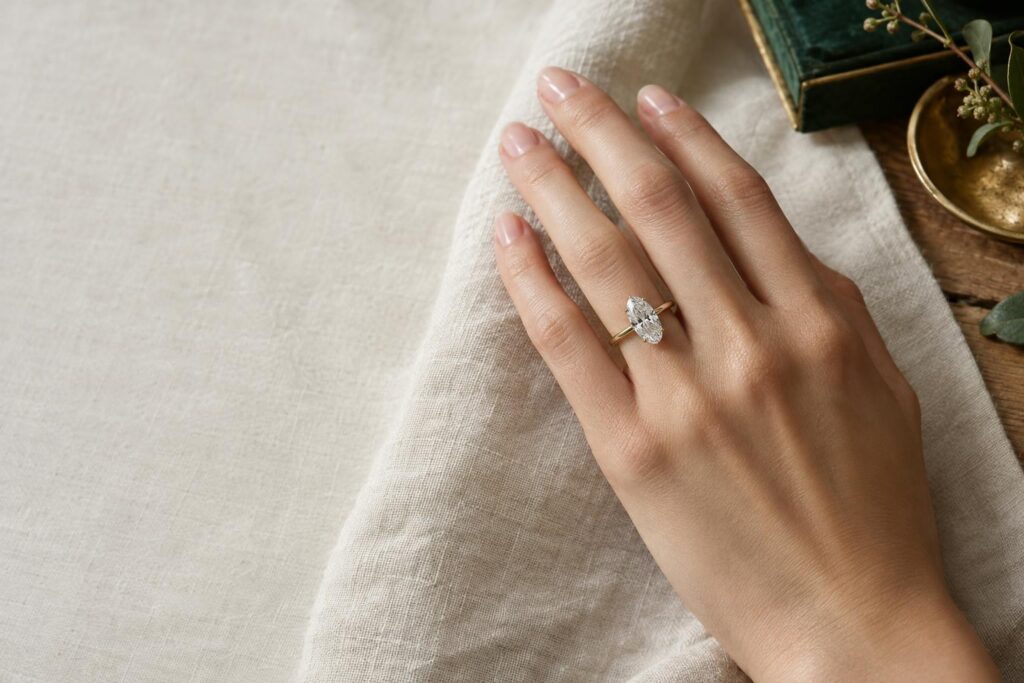
How much should that guide you? Taste varies a great deal. A peer-reviewed GIA study found significant regional and personal differences in which outlines and patterns people prefer 3. Still, a well-cut diamond of any shape will sparkle beautifully, and choosing a shape is a matter of personal preference 4.
Why do corners and points need protecting?
Why plan for this? Because some shapes have thin tips that a knock can damage. The points on pears and marquises and the sharp corners on princess cuts can chip. Claws (also called prongs), V-shaped claws or a bezel, a metal rim around the edge, protect them 1.
How does the cut affect durability? A fancy-cut diamond that is cut too shallow may be more likely to chip. A marquise that is too long may be less durable, and V-shaped prongs help protect marquise and pear points. The sharp points of triangular stones, called trillions, also need protective prongs 2.
What does this mean for the setting? The outline and the setting work together. The radiant cut, for example, has cropped (cut-off) corners, which help prevent chipping 1. Ring Settings Explained: A Visual Guide shows the setting options.
Why do fancy shapes need a closer look before you buy?
Why look harder? Because fancy shapes have less of a shared measuring stick. The round brilliant is the only shape that gets an official GIA cut grade, from Excellent to Poor 1. GIA does not grade overall proportions for fancy cuts. Its reports do assess polish (how smooth the facets are) and symmetry (how evenly the shape and facets line up) 2.
How much do fancy shapes vary? They are often cut by hand, so their proportions vary much more widely 5. Researchers note that the cut-grading methods used for round brilliants can’t simply be applied to fancy shapes 3.
What can you check? Symmetry matters for every fancy cut, because even small differences can make a stone look unbalanced. A stone cut too deep may look less bright 2. How to Read a GIA Diamond Grading Report shows where to find polish and symmetry.
Why each shape has its own character: shape by shape
Why compare them one at a time? Because each shape brings its own mix of look and practicality. Here are three of them.
Diamond shapes, one at a time
Pick a shape to see its outline from above and what it means for sparkle, apparent size and everyday wear.
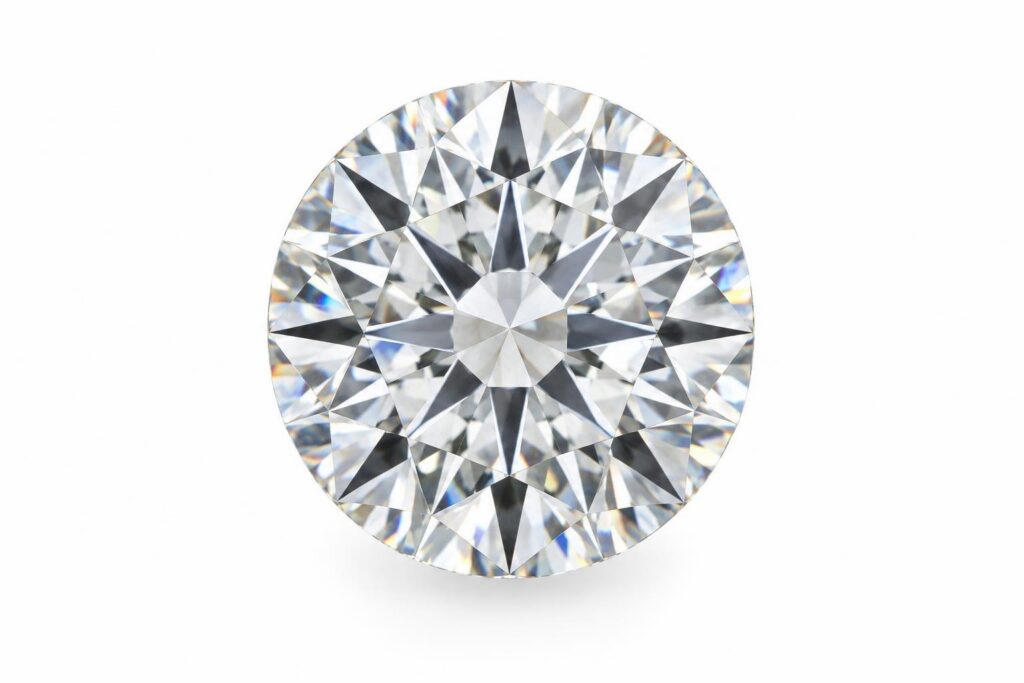
- Round brilliant
- The most popular shape, known for exceptional brilliance and fire. It suits most hands. It is also the only shape that gets an official GIA cut grade.
- Princess
- Square or rectangular with sharp corners and a modern, geometric look. It can look smaller than other shapes of the same carat weight because it is deeper. Its corners can chip, so it relies on a protective setting.
- Emerald
- Rectangular with cropped corners. It is a step cut, so it gives a "hall of mirrors" gleam rather than brilliance. Its large facets show off clarity and colour, and it can make fingers look longer and more slender.
- Oval
- Elongated, so it can look larger than a round of the same carat weight. It can make fingers look longer and more slender. It can show a bowtie, a dark shadow across the centre.
- Pear
- Elongated with one point that can chip without protection, so a V-shaped claw helps. It can look larger than a round of the same weight. It can also show a bowtie.
- Marquise
- Elongated with two points that can chip without protection. V-shaped claws help guard them. It can look larger than a round of the same carat weight and can show a bowtie.
- Cushion
- Like the princess, a cushion can look smaller than other shapes of the same carat weight, because it is deeper.
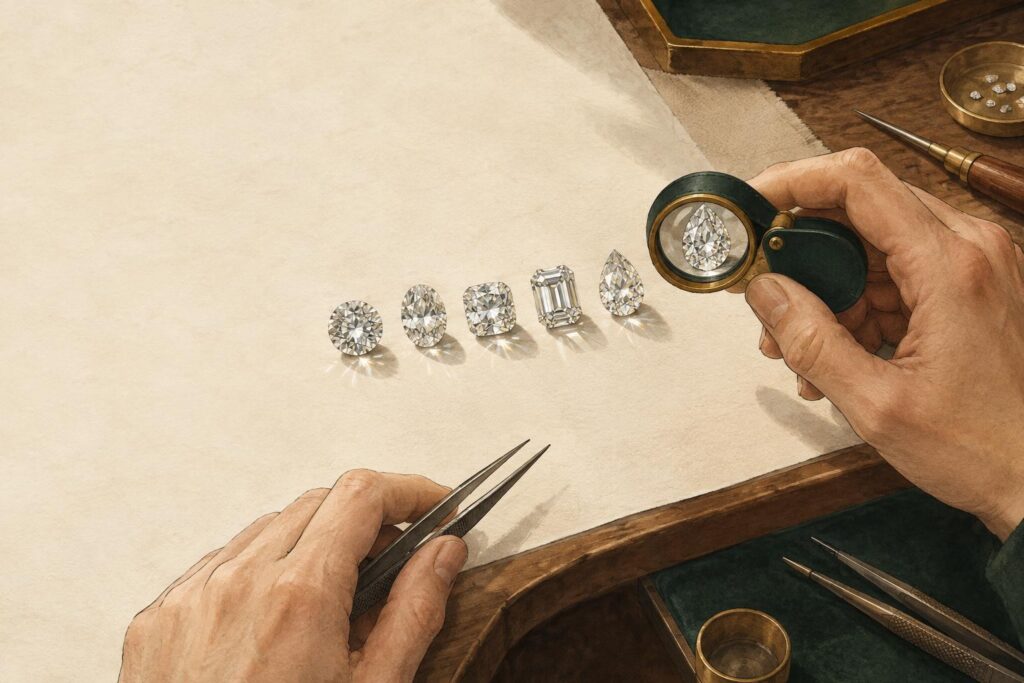
These pictures are simplified. Fancy shapes are often cut by hand, so real stones vary widely in proportions and outline. Pictures: AI-generated illustrations, checked for accuracy. They are not photographs of a real piece.
- Round brilliant: the most popular shape, known for exceptional brilliance and fire, and suited to most hands.
- Princess: square or rectangular with sharp corners, and a modern, geometric look.
- Emerald: rectangular with cropped corners. Its large facets show off clarity and colour 4.
The other shapes differ in these ways.
- Oval: elongated, so it can look larger than a round of the same weight. It can show a bowtie.
- Pear: elongated with one point that can chip without protection. It can also show a bowtie.
- Marquise: elongated with two points that can chip without protection.
- Cushion: deeper, so it can look smaller than other shapes of the same carat weight.
- Asscher: a step cut with a mirror-like gleam that shows colour and clarity more.
- Radiant: cropped corners help prevent chipping, and rectangular radiants make fingers look longer.
- Heart: needs to be about 0.50 ct or larger for the shape to be clear 1.
GIA’s fancy-cut tips add two more. A marquise that is too long may be less durable. Trillions have sharp points that need protective prongs, and even small inclusions can be more visible in shallow trillions 2.
The downsides: when a shape may not be the right choice
Why look at the downsides? Because the popular shapes have trade-offs too. Knowing them helps you weigh your taste against daily life.
- Step cuts such as emerald and Asscher show colour and clarity more than brilliant cuts.
- Ovals, pears and marquises can show a bowtie, a dark shadow across the centre.
- Princess and cushion cuts can look smaller than other shapes of the same weight, and a round can look smaller than an elongated shape of the same weight.
- Pear and marquise points and princess corners can chip, so they rely on protective settings.
- Only the round brilliant gets an official GIA cut grade, so fancy shapes have none on a standard GIA report 1.
A fancy-cut diamond cut too shallow may be more likely to chip, and one cut too deep may look less bright. Trillions have sharp points that need protective prongs 2. Fancy shapes are also often cut by hand, so their proportions vary much more widely 5.
None of these rules a shape out. Each one is a fact to weigh against how the ring will be worn and what you enjoy looking at.
Tools that can help
Why use a tool? Because carat weight alone doesn’t show how big each shape looks: an elongated shape can look larger than a round of the same weight 1. The Carat to Millimetre Estimator turns carat weight into an approximate size across the top. The Engagement Ring Budget Planner helps you weigh the stone against the rest of the ring.
For the other grades, see The 4 Cs of Diamonds and Choosing a Diamond for an Engagement Ring. If you would like to compare shapes side by side, we offer a free consultation, online from anywhere via bookings.ralphjacobs.org.
Sources and methodology
This guide draws on shape guides from GIA, IGI and the American Gem Society, and on a peer-reviewed GIA study of oval, pear and marquise diamonds. It describes general patterns, not any specific stone, and gives no prices. Taste is personal, so the guide sets out the facts and leaves the choice to you.
- Guide to Diamond Shapes for Engagement Rings
- Holiday Buying Guide Part 5: Tips for Purchasing Fancy Cut Diamonds
- Observations of Oval-, Pear-, and Marquise-Shaped Diamonds: Implications for Fancy Cut Grading
- Diamond Shapes
- So fancy!