
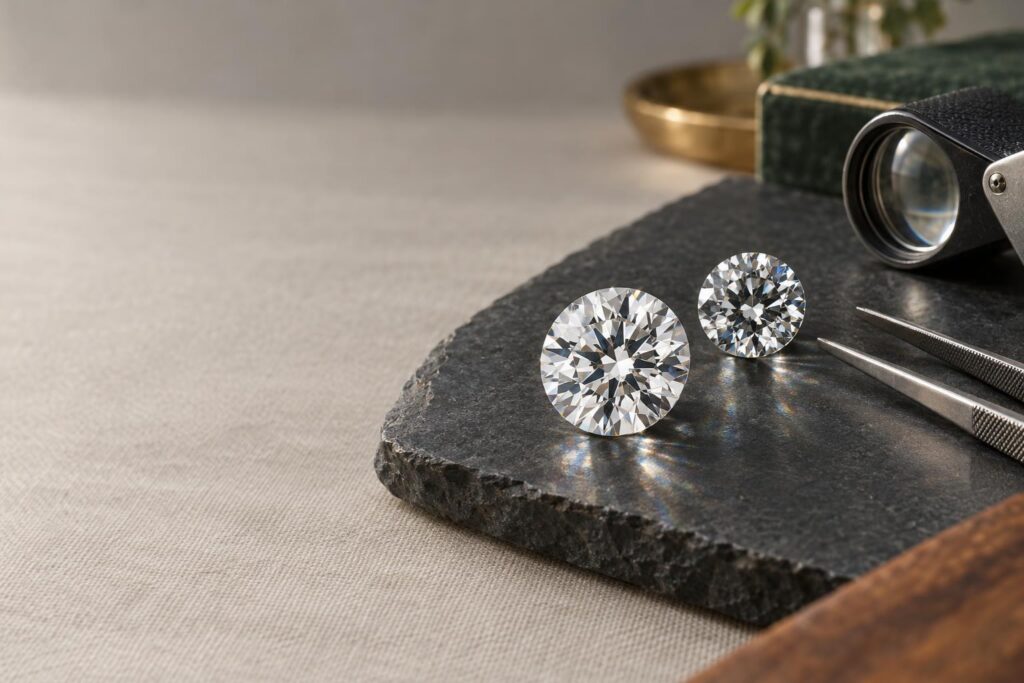
Why same-weight diamonds can look different sizes
You might compare two 1.00 ct diamonds and find that one looks clearly bigger. That matters, because you want to pay for size you can see. Some diamonds carry weight that is "hidden" in their depth, so they look smaller face-up than their carat weight would suggest 4.
Carat: weight and size
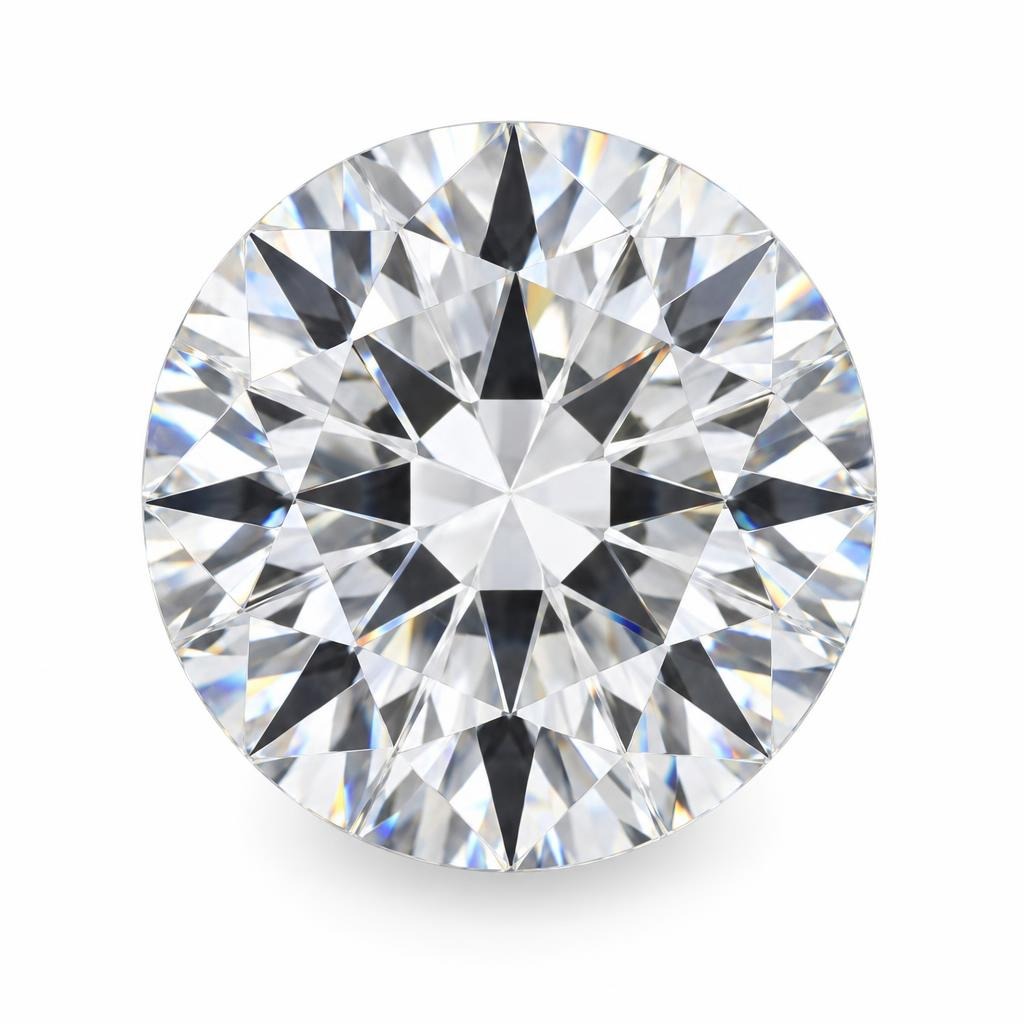
Pictures: one AI-generated illustration of a diamond, adjusted for each grade. They show how the grades differ; they are not a grading of any stone.
Why does this happen? The starting point is simple: carat measures weight, not size 1.
Here are the key points before we go deeper:
- Carat measures weight. Grading reports such as IGI’s also give a diamond’s length, width and depth in millimetres 3.
- Shape, spread and brightness change how big same-weight diamonds look. Seen from above, spread (the average width) shows size better than carat weight does 2.
- A thick girdle (the outer edge at the widest point) may hide extra weight, so the diamond costs more without looking any bigger 5.
Why carat is a measure of weight
Why start with weight? Carat weight is the only one of the 4Cs (cut, colour, clarity and carat) measured objectively and uniformly across the industry 2.
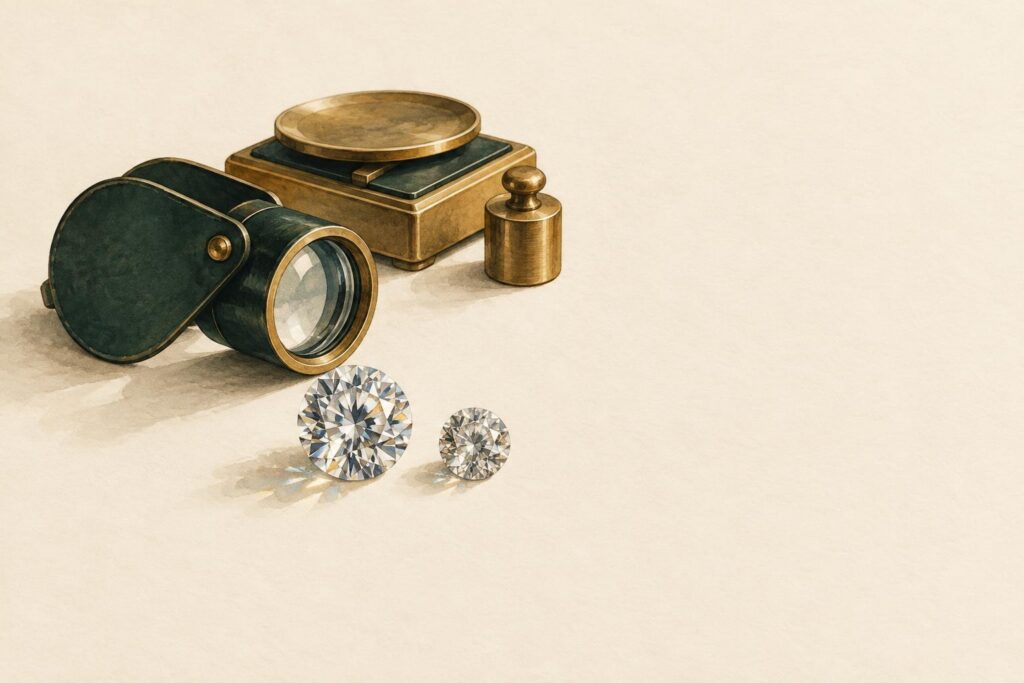
How is it measured? A metric carat is 200 milligrams, and the carat is a standard weight measurement recognised and used worldwide. Each carat is divided into 100 points, so weight is measured to the hundredth of a carat. A 0.25 ct diamond is often called a "twenty-five pointer" 1. In the same way, a 1.07 ct stone is "one carat and seven points" 3.
The name has a long history. It comes from carob seeds, which early gem traders used as counterweights on their scales 1.
A carat figure alone doesn’t tell you how wide the stone is. Nor does it make two stones equal. Two diamonds of the same carat weight aren’t necessarily equal, because colour, clarity and cut also need to be evaluated 1. You can read how each grade works in The 4 Cs of Diamonds.
Why spread shows size better than carat
Why does the way you look at a diamond matter? In a ring, you usually see a diamond from one direction: above. That is why different 1.00 ct diamonds can look different sizes. Three things change how big same-weight diamonds look: shape, spread and brightness 2.
So what is spread? It is a diamond’s average width across the top. For fancy shapes (any shape other than round), it uses the length and the width. Seen from above, spread shows size better than carat weight does 2.
How do you find it? IGI grading reports give length, width and depth in millimetres. The average of the first two figures is the diamond’s physical spread 3. Our guide on how to read a GIA diamond grading report shows where these figures appear.
Why diamond shape changes face-up size
Why does shape matter so much? Each shape shares its weight differently between the top and the body below. Deep shapes like cushions and princess cuts often carry more weight in the body than round brilliants, so they look smaller from the top 2.
Other shapes work the opposite way. Long, narrow shapes like marquise or pear can look larger than round stones of the same weight. Shallow shapes like emerald cuts and marquise can also look larger from the top than a round of the same weight 3.
How big is the difference? IGI gives a worked example. A 1.06 ct round measuring 6.54 × 6.56 mm has a spread of 6.55 mm. A 1.06 ct cushion measuring 6.32 × 6.34 mm has a spread of 6.33 mm, so it looks 0.22 mm smaller from the top 3.
Shape is a large topic of its own. Choosing a Diamond Shape covers the look and feel of each one.
Why depth and proportions can hide weight
Why can one stone weigh more without looking bigger? Because some of its weight can sit where you can’t see it from above. Such diamonds are called "over-weight": their proportions make them look much smaller face-up than their carat weight would suggest 4.
Where hidden weight sits
To see where weight hides, it helps to know the parts of a diamond. The crown is the top section, above the widest point. The girdle is the thin outer edge around the widest point. The pavilion is the lower, pointed part underneath.
Each part can carry extra weight. Crown height, pavilion depth, total depth and girdle thickness can each make a stone overweight 4.
The girdle needs special attention. A thick girdle may hide extra weight, so the diamond costs more without looking any bigger. A pavilion that is too shallow or too deep can also leak light or reduce face-up size 5.
Millimetre comparisons for 1 ct rounds
Why look at real numbers? They show how small differences add up. A 1 ct round with a diameter of about 6.5 to 6.6 mm looks like a fairly typical 1 ct round brilliant. A 1 ct diamond only 5.7 mm across looks smaller face-up, because much of its weight is hidden in its depth. The trade calls such stones "thick" or "heavy" 4.
IGI compared three 1.00 ct round diamonds, giving width and depth in millimetres 2:
- Shallow: 6.64 to 6.66 mm across and 3.80 mm deep, a spread of 6.65 mm.
- Well-proportioned: 6.44 to 6.46 mm across and 3.80 mm deep, a spread of 6.45 mm.
- Deep: 6.24 to 6.26 mm across and 4.06 mm deep, a spread of 6.25 mm.
That is 0.40 mm of spread between stones of exactly the same weight 2. It works the other way too. Two diamonds that look the same size face-up can weigh 0.61 ct and 0.71 ct, and the heavier one has a thicker girdle 5.
Why cut quality changes how big a diamond looks
Why does cut affect size, not just sparkle? Proportions, meaning the crown and pavilion angles and the size and placement of facets, strongly affect how large and sparkling a diamond looks from above. A well-proportioned diamond often looks larger and brighter than a poorly proportioned one 5.
Brightness plays a real part. In normal lighting, IGI found that a well-cut 0.80 ct stone looked larger than a 1.00 ct stone because of cut quality 2.
How grading labs measure hidden weight
Labs have a name for this: weight ratio. It describes a diamond’s overall weight relative to its diameter, and GIA compares it against a reference 1 ct diamond 6.55 mm across. Weight ratio is one of the seven parts of GIA’s cut grade, and a poor result limits the overall grade 4.
Weight ratio is also one of the factors in the American Gem Society (AGS) cut grading system, where it means "the millimeter footprint of a diamond versus its weight" 6. For more on how cut handles light, see Diamond Cut Explained.
The downsides of chasing face-up size
Why not simply pick the widest stone for its weight? Because spreading weight too thin has its own cost. Stones cut too shallow or too deep may leak light, called "windowing". They can go dark at the edges and look smaller away from spotlights 2.
Leakage means areas of a diamond that do not return light 6. Stones cut too shallow or too deep may also lose brilliance, the white light a diamond reflects back to you 3. So a large spread on paper doesn’t promise a stone that looks lively on the hand.
Size is also only one part of the picture. Colour, clarity and cut all need evaluating alongside carat weight 1. And a shape that looks larger may not be the shape you love. If a round is what you want, a slightly smaller spread may matter less to you than the look itself.
How to judge diamond carat weight vs size sensibly
Why have a method? It turns a single carat figure into measurements you can compare side by side. These steps bring together the facts above:
- Ask for the length, width and depth in millimetres, not only the carat weight. The average of the length and width is the diamond’s physical spread 3.
- For a 1 ct round, compare the spread with the 6.55 mm reference diamond GIA uses for weight ratio. That reference is for a 1 ct stone only 4.
- Check the cut grade and girdle thickness. A thick girdle may hide extra weight, and diamonds graded Good, Fair or Poor for cut may look smaller face-up 5.
- For fancy shapes, compare both the length and the width, since spread for these shapes uses both figures 2.
- For a rough starting point, try the Carat to Millimetre Estimator.
Finally, look at stones in normal room light as well as under spotlights. Stones cut too shallow or too deep can look smaller away from spotlights 2.
If you’d like help reading the numbers on stones you’re comparing, Ralph Jacobs offers a free consultation, online from any country at bookings.ralphjacobs.org, or at our showroom in Secunda.
To put size alongside the other choices, read Choosing a Diamond for an Engagement Ring.
Frequently asked questions
Shapes share weight differently between the top and the body. Long, narrow or shallow shapes like marquise, pear and emerald cuts can look larger from the top than a round of the same weight 3.
The girdle is the thin outer edge at a diamond’s widest point. A thick girdle may hide extra weight, so the diamond costs more without looking any bigger 5.
Spread is the average width across the top of a diamond, using length and width for fancy shapes. Seen from above, it shows size better than carat weight does 2.