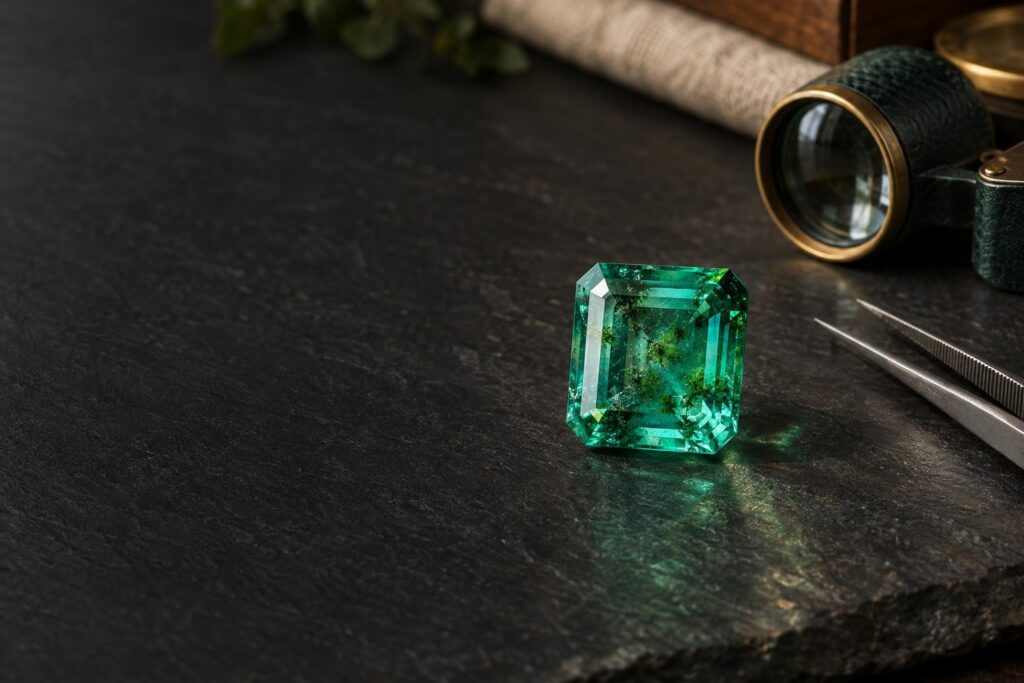
Why emerald is a green beryl
If you love emerald’s green, knowing what the stone is will help you understand how it is treated, worn and cared for. Emerald is the bluish green to green variety of beryl, the same mineral species that includes aquamarine. A variety is a named colour or type within one mineral species. Its chemical formula is Be₃Al₂Si₆O₁₈, and its specific gravity, which compares its weight with the same volume of water, is 2.72 1.
Why is it green? The colour comes from chromium, sometimes with vanadium, inside the beryl crystal 6.
Where does emerald end and green beryl begin? Gemmologists and labs call a stone green beryl when its colour is too light to be emerald. They do not fully agree on how light is too light 1.
Why an emerald’s garden is part of its character
Why does almost every emerald show something inside? Emeralds typically contain inclusions you can see without magnification, and the trade accepts this. Inclusions are tiny crystals, fluids or breaks trapped inside a gem. In emerald they often look mossy or garden-like, so they are sometimes called the jardin, French for garden 2.
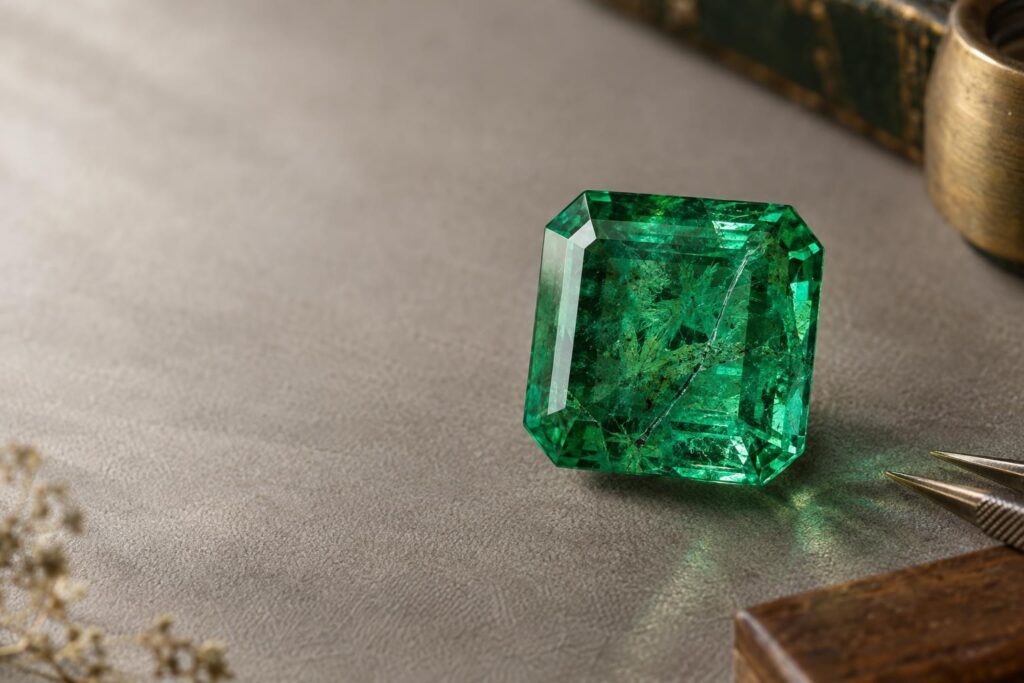
How is colour judged? The most desirable colours are bluish green to pure green, with vivid saturation 1. Saturation means how strong or pure a colour is. The guide to hue, tone and saturation explains this in more depth.
Not all inclusions affect a stone the same way. When they reduce transparency and clarity, they also sharply reduce value. Eye-clean emeralds, with no inclusions visible to the eye, are rare and especially valued 2.
Because of the crystal’s shape, emeralds are commonly cut as rectangular step cuts, known as emerald cuts 1. A step cut has long, flat facets in rows, a little like stairs.
Why most emeralds are treated, and why you should be told
Why treat an emerald at all? Almost all emeralds have significant fractures, which the trade sometimes calls fissures 2. The trade has a long tradition of filling open fissures with colourless oil, wax or artificial resin to make them less visible 5. This is called fracture filling.

How common is it? Most emeralds are treated with oil, resin or polymers to reduce the look of inclusions and surface-reaching breaks 4. Some estimates say 90 percent or more of emeralds are fracture-filled 3.
- near-colourless oils and wax in fissures
- resins or other polymers in fissures
- hardened resins in open fractures or cavities
- dyeing with coloured oils or resins, which happens occasionally
Why does disclosure matter? Under CIBJO’s standard, the seller must tell you about any treatment and any special care it needs, and write the treatment on the invoice. If a treatment is suspected but not confirmed, it should still be disclosed 6. Read more about how gemstone treatments should be disclosed.
Fillers are not all viewed the same way. The high-end trade prefers oil, such as cedarwood oil, over artificial resin, because oil is the most traditional enhancement 5. High-quality untreated emeralds exist but are rare, and a lab report confirms whether a stone is treated 4.
Why emerald asks for gentler wear and care
Why does a fairly hard stone need care? Emerald is 7.5 to 8 on the Mohs scale, a 1-to-10 scale of scratch resistance. Its toughness, or resistance to chipping and breaking, is only fair to good, so it needs more care in wearing than ruby or sapphire 3. See why the Mohs scale is not the whole durability story.
Emeralds are more brittle than corundum, the mineral of ruby and sapphire. This makes them vulnerable during cutting, polishing and setting, and even in careless daily wear 2. Heat can also damage emeralds, especially by extending fractures already inside the stone 3.
How do fillers change the picture? Fillers don’t harm emeralds, but ultrasonic cleaning, alcohol and even jewellery repair can remove or alter them 4. Light and chemicals can make oils, resins and polymers change in appearance or break down 3. Hardened resin fillers can also scratch more easily than the emerald itself 6.
How should an emerald be cleaned? Use warm, soapy water with gentle scrubbing. Ultrasonic and steam cleaning are risky: vibrations can weaken fractured stones, and steam can make oil or unhardened resin sweat out 3. Treated stones should also be kept away from solvents, including some washing-up liquids, chemicals and heat 6.
Why Colombia is linked with a three-part inclusion
Some inclusions tell a story about how a stone grew. Three-phase inclusions are found in Colombian emeralds, each holding a tiny crystal of rock salt, a liquid and a gas bubble 1. Colombia is not the only source. Emeralds also come from Brazil, Zambia and Zimbabwe, and their appearance overlaps between sources 2.
Why a lab report matters when buying an emerald
Why look twice at a flawless-looking emerald? Natural emerald generally has inclusions, so a well-priced gem that looks flawless is suspect. It is likely synthetic or a simulant 4. A synthetic emerald is grown in a laboratory, while a simulant is a different material that only looks like emerald.
How do reports describe treatment? GIA’s Emerald Report rates clarity enhancement as minor, moderate or significant. This describes the level of treatment, not the stone’s overall clarity 2. CIBJO requires disclosure of how much filler is present, and major laboratories agreed on common wording to describe that amount 5.
A report is a snapshot in time. Refilling fissures is quick and easy and can happen even after lab testing, so a report only reflects the stone when it was tested 5. For step-by-step help, see how to buy an emerald and how coloured gemstones are evaluated.
Why the setting is an emerald’s first line of defence
Why does the setting matter so much? Emeralds are not everyday ring stones. For a ring, choose a bezel setting or surrounding accent stones to protect the emerald from blows 4. A bezel is a metal rim that wraps around the stone’s edge. Accent stones are smaller gems set around the centre stone.
How a setting protects an emerald
Emeralds are not everyday ring stones, so the setting does a lot of the protecting. Switch between three styles to see how each one guards the stone.
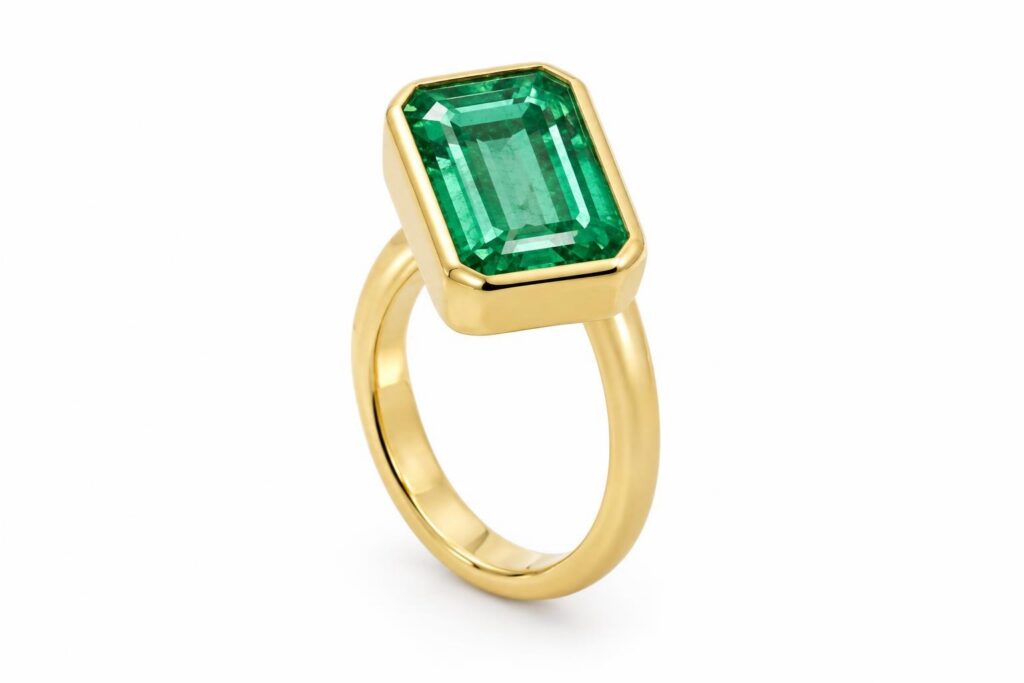
- Bezel setting
- A bezel is a metal rim that wraps around the stone's edge. For a ring, a bezel setting is one of the two recommended ways to protect an emerald from blows.
- Surrounding accent stones
- Accent stones are smaller gems set around the centre stone. Placing them around an emerald is the other recommended way to protect it from blows in a ring.
- Prongs on the corners
- Prongs, also called claws, are the small metal tips that hold a stone in place. The emerald cut has faceted corners, which helps protect against damage and gives a comparatively safe place for prongs.
These pictures show one typical example of each style. Real rings vary in their details. Pictures: AI-generated illustrations, checked for accuracy. They are not photographs of a real piece.
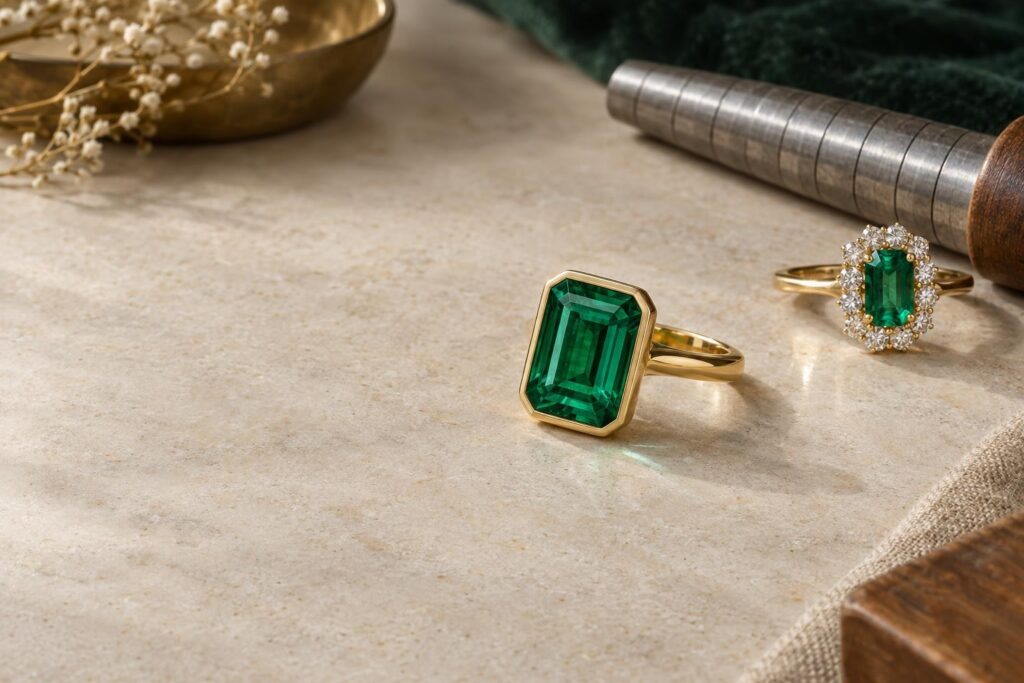
The emerald cut itself helps. Its vulnerable corners are faceted, which helps protect against damage and gives a comparatively safe place for prongs 2. Prongs, also called claws, are the small metal tips that hold a stone in place. Compare styles in ring settings explained and which gemstones suit everyday rings.
Why it helps to ask questions before you choose
Treatment, care and setting are all worth asking about before you choose an emerald. If you would like to talk them through for an emerald or another coloured gemstone, we offer a free consultation, online at bookings.ralphjacobs.org from any country. Inclusion in this guide does not confirm that Ralph Jacobs stocks this gemstone.