Why opal is unlike any other gem
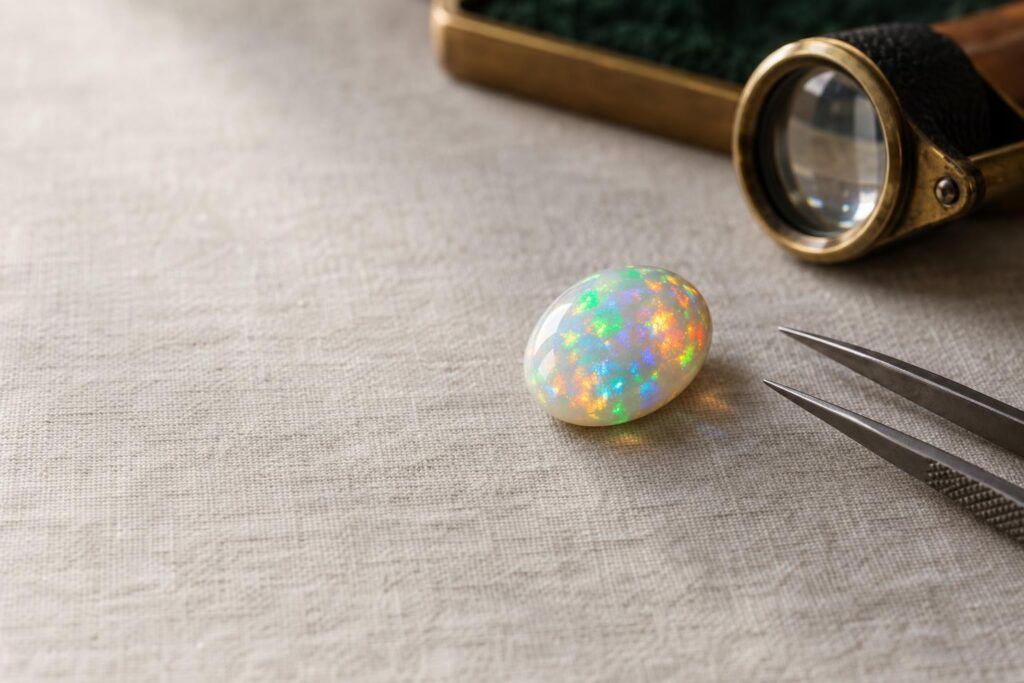
Why does opal feel unlike any other gem? It is known for flashing rainbow colours that seem to move across the stone, a display called play-of-colour 1. Opal also isn’t as hard as many gems, so it is vulnerable to scratches and chips 4. This entry explains both sides: where the colours come from, and how to choose and care for opal.
How is opal made? It is a hardened gel of silica and water, usually holding 6 to 10% water. Unlike other minerals, opal is amorphous, which means it has no definite crystal structure. Its properties change with its structure and its water content 5.
What are the two broad kinds? Precious opal shows play-of-colour, and common opal does not 1. Precious opal is the kind this entry mostly describes.
Why opal’s colours seem to move
Why do the colours shift as you tilt an opal? Precious opal is built from sub-microscopic spheres of silica, stacked in a regular grid. Light bends between the spheres, a process called diffraction, and breaks up into rainbow colours. Spheres of about 0.1 micron produce violet, and spheres of about 0.2 microns produce red 1. When the spheres are larger than about 333 nm, light is split only into the infrared, so no play-of-colour appears 5.
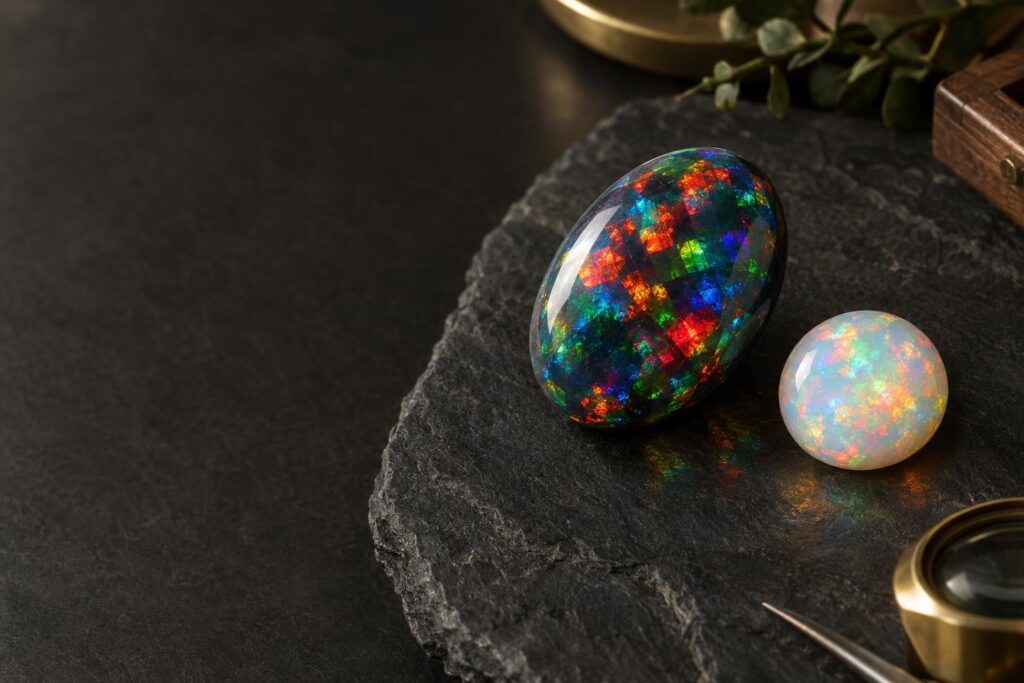
Play-of-colour can also change with the viewing angle or the type of light. Its patterns have names such as pinfire, harlequin, flame and peacock. Areas that show no play-of-colour are called dead spots 2.
- White or light opal: translucent to semitranslucent, with play-of-colour against a white or light grey bodycolour.
- Black opal: translucent to opaque, with play-of-colour against a black or other dark background.
- Fire opal: transparent to translucent, with a brown, yellow, orange or red bodycolour. It often shows no play-of-colour and is also called Mexican opal.
- Boulder opal: keeps fragments of its host rock, called matrix, in the finished gem.
- Crystal or water opal: has a clear background 1.
Why does the background matter? Play-of-colour stands out against a dark background, and black opals are considered the rarest, while white opals are more common. Bodycolour itself comes from tiny impurities held within the silica spheres 2.
Why treatments and assembled opals are worth asking about
Why ask about treatment before you buy? Some opals are treated, and knowing how helps you understand the stone in front of you. Opals can be impregnated with oil, wax or plastic, which means the substance is worked into the stone. They can also be given sugar or smoke treatment 3.
Some opal is hydrophane, which means it is porous enough to soak up water like a sponge. Opal that absorbs water can also absorb dye, so a non-white bodycolour in hydrophane opal calls for extra caution 6.
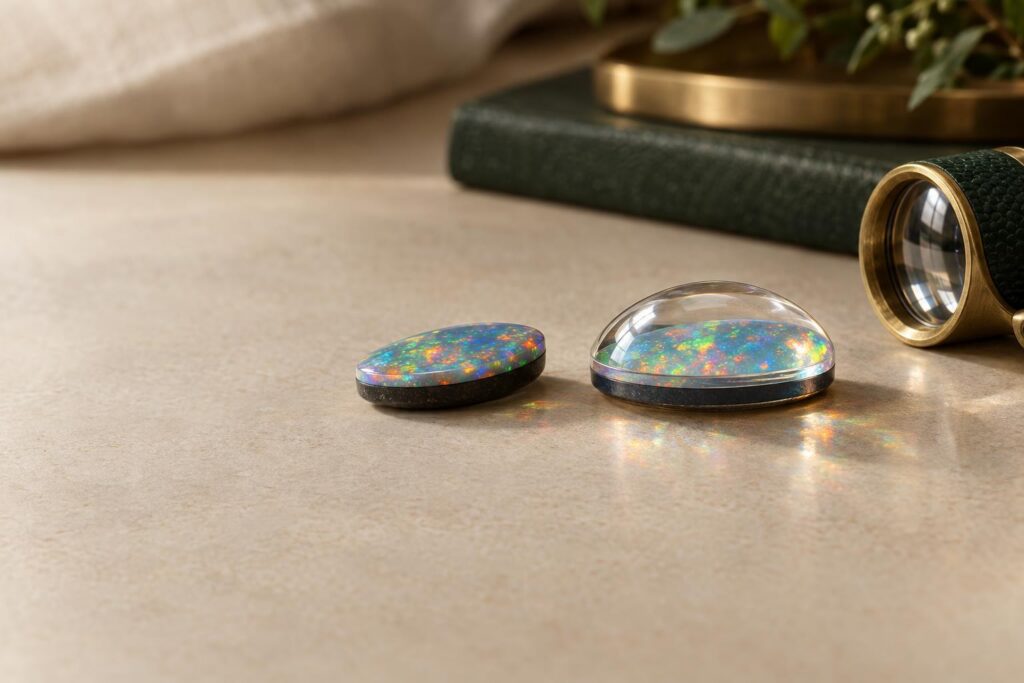
Why are some opals built in layers? Separately from treatment, some opals are assembled. Opal can be fragile, so thin material often gets a rigid backing. A doublet is opal cemented to a backing, and a triplet adds a domed top of clear quartz or glass 2. It helps to ask whether an opal is treated or assembled; see how gemstone treatments should be disclosed.
Why opal needs gentle wear and care
Why does opal need gentle handling? Its hardness, or scratch resistance, ranges from 5 to 6.5 on the Mohs scale. Its toughness, meaning its resistance to chipping and breaking, is rated separately as very poor to fair. Opal is suitable for jewellery, but it needs care so it isn’t scratched or broken 3. The Australian Museum gives a hardness of 5.5 to 6.5, so sources differ slightly 5. You can read more in the Mohs scale is not the whole durability story.
How does water content make opal delicate? Because opal contains water, it may crack after sudden or extreme changes in temperature or humidity 5. If it loses moisture, it can craze, forming a fine network of cracks like a spider’s web. Heat, very dry air, bright light or direct sunlight can cause this 2.
Hydrophane opal carries its own risk. When it is soaked with water, tiny internal cracks often grow and can spread through the whole stone. Owners of hydrophane opal can be advised to avoid putting it in liquid 6.
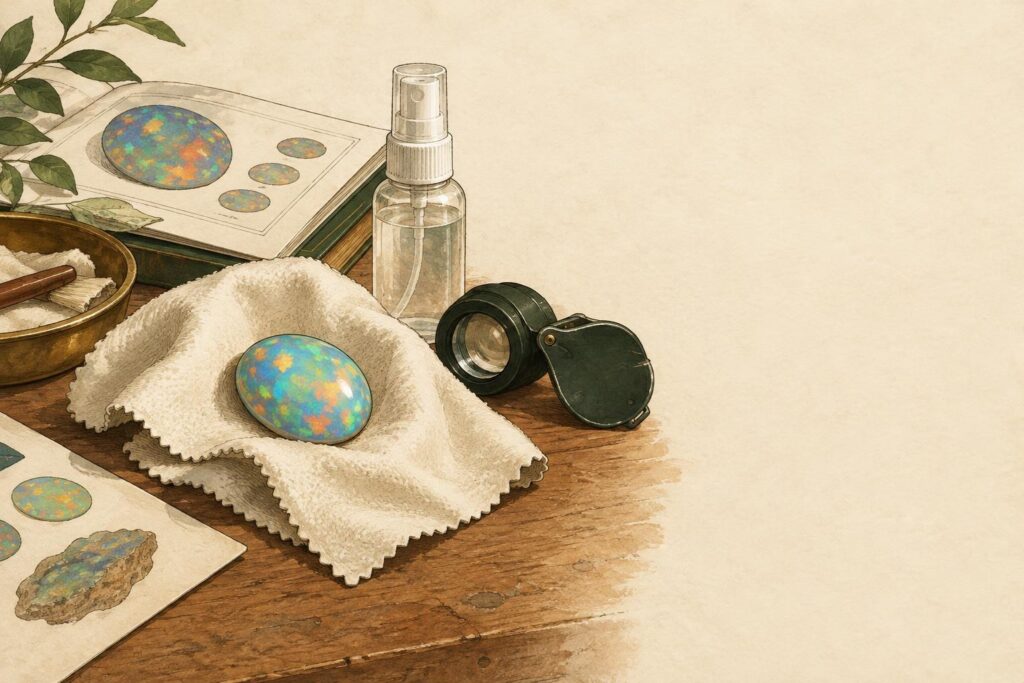
What is safe for cleaning? The only safe way to clean opal is with warm, soapy water. Opal is attacked by hydrofluoric acid and caustic alkaline solutions, both strong chemicals. High heat or sudden temperature changes can also fracture it 3. If your opal is hydrophane, the advice to avoid immersing it in liquid also applies when you clean it 6.
You may hear that storing opal in water stops it drying out. Jewellers often keep a glass of water in opal display cases so the lights don’t dry the air too much. Yet there is no evidence that storing opal in water helps, though it won’t hurt it 4. Hydrophane opal is the exception, because immersion can make its cracks grow 6.
Why buying opal starts with colour, pattern and clarity
Why look closely before you buy? Opal is judged on qualities you can see. GIA names three main aspects: colour, meaning both background colour and play-of-colour; pattern; and clarity 2. Its value is based on quality, not on where it was mined 4. For the wider picture, see how coloured gemstones are evaluated.
- How does the play-of-colour look from different angles and under different lights?
- Are there dead spots, areas with no play-of-colour?
- Is the cabochon (a smooth, domed stone without facets) very flat? A cabochon that is too flat may be vulnerable to breakage, especially while being set.
- Is the stone a doublet or a triplet 2?
- Has it been treated, and is it hydrophane opal?
Why the setting matters so much for opal
Why think about the setting early? The setting is the metal that holds the stone, and for opal it also protects it. Opal isn’t as hard as many gems, so it is vulnerable to scratches and chips. If you are tough on your jewellery, choose a protective setting with metal or gems around the opal 4.
An opal ring is like silk: beautiful, but needing more care than cotton 4. Opals are cut as cabochons to bring out their shifting colour patterns 5. You can compare setting styles in ring settings explained and read more in which gemstones suit everyday rings.
Why this entry is a starting point
This entry describes opal in general terms. The type, construction and any treatment of a specific stone are details to ask about directly. Inclusion in this guide does not confirm that Ralph Jacobs stocks this gemstone. If you’d like to talk through an opal design, we offer a free consultation, online at bookings.ralphjacobs.org from any country.