Why moonstone seems to glow from within
Why does moonstone seem to hold a soft, moving light, as if moonlight were drifting under its surface? That glow is why many people fall for this stone. It also shapes how moonstone is cut and judged, so knowing its cause helps you understand what you are looking at.
How does the glow form? Moonstone is a variety of orthoclase, a mineral in the feldspar group, and it is made of two feldspar minerals: orthoclase and albite. As the mineral cools, these two separate into thin, flat layers stacked one on top of another. 1 The layers are micron-thick, meaning extremely thin. Each layer has a different refractive index, meaning it bends light by a different amount. 5
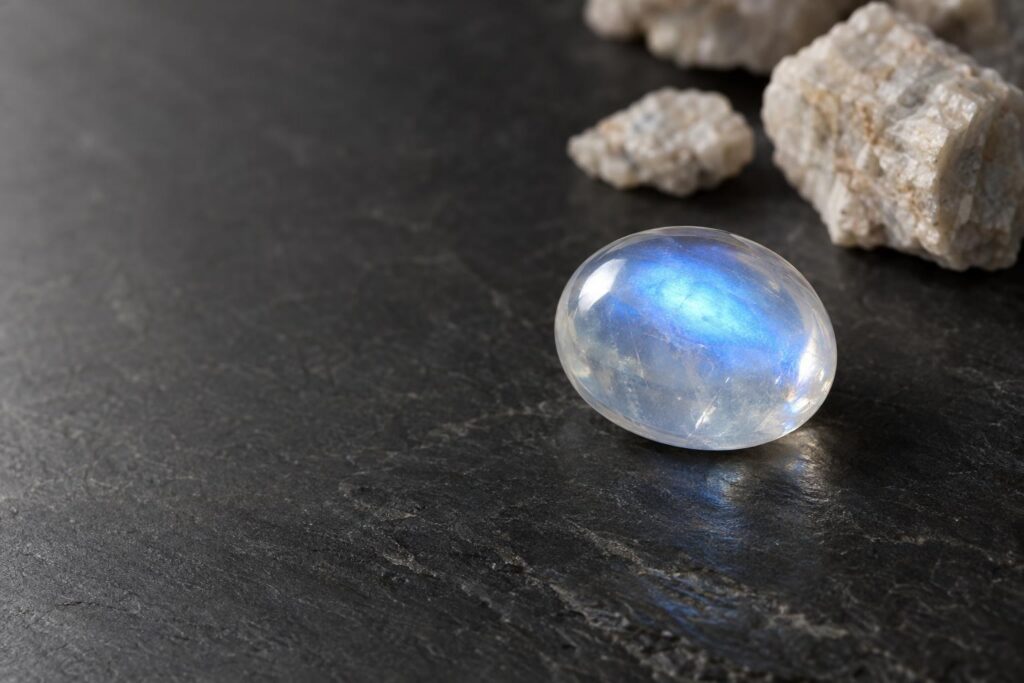
This effect has a name: adularescence. It is light that seems to billow across a gemstone, giving its surface a glowing look. It happens when light falls between the thin layers and scatters in many directions. Feldspars are the most widespread minerals in the earth’s crust, and sanidine, another feldspar, can also produce moonstones. 1 The stone is named for this shimmer, which looks different whenever it moves. 6
Why the sheen and the background colour both matter
Why can two moonstones look so different? Each has two colours working together. The bodycolour is the background colour of the stone, and the sheen is the light floating over it. Sheen can be blue, silver or white. Bodycolours include colourless, white, green, yellow to brown, grey to nearly black, and peach. Moonstones range from semitransparent to opaque. 2
Moonstone sheen, bodycolour and effects
Every moonstone pairs a background colour with a floating sheen, and a few stones add an effect of their own. Switch between the pictures to see how the looks differ.
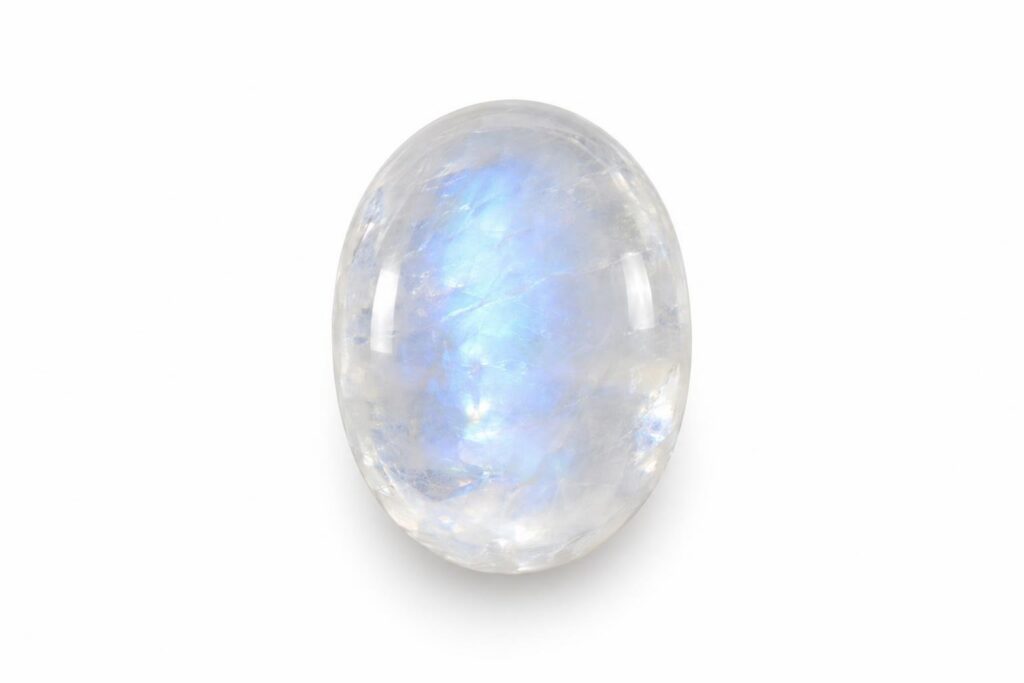
- Blue sheen on a colourless body
- Blue sheen is uncommon. Against a colourless background it is a prized combination. Sri Lanka is the classic source of pale blue sheen on a nearly transparent background.
- White to silvery sheen
- Sheen is usually white to silvery. It is the light floating over the bodycolour, which is the background colour of the stone.
- Peach bodycolour
- Peach is one of the bodycolours moonstone comes in. The others are colourless, white, green, yellow to brown, and grey to nearly black.
- Grey to nearly black
- Bodycolour can run from grey to nearly black. Moonstones range from semitransparent to opaque, so the sheen sits on a much deeper background here.
- Cat's-eye effect
- Some moonstones show a cat's-eye effect, which is a single band of light across the stone.
- Four-rayed star
- Some moonstones show a four-rayed star instead of a single band of light.
- Rainbow moonstone
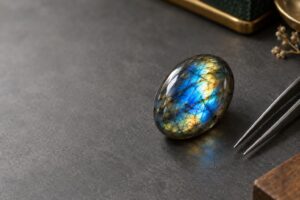
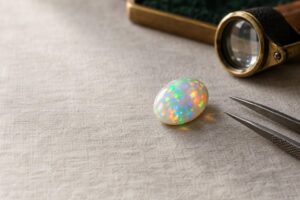
- Rainbow moonstone shows flashes of various colours. Despite its name, it is a calcium-rich plagioclase feldspar of the labradorite variety, not orthoclase.
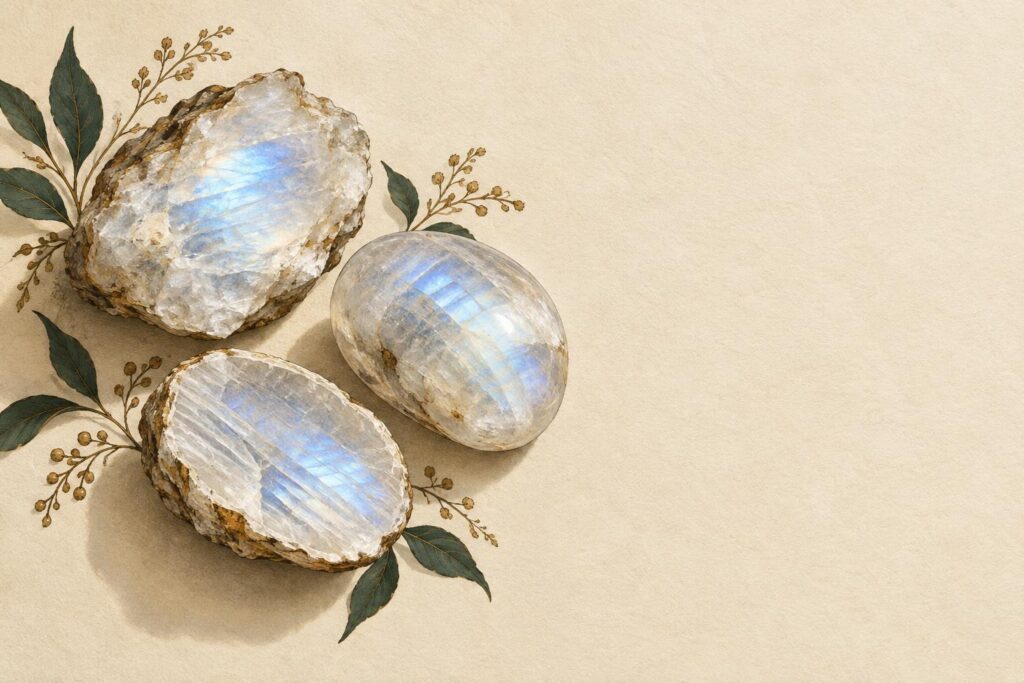
Sheen moves as the viewing angle changes, so each picture shows only one view of it. Real stones vary from these examples. Pictures: AI-generated illustrations, checked for accuracy. They are not photographs of a real piece.
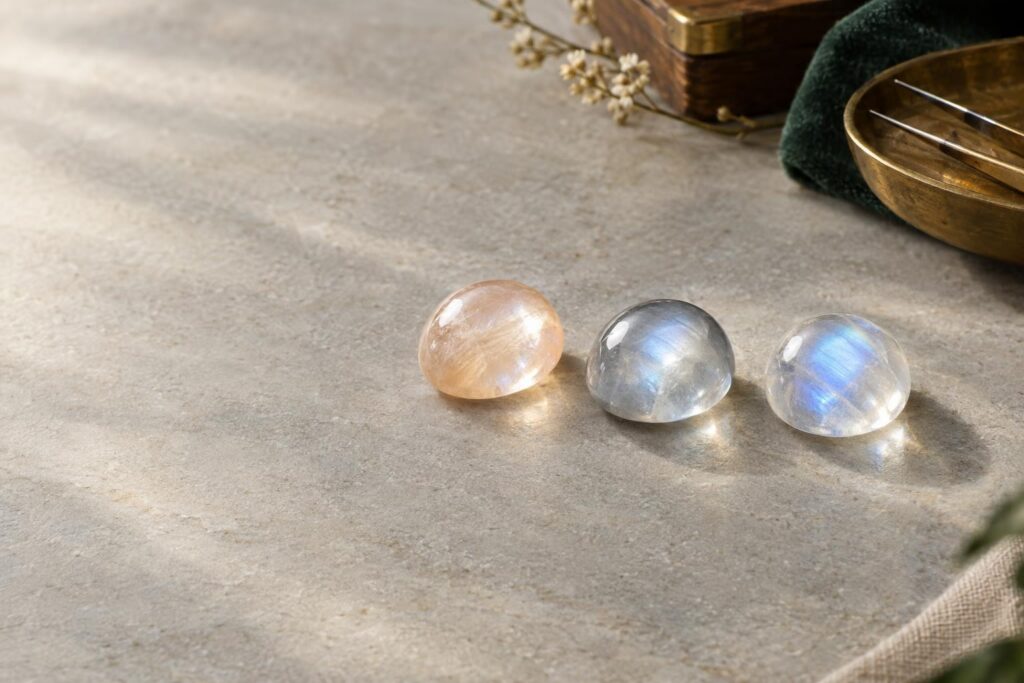
Sheen is usually white to silvery, and blue sheen is uncommon. 5 A blue sheen against a colourless background is a prized combination. 1 Some moonstones also show a cat’s-eye effect, a single band of light, or a four-rayed star. 2
Rainbow moonstone shows flashes of various colours. Despite its name, it is a calcium-rich plagioclase feldspar of the labradorite variety, not orthoclase. 4 You can read more about its relative on the labradorite page.
Why it is worth asking about treatments and assembled stones
Why does disclosure matter for a stone loved for its natural glow? Because you deserve to know exactly what you are buying. The sources used for this entry do not describe a common treatment for moonstone, so none is listed here. This entry describes the material in general and cannot speak for any individual stone.
Assembled stones also exist. A quartz–moonstone doublet is a quartz cap glued over a thin slice of moonstone. 5 A doublet is a different product from a solid moonstone, so it should always be named for what it is. The sources used here do not describe laboratory-grown moonstone. Our article on how gemstone treatments should be disclosed explains what to ask.
Why moonstone needs gentle handling
Why can a stone that glows so softly also break so easily? It comes down to hardness, toughness and cleavage. Moonstone is 6 to 6.5 on the Mohs scale, which measures scratch resistance. It also has poor toughness, meaning it resists chipping and breaking poorly. Cleavage is a direction of atomic weakness that makes a crystal more likely to break, and moonstone has two, like other feldspars. A hard blow can break it. 3
Both cleavage directions are perfect, which is why a sharp impact is a real risk. 5 Hardness is only part of the picture, as our article The Mohs Scale Is Not the Whole Durability Story explains.
Heat and chemicals matter too. High heat or a sudden temperature change can crack moonstone. It is stable to light but is damaged by hydrofluoric acid. Warm soapy water is the only recommended cleaner, and ultrasonic and steam cleaners are never recommended. 3 A moonstone that has become dull with wear can be repolished. 6
Why origin can hint at colour
Why does a moonstone’s source come up when people describe it? Some places are linked with particular looks. Sri Lanka is the classic source of pale blue sheen on a nearly transparent background. Material from India comes in beige-brown, green, orange and brown. 6 Rainbow moonstone comes from Madagascar. 1 The sources used here do not say how reliably a stone’s origin can be identified.
Why the cut and the angle of the glow shape quality
Why can two moonstones of the same colour look so different in the hand? Buyers look at three key factors: the bodycolour, the colour of the sheen and the orientation of the sheen, meaning where it sits on the stone. The finest moonstone is colourless, nearly transparent, has no visible inclusions (tiny features inside a stone) and shows a vivid blue sheen. GIA describes it as "a gem of glassy purity with a mobile, electric blue shimmer." 2
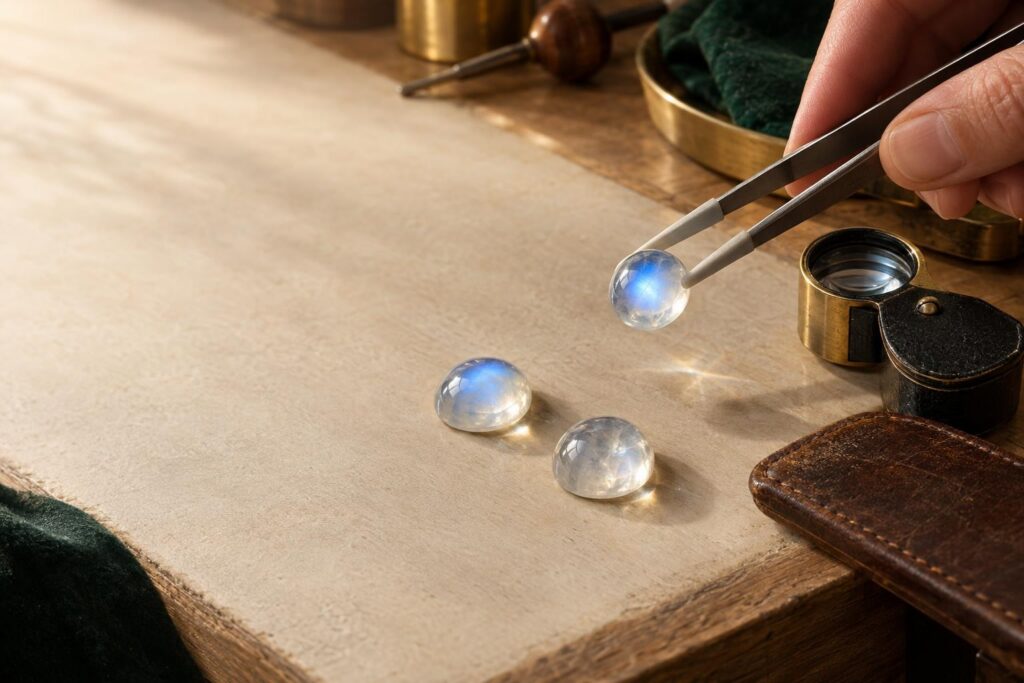
- Where the sheen sits: it should be centred on top of the cabochon (a domed stone with no facets) and visible from a wide range of angles. A sheen that shows only in a narrow range lowers a stone’s value.
- Inclusions: these can interfere with the sheen. Typical ones are tiny tension cracks called "centipedes".
- The dome: the cabochon is by far the most common cut, and very flat cabochons do not show the sheen well. 2
- Solid or assembled: it is fair to ask whether a stone is solid moonstone or a doublet.
How do cutters aim the glow? The plane of adularescence runs parallel to a cleavage direction, so cutters set the cabochon’s flat base parallel to that plane. 5 The correct dome height matters, and the crystal axes must line up with the top of the dome. 6 Very transparent material may be faceted instead. 4 For the wider picture, see how coloured gemstones are evaluated.
Why moonstone is often worn away from the hands
Why do so many moonstones end up in earrings and pendants? Rings take more knocks, so manufacturers usually set moonstone in pendants, earrings and pins instead. 3 Geology.com notes that moonstone is not suited to everyday wear but works well in earrings and pendants. 5
If you are drawn to a moonstone ring, the relevant facts are its cleavage, its poor toughness and how often the ring would meet hard surfaces. Our visual guide to ring settings shows how different settings hold a stone. Moonstone also has a long design history: it was popular in Art Nouveau jewellery, including work by René Lalique. 6
Why this entry describes rather than sells
This entry describes moonstone as a material, so you can understand its glow and its limits. Inclusion in this guide does not confirm that Ralph Jacobs stocks this gemstone. We work with a wide range of coloured gemstones, and if you would like to talk through a design, we offer a free consultation, online from anywhere at bookings.ralphjacobs.org.
Frequently asked questions
Moonstone contains thin, alternating layers of two feldspar minerals, orthoclase and albite, which separate as the mineral cools. Light scatters between these layers, creating adularescence: a soft glow that seems to roll across the surface as you change the viewing angle. 1
Moonstone is 6 to 6.5 on the Mohs scale and has poor toughness. It also has two cleavage directions, so a hard blow can break it. High heat or a sudden temperature change can crack it too. 3
Clean moonstone with warm soapy water only. Ultrasonic and steam cleaners are never recommended, and the stone can crack under high heat or a sudden temperature change. 3