Why a ruby gemstone is red: what it is
If you are thinking about a ruby for a ring you will wear every day, three questions matter most. What makes a ruby a ruby, how is it often treated, and how well does it stand up to wear? This entry answers each in turn.
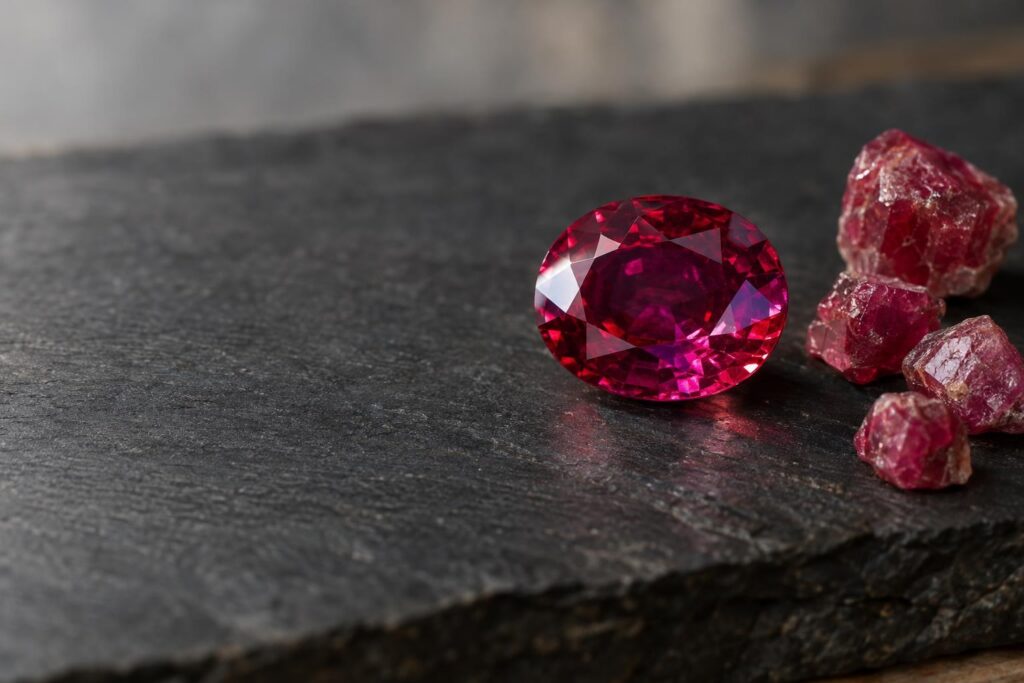
Why does a ruby glow so red when the mineral underneath has no colour at all? Ruby is a variety of the mineral corundum, which also gives us sapphire. In its purest form, corundum is colourless. Colour comes from trace elements, tiny amounts of other elements caught inside the crystal structure. 1
In ruby, that trace element is chromium. The more chromium a stone holds, the stronger its red. Chromium can also cause fluorescence, a glow given off under ultraviolet (UV) light, which makes the red look more intense. 1
Why not every red corundum is called ruby
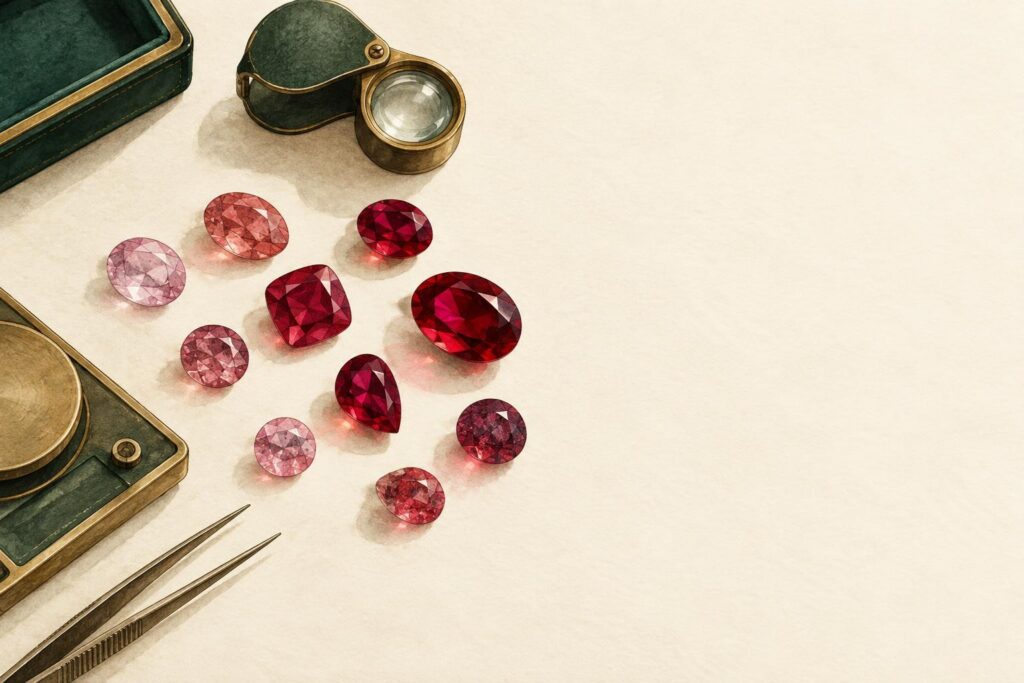
Why does the name depend so much on colour? Ruby ranges from orangy red to purplish red. 1 Because ruby and pink sapphire are the same mineral, the name depends on two things: which hue, or basic colour, is dominant, and how light the colour is. The finest ruby has a pure, vibrant red to slightly purplish red colour, while orange and purple overtones are valued less. 2
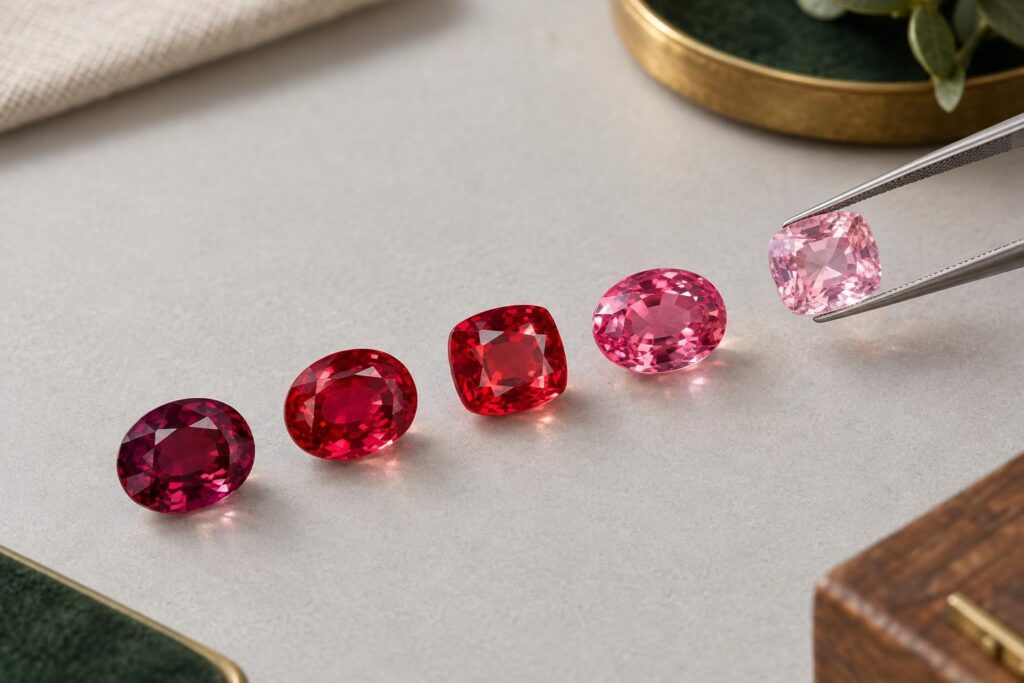
If the colour is too light, the stone may be called pink sapphire, even when the colour is strong. Historically, "ruby" covered red shades that included pink, and in some producing countries, such as Sri Lanka, pink was always considered ruby. GIA’s lab compares stones with reference stones called masterstones, on the principle that red must be the dominant hue. Even so, judging which hue dominates depends on personal perception. 2 You can read more in Hue, Tone and Saturation in Gemstones.
How a ruby formed can also shape its colour. Rubies from marble deposits are low in iron, so they are often intensely red. They usually fluoresce red under UV light, even the UV in sunlight. Rubies from deposits associated with basalt, a volcanic rock, can contain more iron, which can make them darker and less intense. 1
Why ruby treatments matter to you
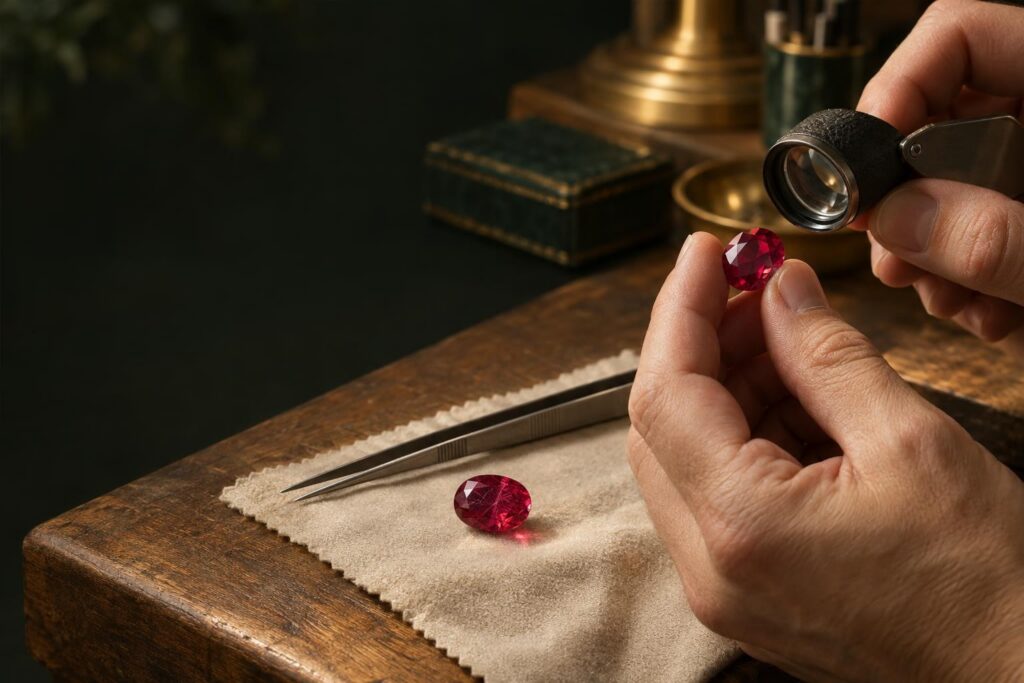
Why are so many rubies treated? Because corundum is very durable, it lends itself to many treatments, and ruby is often a prime focus. 4 The CIBJO Blue Book, an international trade standard, lists untreated ruby as rare. 6
- Heating, to improve colour, clarity or both
- Fracture healing, which closes cracks inside the stone
- Glass filling of cavities and fractures
- Diffusion, where elements are moved into the crystal with heat
- Dyeing and coating
- Synthetic overgrowth, a layer of laboratory-made material grown onto the stone
CIBJO lists heating, and flux-assisted healing of fissures (cracks closed with the help of a melting agent called flux), as common and stable. 6 Fine needles of rutile called "silk" are one kind of inclusion, a tiny feature inside a stone. Intact silk shows the ruby was not heated at very high temperatures, but lower-temperature heating may still have happened. 2 See Heat Treatment in Gemstones for how heating works.
Glass filling changes a ruby much more. In fracture filling, high-lead glass fills cracks. Its refractive index, a measure of how much it bends light, closely matches ruby’s, so the cracks become much less visible. Under a gemmological microscope, signs include a blue "flash effect" and gas bubbles in the glass. 4 CIBJO lists lead-glass filling as common and unstable, and ruby-glass products can be classed as manufactured or composite material. 6
Treatment also affects care: untreated and heat-treated rubies are very durable, while fracture-filled rubies need more care. 3 So it is worth asking which treatments a stone has had, and whether a laboratory report covers them. How Gemstone Treatments Should Be Disclosed explains what to expect.
Why ruby suits daily wear, and when it needs more care
Why is ruby so often set in rings worn every day? Corundum is 9 on the Mohs scale, which ranks scratch resistance. It has excellent toughness, meaning resistance to chipping and breaking. It has no cleavage, a flat plane along which some crystals split. That makes it a great choice for rings worn every day, and corundum also resists heat, light and common chemicals. 3
The exception is glass-filled ruby. Untreated and heat-treated rubies are very durable, but fracture-filled rubies need more care, and even lemon juice can change the glass. 3 In GIA testing, the filler reacted readily with jewellers’ pickling solution, an acid bath used after soldering. Oven cleaner, ammonia and bleach also etched it. 4 Glass fillers can scratch more easily than the host stone, and are more easily damaged by heat or some acids. 6
Cleaning follows the same split. Warm soapy water is always safe. Ultrasonic and steam cleaners are usually safe for untreated, heat-treated and lattice-diffused stones, whose colour was changed by diffusion. Fracture-filled, cavity-filled or dyed stones should only be cleaned with a damp cloth. 3 To see how hardness and toughness differ, read The Mohs Scale Is Not the Whole Durability Story.
Why a ruby’s origin is often an opinion
Why can’t a lab always say where a ruby came from? Labs split rubies into two groups by trace-element chemistry: marble-hosted (low-iron) and high-iron. High-iron rubies are usually straightforward to identify. Marble-hosted rubies are harder, because stones from different places tend to overlap, especially in their chemistry. 5
The ruby trade relies largely on reputable gemmological labs to judge origin. When a stone has no telling inclusions and its chemistry is unclear, "inconclusive" is the only fitting answer, and some stones will always get that call. 5 Under CIBJO’s standard, origins given for gemstones "shall be considered as a matter of opinion", and origin does not imply a level of quality. 6
Why the right questions matter when buying a ruby
Why ask before you buy? Two red stones sold under similar names can differ in treatment, durability and care. Some products are not a single natural stone at all: CIBJO lists "ruby-glass composites" among composite stones. 6 How Coloured Gemstones Are Evaluated covers the wider quality picture.
- Has the stone been treated, and how?
- Is it glass-filled, or a ruby-glass composite?
- Does a laboratory report cover treatment and, if stated, origin?
- Is the red the dominant hue, or could the stone be described as pink sapphire?
- What cleaning and repair care does this particular stone need?
Why setting choices affect a ruby over time
Why does the setting matter for such a hard stone? Ruby’s hardness, toughness and lack of cleavage suit rings and other mountings worn every day. 3 For a glass-filled stone, the picture changes. The study authors say it is prudent to unmount these stones before torch work. 4 If a ring with a filled stone may later need repair or resizing, you can ask the jeweller how they will handle the stone. Ring Settings Explained: A Visual Guide shows the main setting styles.
Why this entry is here
This entry describes ruby as a material, so you can ask clear questions wherever you look. Ralph Jacobs works with a wide range of coloured gemstones as centre stones, and we offer a free consultation, online from anywhere at bookings.ralphjacobs.org. Inclusion in this guide does not confirm that we stock this gemstone.
Frequently asked questions
Why does ruby suit daily wear? Corundum is 9 on the Mohs scale, with excellent toughness and no cleavage. Untreated and heat-treated rubies are very durable. Fracture-filled rubies, filled mainly with high-lead glass, need more care, because even lemon juice can change the glass. 3
Why two names? Both are corundum. GIA’s lab works on the principle that red must be the dominant hue for a stone to be called ruby. If the colour is too light, it may be called pink sapphire. Judging the dominant hue depends on personal perception. 2
Why not? Marble-hosted rubies from different places overlap, especially in trace-element chemistry. When a stone has no diagnostic inclusions and its chemistry is ambiguous, "inconclusive" is the only appropriate answer, and some stones will always get that call. 5
Why ask? Treatment affects care and description. The CIBJO Blue Book lists heated ruby as common and stable, and untreated ruby as rare. It lists lead-glass-filled fractures and cavities as common and unstable. 6