
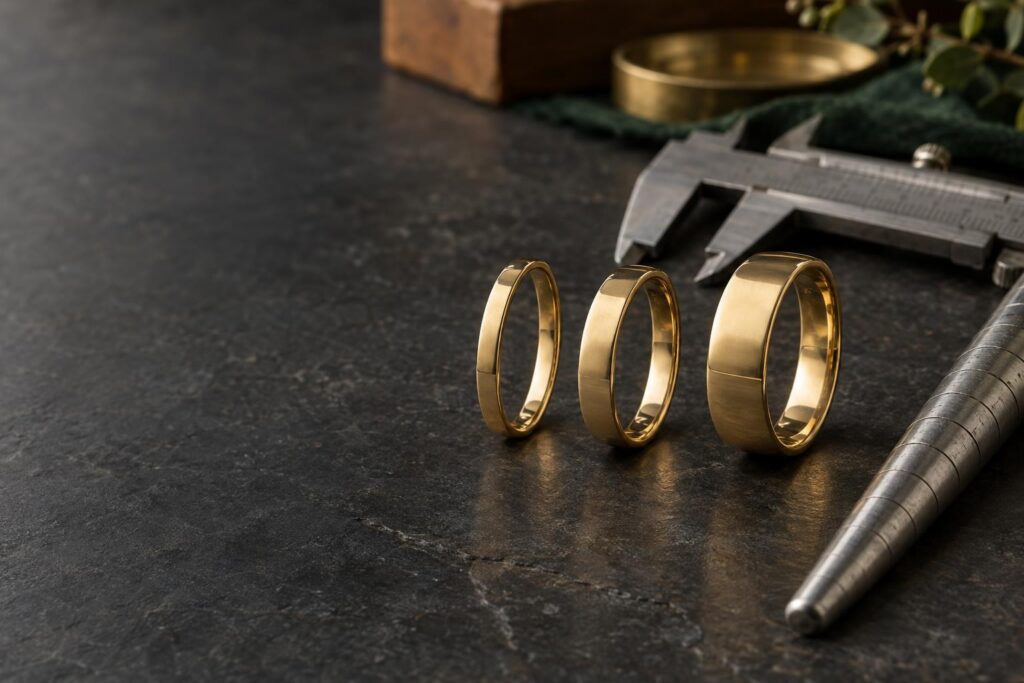
The decision in brief
- If you plan to wear your band with an engagement ring every day, check the combined width. Sets wider than 4 or 5 mm, worn together, need special consideration.
- If you like a wide band, ask about finger gauges made for wider bands. Wide bands usually fit more snugly and may need to be a bit larger.
- If you are very active or play sport, keep in mind that an ornate band with many gems can be damaged in sport.
- If your engagement ring has a large solitaire, a thin but detailed band is one way to complement it without competing.
- If you want to stack several bands, allow for a tighter fit, put the thickest ring at the bottom and leave room below the knuckle.
- If your knuckles are larger than the rest of your finger, check that the width you choose still slides over them.
- If you are unsure between two sizes, note that removing metal from a ring that is too big is easier than adding metal to one that is too small.
Editorial guidance — context changes what is right for you.
Start with the wearer and the ring
No other piece of jewellery is worn as often and as regularly as a wedding ring. So before you think about millimetres, think about the hands that will wear it: the work they do, the sports they play, and how often the ring will come off.
Then think about the ring it may sit beside. Will the band be worn alone, or every day with an engagement ring? Will more bands be added later? Pairing, stacking and activity each raise their own fit questions, and this guide covers each one.
Quick checklist
- What does the wearer do with their hands each day?
- Will the band be worn alone or with an engagement ring?
- Are more bands likely to be stacked on the same finger later?
- Are the wearer's knuckles larger than the rest of the finger?
- If a wide band is planned, has the finger been measured with a gauge made for wider bands?
- Has the jeweller allowed for temperature and time of day when sizing?
- Which metal will the band be made in, and will it sit next to a harder metal?
The criteria that matter
Fit and ring size
Wider bands usually fit more snugly, so they may need to be a bit larger. Finger gauges are also made for wider bands.
Why ring sizes differ by country: how to read a conversion chartPairing with an engagement ring
Sets wider than 4 or 5 mm, worn together, need special consideration. A thin, detailed band can sit beside a large solitaire without competing.
Why the setting matters: how to choose an engagement ring settingLifestyle and activity
GIA links an active life with a simpler band, because an ornate band with many gems can be damaged in sport.
Stacking
Several rings on one finger can make the fit tighter. Put the thickest ring at the bottom, with room left below the knuckle.
Metal and long-term wear
Gold rings wear away slowly while worn. In one study, wear rose on a beach holiday and with gardening and skiing. Gold can wear faster when stacked with harder metals.
Why karat matters: what changes in 9ct vs 14ct vs 18ct goldCompare your options
| Area | What changes visibly | When to prioritise | Reasonable compromise |
|---|---|---|---|
| Fit and size | Wider bands usually fit more snugly than narrow bands of the same size. | If you are drawn to a wide band. | A wide band may need to be a bit larger, and it must still slide over the knuckle. |
| Wearing with an engagement ring | Worn together, the band and engagement ring are sized as one set. | If you plan to wear both rings together every day. | Sets wider than 4 or 5 mm need special consideration. |
| Style beside a large solitaire | A thin but detailed band can complement a large centre stone without competing with it. | If the centre stone is the feature you want people to notice. | An ornate band with many gems can be damaged in sport. |
| Decoration and active hands | GIA links an active life with simpler designs, because ornate bands with many gems can be damaged in sport. | If you work with your hands or play sport often. | A plain band has less decoration, which may not match the look you want. |
| Stacking | More rings on one finger can make the fit tighter. | If you plan to add bands over time. | Gold can wear down faster when stacked with harder metals. |
A practical decision process
- Note how the wearer uses their hands each day, at work and in hobbies.
- Decide whether the band will be worn alone, with an engagement ring or as part of a stack.
- Try on narrow and wide bands to feel how differently they fit.
- Place each band beside the engagement ring, if there is one, and note the combined width.
- Get sized with a finger gauge, and ask whether gauges for wider bands are available.
- Check that the band slides over the knuckle, and ask how temperature and time of day were allowed for.
- Ask how the chosen metal will wear, especially if it will be stacked.
- Weigh comfort, style and daily life, and choose the width that fits your own priorities.
Numbers indicate order, not saved progress.
Common buying mistakes
- Not asking about gauges for wide bands Wide bands usually fit more snugly, and finger gauges are also made for wider bands. Ask whether one is available for your sizing. Why ring sizes differ by country: how to read a conversion chart
- Ignoring how fingers change Fingers shrink in the cold and swell in the heat, and humidity, altitude and time of day matter too. Ask how your jeweller allowed for these.
- Forgetting the knuckle A band must slide over the knuckle, which for most people is larger than the rest of the finger. Test that it goes on and off comfortably.
- Choosing the band without the engagement ring Worn together, sets wider than 4 or 5 mm need special consideration. Try both rings on together before you decide. Why the setting matters: how to choose an engagement ring setting
- Overlooking stones on a band for an active life An ornate band with many gems can be damaged in sport. If you are active, compare simpler designs too.
- Stacking without allowing for a tighter fit Several rings on one finger can make the fit tighter, and a stack that is too tight can cause discomfort and circulation problems. Ask a jeweller to check the whole stack.
- Assuming gold will not wear Gold rings wear away slowly while worn, and gold can wear faster next to harder metals. Ask how your chosen metal will age. Why karat matters: what changes in 9ct vs 14ct vs 18ct gold
- Buying on the small side to be safe It is easier to remove metal from a ring that is too big than to add metal to one that is too small. Ring Size Converter
Questions to ask
Fit and sizing
- Do you have finger gauges for wider bands, close to the width I want?
- Would a wide band need to be a bit larger for my finger?
- Is the inside of this band rounded or flat, and how is it measured?
Pairing and stacking
- How will this width sit beside my engagement ring?
- Is the combined width of my set wider than 4 or 5 mm, and does that change the sizing?
- If I add more bands later, how will the fit change?
Wear and daily life
- How will this band hold up to my work and hobbies?
- How will this metal wear if I stack it with a harder metal?
- Can this band be resized later, and how?
- How long might a narrow band last compared with a wide one?
Frequently asked questions
Do wider wedding bands need a bigger size?
Often. Wide bands usually fit more snugly, so they may need to be a bit larger. Finger gauges are also made for wider bands, so you can ask to be sized with one.
Can I wear a wide band with my engagement ring?
Fit needs extra care. Bridal sets wider than 4 or 5 mm, worn together, need special consideration. Try both rings on together and ask your jeweller how the combined width affects sizing.
Will my gold wedding band wear down over time?
Slowly, yes. Gold rings wear away continuously while worn. One study weighed an 18ct gold wedding ring weekly for a year and found it lost 6.15 mg of gold. Wear rose on a beach holiday and with gardening and skiing.
Why does my band feel tighter on some days?
Fingers change size. They shrink in the cold and swell in the heat, and humidity, altitude and time of day also play a part. Jewellers factor these in when sizing.
Is a ring that is a little big easier to fix than one that is a little small?
It is easier to remove metal from a ring that is too big than to add metal to one that is too small. Ask your jeweller whether your chosen band can be resized.
Why width changes how a wedding band fits
Why can two wedding bands in the same size feel different on your finger? Width is one reason. Rings with a wide shank (the band of metal that circles your finger) usually fit more snugly, so they often need to be a bit larger 1.
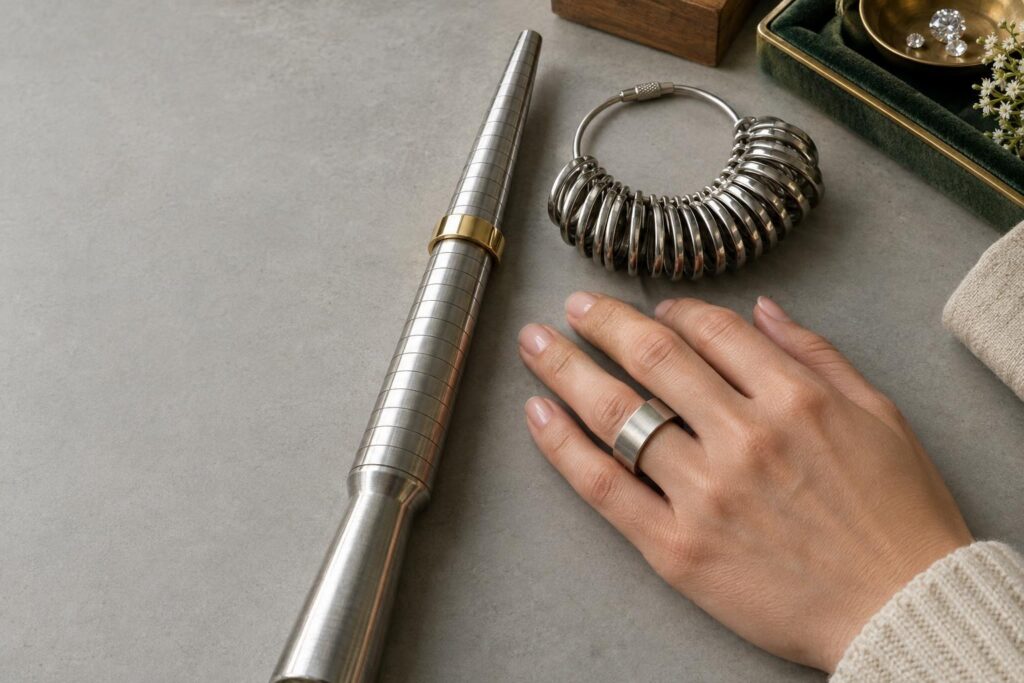
How do jewellers allow for this? They use a finger gauge, also called a ring sizer. It is a set of metal bands that slide onto your finger. Finger gauges are also made for wider bands, so you can ask to be sized in a width close to the one you want 2.
What about measuring a ring you already own? Jewellers often use a mandrel, a tapered measuring rod. If the band is unusually wide, it is measured from its centre 1.
What is a ring size, exactly? The international standard ISO 8653 defines it as the circumference of the largest cylinder that fits inside the ring. The standard separates two inside profiles, meaning the shape of the band’s inner surface: rounded and flat. On a rounded profile, the measuring point is the middle of the band’s thickness; on a flat profile, it is the bottom edge 5. To compare this with the sizes used where you live, try the Ring Size Converter.
Why your finger and knuckle matter as much as the band
Why can a band that fitted well in the shop feel tight later? Fingers change. They shrink in the cold and swell in the heat, and humidity, altitude and time of day also play a part 1. Jewellers take these factors into account when they size you 2.
How should a wedding band feel once it is on? It must slide over your knuckle, which for most people is larger than the rest of the finger. It should be snug but not uncomfortable, and it should not fall off during work, play or hand-washing 1.
GIA’s stacking guide adds that wedding rings should sit snugly, turn very little and allow normal blood flow 4.
What if you are unsure between two sizes? It is easier to remove metal from a ring that is too big than to add metal to one that is too small 1.
Why width matters next to an engagement ring
Why think about the engagement ring when choosing a band? Because you may wear the two side by side. Not everyone does: some people wear only the wedding band every day and keep the engagement ring for special occasions 3.
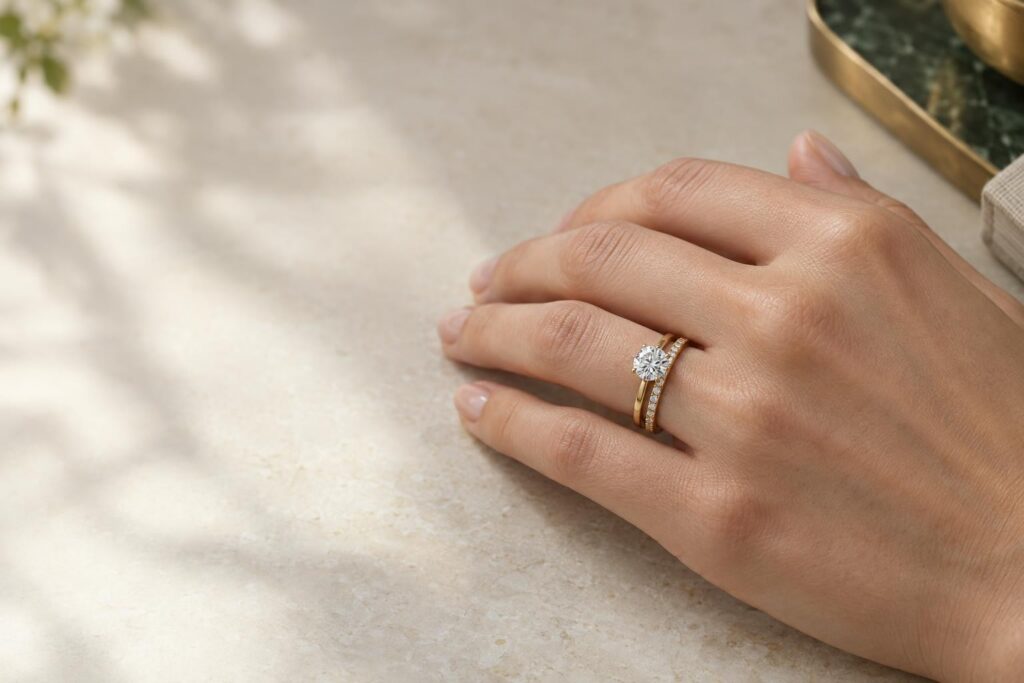
How wide is too wide for a set? Bridal sets wider than 4 or 5 mm, with the band and engagement ring worn together, need special consideration, so ask your jeweller 1.
What about the look? A solitaire is a ring with a single centre stone. Micro-pavé means rows of very small diamonds set close together. With a large solitaire, a thin but detailed band, such as micro-pavé, can complement the stone without competing, but overly bulky band sets are best avoided unless they suit your style 4. For more on how settings shape the whole ring, see How to Choose an Engagement Ring Setting.
Why stacking changes the width you feel
Why does a stack feel different from a single ring? Several rings on one finger can make the fit tighter. Adjust the stack, or asking a jeweller, to avoid discomfort and circulation problems 4.
How do you stack bands of different widths? Put the thickest ring at the bottom, and leave a comfortable amount of room between the stack and your knuckles. Bear in mind that softer metals like gold can wear down faster when stacked with harder metals 4.
If your bands will be in different metals, White Gold vs Platinum explains how the two compare.
Why your daily life shapes the choice
Why does your work or hobby matter? Because a wedding band goes where your hands go. Narrow your choices by thinking about both personal style and lifestyle 2.
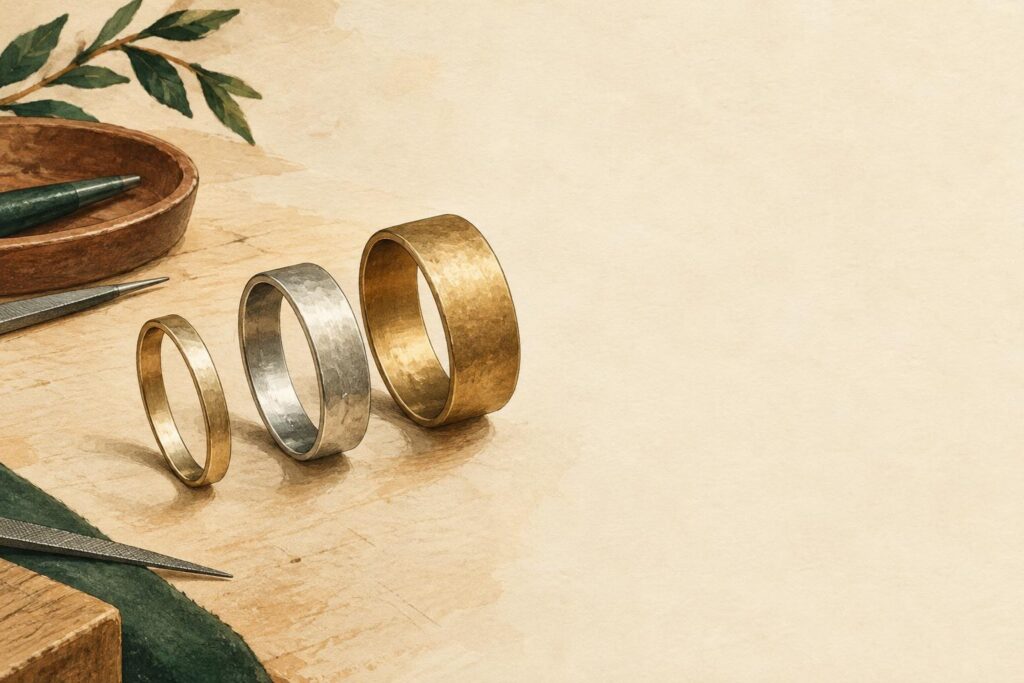
How does activity come into it? GIA’s guide to choosing a wedding band links an active life with a simpler band. It notes that an ornate band with many gems can be damaged in sport 2. This point is about stones and decoration, not width itself.
What can you do day to day? Take rings off during heavy physical activity and when handling harsh chemicals. Remove them before swimming too, because cold water can make fingers shrink 3.
Why gold bands slowly wear away
Why does wear matter more for a wedding band? No other piece of jewellery is worn as often and as regularly. Gold rings wear away continuously while they are worn 6.
How much metal is lost? In one peer-reviewed study, an 18ct (18K) gold wedding ring was weighed every week for a year. It lost 6.15 mg (0.39 mm³) of gold to abrasive wear, meaning metal rubbed away by friction 6.
What raised the wear? It was highest on a beach holiday, where sand increased friction, and gardening and skiing also increased it 6. The study followed one ring, so it does not show how width changes wear. To compare gold purities, see 9ct vs 14ct vs 18ct Gold.
The downsides: when a wide or narrow band may not suit you
Why look at the downsides? So you can weigh them against what you like about a width before you decide.
A wide band may need to be a bit larger than a narrow one, because wide shanks fit more snugly. Worn with an engagement ring, it may also take the set past 4 or 5 mm, the width at which a set needs special consideration 1.
A thin band covered in small stones can complement a large solitaire 4. But an ornate band with many gems can be damaged in sport 2.
Several bands on one finger can make the fit tighter, and GIA links an overly tight stack with discomfort and circulation problems 4.
What the sources here do not tell you: none of them compare how long a narrow band lasts against a wide one, or show how width changes wear. If that matters to you, it is a question to put to a jeweller.
Tools that can help
Why use a tool? Ring sizes are not named the same way everywhere 1. The ISO standard measures size on a metric ring stick, from size 41 to size 76, and it was written because ring-size checks varied between manufacturers and brands, which caused conflicts 5.
- Ring Size Converter: compare sizes across systems.
- Ring Size Systems: South Africa, UK, US and Europe: how each system works.
- How to Find a Ring Size Secretly: if a band is a surprise.
Ralph Jacobs service: why try widths before you decide
Why try widths with a jeweller? Because width, stacking and your own finger all change how a band fits. If you would like to compare widths, we offer a free consultation, online from any country at bookings.ralphjacobs.org, or in our Secunda showroom.
Sources and methodology
This guide draws on GIA guidance on ring sizing, wedding bands and stacking, the ISO 8653 standard on ring sizes, and a peer-reviewed study of wear on an 18ct gold wedding ring. The sources do not compare how long narrow and wide bands last, so the guide makes no claim about that.
- How to Determine Ring Size: Tips and Ring Size Chart
- Men’s Diamond Wedding Band | Choosing a Ring (Men’s Wedding Rings – Pick one that Suits His Style)
- How to Wear Your Engagement Ring and Wedding Band
- Ring Stacking Guide: How to Style and Stack Your Rings
- ISO 8653:2016 Jewellery — Ring-sizes — Definition, measurement and designation (preview sample)
- Quantification of the abrasive wear of a gold wedding ring