
The decision in brief
- If the wearer works with their hands or leads an active life, consider a bezel. It resists chips, protects the stone's edge and is less likely to catch.
- If letting the most light into the stone matters most, consider prongs, and plan to have their raised tips checked from time to time.
- If the diamond has points, such as a princess, pear, marquise or heart shape, consider V-shaped prongs or a bezel to protect the corners.
- If extra security from a prong setting matters to you, six prongs are more likely than four to keep the diamond in place if one breaks.
- If you want the centre stone to look bigger, a halo can help, but its many small stones may need more maintenance.
- If the diamond is colourless, consider white-metal prongs even with a yellow or rose band, because facets reflect the metal's colour.
- If the ring may need resizing later, or a wedding band will sit beside it, check how the setting handles both before you decide.
Editorial guidance — context changes what is right for you.
Start with the wearer and the ring
You have chosen, or nearly chosen, a diamond. The setting is the part that turns it into a ring the wearer will put on every day. So it is worth matching to their life as well as their taste.
Start with the person, not the catalogue. Think about their work, sport and hobbies, the shape of the stone, their hands, and the style they already wear. If the ring is a surprise, notice the jewellery they choose for themselves.
Quick checklist
- Does the wearer work with their hands, play sport or garden?
- Is the stone a pointed shape, such as princess, pear, marquise or heart?
- Are the wearer's fingers short, petite, larger, or long and slender?
- Does the wearer mostly wear white, yellow or rose metal?
- How much upkeep, such as a yearly clean and inspection, feels manageable?
- Will a wedding band be worn next to the engagement ring?
- Has the ring size been measured professionally?
The criteria that matter
Security and protection
A setting holds the diamond and protects it from damage, and settings differ in how much they protect. A bezel protects the stone's edge, and six prongs give more protection than four.
Why claw count matters: 4 claw vs 6 claw ring settingDaily life and activity
Prongs can loosen with exercise, gardening and knocks. Raised prong edges and cathedral settings can catch on fabric or objects, while bezels are less likely to catch.
Why the setting matters: ring settings explainedStone shape
Princess, pear, marquise and heart shapes are more likely to chip because of their points. V-shaped prongs or a bezel protect those points.
Why your diamond shape matters: choosing a diamond shape that suits youHand and style
Marquise, oval, rectangular and pear shapes point along the finger and can make it look longer. Styling guidance pairs simpler designs with short or petite fingers, and long, slender fingers can carry larger stones and stacked bands.
Metal colour
Facets reflect the colour of the metal. White metal suits colourless and near-colourless diamonds, and yellow gold brings out the tint in stones graded M and below.
Why your priorities decide a white gold or platinum engagement ringUpkeep, resizing and the wedding band
Halos may need more maintenance, channel, bar, pavé and tension rings can be hard to resize, and a simple solitaire pairs easily with many wedding bands.
Why can’t every ring be resized? How ring resizing worksCompare your options
| Area | What changes visibly | When to prioritise | Reasonable compromise |
|---|---|---|---|
| Prong (claw) setting | Small metal arms grip the stone and let the most light into it. | If light into the stone and an open look matter most to you. | Raised tips can catch on fabric, prongs can loosen, and they may need re-tipping over time. |
| Bezel setting | A thin metal rim wraps the stone and protects its edge. | If the wearer works with their hands or leads an active life. | Lets in slightly less light than prongs. |
| Halo setting | A circle of small stones around the centre can make it look bigger. | If more visible size from the same centre stone matters to you. | Many small stones may need more maintenance. |
| Cathedral setting | Metal arches raise the stone higher above the band. | If a raised, prominent stone matters to you. | May be more likely to catch on clothing or objects. |
| Channel, bar and pavé | Small stones are set along the band. | If you want sparkle along the band as well as the centre. | Can be hard to resize. |
| Tension setting | The pressure of the band holds the stone. | If a distinctive, open look matters most to you. | A hard blow can loosen the stone, and resizing is sometimes impossible. |
A practical decision process
- Write down the wearer's daily routine: work, sport, gardening and other hands-on activities.
- Note the stone's shape, and whether it has points or sharp corners.
- Shortlist two or three settings that fit the routine and the stone's shape.
- Compare how each shortlisted setting would look on the wearer's fingers and with their style.
- Choose a metal colour with the diamond's colour grade in mind, including the colour of the prongs.
- Ask how often the setting should be checked, and what maintenance or re-tipping may involve.
- Check whether the setting can be resized, and have the ring size measured professionally.
- Picture the wedding band beside it, then decide which trade-offs the wearer can live with.
Numbers indicate order, not saved progress.
Common buying mistakes
- Judging a setting on looks alone Raised prong edges and cathedral settings can catch on fabric or objects. Ask how high the stone sits and how likely the setting is to catch. Why the setting matters: ring settings explained
- Ignoring the wearer's routine Prongs can loosen with exercise, gardening and knocks. Match the level of protection to how active the wearer's hands are.
- Leaving pointed corners exposed Princess, pear, marquise and heart shapes are more likely to chip. Ask whether V-shaped prongs or a bezel will protect the points. Why your diamond shape matters: choosing a diamond shape that suits you
- Forgetting about resizing Channel, bar, pavé and tension rings can be hard to resize, and finger size can change with temperature. Check the setting's limits before you commit. Why can’t every ring be resized? How ring resizing works
- Choosing metal without thinking about colour Facets reflect the metal, so yellow prongs can change how a colourless diamond looks. Consider the prong colour as well as the band colour. Why your priorities decide a white gold or platinum engagement ring
- Skipping regular checks Prongs can loosen over time, so have the ring professionally cleaned and inspected once a year. An ultrasonic cleaner can dislodge a stone that is already loose. Why claw count matters: 4 claw vs 6 claw ring setting
- Forgetting the wedding band Traditionally the wedding band goes on first, with the engagement ring on top, though customs vary. Think about how a band will sit beside the setting before you choose.
Questions to ask
Security and wear
- How many prongs does this setting have, and how are any pointed corners protected?
- How likely is this setting to catch on clothing?
- How does this setting protect the stone's edge from knocks?
Upkeep and resizing
- How often should this setting be cleaned and inspected?
- Will the prongs need re-tipping over time, and what does that involve?
- Can this ring be resized later, and what would limit that?
Metal and matching
- What colour will the prongs be, and how might that affect the diamond's colour?
- Which wedding bands will sit comfortably beside this setting?
- If there are side stones, how closely do their grades match the centre stone?
Frequently asked questions
Which engagement ring setting is the most secure?
It depends on the wearer and the stone. Bezels resist chips and protect the stone’s edge. Six prongs give more protection than four. A tension setting may be a riskier choice, because a hard blow can loosen the stone.
Do prong settings catch on clothes?
Their raised edges can catch on fabric. Prongs can also loosen over time, so have the ring professionally cleaned and inspected once a year.
Does the metal colour change how a diamond looks?
It can. Diamond facets reflect the colour of the band and prongs. Yellow gold prongs could make a colourless stone look like a different colour grade, while yellow gold brings out the tint in stones graded M and below.
Can every setting be resized?
No. Channel, bar, pavé and tension rings can be hard to resize, and tension rings sometimes cannot be resized at all. Finger size can also change with temperature, so have the size measured professionally.
Which settings pair easily with a wedding band?
A solitaire’s simple design pairs easily with a wide range of wedding bands. Traditionally the band goes on first, with the engagement ring on top, though customs vary between countries.
Why the setting matters as much as the stone
Why spend time on the setting once the diamond is chosen? Because the setting is the part the wearer lives with every day. It secures the stone and shapes the ring’s look, how light enters the stone and how the ring wears 1. A setting has two jobs: to hold the diamond in place and to protect it from damage, and different settings give different levels of protection 4.
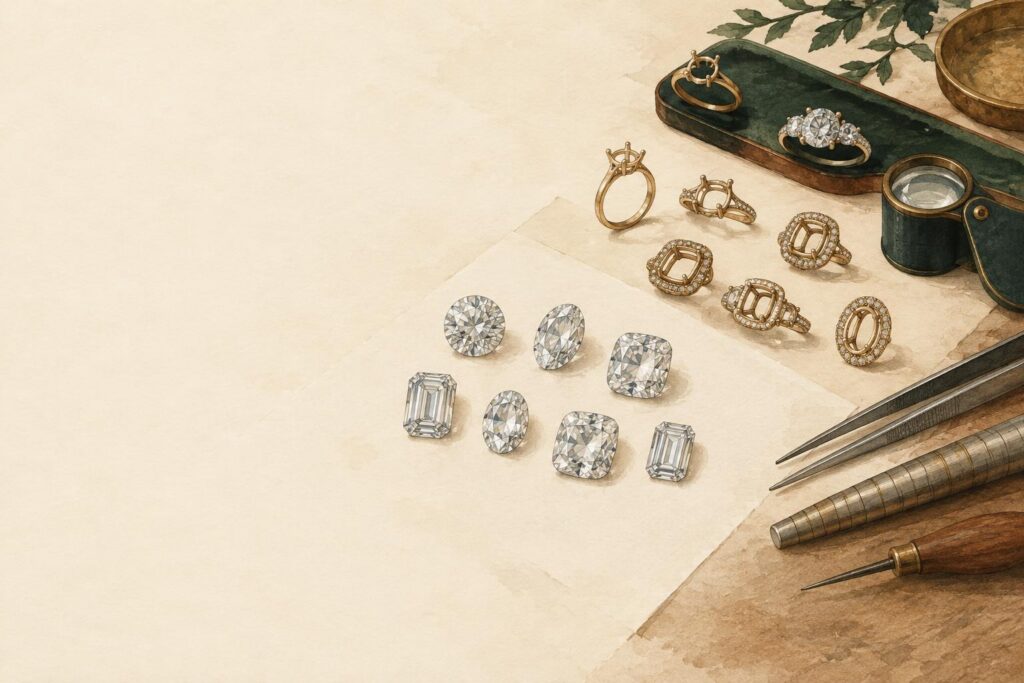
Why would a diamond need protecting? Diamond ranks 10 on the Mohs scale, a scale of scratch resistance. A high rank still does not make it unbreakable. A diamond can chip, usually near the girdle, the thin outer edge of the stone 2. How much of that edge the setting covers is one of the choices in front of you. For pictures of each style, see Ring settings explained.
Why the wearer’s daily life comes first
Why start with the wearer’s routine? Because some settings catch, loosen or take knocks more easily than others. Prongs, also called claws, are small metal arms that grip the stone. They let the most light into it, but their raised edges can catch on fabric, and they should be checked from time to time 1.
How does an active life affect a ring? Prongs can shift and loosen over time, and exercise, gardening and accidental knocks all take their toll 2. Take rings off for heavy physical activity, too 6.
What suits hands-on work? A bezel is a thin rim of metal that wraps around the stone’s edge. Bezels resist chips and everyday wear and are less likely to catch. They are practical for people who work with their hands, such as nurses, or who lead active lives 1. A bezel also helps stop the centre stone falling out and protects the girdle against bumps 2.
Why the stone’s shape changes the setting
Why do some diamond shapes need extra care? Princess, marquise, pear and heart shapes are more likely to chip, because they have points or sharp corners 2. How can a setting help? V-shaped prongs fold around a point and protect the pointed corners of heart, princess, pear and marquise cuts 1.
Does the number of prongs matter? A six-prong setting gives more protection than a four-prong one. If one prong breaks, six prongs are more likely to keep the diamond in place 2. You can compare the look of each in Four claws vs six claws, and the shapes themselves in Choosing a diamond shape.
Why the wearer’s hand and style matter
Why think about the hand itself? The same ring can look quite different on different fingers. Marquise, oval, rectangular and pear shapes have a north-south axis, meaning they point along the finger, which can make it look longer 3.
- Short fingers: GIA’s styling guidance pairs them with simpler designs, because a complicated design can overwhelm the finger.
- Petite fingers: the same guidance pairs them with small, simple rings.
- Larger fingers: the same guidance pairs them with medium to wide bands, and a prong setting that raises the diamond can make the finger look narrower.
- Long, slender fingers: they can carry larger stones and wide bands, and they suit stacking extra bands 3.
These are styling guides, not rules, and the wearer’s own taste decides. A solitaire is a single stone on a band, which gives a simple look. A halo is a circle of small stones around the centre stone, and it can make the centre stone look bigger 1. If you are unsure of the wearer’s taste, look at the jewellery they already wear.
Why metal colour changes how the diamond looks
Why can metal change how a diamond looks? Diamond facets, the small flat polished surfaces, act like tiny mirrors and reflect the colour of the band and prongs 5. The 4 Cs of diamonds explains how colour is graded.
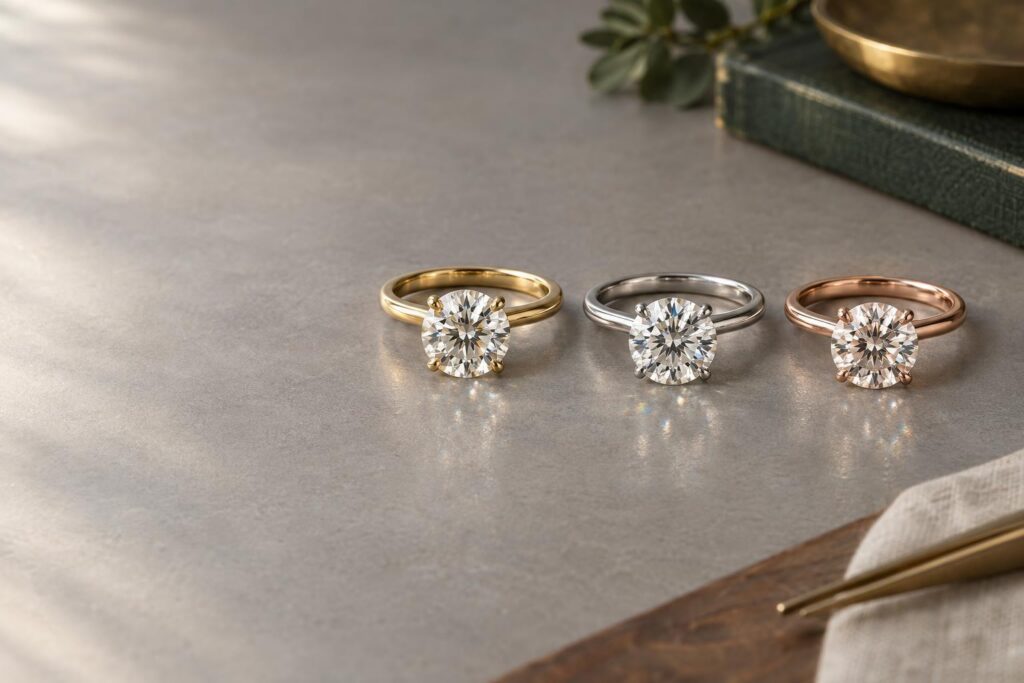
How do the metals work with each colour grade? On GIA’s scale, D to F diamonds are colourless and G to J are near-colourless, and both pair well with platinum or white gold 5.
What about yellow and rose metal? Yellow gold prongs could make a colourless stone look like a different colour grade, so white-metal prongs are worth considering with a yellow or rose band. Yellow gold brings out the tint in diamonds graded M and below, and K to L diamonds work with either yellow or white metal 5.
What changes with wear? Pure gold is soft, so it is alloyed, or mixed, with other metals, and 18ct (18K) gold is 75% gold. White gold is usually plated with rhodium, a thin white coating that can wear away. It then needs replating, or the slightly yellowish metal underneath may show through. Platinum is a slightly greyish white metal that is extremely durable and resists corrosion 4. See White gold vs platinum for a fuller comparison.
Why upkeep and resizing differ between settings
Why ask about upkeep before choosing? Some settings need more care over the years than others. Halo rings have many small stones, so they may need more maintenance 1. Prongs can loosen over time, so have rings professionally cleaned and inspected once a year 6.
How is a prong setting looked after? Prongs may need re-tipping over time, which means adding metal to worn prong tips. An ultrasonic cleaner, a machine that cleans with vibrations in liquid, can dislodge stones that are already loose 1.
Why does resizing belong in this decision? Finger size can change with temperature and other factors, so have rings professionally sized 6. Channel, bar, pavé and tension rings can be hard to resize, and tension rings are sometimes impossible to resize 1. In a channel setting, small stones sit in a groove between two metal walls. A bar setting separates stones with thin metal bars, and pavé covers the band in closely set small stones. In a tension setting, the band’s pressure holds the stone.
To compare sizes between sizing systems, use the Ring Size Converter. Why can’t every ring be resized? explains how resizing works.
Why the wedding band belongs in this decision
Why think about a band before it is bought? Because the two rings may be worn side by side. Traditionally the wedding band goes on first, with the engagement ring on top, though customs vary between countries 6.
How does the setting affect the pair? A solitaire’s simple design pairs easily with a wide range of wedding bands 1. If the setting has side stones, their 4Cs grades should sit close to the centre stone’s, especially the colour grade 4.
The downsides: when a setting may not suit the wearer
Why look at downsides at all? Each setting in this guide comes with at least one trade-off, listed below. Knowing them helps you match the setting to the wearer’s life.
Engagement ring settings compared
Each setting holds the diamond differently, and each has its own trade-off. Switch between them to see how they look and what they mean for daily wear.
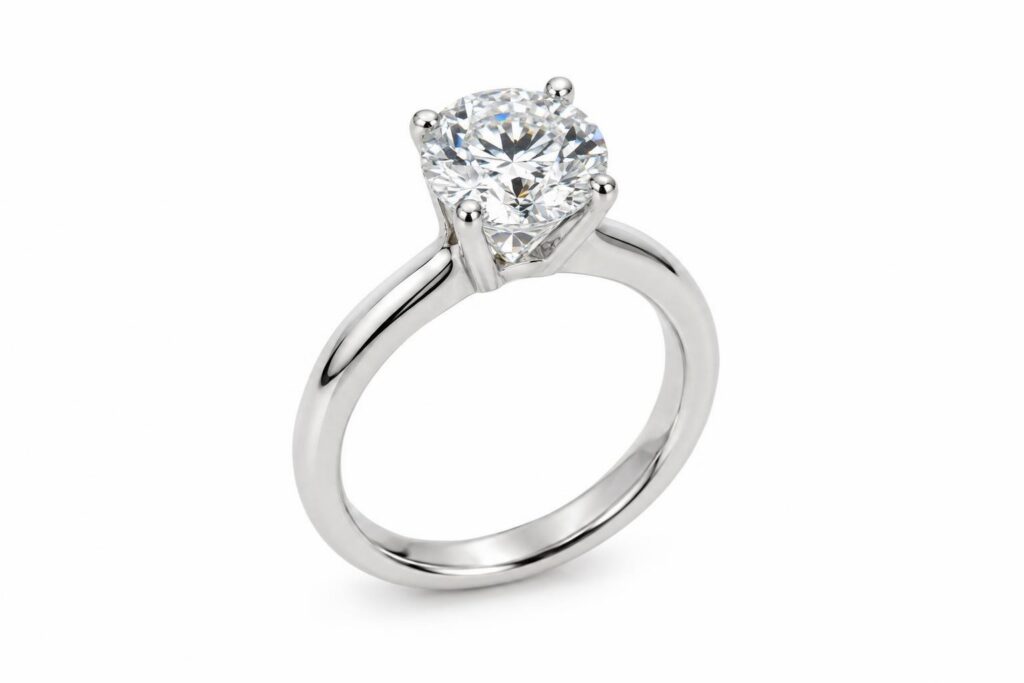
- Prong (claw) setting
- Prongs, also called claws, are small metal arms that grip the stone. They let the most light into the diamond. Their raised edges can catch on fabric, and they can shift and loosen over time, so they should be checked from time to time.
- V-shaped prongs
- V-shaped prongs fold around a point. They protect the pointed corners of heart, princess, pear and marquise cuts, which are more likely to chip because of their points or sharp corners.
- Bezel setting
- A bezel is a thin rim of metal that wraps around the stone's edge. It resists chips and everyday wear and is less likely to catch. It lets in slightly less light than prongs.
- Halo setting
- A halo can make the centre stone look bigger. Its many small stones may need more maintenance.
- Cathedral setting
- In a cathedral setting, metal arches lift the stone high. It may be more likely to catch on clothing or objects.
- Tension setting
- A hard blow can loosen a tension-set stone. Tension rings are sometimes impossible to resize.
Each picture shows one typical example. Real designs vary, and many rings combine features, such as a halo on a cathedral setting. Pictures: AI-generated illustrations, checked for accuracy. They are not photographs of a real piece.
- Prong settings let in the most light, but their raised edges can catch on fabric and need checking.
- Bezel settings protect the stone but let in slightly less light than prongs.
- Halo settings can make the centre stone look bigger, but their many small stones may need more maintenance.
- Cathedral settings, where metal arches lift the stone high, may be more likely to catch on clothing or objects.
- A hard blow can loosen a tension-set stone, and tension rings are sometimes impossible to resize 1.
A tension setting may also be a riskier choice for an engagement ring 2. None of these downsides rules a setting out on its own. Which ones the wearer can live with depends on their routine, the stone’s shape and how much upkeep feels manageable.
Sources and methodology
This guide is built from published guidance by the Gemological Institute of America (GIA) on settings, diamond protection, metal colour, hand shape, ring sizing and care. It sets out the facts behind each option and the trade-offs between them, and it does not rank settings or choose one for you.
- Complete Guide to Engagement Ring Settings: Types vs. Styles
- How to Protect Your Diamond Engagement Ring
- Engagement Ring Styles to Flatter Her Hand and Finger
- 10 Tips for Buying a Diamond Engagement Ring
- Diamond Engagement Ring Setting: How Metal Affects Diamond Color Appearance
- How to Wear Your Engagement Ring and Wedding Band