
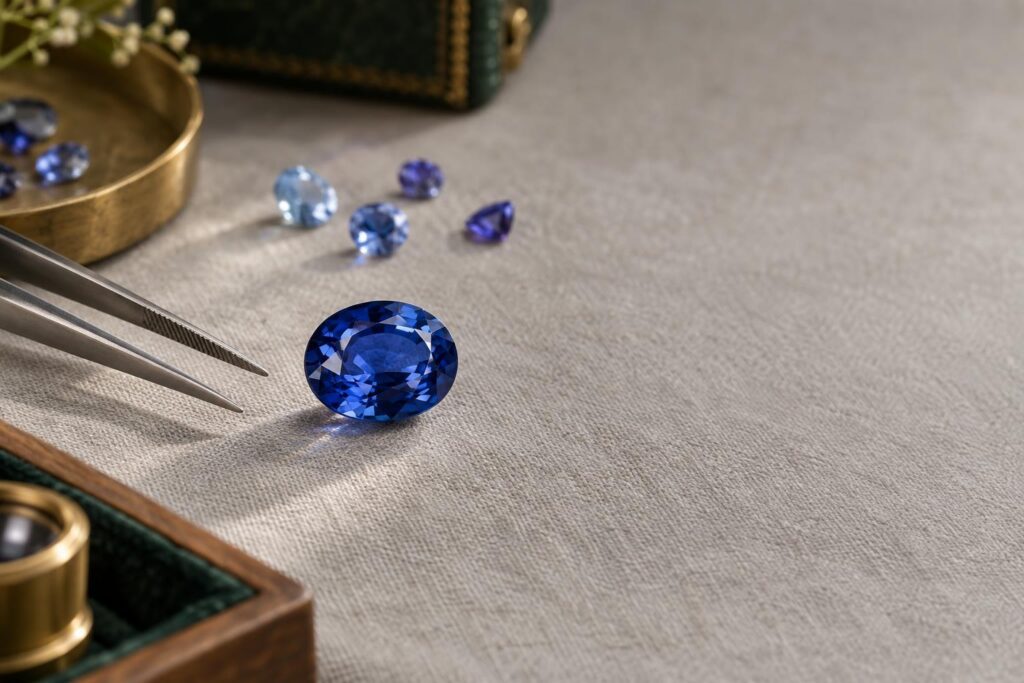
The decision in brief
- If you want the most from your budget, judge colour first, because colour has the greatest influence on a sapphire's value.
- If you love a deep navy or a softer greyish blue, these usually cost less than vivid blues, which may suit your budget.
- If two stones look similar, compare how evenly each returns light across its whole face, because poorly cut stones sell at a discount.
- If you notice inclusions (tiny features inside the stone), ask whether they could affect durability, because that can lower the price sharply.
- If a stone is sold as unheated, ask for an independent lab report that supports the claim.
- If origin is part of the appeal, keep in mind that it can be hard or impossible to confirm for a heated blue sapphire, and that a famous place name does not prove quality.
- If you want a large stone of fine quality, expect size to affect the price more than it does for everyday-quality stones.
Editorial guidance — context changes what is right for you.
Start with the wearer and the ring
Start with the person who will wear the sapphire and the colour they love. Some people want a vivid, pure blue. Others prefer a violet tint, a deep navy or a fancy sapphire in another colour. Knowing this first keeps you focused on stones the wearer will enjoy.
Then think about the ring itself. A piece worn every day makes durability part of the decision, so inclusions that could weaken the stone matter more. Decide early, too, how much an unheated stone or a named origin matters to you. Blue sapphire is rarely untreated, and both claims are ones you may want supported by an independent lab report.
Quick checklist
- Which hue does the wearer love: pure blue, violetish blue or another colour?
- Do they prefer a lighter, medium or darker tone?
- Will the ring be worn every day?
- Does an unheated stone matter to you, or is a heated stone acceptable?
- Is a named origin important, and would you want a lab report to support it?
- What size range suits the design and your budget?
The criteria that matter
Colour: hue, tone and saturation
Colour has the greatest influence on value. The most valued blue sapphires are velvety blue to violetish blue, medium to medium-dark in tone, with strong to vivid saturation. Evenly blue stones are worth more than those with secondary green hues.
Why hue, tone and saturation matter in gemstonesClarity
Most blue sapphires have some inclusions. Extremely high clarity is rare and very valuable, and inclusions that threaten durability can lower the price sharply.
Cut
A good cut returns light evenly across the whole stone, and the cutter's choices affect the colour you see face-up. Poor cuts, including stones with a see-through window, sell at a discount.
What makes one stone better? How to evaluate coloured gemstonesCarat weight
Most commercial-quality blue sapphires weigh less than 5 ct. Fine quality in large sizes is rare, so size affects the price of fine sapphire more.
Treatment and disclosure
Most blue sapphires are heated, which is an accepted treatment. Diffused stones generally cost less, and confirmed unheated fine stones carry added rarity and value. Sellers should disclose all treatments, including suspected ones, in writing.
Why are heat treated gemstones so common, and does it matter?Origin and lab reports
Origin can be hard or impossible to determine, especially for heated stones, and famous places also produce poor material. An independent lab report can list detectable treatments and may give an origin opinion.
Compare your options
| Area | What changes visibly | When to prioritise | Reasonable compromise |
|---|---|---|---|
| Colour (hue, tone, saturation) | How blue, how light or dark, and how intense the stone looks, plus how even the colour is. | Almost always, because colour has the greatest influence on value. | Darker navy or greyish blues usually cost less than vivid blues. Whether you prefer how they look is your call. |
| Clarity | How many inclusions the stone has and whether they affect durability. | When the stone will be worn every day, or when inclusions might weaken it. | Some inclusions are usual in blue sapphire; extremely high clarity is rare and very valuable. |
| Cut | How evenly light returns across the stone and which colour shows face-up. | When comparing stones of similar colour, or when a stone looks pale or see-through in the middle. | A cutter balances colour, proportions and weight, so the best colour can mean a different shape or weight. |
| Carat weight | The stone's weight. Weight alone does not tell you how large it looks face-up. | When a larger stone matters to the wearer or the design. | Fine quality in large sizes is rare, so size raises the price of fine sapphire more. |
| Treatment | Whether the colour has been changed by heating, diffusion or other methods. | When you want an unheated stone or full knowledge of what you are buying. | Confirmed unheated fine stones carry added value; heated stones are common; diffused stones generally cost less. |
| Origin | The place a stone is believed to come from, sometimes supported by a lab's origin opinion. | When origin is part of the meaning or appeal of the stone for you. | Origin may be impossible to determine, especially after heating, and a famous name does not prove quality. |
A practical decision process
- Decide which colour the wearer loves and how often the ring will be worn.
- Decide how much an unheated stone or a named origin matters to you.
- Compare stones on hue, tone and saturation, looking for strong colour that is not too dark or greyish.
- Check colour evenness by turning each stone upside down on white paper to spot colour zoning.
- Look at the cut: light should return evenly, with no see-through window in the middle.
- Judge inclusions by whether they could affect durability, not only by how they look.
- Ask the seller about every treatment, including suspected ones, and get the answer in writing on the sales documents.
- For a fine, unheated or origin-named stone, ask for an independent lab report and read what it says about treatment and origin.
- Weigh colour, size, treatment and paperwork against your own priorities, then choose the stone that fits them.
Numbers indicate order, not saved progress.
Common buying mistakes
- Assuming the darkest blue is the best The most valued blue sapphires are medium to medium-dark, and stones that are too dark are less valued. Compare tone as well as intensity before deciding. Why hue, tone and saturation matter in gemstones
- Overlooking uneven colour Evenly blue stones are worth more than those with secondary green hues. Turn the stone upside down on white paper to check for colour zoning before you buy. Why hue, tone and saturation matter in gemstones
- Paying extra for an unheated claim without proof Most blue sapphires are heated, and independent confirmation of no heating is what adds value for fine stones. Ask for an independent lab report before paying for that claim. Why are heat treated gemstones so common, and does it matter?
- Asking only about heating Diffusion and other treatments also exist, and diffused stones generally cost less. Ask about every treatment and have it stated in writing.
- Paying for a place name Some stones are labelled with a famous origin only because the colour looks similar, and famous places also produce poor material. Judge the stone itself, and rely on a major lab's origin report for exceptional stones.
- Accepting a windowed or poorly cut stone If the main lower facets are too shallow you can see through the stone, and poorly cut stones sell at a discount. Look for light returned evenly across the whole face.
- Ignoring inclusions that affect durability Price can drop sharply when inclusions threaten durability. Ask the seller whether any inclusion could weaken the stone, especially for a ring worn daily.
Questions to ask
About colour and cut
- How would you describe this stone's hue, tone and saturation?
- Does it show any colour zoning or secondary green hue?
- Does it show any windowing when viewed face-up?
- Which colour does it show face-up, and how was it oriented when cut?
About clarity and durability
- What inclusions does this stone have?
- Could any of these inclusions affect durability in everyday wear?
About treatment, reports and origin
- Has this stone been heated, or treated in any other way?
- Will every treatment, including any suspected treatment, be stated on the invoice?
- Does the stone come with an independent lab report, and which treatments does it list?
- Does the report give an origin opinion, and how confident is it?
Frequently asked questions
Why is colour the most important factor in a sapphire?
Colour has the greatest influence on a sapphire’s value. In general, the more intense and even the colour, the more valuable the stone. The most valued blues are velvety blue to violetish blue, medium to medium-dark in tone.
Is a heated sapphire a poor buy?
Heating is an accepted treatment, and most blue sapphires on the market have been heated. For fine stones, independent confirmation of no heating adds rarity and value. Whether that matters depends on your priorities.
Why might I want a lab report for a sapphire?
A lab report can say whether a stone is natural or laboratory-grown, list detectable treatments and sometimes give an origin opinion. When in doubt, get a lab report.
Can a lab always tell where a sapphire comes from?
No. Origin is especially hard for blue sapphire because stones from different places often overlap. Heating can remove the inside features that point to origin, so it may be impossible for heated stones.
Are sapphires only blue?
No. Sapphire is every colour of the mineral corundum except red, which is called ruby. Sapphires in colours other than blue are called fancy sapphires.
Why colour comes first when you buy a sapphire
Why start with colour? Colour has the greatest influence on a sapphire’s value. In general, the more intense and even the colour, the more valuable the stone 1. So if you learn to read colour, you can choose a stone you love and see where your money goes.
What exactly is a sapphire? The name covers every colour of corundum, a mineral, except red. Red corundum is called ruby, and sapphires in colours other than blue are called fancy sapphires 1.
Why hue, tone and saturation shape how a sapphire looks
Why break colour into parts? Two blue stones can differ in three separate ways. Hue is the basic colour, such as blue or green. Tone is how light or dark it is, and saturation is how intense or rich it is 3. Our guide to hue, tone and saturation explains each one in more depth.
Reading a blue sapphire's colour
Two blue stones can differ in hue, tone and saturation. Switch between these examples to see which looks less valued and which looks most valued.
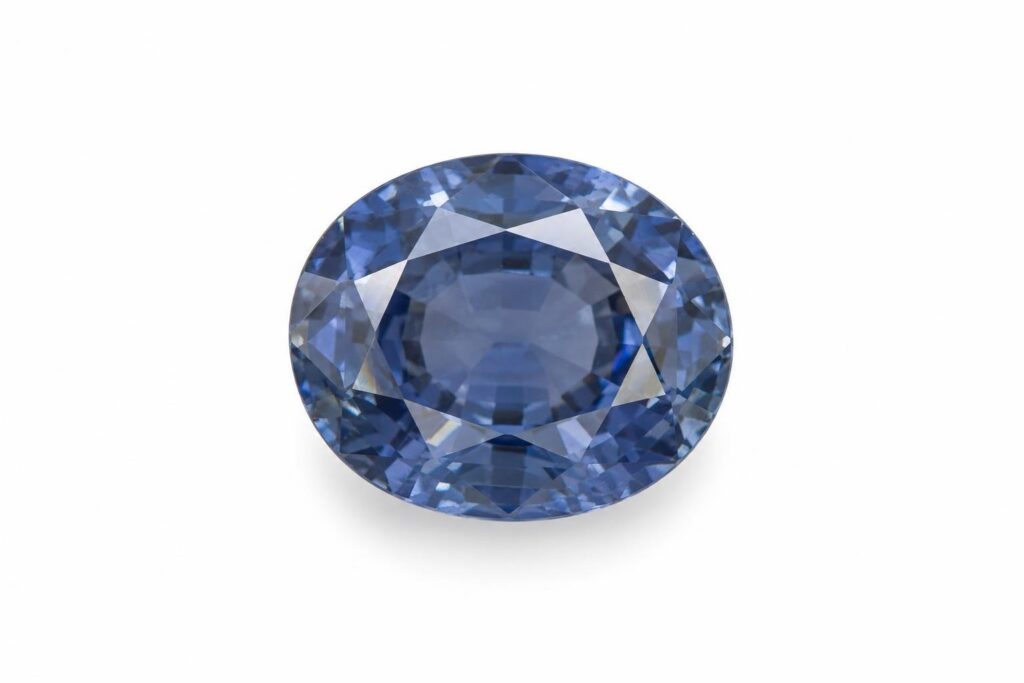
- A greyish blue
- Less valued stones may look greyish. Saturation, how intense or rich the colour is, is weak here, so the blue looks dulled.
- A tone that is too light
- Tone is how light or dark a colour is. Less valued stones may look too light, so the blue appears pale rather than rich.
- A tone that is too dark
- Less valued stones may also look too dark. Saturation should be as strong as possible without darkening the colour or reducing brightness.
- A violetish blue
- The most valued stones run from velvety blue to violetish blue. A cutter ideally cuts the stone so it shows violetish blue face-up, when you look down on it.
- A velvety blue
- The most valued stones are velvety blue to violetish blue, in medium to medium-dark tones, with strong to vivid saturation.
Screens and photographs change how colour looks, and these pictures simplify a continuous range into five examples. Judge a real stone in person. Pictures: AI-generated illustrations, checked for accuracy. They are not photographs of a real piece.
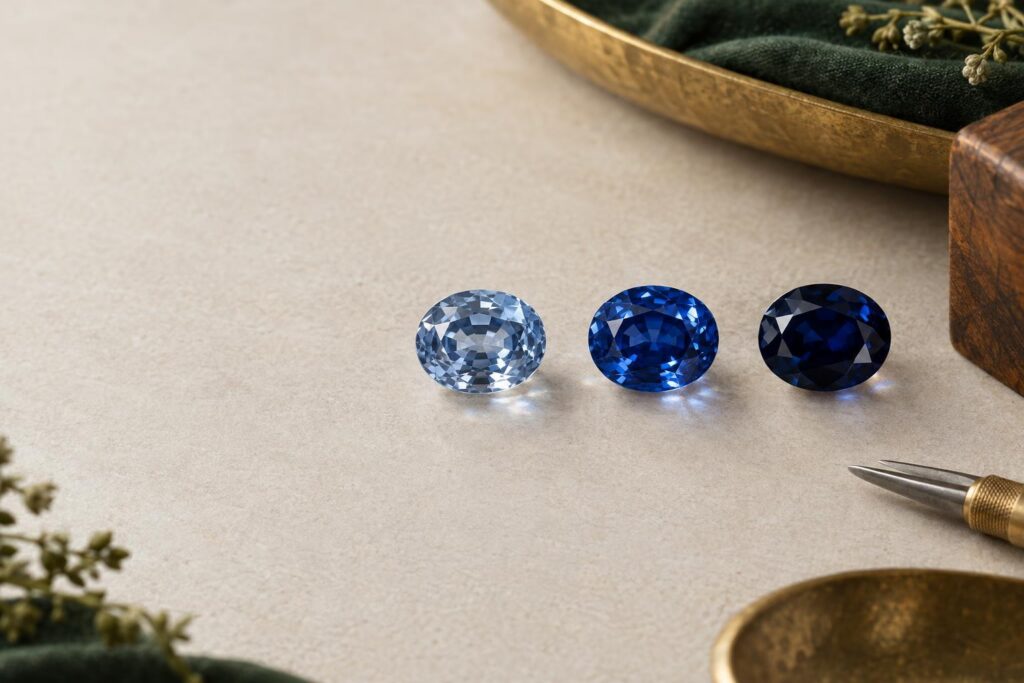
How do the three combine in a blue sapphire? The most valued stones are velvety blue to violetish blue, in medium to medium-dark tones, with strong to vivid saturation. Less valued stones may look greyish, too light or too dark 1.
What does that mean when you compare stones? Saturation should be as strong as possible without darkening the colour or reducing brightness. Dark colours like navy or midnight blue, and weaker colours like greyish blue, are more affordable than vivid colours 2. If you love a deep navy, that is a useful fact.
Why check evenness? Evenly blue sapphires are worth more than those with secondary green hues. Colour zoning is uneven colour inside the stone. To spot it, turn the stone upside down on white paper 3.
Why clarity is about durability as much as looks
Why look inside a sapphire? Blue sapphires usually have some inclusions, which are tiny features trapped inside the stone. They include needles, "silk" (made of a mineral called rutile), crystals, fingerprints and colour zoning 1.
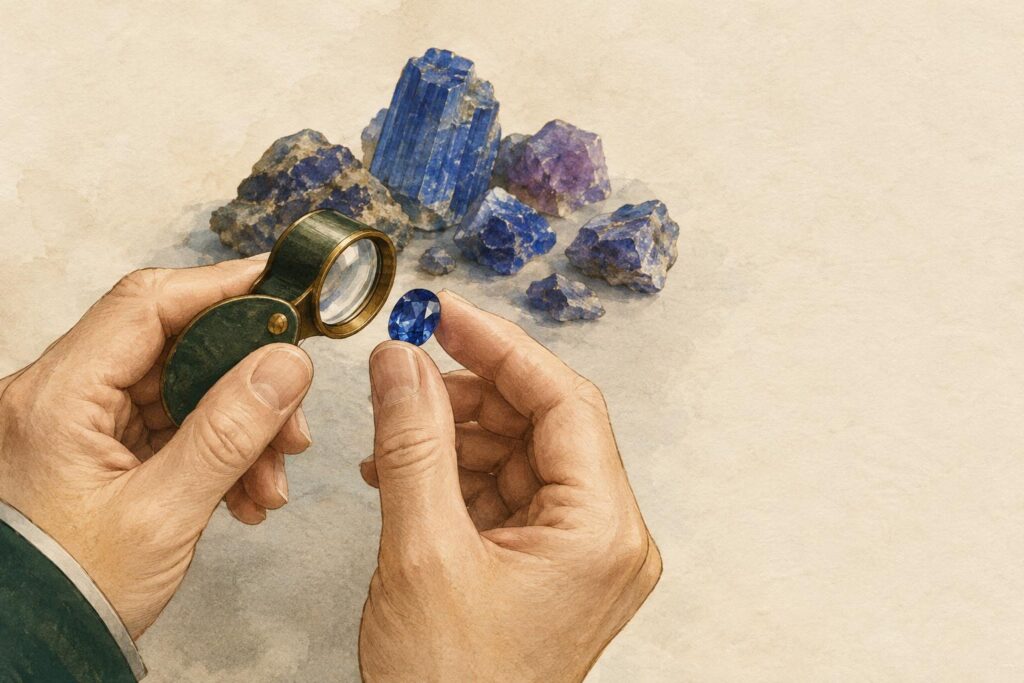
How much does clarity matter? Sapphires with extremely high clarity are rare and very valuable. Price can drop sharply if inclusions threaten durability, which is how well the stone stands up to wear 1. So ask not only whether you can see an inclusion, but whether it could weaken the stone.
Why cut changes the colour you see
Why does cut matter so much for a coloured stone? Before cutting, a cutter studies colour zoning, pleochroism and how light or dark the crystal is. They then orient the stone to get the best colour, proportions and weight 1.
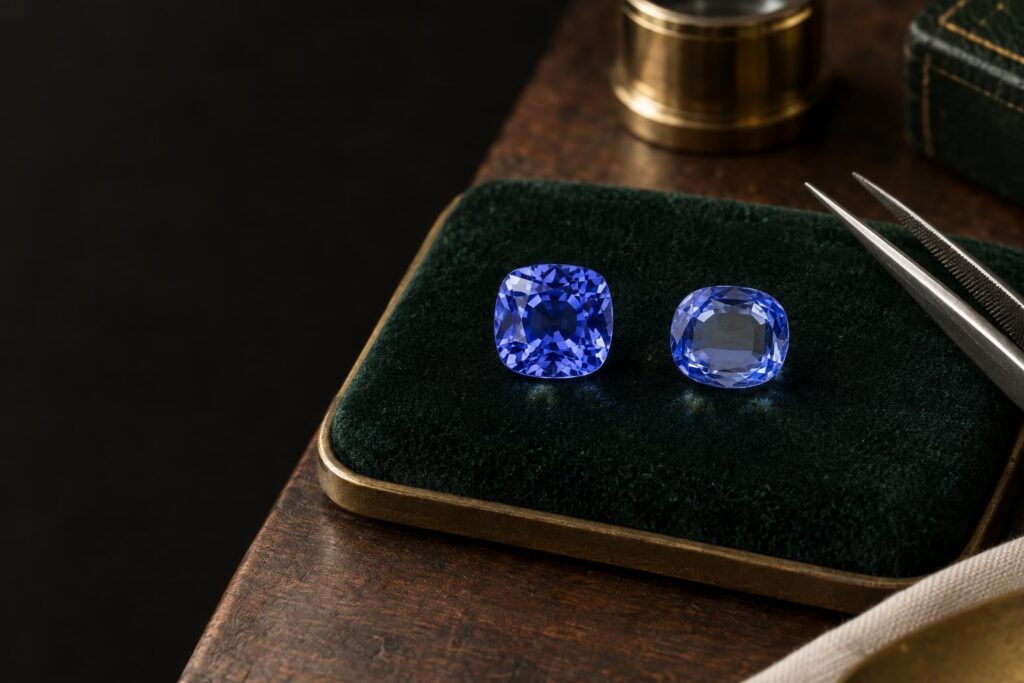
Pleochroism means a stone shows different colours from different directions. Blue sapphires often show greenish blue and violetish blue. Ideally, the stone is cut so it shows violetish blue face-up, meaning when you look down on it 1.
What should you look for? A well-cut sapphire reflects light back evenly across the whole stone, and poorly cut stones sell at a discount 2. If the main pavilion facets, the angled faces on the underside, are cut too shallow, you can see through the stone. This is called windowing 3.
Why size raises the price of fine sapphire faster
Why does size matter more for some sapphires than others? Carat is the unit used to weigh gemstones, written ct. Most commercial-quality blue sapphires weigh less than 5 ct, and fine quality in large sizes is rare. That is why size affects the price of fine sapphire more 1.
Why you need to know about treatment and disclosure
Why ask about treatment at all? Most blue sapphires on the market have been heated 4. Heating means treating a stone with a thermal process in a furnace, kiln or other heating apparatus 5. Our guide to heat treatment in gemstones explains how it works.
How does treatment affect value? Heating is an accepted treatment. For fine sapphire, independent confirmation of no evidence of heating adds to rarity and value. Lattice diffusion uses heat and chemicals to add colour, and diffused stones generally cost less than heated-only or untreated ones 2.
Which other treatments exist? An international trade standard, the CIBJO Blue Book, lists blue sapphire as commonly heated and rarely untreated. Other corundum treatments it lists include heating in flux, glass filling, irradiation and diffusion 5.
What should a seller tell you? The same standard says the seller must disclose all material information, whether or not you ask and whatever the effect on value. Spoken disclosure should be clear and come before the sale is completed. Written disclosure should appear on all commercial documents, and a suspected treatment should be disclosed even if it can’t be confirmed 5. See how gemstone treatments should be disclosed.
Why origin and lab reports need careful reading
Why be careful with origin? Some dealers call stones "Kashmir" because the colour looks similar, and charge a false premium. A lot of poor-quality material also comes from highly prized places, and for those stones origin shouldn’t add value 3. Every mine produces a wide range of quality, so a famous name alone tells you little 2.
How is origin worked out? A reliable origin call needs analysis of inclusions, trace elements (tiny amounts of other chemical elements) and spectroscopic data (how the stone responds to light). Stones from different places often overlap. Heating dissolves rutile silk, which may be the only inside clue to origin, so origin can be "challenging, if not impossible" for heated blue sapphire. Even Kashmir, Burma and Sri Lanka stones can’t always be told apart with 100% confidence 4.
What does a lab report tell you? GIA, a gemmological laboratory, doesn’t grade coloured stones. Its reports give weight, measurements, shape, cut and colour, and say whether the stone is natural or laboratory-grown. They list detectable treatments and can give an origin opinion where possible. The simple rule: when in doubt, get a lab report 2.
The downsides: when a sapphire may not be the right choice
Why think about the downsides before you shop? Some priorities are hard to meet with sapphire. If a fully untreated stone matters to you, the choice narrows, because blue sapphire is listed as rarely untreated 5. Heating can also remove the clues labs use to find origin, so a firm origin claim may not be possible 4.
If you want a large stone of fine quality, rarity works against your budget, because size affects the price of fine sapphire more 1. And if the ring will be worn every day, durability is its own topic. Read which gemstones suit everyday rings and why the Mohs scale is not the whole durability story.
Tools and guides that can help
Why use tools? They help you keep the whole ring in view, not only the stone. The Engagement Ring Budget Planner helps you plan the complete ring. How coloured gemstones are evaluated covers the wider grading ideas, and How to buy an emerald shows how another coloured stone is judged.
If you’d like help comparing stones, Ralph Jacobs offers a free consultation, online from any country via bookings.ralphjacobs.org, or in the showroom.
Sources and methodology
This guide draws on GIA’s sapphire quality and buying guidance, GIA’s Gems & Gemology research on sapphire origin, and the CIBJO Blue Book’s disclosure standard. It explains what drives sapphire quality and value without giving prices, and it leaves the choice to you.
- Sapphire Quality Factors
- Sapphire Buyer’s Guide
- Colored Gemstone Value Factors
- Geographic Origin Determination of Blue Sapphire
- The Gemstone Book (CIBJO Blue Book)