Why moissanite is not a diamond: what it is
If you are weighing moissanite against diamond, it helps to know what you are actually looking at. Its make-up explains how it sparkles, how it wears and how experts tell it apart. Moissanite is silicon carbide, a compound written as SiC. 1
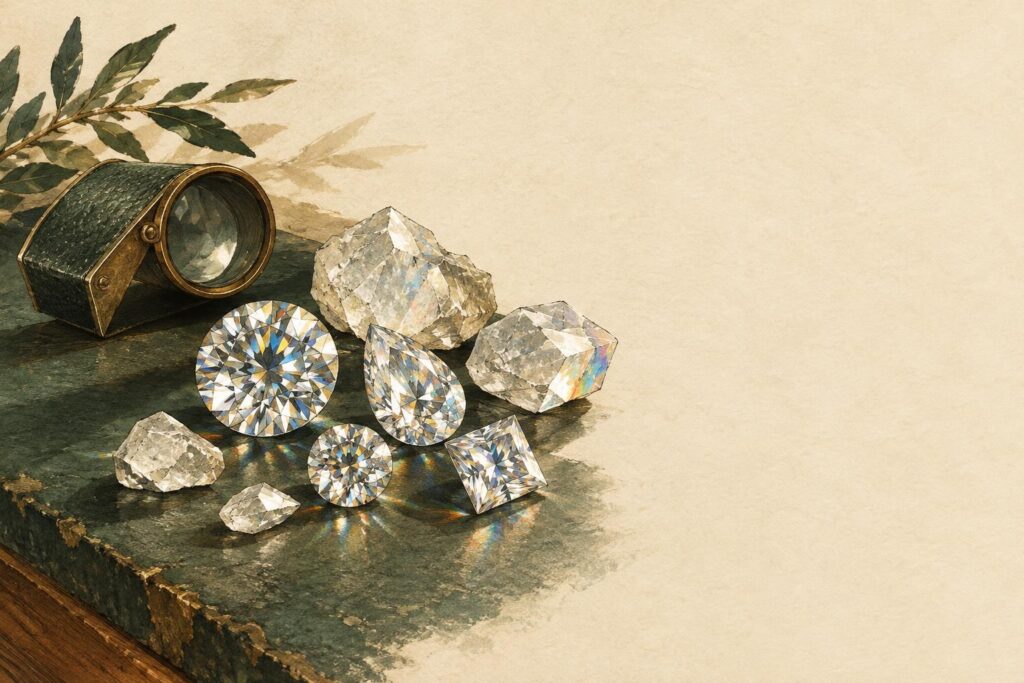
Why is it made in a laboratory? Natural moissanite is extremely rare, and gem-quality natural material has never been found, so moissanite gems are made in a laboratory. 7 The crystals found in nature are tiny: at the time of GIA’s 2014 report, the largest known natural crystal measured only 4.1 mm. 4
How is it made? Large single crystals are grown by seeded sublimation, a process based on the Lely method. In sublimation, a solid turns to vapour and then back into a solid crystal. Lely’s original work heated SiC to 2500°C in a sealed graphite container. 1 Colourless moissanite became popular as a diamond imitation in the late 1990s. Many people choose it for engagement rings because of its brilliance, intense fire and durability. 3
Why moissanite shows so much fire: appearance and colour
Why does moissanite look different from diamond? Two optical properties explain most of it. Refractive index measures how strongly a stone bends light. Moissanite’s is 2.648 to 2.691, against 2.417 for diamond. Its dispersion, the splitting of white light into rainbow flashes called fire, is 0.104 against diamond’s 0.044. 1
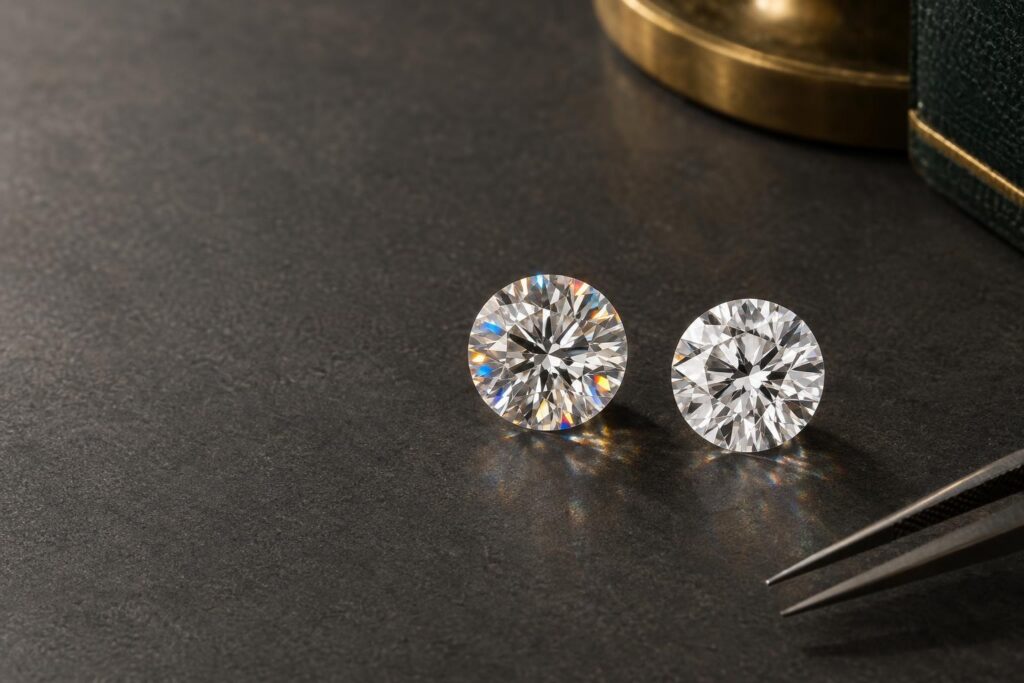
Moissanite has more than twice the fire of diamond and slightly more brilliance, the white light a stone returns to your eye. In stones of one carat or more, that intense fire may show it is not a diamond. In very large stones the effect is sometimes called the ‘disco ball’ effect. 3 You can read more in Brilliance, Fire and Scintillation Explained.
Moissanite is also doubly refractive: light entering it splits into two rays. So you can see a double image of the back facets, and the inside may look blurry. Some moissanites look slightly yellow or grey at certain angles. It also comes in colours such as yellow, black and blue. 3
Cutters usually line up the stone so that no doubling shows when you look straight down through the table, the large flat facet on top. Common inclusions, the tiny features inside a stone, are white needles running roughly parallel to one another. 1
Why disclosure matters: treatments and identification
Why does honest naming matter so much with moissanite? Because it can be mistaken for diamond. Its hardness and thermal conductivity, how well it carries heat, come close to diamond’s. 5 Thermal probes, handheld testers that read how a stone carries heat, react to it as if it were diamond. 1
What about treatments? The sources used for this entry do not describe treatments for moissanite. That is a gap in what this entry covers, not proof that any stone is untreated. If you are looking at a coloured moissanite, you can ask the seller whether it has been treated in any way, and whether that changes how to care for it. How Gemstone Treatments Should Be Disclosed explains what good disclosure looks like.
How do experts tell moissanite and diamond apart? Under magnification, moissanite’s facet edges look doubled. A 1997 study also found its facet edges somewhat rounded, where diamond’s are sharp. 1 Moissanites sent in for diamond grading are easily detected. Double refraction shows clearly under the microscope, and laboratory instruments that read how a material interacts with light confirm it. One GIA lab note even records a moissanite carrying a fake GIA inscription. 5
Why hardness is only part of the story: durability and care
Why should you care how hard a stone is? If you plan to wear a ring every day, scratch resistance is one of the first things to ask about. On the Mohs scale, which ranks how well a material resists scratching, moissanite is 9.25. It is very hard and durable, though not as hard as diamond. 3
In GIA’s 1997 comparison table, diamond is 10 on the same scale. Hardness is not the same as toughness, which is resistance to chipping and breaking. Moissanite’s toughness is listed as excellent. Yet when researchers struck a cube with a hammer, it shattered with conchoidal fractures, curved breaks like the inside of a shell. They did not see cleavage, a tendency to split along flat planes. It is reportedly stable in air up to 1700°C and resists most chemicals. 1 For more, see The Mohs Scale Is Not the Whole Durability Story.
Why natural moissanite is a scientific curiosity: where it is found
Why does a gem named after a chemist come from a meteorite? Henri Moissan reportedly found silicon carbide after dissolving a 50 kg sample of the Canyon Diablo meteorite in acid. George F. Kunz named the mineral moissanite in his honour in 1904. Other researchers suspected Moissan’s sample was contaminated by man-made SiC from tools and abrasives, a debate the authors of a 2004 study described as still open at the time. 6
SiC has since been confirmed in a type of meteorite called carbonaceous chondrites. 6 On Earth, natural SiC has been found only as tiny crystals, usually under 1.5 mm, in a few deposits worldwide. Record-size natural crystals have been reported from Israel, the largest measuring 4.1 mm in its longest dimension. 4
Why carat weight can mislead: buying considerations
Why can’t you compare moissanite and diamond by weight alone? Specific gravity, a measure of density, is 3.22 for moissanite and 3.52 for diamond. So a moissanite and a diamond of the same weight have different measurements. 5 If size matters to you, you can ask for the measurements in millimetres as well as the weight. Diamond Carat Weight vs Visible Size explains how weight and size relate.
Moissanite is also not a laboratory-grown diamond: it is a different material with different properties. These points can help you compare stones side by side:
- How much fire you enjoy: moissanite shows more than diamond, and in stones of one carat or more it may show that the stone is not a diamond.
- Whether the stone looks slightly yellow or grey at some angles.
- Whether you can see a double image of the back facets, which can make the inside look blurry.
Natural Diamond, Lab-Grown Diamond or Moissanite? sets out the facts on all three.
Why the setting still matters: design and settings
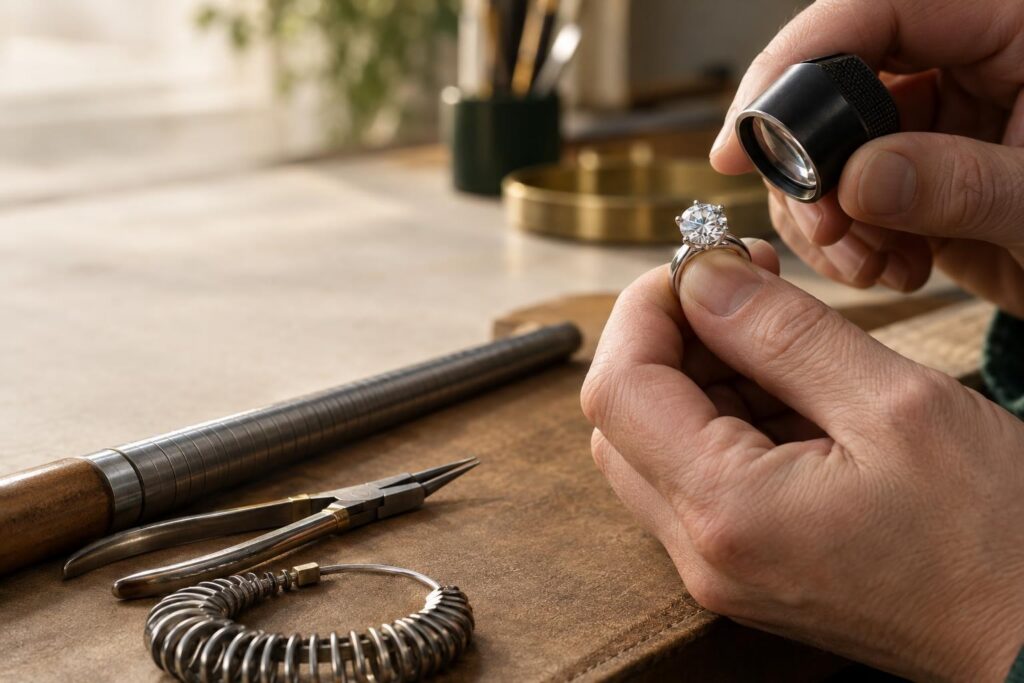
Why think about the setting if the stone is so hard? The setting decides how the stone sits, how much of it shows and how it is held in the metal. In GIA’s 1997 study, the manufacturer reported no problems with conventional setting, repairing and cleaning. 1 Because moissanite’s fire is more noticeable in larger sizes, stone size shapes the look of the finished ring. 3 Ring Settings Explained: A Visual Guide shows how different settings hold a stone.
Why this entry describes rather than recommends
This entry gives the facts so you can decide what suits you. If you would like to talk through moissanite for a ring, we offer a free consultation, booked online at bookings.ralphjacobs.org from any country. Inclusion in this guide does not confirm that Ralph Jacobs stocks this gemstone.
Frequently asked questions
No. Moissanite is silicon carbide, a different material with a different hardness, density, refractive index and fire. It is also doubly refractive, which makes its facet edges look doubled under magnification. 1
Its hardness and thermal conductivity come close to diamond’s, so heat-based testers can be misled. Gem laboratories identify it easily, using its double refraction under a microscope and instruments that read how it interacts with light. 5
It is 9.25 on the Mohs scale, not as hard as diamond at 10, and its toughness is listed as excellent. In a hammer test, a moissanite cube shattered, so a hard blow can damage it. 1