
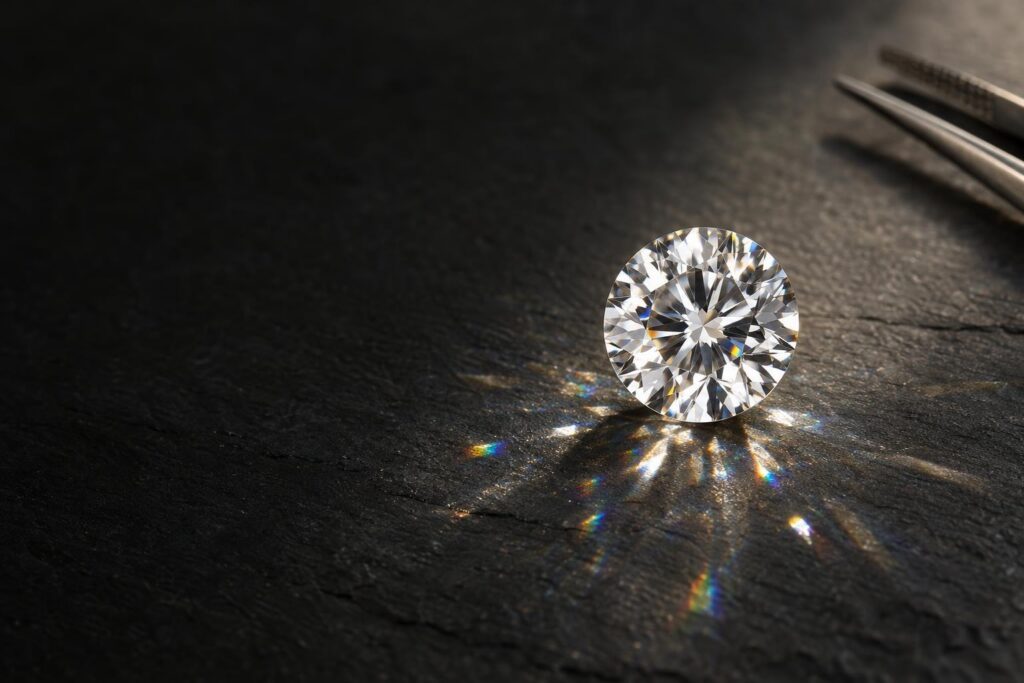
Why a diamond’s sparkle needs three words: brilliance, fire and scintillation
Why would a jeweller use three different words for one sparkle? Because a diamond does three different things with light, and each one catches your eye in its own way. Once you know the words brilliance, fire and scintillation, you can see what the jeweller sees and say what you like.
Cut: what proportions do to light
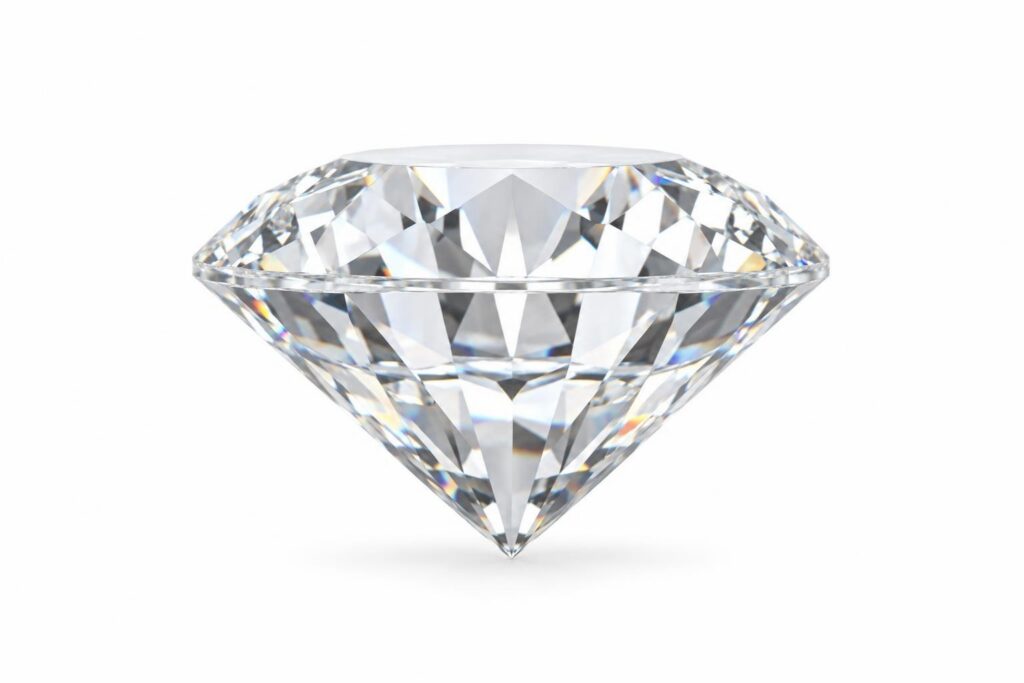
Cut grades for round brilliants run: Excellent, Very good, Good, Fair, Poor.
Pictures: one AI-generated illustration of a diamond, adjusted for each grade. They show how the grades differ; they are not a grading of any stone.
There is a catch. Different organisations define these words, some clearly and some vaguely 4. So this guide uses the definitions of the gem laboratories GIA, AGS and IGI, explained in plain words. In GIA’s cut grade, brightness, fire and scintillation are the terms that describe how a diamond looks 5.
- Brilliance is white light coming back to your eye, broken up by a pattern of light and dark.
- Fire is white light split into flashes of colour.
- Scintillation is the sparkle you see when the diamond, the light or you move, plus the pattern of bright and dark areas.
- Cut creates all three, and the lighting changes how much of each you see.
Why the brightest diamond is not always the most brilliant
Why does this difference matter? Because a stone can send back plenty of light and still look flat. To see why, start with what happens to light inside a diamond.
When light hits a diamond, part of it reflects straight back from the surface 6. The rest enters the stone and bounces off its facets, the small flat polished surfaces cut into it. Some of that light comes back out of the top towards you. Polished diamonds return less than half of the light energy that enters them, not most of it 4.
For the American Gem Society (AGS), brightness is the amount of white light returned to you. It calls areas that return no light leakage, and it defines brilliance as brightness with positive contrast effects 1. Contrast here means the pattern of light and dark areas you see in the stone.
Here is an everyday comparison from GIA researchers. A mirror and a sheet of white paper both return a lot of light, but neither one looks brilliant. Seeing brilliance needs a well-distributed contrast of light and dark areas 4.
In GIA’s terms, brightness is the white light reflected inside and outside a diamond when you look at it face-up, which means from directly above. The lab first called this property brilliance. It switched to brightness because many people include other things, such as contrast, in the word brilliance 2.
Why some diamonds flash with colour: fire
Why do you sometimes see flashes of rainbow colour in a colourless diamond? That is fire, and knowing when it appears helps you judge a stone fairly.
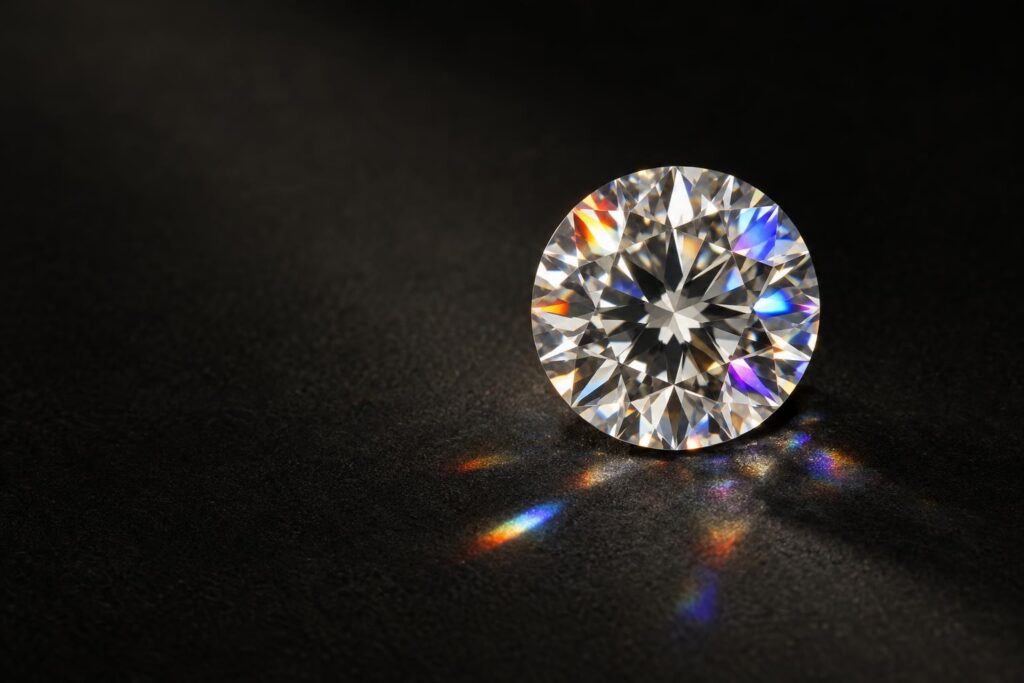
How does it happen? Dispersion is the separation of white light into spectral colours, the colours of a rainbow 1. Fire is the visible extent of light dispersed into those colours 3. Put simply, it is dispersed light seen as flashes of colour 6.
What decides how much fire you notice? Lighting plays a big part. Fire is best seen with directed spot lighting, which comes from a single small source 3. Diffuse lighting is soft light spread from many directions. That kind of light, such as a fluorescent desk lamp, suppresses fire, while spot lighting, common in shops, accentuates it 2.
Why scintillation is the sparkle you see when things move
Why does a diamond seem to come alive when a hand moves? A ring is rarely still while it is worn, and scintillation describes what happens in that movement.
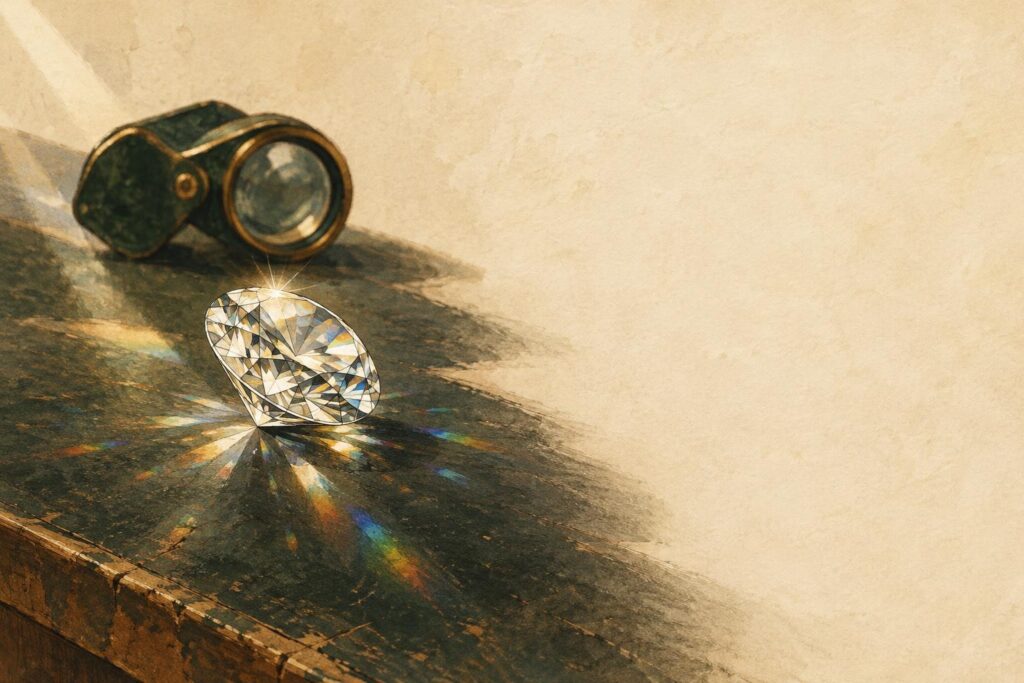
Scintillation is the combination of white and coloured sparkles seen as the diamond, the observer or the light sources move 1. GIA splits it into two parts. Sparkle is the spots of light that flash as something moves. Pattern is the size, arrangement and contrast of bright and dark areas, whether the diamond is still or moving 2.
Where do the dark areas come from? GIA researcher Al Gilbertson likens a diamond to "a series of mirrors reflecting its environment", including you. The dark parts of the pattern are often a reflection of your face, or of the camera in a photo 5. AGS adds that this contrast is usually, though not only, caused by the observer’s head 1.
Movement changes the picture too. A diamond should also perform well while it is rocked and tilted. The change in contrast and brightness is an important part of what the eye sees 4.
Why cut decides how much of each you see
Why focus on cut? Lighting changes from room to room, but the cut is fixed in the stone. Planning, proportions, cutting precision and finish determine how brilliant, dispersive and scintillating a diamond will be 6. Proportions are the sizes and angles of the parts of the diamond.
How much does the detail matter? GIA’s research found that every facet contributes to the look of a round brilliant, the classic round diamond with many facets. Most cut-evaluation systems ignore the lengths of the star facets and lower-girdle facets. Yet these lengths can noticeably affect both brilliance and fire 3.
Star facets are small facets next to the table, the large flat facet on top. Lower-girdle facets sit just below the girdle, the thin outer edge of the diamond.
Is there one perfect set of proportions? GIA computed its fire measure for more than 26,000 combinations of round brilliant proportions. In general, different proportions bring out the most fire and the most brilliance, but some combinations give above-average amounts of both 3. Many different proportions can also produce attractive diamonds 5.
Laboratories measure this in different ways. The AGS system uses ray-tracing software, a computer model that follows light through every facet, to measure brightness, dispersion, leakage and contrast 1. For how cut is graded, see Diamond cut explained: why light performance matters.
Why lighting changes what you see, and how to look
Why does the same diamond look different in the shop and at home? Because its cut responds differently to each kind of light and to its surroundings. A diamond looks different in sunlight, candlelight, daylight and office lights 5. Both the type and the position of the lighting matter 2.
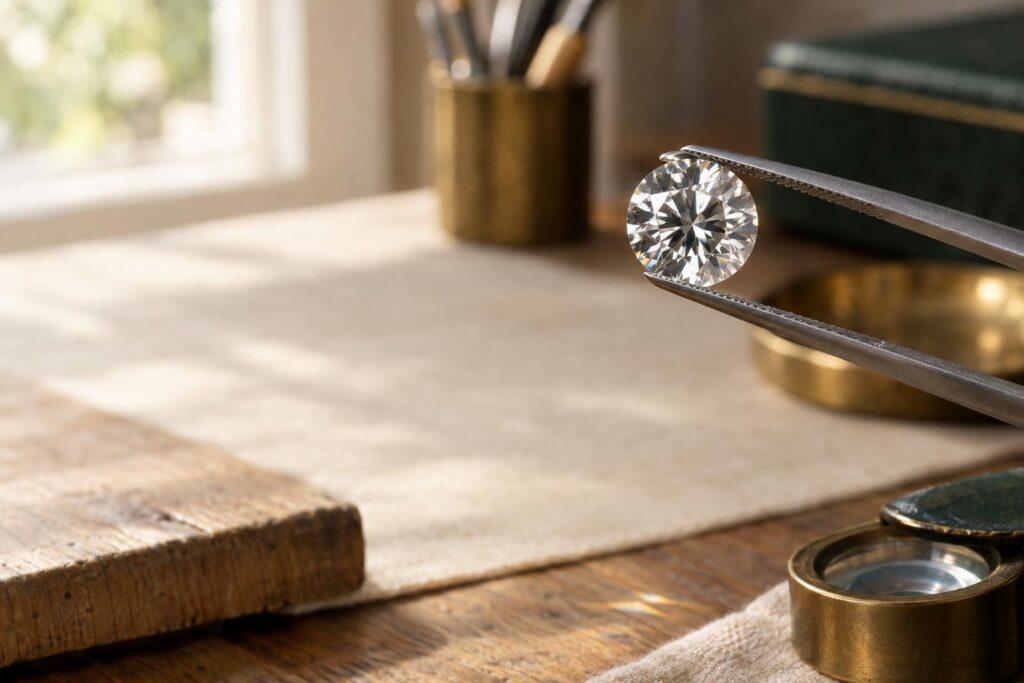
Here is how to see each effect for yourself:
- Brilliance: look at the diamond face-up. Notice the bright white areas and the dark areas between them. A well-spread mix of both is what brilliance looks like.
- Fire: look under a spot light, such as a single bulb, and watch for flashes of colour. Under soft, spread-out light, expect to see less.
- Scintillation: rock and tilt the diamond slowly, or move your head, and watch the flashes of white and colour change.
- Contrast: hold the diamond at arm’s length, then bring it closer to your eye. The dark area grows as you come closer.
- Everyday light: Gilbertson suggests looking at a diamond in the lighting it will usually be worn in 5.
The downsides: when these words can mislead you
Why be careful with these terms? They help you describe what you see, but they are not a scorecard. Organisations define them differently, so two people may mean different things by the same word. Brilliance is the clearest case: GIA stopped using it for white light because many people also include contrast in it 2.
More light is not automatically better. GIA researchers found that a diamond with good contrast and somewhat lower light return can look better than one with high light return and little contrast. They also say personal taste is an important factor in how light performance is seen 4.
Lighting can flatter or hide. Shop spot lights bring out fire, while soft desk lighting can suppress it, so a stone may look different once it leaves the counter 2. Photos have their own trap: the dark areas may be the camera’s reflection rather than the stone 5.
None of this tells you which balance to prefer. If colour flashes matter most to you, fire and the lighting you will wear the ring in are the relevant facts. If a bright, crisp look matters more, brightness and contrast are the ones to compare.
Why seeing it for yourself helps
Why put this into practice? Words only help when you can match them to what your own eyes see. Compare stones side by side in more than one kind of light, and move them as you look. For the bigger picture of grading, see The 4 Cs of diamonds, or watch What cut quality actually looks like.
If you would like someone to point out brilliance, fire and scintillation in real stones, we offer a free consultation. You can book it online at bookings.ralphjacobs.org from any country, or visit our showroom.
Frequently asked questions
Not quite. Brightness is the amount of white light a diamond returns to you. Brilliance is brightness with positive contrast, meaning a well-spread pattern of light and dark areas 1. A mirror returns plenty of light but does not look brilliant.
Lighting is a likely reason. Spot lighting, common in shops, accentuates fire. Diffuse lighting, such as fluorescent desk lamps, suppresses it 2. Try looking at the diamond under a single small light source.
Not necessarily. The dark parts of the pattern are often a reflection of your face, or of the camera in a photo 5. Some contrast is needed for brilliance. Areas that return no light at all are called leakage.
No single set of proportions defines a well-cut round brilliant, and many different proportions can produce attractive diamonds 5. In general, some proportions favour fire and others favour brilliance, though some give above-average amounts of both.