
Why do some gems flash rainbow colours in plain white light? White light is a mix of colours, each with its own wavelength. Each colour travels through a gem at a slightly different speed, so the colours separate and spread apart 4. The spread starts small and widens with each facet (a flat, polished surface on the stone) that the light meets. The more times light reflects inside, the more obvious the fire 1.
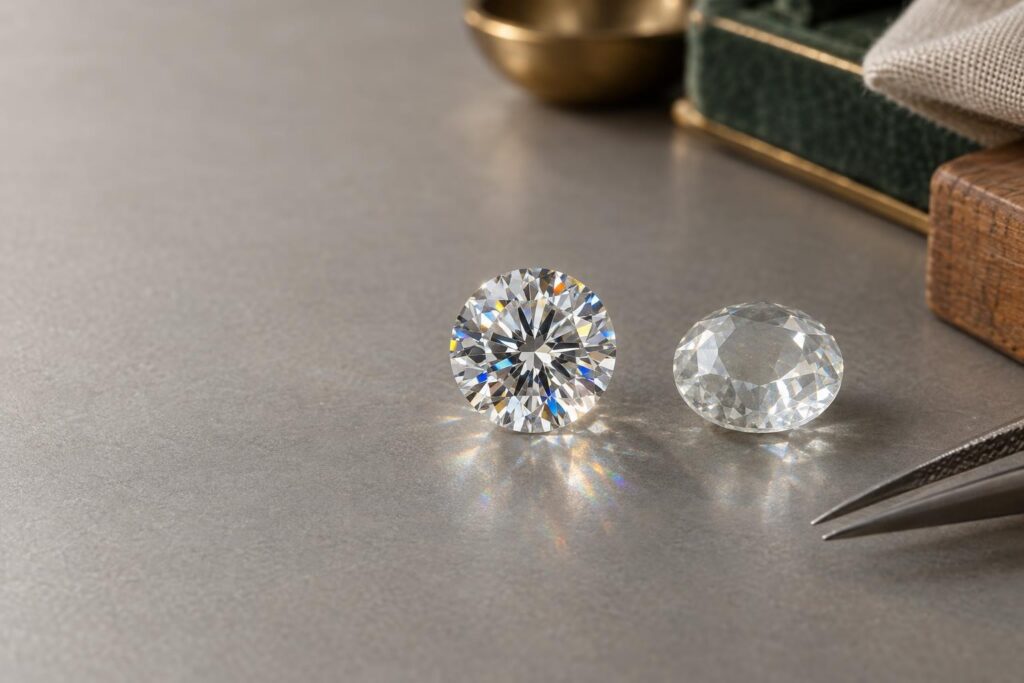
Why do two stones of the same type show different amounts of fire? The cut is critical, and a gem’s body colour (its own colour) also plays a part. A poorly cut gem may show little fire 4. For a diamond, the cut is the factor that fuels fire, sparkle and brilliance 3. Step-cut fancy-colour diamonds (cut with long, straight facets) typically show little dispersion 1. Dark body colours can also hide fire, as in deep green demantoid garnet 5. Fire is different from sparkle, the pattern of light and dark flashes; see Brilliance, fire and scintillation explained.
How do gems compare? Gemmologists give dispersion as a number with no units, and a higher number means a gem can show more coloured flashes. Diamond measures 0.044, cerussite 0.055 and rutile 0.28 4. Demantoid, a green garnet, measures 0.057, higher than diamond, emerald and peridot 5.
Example: Tilt a round diamond ring under a single spotlight and you may see tiny flashes of colour that appear and disappear as your hand moves. That is fire, and it is easiest to see in directed light like this 2.