
Why your diamond report lists these numbers
Why would a laboratory measure your diamond so precisely? Because sparkle depends on where light goes after it enters the stone. Depth and table percentages are two of the proportions that steer that light, so they do matter. They just don’t tell the whole story, because a diamond’s look comes from all its proportions working together. 3
In short:
- For a round brilliant, depth and table are measured as percentages of the average girdle diameter, the width across the diamond’s outer edge. 2
- Together with the other proportions, they affect whether light comes back to your eye or escapes through the side or bottom. 3
- GIA research found that no single proportion can be judged on its own. 1
- Grading methods for round diamonds cannot simply be transferred to other shapes. 6
How diamond depth and table percentage are measured
Why does it help to know exactly what each number measures? Because then you know which part of the stone each figure describes. First, a few terms. The table is the large, flat facet on top of the diamond. A facet is one of the small, flat, polished surfaces cut into the stone.
The girdle is the thin outer edge where the top and bottom of the diamond meet. The culet is the bottom tip. For a round brilliant, the classic round diamond, the two numbers on your report work like this:
- Total depth percentage is the height from the table to the culet, shown as a percentage of the average girdle diameter. The formula is depth ÷ average girdle diameter × 100, reported to the nearest 0.1%.
- Table percentage is the average of four measurements across the table, shown as a percentage of the average girdle diameter. It is reported to the nearest 1%. 2
So on a round brilliant, a 57% table means the average table width is about 57% of the average girdle diameter, allowing for rounding. A 62% depth means the height from table to culet is 62% of that same diameter. 2
Why proportions decide where the light goes
Why does the shape inside a diamond change how bright it looks? Because each part of the stone has a job in handling light. The table gathers light from above and either reflects it back to you or sends it into the diamond. The crown, the part above the girdle, gathers and spreads light to create brightness, fire and a sparkling pattern of light and dark. The pavilion, the part below the girdle, has facets that reflect light back up through the crown to your eye, a little like angled mirrors. 2
Cut: what proportions do to light
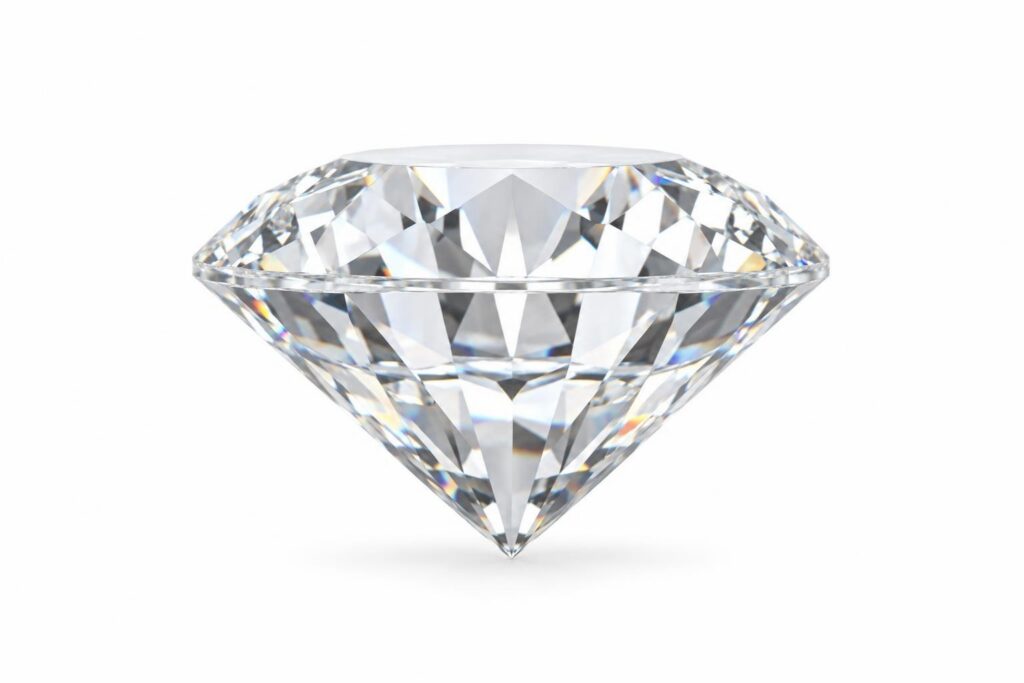
Cut grades for round brilliants run: Excellent, Very good, Good, Fair, Poor.
Pictures: one AI-generated illustration of a diamond, adjusted for each grade. They show how the grades differ; they are not a grading of any stone.
This is where depth comes in. If the pavilion is too shallow or too deep, light escapes from the side or bottom. A well-cut diamond sends more light up through the crown. Crown height can also affect both brightness and fire. 3
These effects have names. Brilliance is the white light a diamond returns. Fire is light split into its spectral colours, seen as flashes of rainbow colour. 5 The splitting of light itself is called dispersion; fire is what you see as a result. Scintillation is the pattern of light and dark sparkles you see as the diamond moves. Our guide to brilliance, fire and scintillation explains each one in more depth.
Why laboratory research matters more than rules of thumb
Why trust a lab’s view of proportions over a simple rule? Because the effect of proportions was tested with computer models and real stones. GIA built a ray-tracing program, software that follows the path of light inside a model diamond. It showed which combinations of proportions look brighter and more fiery. 1
Researchers analysed tens of thousands of proportion sets. Each set combined table size, crown angle, pavilion angle, girdle thickness, culet size and total depth. They also made over 70,000 observations on more than 2,300 diamonds. Based on this research, GIA began issuing cut grades for round brilliant diamonds in 2006. 1
One published model measured brilliance as "weighted light return", a score that approximates how bright a round diamond looks. It showed how that score changes with crown angle, pavilion angle and table size. 4 A later study calculated fire for more than 26,000 proportion combinations. 5
Why no single number guarantees sparkle
Why can’t you simply look for the right depth or the right table? Because every proportion affects the others. GIA found these measurements were interrelated, and no single proportion, or small group of them, could be judged alone. 1
A cut grade is a laboratory’s rating of how well a diamond is cut. A diamond with every number inside a grade’s limits can still get a lower grade if those numbers work badly together. For example, an Excellent round has a table between 52% and 62%, but its other proportions must fit too. Its pavilion angle should be 40.6° to 41.8°, as long as the other measurements also fit. 3
There is also no single perfect recipe. A wide range of proportions can give high-quality light performance. 1 One model found many combinations that scored equal to or higher than so-called "Ideal" cuts. Its results did not support judging cut one proportion at a time. 4
Why brilliance and fire can pull in different directions
Why might one diamond look very bright but show fewer flashes of colour? Research found that different sets of proportions generally give the most fire and the most brilliance. Some combinations still score well on both. 5
Table size shows this clearly. In that study of round brilliants, fire generally:
- was higher with tables below 58%
- stayed roughly level from 58% to about 62–64%
- was lower with tables larger than that 5
Smaller tables and larger crown angles generally gave more fire. Pavilion angle and the length of some smaller facets mattered too. As the researchers put it, "every facet matters in a round brilliant diamond." Fire is also best seen under spot lighting, such as a single bright lamp. 5
Why shape changes the ranges
Why do the numbers for an oval or pear look so different from a round? Because the ranges above come from research on round brilliants. GIA recognises more than 40 categories of fancy-shaped diamond, such as ovals, pears and marquises. Fancy shapes show patterns of light that a round brilliant never shows, at any proportions. 6
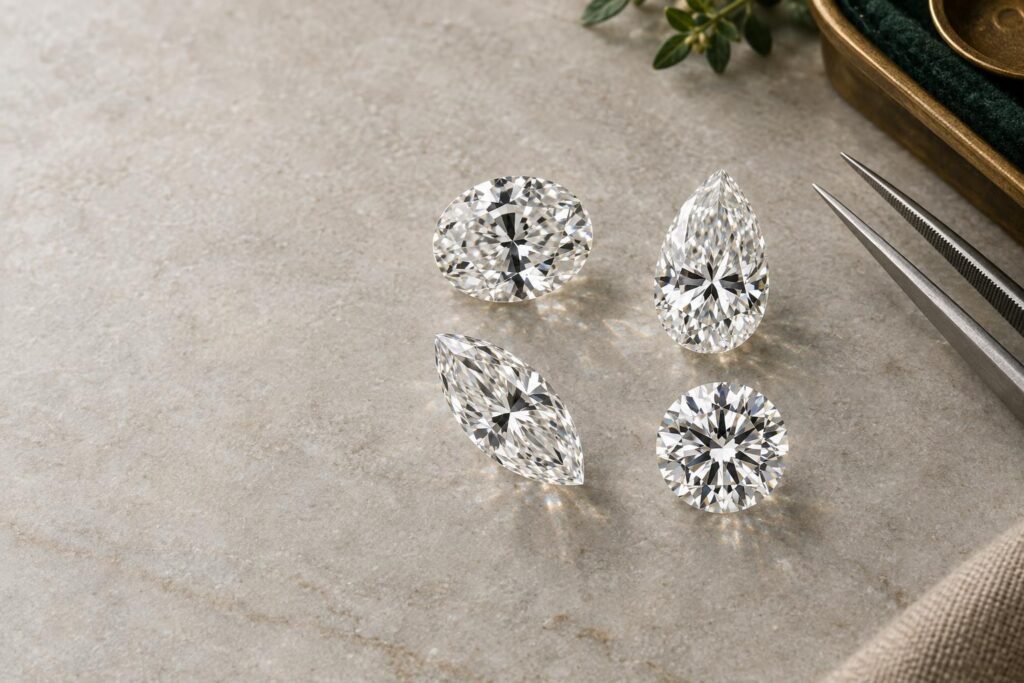
GIA researchers found that cut-grading methods for rounds "cannot be simply transferred" to fancy shapes. Each shape needs its own approach, based on a 3D model of the polished diamond. The trade has argued for decades over which depth percentages, table percentages and length-to-width ratios make fancy shapes attractive. A length-to-width ratio compares how long a stone is with how wide it is. 6
Some looks are judged more consistently than others. Observers consistently disliked strong windowing, a see-through area in the centre of the stone. Views on a bow tie (a dark, bow-tie-shaped area across the middle) and crushed ice (a busy, broken-up sparkle) varied more with regional and personal taste. 6 If you are comparing shapes, our guide to choosing a diamond shape covers them in more detail.
The downsides of judging a diamond by depth and table alone
Why can these two numbers mislead you? Because they are only two of several measurements, alongside crown angle, pavilion angle, girdle thickness and culet size, that work together. 1 Here are the main limits to keep in mind:
- Two numbers are not the whole cut. A diamond can sit inside a grade’s table range and still get a lower grade if its proportions work badly together. 3
- One grade can hold many looks. Each cut grade covers a range of proportions, so diamonds with the same grade can look different, and personal and regional taste often decided which one people preferred. 1
- Brightness and fire can trade off. Different sets of proportions generally give the most of each, although some combinations score well on both. 5
- Round ranges don’t fit fancy shapes. Using round-diamond methods to judge an oval, pear or marquise can mislead you, because each shape needs its own approach. 6
So depth and table are useful clues rather than a final answer. GIA’s research found that appearance comes from all the proportions working together, not one number. 3 Our guide to diamond cut and light performance looks at cut as a whole.
What to do with the numbers on your report
Why read the numbers at all, then? Because they describe the parts of the diamond that gather light and send it back to your eye. 2 Here is a practical way to use them:
- Read depth and table alongside the other proportions, such as crown and pavilion angles, because no single proportion shows what the cut grade will be. 3
- Remember that grading methods for a round brilliant cannot simply be transferred to fancy shapes. 6
- Look at the diamond in more than one kind of light, including a spotlight, where fire is best seen. 5
- Decide what matters more to you: bright white light, flashes of colour, or a balance of both.
Our guide on how to read a GIA diamond grading report walks through the rest of the report. If your diamond has a different lab’s report, GIA vs IGI diamond reports explains how the two compare. For how cut fits with colour, clarity and carat, see the 4 Cs of diamonds.
If you’d like to go through the numbers on a report with someone, we offer a free consultation. You can book online at bookings.ralphjacobs.org from any country, or visit our showroom in Secunda.
Frequently asked questions
Not on its own. If the pavilion is too shallow, light can escape from the side or bottom instead of returning to your eye. Too deep causes the same problem. For round brilliants, GIA found that no single proportion shows the cut grade; they work together. 3
In GIA research on round brilliants, fire was generally higher with tables below 58%, roughly level from 58% to about 62–64%, and lower beyond that. Crown and pavilion angles also mattered, so table size alone doesn’t decide fire. 5
No. GIA research found that round grading methods cannot simply be transferred to fancy shapes, which show light patterns a round never shows. Each shape needs its own approach. 6
Yes. Each cut grade covers a range of proportions, so diamonds with the same grade can look different. GIA also found that personal and regional taste often decided which one people preferred. 1
For a round brilliant, both are percentages of the average girdle diameter. Depth is the height from table to culet, divided by that diameter, times 100, reported to the nearest 0.1%. Table is the average of four table measurements as a percentage, reported to the nearest 1%. 2