
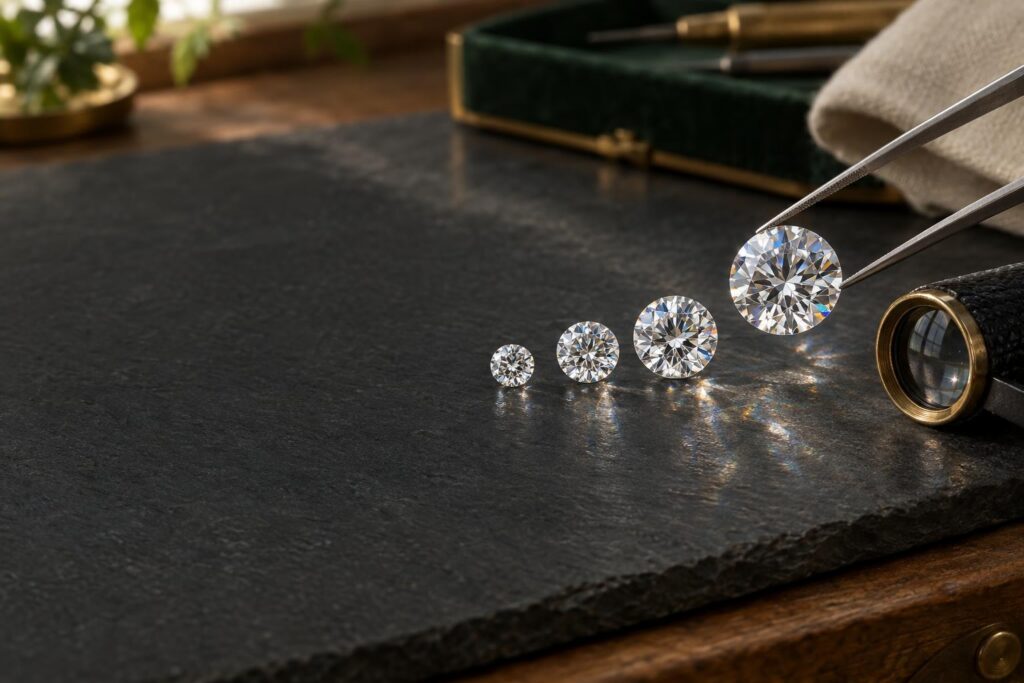
Why the 4 Cs of diamonds exist
You keep hearing about the 4 Cs, but can you actually see the difference between grades? Not always. The gap between neighbouring colour grades, for example, can be too subtle for an untrained eye. 4 Knowing which grades change a diamond’s look helps you decide where to spend and where to save. The 4 Cs are cut, colour, clarity and carat weight, which GIA calls "the defining characteristics of every diamond." 1
Colour: from D to Z
- D–F Colourless
- G–J Near colourless
- K–M Faint
- N–R Very light
- S–Z Light
Clarity: from flawless to included
- FL Flawless
- IF Internally flawless
- VVS1 Very, very slightly included
- VVS2 Very, very slightly included
- VS1 Very slightly included
- VS2 Very slightly included
- SI1 Slightly included
- SI2 Slightly included
- I1 Included
- I2 Included
- I3 Included
Cut: what proportions do to light
Cut grades for round brilliants run: Excellent, Very good, Good, Fair, Poor.
Carat: weight and size
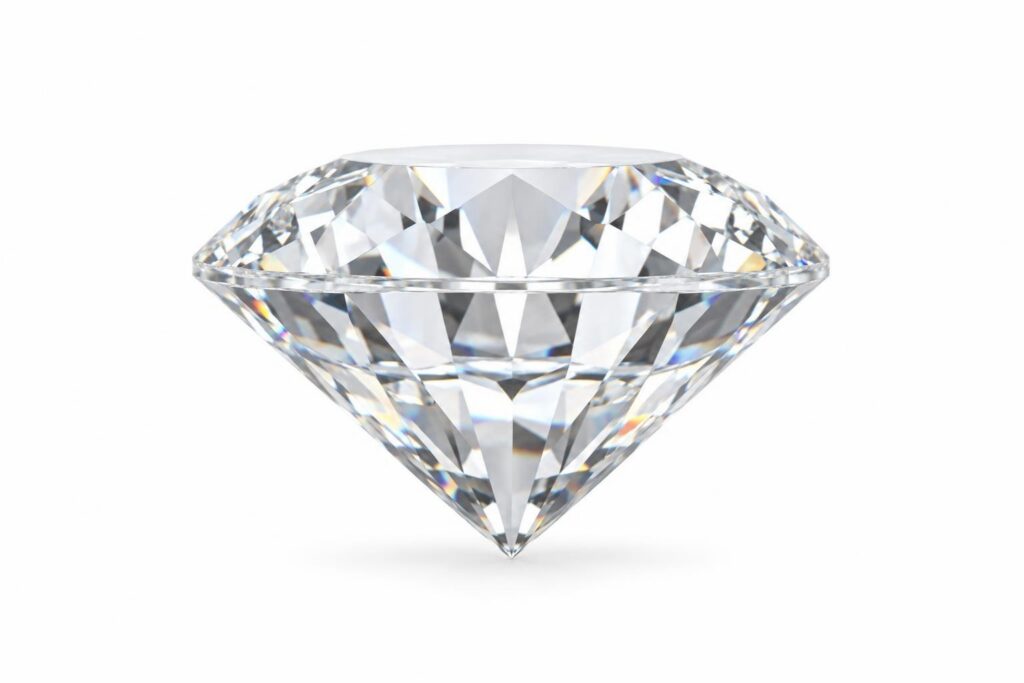
The parts of a diamond
- Table
- The large flat facet on top. Most light enters the stone here.
- Crown
- The upper part, between the table and the girdle. Its angled facets help split light into flashes of colour (fire).
- Girdle
- The thin outer edge at the widest point. The setting usually grips the stone here.
- Pavilion
- The lower part, below the girdle. Its angle decides how much light reflects back up through the top.
- Culet
- The point, or tiny facet, at the very bottom of the pavilion.
- Total depth
- The height from the table to the culet, compared with the diameter. It is one of the measurements behind the cut grade.
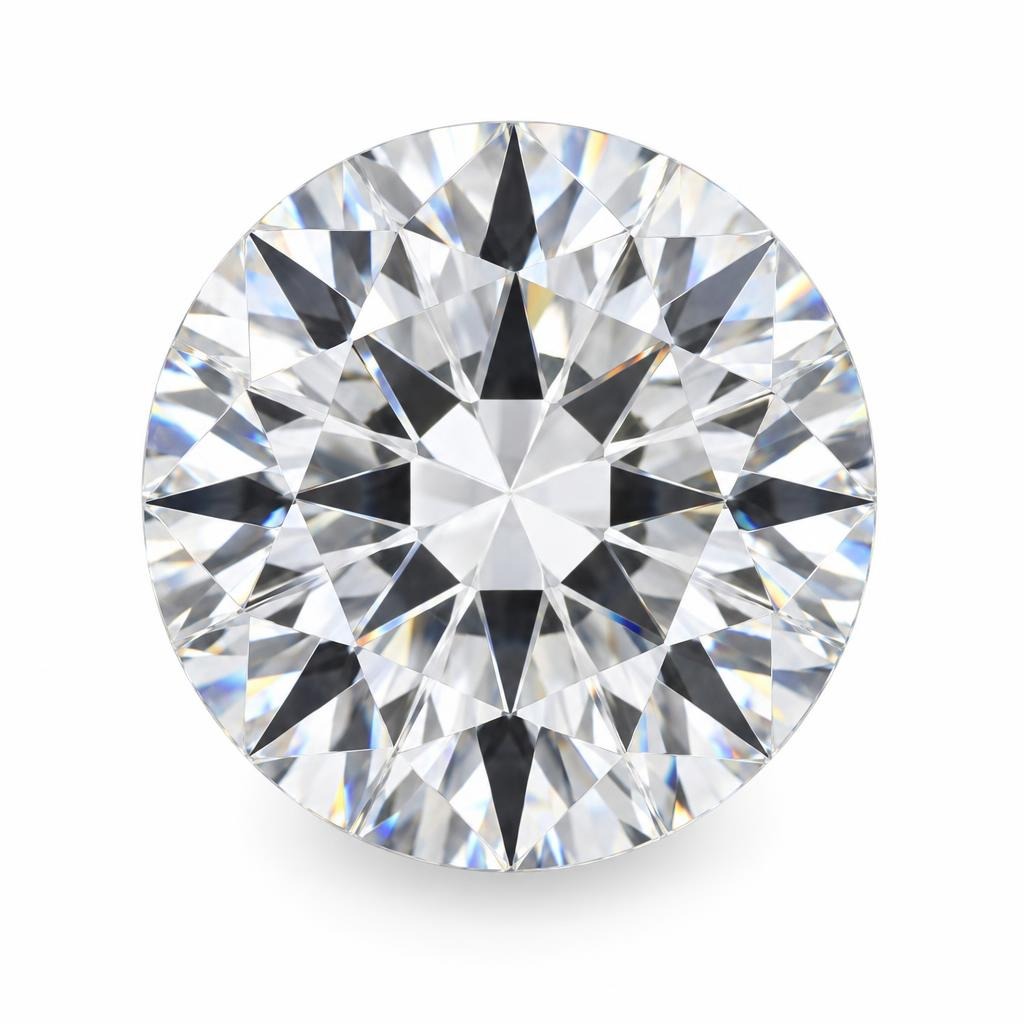
Pictures: one AI-generated illustration of a diamond, adjusted for each grade. They show how the grades differ; they are not a grading of any stone.
Why were they needed at all? Before them, traders used loose words. A colourless stone might be called "water", and a good cut "made well". Only carat weight had a steady meaning, used since the 1500s. In the 1940s, GIA founder Robert M. Shipley coined "the 4Cs of diamond quality" to help students remember four factors. 1
So the 4 Cs describe a diamond, and the cut grade includes how it looks, but they cannot decide which stone you will find most beautiful. They are the universal method for assessing the quality of any diamond, anywhere in the world. As GIA puts it, "Choosing a diamond may be a matter of preference, but evaluating a diamond is a matter of precision." 1
- Cut is said to have the greatest impact on a diamond’s beauty. 3
- Neighbouring colour grades can be too subtle for an untrained eye to tell apart. 4
- Most diamonds have inclusions you can see only with magnification. 5
- Carat is weight, not size, and small weight steps can be hard to see. 6
Why cut matters most to the eye
Why start with cut? Of the 4 Cs, cut is said to have the greatest impact on a diamond’s beauty. An expertly cut diamond can look brilliant even with lower colour and clarity grades. A poorly cut one can look dull even with top grades. 3
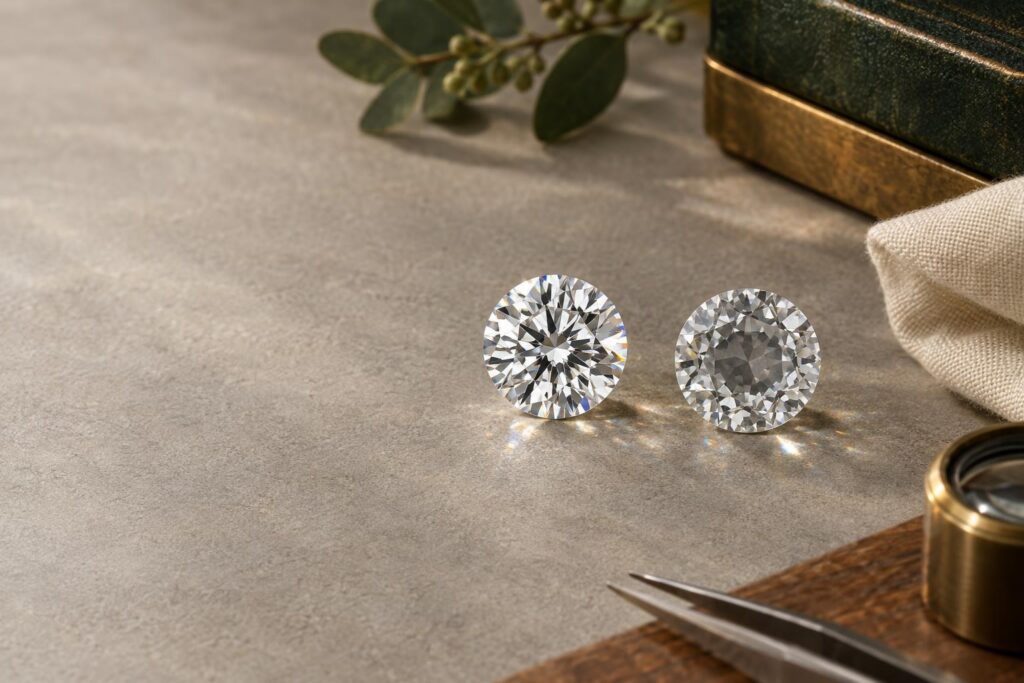
How cut changes what you see
Here, cut means how well a diamond’s facets (its flat, polished surfaces) handle light. It is separate from the stone’s shape. GIA grades cut from Excellent to Poor. An Excellent cut looks bright and sparkling, with an even spread of light and dark. A Poor cut looks dull and lifeless, because light leaks out and there is little contrast. 3
Three words describe this light. Brightness is the white light a diamond returns to your eye, and GIA’s researchers preferred this term to brilliance. 2 Fire is the flashes of colour you see, and scintillation is the sparkle of light and dark as the stone moves. For more depth, see Brilliance, fire and scintillation explained.
Here is a clear example. Diamonds with an Excellent cut and J colour, or a Good cut and L colour, look brighter than a Poor-cut diamond with I colour. 3 Colour letters are explained below; the point is that cut outweighed a better colour grade.
What the cut grade includes
The overall cut grade weighs seven factors: brightness, fire, scintillation, weight ratio, durability, polish and symmetry. The round brilliant, the classic round diamond, is the only shape that gets an official GIA cut grade. Other shapes, such as ovals or emerald cuts, are graded for polish and symmetry only. 3
The girdle, the thin outer edge of the diamond, matters too. A thin girdle may risk chipping. A thick girdle can hide extra weight, adding cost without adding visual impact. 3 You can see more in Diamond cut explained.
Why colour grades are hard to see
Why might you pay for a colour difference you can’t see? Because the gap between neighbouring colour grades can be too subtle for an untrained eye. 4 GIA introduced its D-to-Z colour scale in 1953. 1
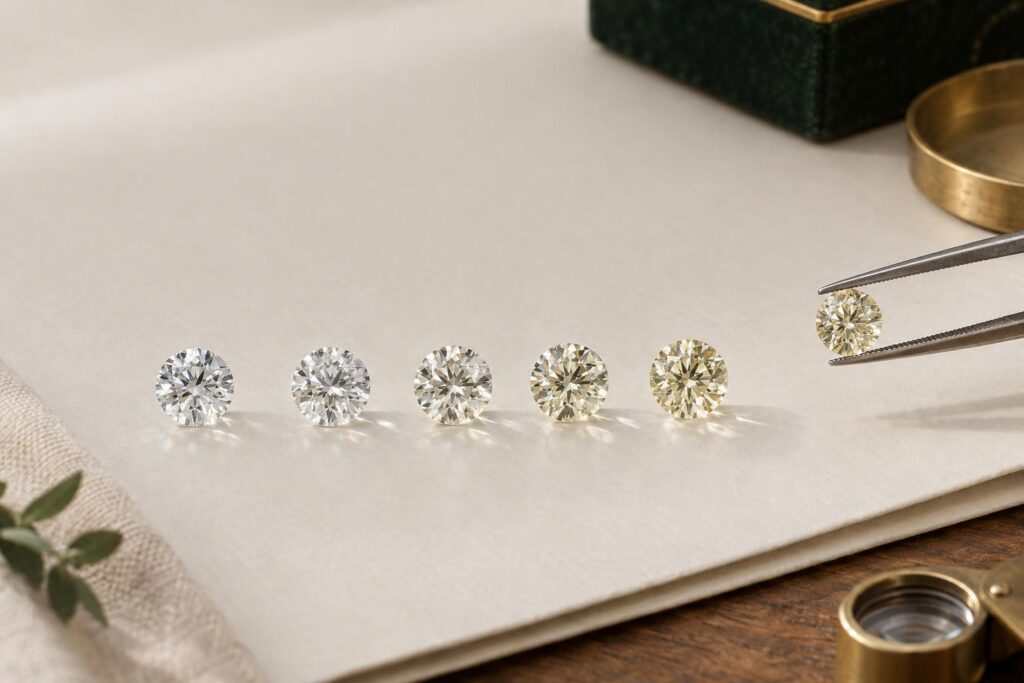
How colour is graded
Most diamonds in engagement rings are near-colourless, with hints of yellow or brown. Graders place the diamond upside down on its table, the large flat facet on top. They compare it with reference stones called masterstones, under controlled lighting. 4
- D to F, colourless: the rarest.
- G to J, near-colourless: colour is often unnoticeable except by trained graders.
- K to M, faint: colour is still hard to see for an untrained eye.
- N to R, very light: subtle colour is visible in larger stones.
- S to Z, light: colour is visible in stones of different sizes. 4
What changes colour in a ring
Why does the metal matter? Because it sits right next to the stone. White metal can emphasise the absence of colour. A gold band can make a diamond lower on the D-to-Z scale look more yellow. 4
A report may also list fluorescence, a glow some diamonds show under ultraviolet light. GIA treats it as an identifying characteristic, not a grading factor. Average observers saw no systematic effect on face-up appearance. 4
Fancy-coloured diamonds, such as yellow or pink stones, follow different logic. They are graded on the presence of colour face-up, not on its absence. 4
Why most clarity differences need a magnifier
Why does clarity have so many grades if you can’t see most of them? Because it is graded under 10× (ten times) magnification, which shows far more than your eye does. Clarity is the relative absence of inclusions, which are features inside the stone, and blemishes, which are on its surface. 5
How the clarity scale reads
- FL and IF: Flawless and Internally Flawless, the top of the 11-grade scale.
- VVS1 and VVS2: inclusions are very difficult to see under 10×.
- VS1 and VS2: inclusions are difficult to somewhat easy to see under 10×.
- SI1 and SI2: inclusions are easy to very easy to see under 10×.
- I1, I2 and I3: inclusions are obvious under 10× and often visible to the unaided eye, which may affect transparency and brilliance. 5
What clarity changes in how a diamond looks
Most faceted diamonds have inclusions visible only with magnification. Even so, a diamond with many inclusions and blemishes can look off-colour, pitted and scratched. 5
Shape plays a part as well. Inclusions are easier to see in emerald cuts than in round brilliants. Inclusions also usually affect beauty and value more than blemishes, because many blemishes can be polished away. 5
You may hear a seller call a stone "eye clean". That is a trade term that GIA does not use, and GIA does not issue a grade called SI3 either. 5 If you hear these terms, ask how they were judged, and check the grade on the report.
Why carat weight is not the same as size
Why can two diamonds of similar weight look different? Because carat measures weight, not size. A poorly cut 1.20 ct diamond may look the same size as a well-cut 1.00 ct one. 6
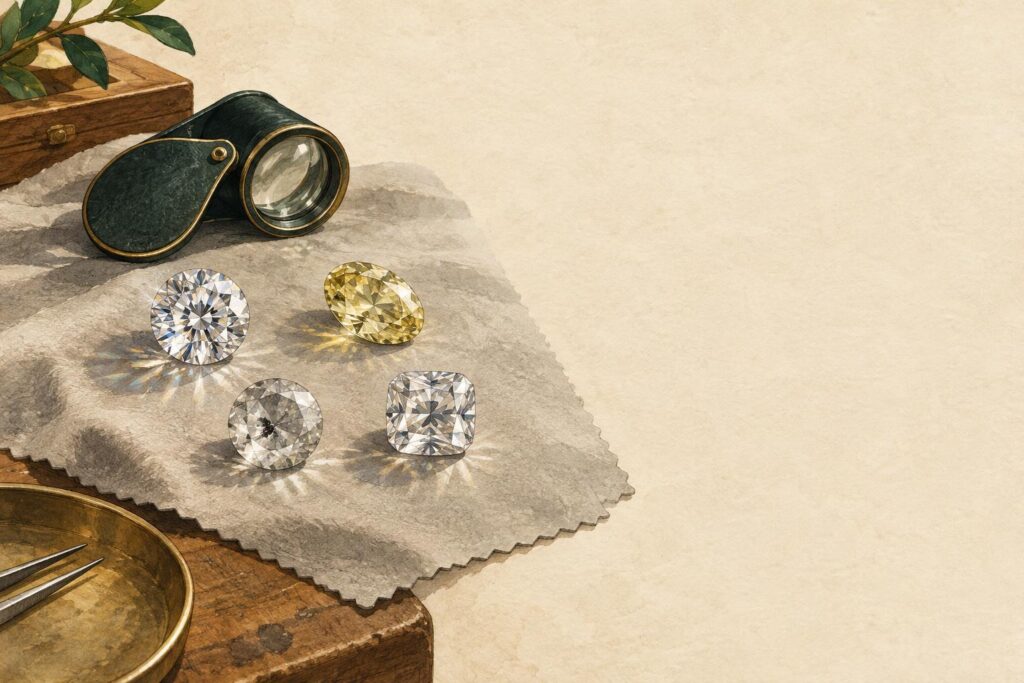
How carat is measured
One carat equals 0.20 g and is divided into 100 points. The word comes from the carob seed, which early traders used as counterweights. It is not the same as karat, which measures gold purity. 6 If gold purity is your next question, see 9ct vs 14ct vs 18ct gold.
What extra weight changes
Larger diamonds are rarer than smaller ones. Yet it is hard to tell the size difference between a 0.98 ct and a 1.01 ct diamond. 6
Don’t judge size by carat weight alone. Check the cut grade, so you are not paying for wasted weight. 6 In one GIA example, two diamonds looked the same size face up, but one weighed 0.71 ct and the other 0.61 ct, because of a thicker girdle. 3
On a ring with several stones, "total carat weight" is the combined weight of all the diamonds. It is not the weight of the centre stone. 6 To see how weight relates to face-up size, try the Carat to Millimetre Estimator or read Diamond carat weight vs visible size.
Why balance matters: where to spend and where to save
Why think about balance? Because one grade can change how you see another. In GIA’s example, a better cut outweighed a better colour grade. 3 The facts above lead to a few questions you can ask yourself.
- If sparkle matters most to you, the relevant fact is that cut has the greatest impact on beauty, and a strong cut can lift lower colour and clarity grades. 3
- If you are weighing colour, neighbouring grades can be too close to see, and your metal changes how colour reads. 4
- If you are weighing clarity, most diamonds have inclusions visible only under magnification, while I grades are often visible to the eye. 5
- If size matters to you, carat is weight rather than size, and small weight steps can be hard to see. 6
How you balance these depends on what you value: size, sparkle, a whiter look, or the reassurance of high grades. The grades help you compare; the choice stays yours. For a step-by-step process, see Choosing a diamond for an engagement ring.
If you have questions about any of these grades, we offer a free consultation, online from any country at bookings.ralphjacobs.org, or in our showroom.
The downsides: what the 4 Cs don’t tell you
Why look at the limits? Because a list of grades can seem complete when it isn’t. GIA’s own researchers describe cut as "the least understood—and least agreed upon—aspect of diamond appearance." 2
- Factors beyond brightness and fire affect how a cut looks, and factors beyond face-up looks, such as durability, also matter. 2
- Fancy shapes get no overall GIA cut grade, only polish and symmetry grades. 3
- Colour is graded table-down under controlled lighting, while you see a set stone face-up next to metal. 4
- "Eye clean" is a trade term that GIA does not use, so it is not a GIA clarity grade. 5
The 4 Cs are the four factors that characterise a faceted diamond. 1 To check what a report does and doesn’t say, see How to read a GIA diamond grading report.
Frequently asked questions
Cut has the greatest impact on a diamond’s beauty. A well-cut stone can look brilliant even with lower colour and clarity grades. Which matters most to you depends on whether you value sparkle, size, a whiter look or the grades themselves. 3
Neighbouring grades can be too subtle for an untrained eye. In the G to J range, colour is often unnoticeable except by trained graders. Lower grades, and larger stones, make colour easier to see. 4
No. Carat is weight: one carat is 0.20 g. Cut changes how big a diamond looks, so a poorly cut 1.20 ct diamond may look the same size as a well-cut 1.00 ct one. 6
It is a trade term, not a clarity grade, and GIA does not use it. Ask the seller how they judged it for that stone, and check the clarity grade on the report. 5
Not an overall one from GIA. The round brilliant is the only shape that gets an official GIA cut grade. Fancy shapes are graded for polish and symmetry only. 3