
Why it helps to know how to read a GIA diamond report
You have been handed a GIA report, full of grades, numbers and small symbols. Why does it matter that you understand it? Because each line describes the diamond in front of you, written by a laboratory that is not selling it. Here that laboratory is GIA, the Gemological Institute of America, which presents itself as an independent, impartial entity 3.
This guide follows GIA’s diamond grading report for a diamond on the D-to-Z colour scale. It covers measurements, carat weight, colour, clarity, cut, polish, symmetry, fluorescence, the plot and the inscription. It then shows how to match the report to the stone, and what the report cannot tell you. Other GIA documents can differ. The Diamond Dossier, for example, is a shorter version without the plotted diagram 3.
- The report describes the diamond. It does not give it a value 4.
- Colour runs from D to Z, clarity from Flawless to Included, and cut, polish and symmetry from Excellent to Poor 1.
- The measurements, plot and inscription give you details to compare with the stone itself.
- The report number lets you look up the data through GIA’s Report Check 3.
Why a GIA report counts as an independent description
Why should you trust a description written by someone else? It helps to know who writes it and how. GIA is a nonprofit and, in its own words, does "not sell gems or jewelry, or represent people who sell them" 3.
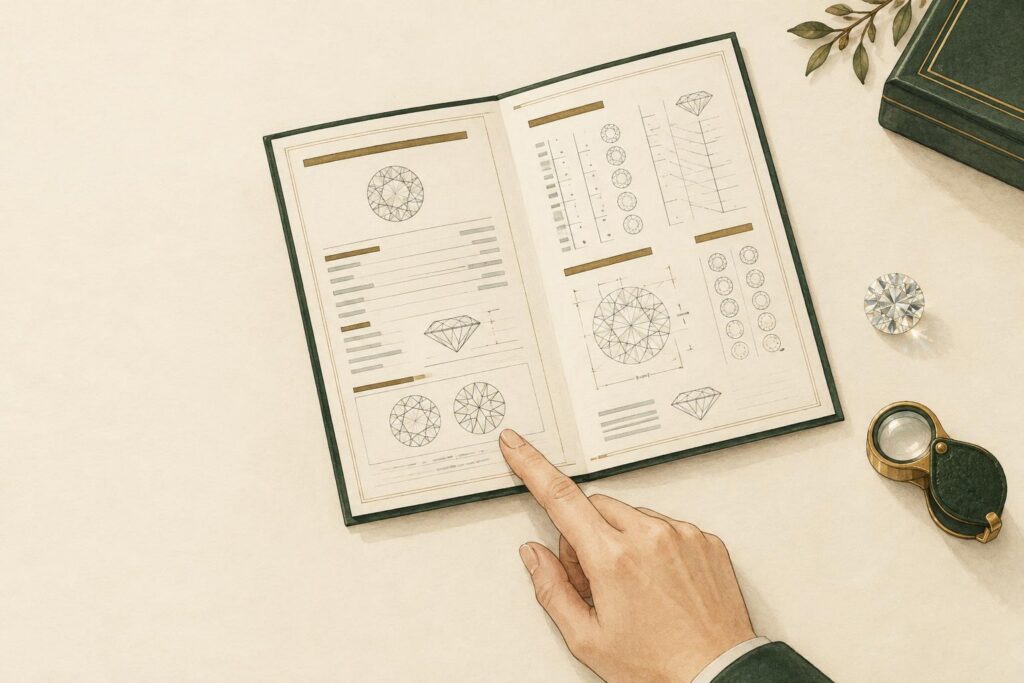
How is the grading kept separate from the seller? Objectivity and independence are meant to be the hallmarks of every report: all references to a diamond’s owner are removed or concealed, and diamonds are handed out to graders at random 2.
What is the document itself? GIA issues "reports (not certificates)", with technical information on a diamond’s dimensions, quality and identifying features. GIA does not certify or appraise any material, so the report states no value 4. Every diamond GIA evaluates gets a report number, and the report confirms whether the diamond is natural and discloses any treatments 3.
If you want to understand how natural and laboratory-grown diamonds differ, see Natural vs lab-grown diamonds: a clear comparison.
Why measurements and carat weight come first
Why start with size? Measurements describe the stone’s physical size, and the carat line records its weight. For round diamonds, measurements are listed as minimum diameter – maximum diameter x depth. For fancy shapes, meaning any shape other than round, they are listed as length x width x depth 1. Two different diameters on a round stone simply show that it is not perfectly round.
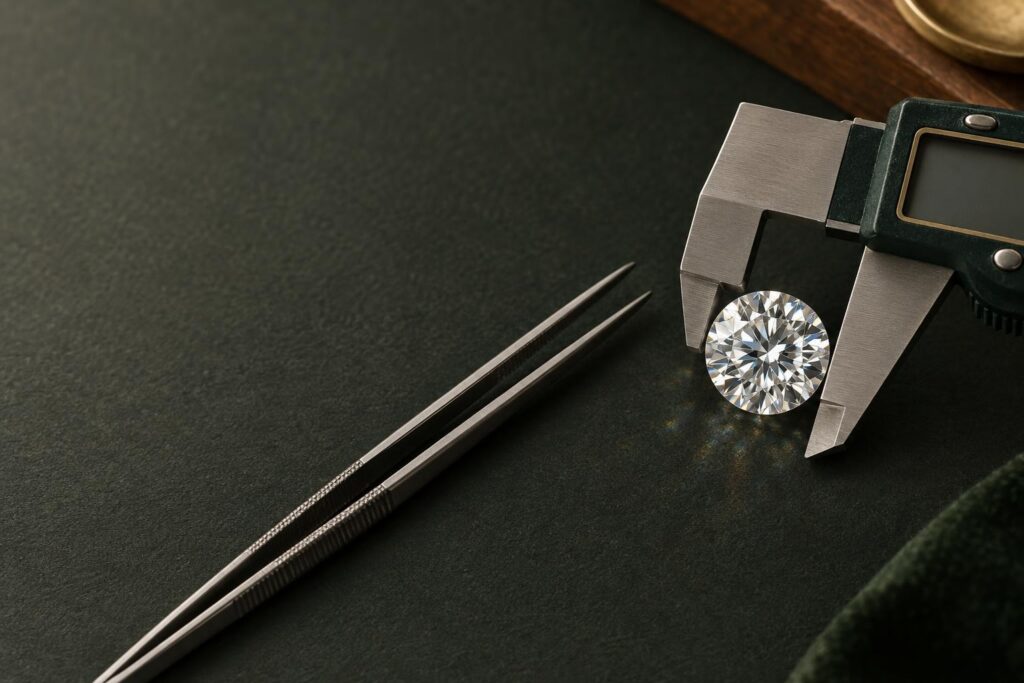
How are they taken? GIA weighs each diamond on an electronic micro-balance to the fifth decimal place. An optical device measures its proportions, measurements and facet angles 2. Facets are the small, flat, polished surfaces cut into the stone.
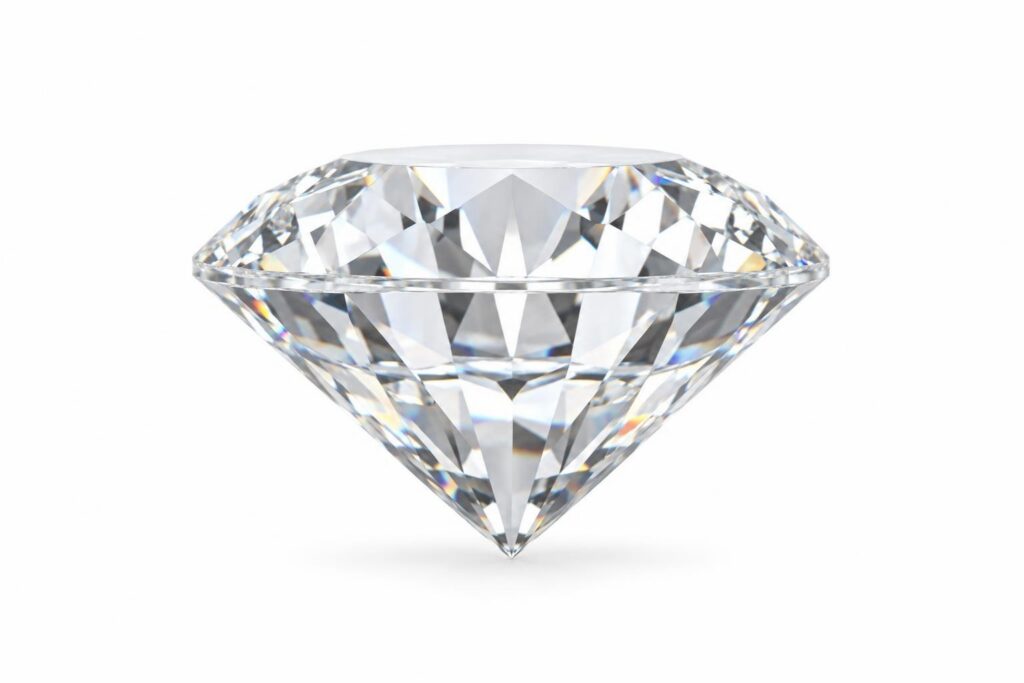
The report’s proportions diagram is a graphic profile of the diamond’s actual proportions, given as percentages and angles 1. You will meet words such as the table (the large flat facet on top), the pavilion (the lower part of the stone) and the culet (the very bottom tip).
What do the two main percentages mean? The table percentage is the size of the table, given as a percentage of the diamond’s average diameter at its outer edge. The total depth percentage is the height from the table down to the culet, given as a percentage of that same diameter 7. Because both are measured against the diameter, they describe the diamond’s shape rather than its size.
For how proportions affect the way a diamond returns light, read Diamond cut explained.
What does the carat line tell you? Carat is the unit of weight for diamonds. One carat equals one-fifth of a gram, and the report records weight to the nearest hundredth of a carat, for example 1.01 ct 1. To see how weight relates to how big a diamond looks, read Diamond carat weight vs visible size.
Why the colour and clarity grades need a closer look
Why do these two grades need extra care? Each is a judgement placed on a fixed scale, so a grade only makes sense once you know the scale. Colour is graded from D to Z, and clarity from Flawless to Included 1.
Colour: from D to Z
- D–F Colourless
- G–J Near colourless
- K–M Faint
- N–R Very light
- S–Z Light
Clarity: from flawless to included
- FL Flawless
- IF Internally flawless
- VVS1 Very, very slightly included
- VVS2 Very, very slightly included
- VS1 Very slightly included
- VS2 Very slightly included
- SI1 Slightly included
- SI2 Slightly included
- I1 Included
- I2 Included
- I3 Included
Cut: what proportions do to light
Cut grades for round brilliants run: Excellent, Very good, Good, Fair, Poor.
Carat: weight and size
The parts of a diamond
- Table
- The large flat facet on top. Most light enters the stone here.
- Crown
- The upper part, between the table and the girdle. Its angled facets help split light into flashes of colour (fire).
- Girdle
- The thin outer edge at the widest point. The setting usually grips the stone here.
- Pavilion
- The lower part, below the girdle. Its angle decides how much light reflects back up through the top.
- Culet
- The point, or tiny facet, at the very bottom of the pavilion.
- Total depth
- The height from the table to the culet, compared with the diameter. It is one of the measurements behind the cut grade.
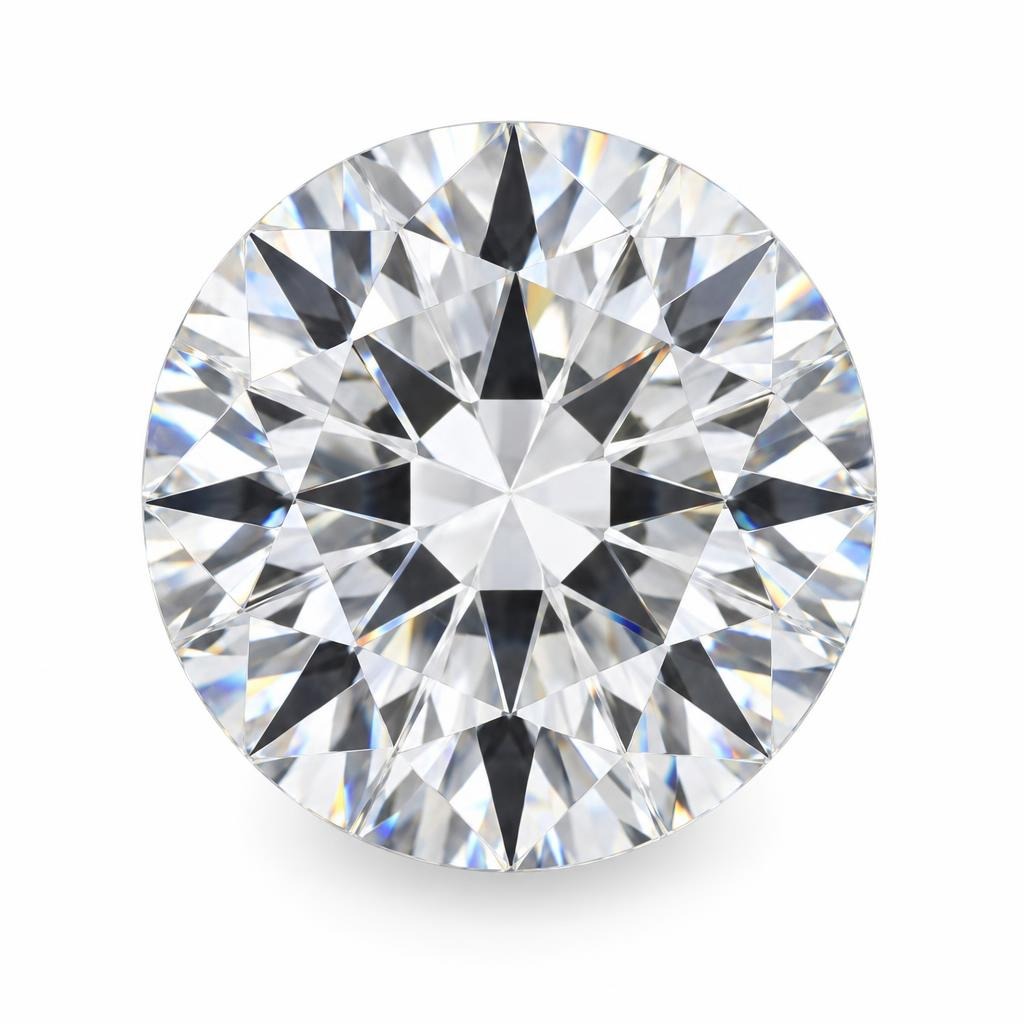
Pictures: one AI-generated illustration of a diamond, adjusted for each grade. They show how the grades differ; they are not a grading of any stone.
Why colour is graded against reference diamonds
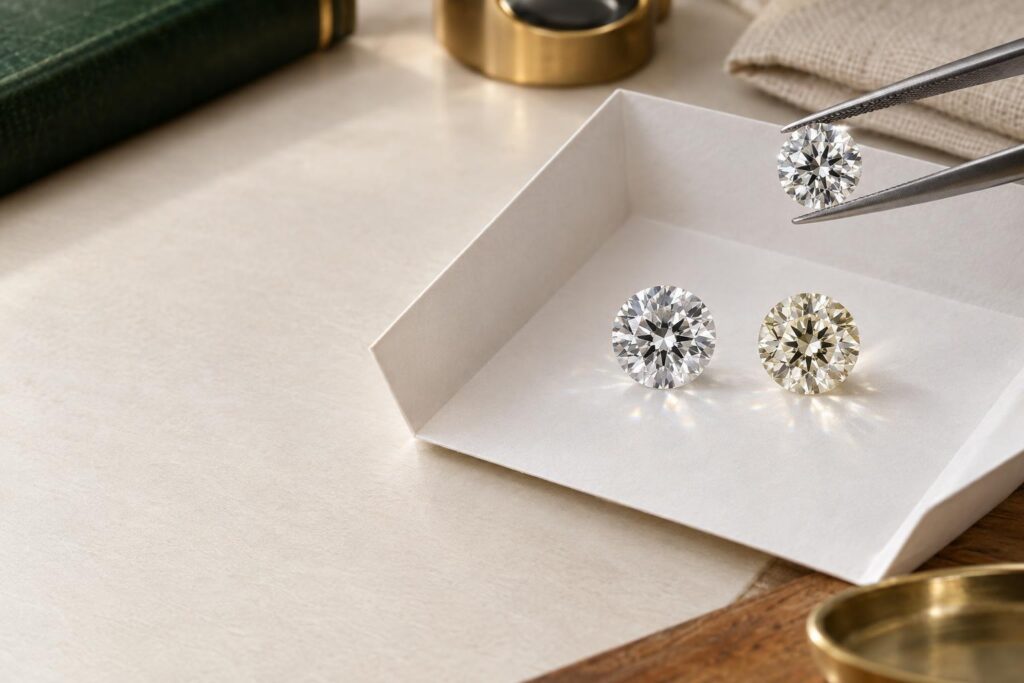
Why does the colour grade use letters? Each letter marks a position on one fixed scale. GIA grades colour from D to Z by comparing the diamond with its Master Color Comparison Diamonds 1. The scale describes the absence of colour, from colourless at D towards light yellow or brown at Z 1. Grading takes place in a standardised viewing environment, and each grader gives an independent opinion without seeing earlier ones 2.
So the letter on your report tells you where your diamond sits against those reference stones. What each part of the D-to-Z scale looks like in practice is covered in The 4 Cs of diamonds.
What should you look for beside the grade? An asterisk (*) next to the colour grade means a colour treatment was detected 1. A treatment is a process used to change how a stone looks. For more, see How gemstone treatments should be disclosed.
Why clarity is judged at ten times magnification
Why does clarity matter? It describes the small features in and on a diamond. These are inclusions, which are features inside the stone, and blemishes, which are features on its surface. GIA judges clarity at 10x, meaning ten times magnification, on a scale of 11 grades from Flawless to Included 6.
How is the grade decided? It is based on the size, nature, number, position and relief of the features seen at 10x 1. Relief describes how clearly a feature stands out against the rest of the diamond.
What do the letters mean? The grades run in order, and the names describe that order. "Very very slightly" comes before "very slightly", which comes before "slightly", and "included" comes last. The 1 and 2 within each pair also follow that order.
- FL (Flawless): no inclusions or blemishes are visible at 10x.
- IF (Internally Flawless): no inclusions are visible, but there are blemishes.
- VVS1 and VVS2 (Very Very Slightly Included).
- VS1 and VS2 (Very Slightly Included).
- SI1 and SI2 (Slightly Included).
- I1, I2 and I3 (Included): inclusions are obvious and may affect transparency, brilliance (the light the stone returns) and durability 6.
Why cut, polish and symmetry describe the diamond’s finish
Why does the report grade how the diamond was cut? Because the cut grade looks at how the finished stone performs, not only at its shape. GIA’s cut grade takes into account brightness, fire, scintillation, weight ratio, durability, polish and symmetry 2. Brightness is the light the diamond returns, fire is its flashes of colour, and scintillation is the sparkle as it moves. See Brilliance, fire and scintillation explained for more.
Which diamonds get a cut grade? GIA gives one only to standard round brilliants in the D-to-Z colour range, graded from Excellent to Poor 1. A round brilliant is the familiar round diamond with many facets. If your diamond is another shape, the report will not show an overall cut grade.
What do polish and symmetry mean? Polish is the smoothness of the diamond’s surface. Symmetry is the exactness of its outline and of the shape, placement and alignment of its facets. Both are graded from Excellent to Poor 1.
Why fluorescence is listed even though it isn’t a grade
Why is there a line for fluorescence? Fluorescence is the strength and colour of the glow a diamond gives off under long-wave ultraviolet (UV) light 1. It is not one of the 4Cs (cut, colour, clarity and carat), but it is an identifying characteristic 5.
How is it described? The report gives the intensity as None, Faint, Medium, Strong or Very Strong. The colour of the glow is noted when it is Medium or stronger. Most fluorescent diamonds glow blue, and yellow or green is rare 5.
What does "None" mean? It does not always mean zero glow. It covers a range from Indiscernible to Very Faint 1.
You may hear that fluorescence makes a diamond look hazy or changes its colour. The idea is easy to understand, because the stone visibly glows under UV light. In fact, fluorescence does not cause haziness by itself, and blue fluorescence doesn’t change the colour grade, because the grading environment is engineered for consistency 5. How much the fluorescence line matters to you is your decision.
Why the plot and inscription help identify your diamond
Why draw a map of the stone? The plot records where a diamond’s clarity features sit. The plotted diagram roughly matches the stone’s shape and cutting style, and its symbols show the type, position and approximate size of the clarity features plotted 1.
How do you read it? Each symbol stands for a type of feature, so learning the symbols tells you what kind of inclusion or blemish sits where. The key to symbols lists the characteristics shown on the plot. Red symbols mark internal features (inclusions), and green or black symbols mark external ones (blemishes) 1. The plot is a diagram, not a photograph, so treat it as a guide to the features plotted.
How is it made? The grader plots the features on a diagram chosen from hundreds of stored diagrams 2. Not every GIA document has one, because the Diamond Dossier leaves it out 3.
What is the inscription field? The girdle is the thin outer edge of the diamond. The inscription field records any text, symbols, logos or GIA report number on the girdle 1. So an inscription is not always a report number; read the field to see what was recorded.
Why matching the report to the stone matters, and how to do it
Why check at all? A report only tells you about your diamond if it belongs to that diamond. Every diamond GIA evaluates gets its own report number, so each report describes one stone 3.
How do you check the document? Look up the report number through GIA’s Report Check, which lets you see the data at any time 3. You can also scan the QR code, which checks the report’s data against GIA’s database. Other security features include microprinting, a hologram and watermarks 1.
These features help authenticate the document and verify its data against GIA’s database 1. The report also records details of the stone itself, which you can look at next.
Which details describe the stone? The report records its shape and measurements, anything inscribed on its girdle, and a plot showing the type, position and approximate size of the clarity features plotted 1. A jeweller can help you look at these details on the stone itself.
If you have questions about a diamond you are considering, we offer a free consultation, online from anywhere at bookings.ralphjacobs.org, by WhatsApp, or at our showroom.
When a GIA report isn’t enough: what it can’t tell you
Why look at the limits? Knowing them stops you from reading more into the report than it says.
- It is not a certificate or an appraisal. GIA gives technical information on dimensions, quality and identifying features, and no appraisal value is stated on the report 4.
- It cannot choose for you. Which diamond suits you, your budget or your setting sits outside that technical description.
- Only standard round brilliants in the D-to-Z colour range get an overall cut grade, and the plot only roughly matches the stone’s shape 1.
- A Diamond Dossier has no plotted diagram, so you cannot compare features against a plot 3.
- The grades come from graders, who each give an independent opinion 2, expressed on the scales the report sets out 1.
Your report may also show lines this guide does not cover. If one is unclear, GIA’s own guidance on reading its reports, or a jeweller, can explain it. To see how laboratories differ, read GIA vs IGI diamond reports. There is also a video, How to read a diamond grading report.
Frequently asked questions
No. It is a report, not a certificate, and GIA does not certify or appraise any material. The report gives technical information on a diamond’s dimensions, quality and identifying features 4.
No. No appraisal value is stated on a GIA report 4. It describes the diamond’s characteristics, such as its weight, colour and clarity, but leaves value out.
GIA gives an overall cut grade only to standard round brilliants in the D-to-Z colour range. Polish and symmetry are still graded from Excellent to Poor 1.
An asterisk (*) next to the colour grade means GIA detected a colour treatment, a process used to change how the diamond looks 1.