
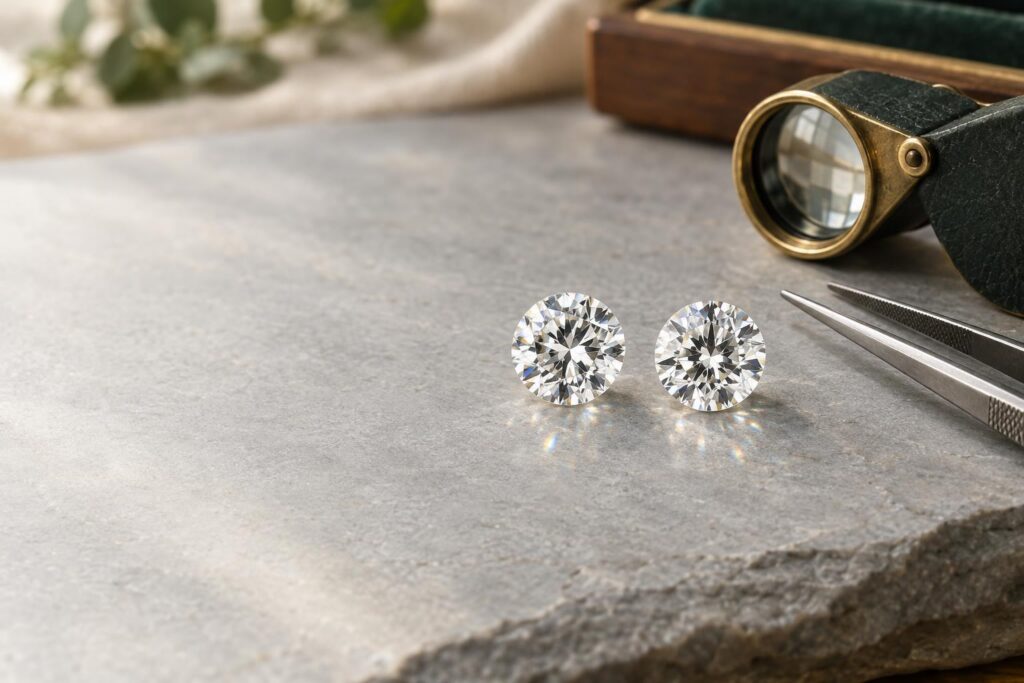
Why the lab behind a diamond grade matters
You have found two diamonds that look alike on paper. One has a GIA report and the other has an IGI report. You want to know if their grades mean the same thing. That matters, because diamond grading is subjective by nature, and graders within the same lab sometimes disagree 6.
So it helps to know how each lab says it reaches a grade, what its reports show, and what independent testing has found. This article sets out those facts side by side. You can then decide how much weight to give each report.
First, a word on names. Sellers often say "certificate", but the document’s proper name is a grading report: a blueprint of the diamond’s measurements, shape and individual features. It confirms the stone is a diamond, describes its 4Cs (colour, clarity, cut and carat weight) and its finish, and names any known treatments. A report is not a certificate or a guarantee, and it does not tell you what the diamond is worth 3.
Why each lab’s background is worth knowing
Why look at background? You will see both names on reports, so it helps to know where each lab started and what each says about itself. Here is how each lab describes its own history.
GIA: the lab behind the grading scales
Established in 1931, GIA (the Gemological Institute of America) calls itself an independent nonprofit organisation. It developed the colour and clarity scales for natural diamonds in the 1940s, and it invented the 4Cs. In 1953 it created the International Diamond Grading System, which it says is recognised worldwide as the standard for diamond quality 1.
IGI: an early grader of laboratory-grown diamonds
IGI (the International Gemological Institute) 6 was founded in Antwerp, Belgium, by Marcel Lorie in 1975. It describes itself as one of the world’s largest independent grading services. IGI analysed and graded the first gem-quality laboratory-grown diamonds, which are diamonds grown in a laboratory rather than formed in the earth 4. It says it pioneered the grading of lab-grown diamonds in 2005 5.
IGI achieved ISO laboratory accreditation, an international standard for testing labs, for both natural and lab-grown diamonds. It also developed photoluminescence spectrometer technology, a light-based test that can identify HPHT-processed diamonds (stones treated with high pressure and high temperature) 4.
Why the grading method is worth understanding
Why does method matter to you? A grade is the result of a process. Knowing that process tells you what the letters on the page stand for. Here is how each lab describes its own method.
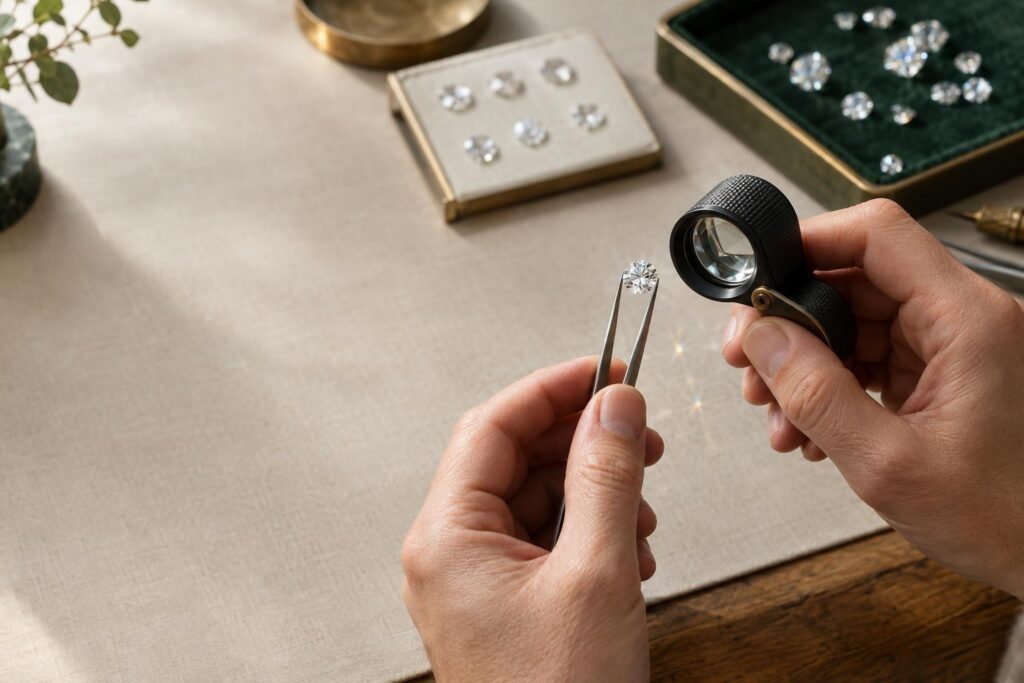
At GIA, colour is graded against masterstones (reference diamonds of known colour) in a standardised viewing environment. Several graders judge each diamond independently, and no grade is set until they agree; more graders may be brought in if needed. Clarity is judged at 10x magnification, and the graders plot the clarity characteristics on a diagram. Carat weight is measured to the fifth decimal place and reported to the hundredths 2.
GIA grades cut with its GIA Cut Grading System, which predicts light performance. It was built on more than 1 million modelled proportion sets and checked against more than 70,000 human observations 2. Our guide to diamond cut explains what cut grades describe.
At IGI, every stone is first screened to find out whether it is natural, lab-grown or a simulant (a material that only imitates diamond). Several graders give their opinions independently, without discussing them, and the grade is set when enough of them agree. Clarity is judged at 10x magnification. The grade depends on how visible, large, numerous and well-placed the inclusions and other characteristics are, and what kind they are 5.
For round brilliants, IGI’s cut grade compares the stone’s proportions against its own studies of brightness, fire, scintillation and pattern. Brightness is close to brilliance, the white light a diamond returns, and fire is flashes of colour. IGI’s lab-grown diamond report also gives polish and symmetry grades, which describe the surface finish and how evenly the facets line up 5. Keep in mind that both descriptions come from the labs themselves.
Why lab-grown diamonds read differently on each lab’s report
Why does this matter? If you are comparing lab-grown stones, the two labs describe them in different ways. IGI grades lab-grown diamonds on the same D-to-Z colour scale and IF-to-I3 clarity scale used for natural diamonds 5.
GIA takes a different path. It uses descriptive terms for lab-grown diamonds instead of the colour and clarity terms it developed for natural stones. The report confirms the stone is lab-grown and places it as "premium" or "standard", based on colour, clarity and finish together. A stone below GIA’s minimum quality standard gets no designation. GIA’s reasoning is that more than 95% of lab-grown diamonds fall into a very narrow range of colour and clarity 1.
GIA reports in the format introduced on 1 October 2025 do not give a lab-grown stone a single colour or clarity letter, so they cannot be lined up letter by letter with an IGI report. Older GIA reports for lab-grown diamonds remain valid, so you may also see GIA lab-grown reports in the earlier style 1. If you are still deciding between the two kinds of stone, our natural vs lab-grown comparison covers it.
Why the report format matters when you check a stone
Why look at the layout? Some report features may help you match the paper to the stone in front of you. GIA’s full Diamond Grading Report includes a plotted clarity diagram and a graphic of the stone’s proportions. Some shorter GIA formats have instead had the report number laser-inscribed on the girdle, the thin outer edge of the diamond 3.
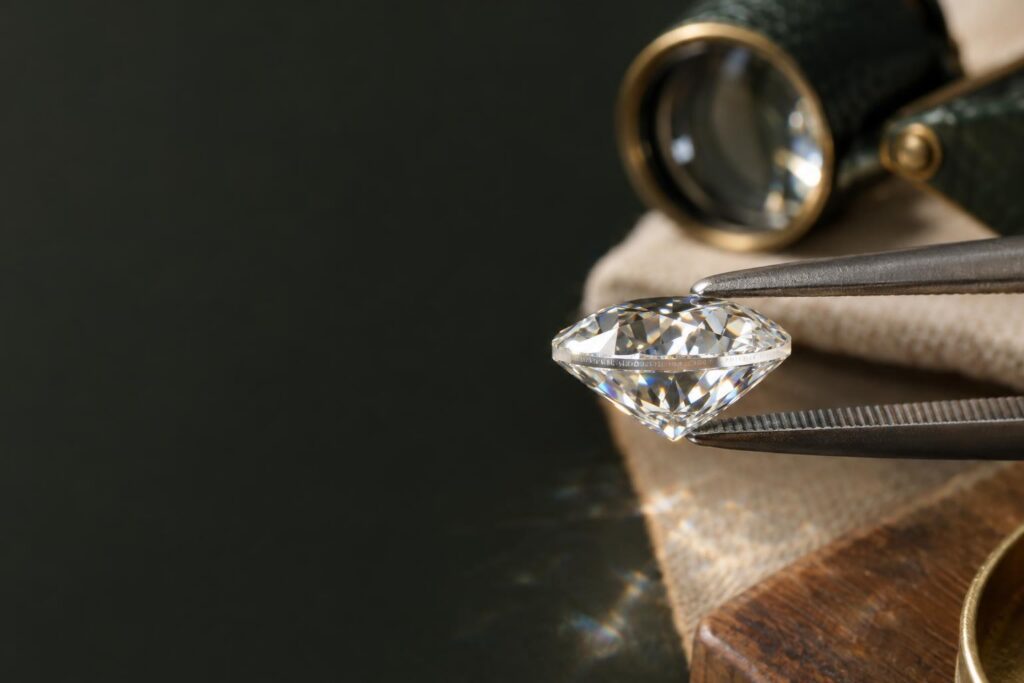
Report types vary, so check which of these features your own report includes. GIA results can also be looked up online with GIA Report Check, using the report number 2.
IGI introduced the patented LaserScribe inscription system and tamper-proof sealed reports 4. On request, the growth process and any treatments are noted in the comments section of IGI’s lab-grown reports 5. For a walk through each part of a report, see How to Read a GIA Diamond Grading Report.
Is one lab stricter? Why people say so, and what the evidence shows
Many buyers hear that one lab grades more strictly than another. Where does that belief come from? As labs grow and open international branches, keeping standards the same everywhere gets harder. Some labs have a reputation in the trade for generous grading, and some branches are seen as looser than others 6.
What does testing show? The trade publication JCK sent one round diamond of 0.6 to 0.7 ct to four labs. IGI and GIA both graded it F VS2 with an Excellent cut. Only one lab graded the colour higher, and that was within the generally accepted one-grade tolerance. Yet in a similar JCK test in the mid-1990s, one diamond received three different grades from three labs 6.
Each test looked at a single stone, and the two results point in different directions. How much weight you give a lab’s reputation is your decision. The checks below help you test a report for yourself.
The downsides: what no report can tell you
Why should you know the limits? Because a report can feel more final than it is. Keep these points in mind.
- A report is not a certificate or a guarantee, and it does not indicate value. Estimating worth is the job of an appraisal, which is a different document 3.
- Grading is subjective. Graders within the same lab sometimes disagree, and some branches are seen in the trade as looser than others 6.
- For lab-grown stones, GIA reports in the format introduced on 1 October 2025 use "premium" and "standard" labels rather than colour and clarity grades, so they do not compare directly with IGI letter grades 1.
How to compare diamonds across GIA and IGI reports
Why have a method? It lets you compare like with like, instead of relying on two letters on two different papers. These steps are practical checks, not a guarantee.
- Look up the report number. GIA results can be checked online with GIA Report Check 2.
- Match the stone to the paper. Some reports record a laser inscription on the girdle, such as IGI’s LaserScribe system 5. You can ask a jeweller to show it to you under magnification.
- Where you can, compare stones graded by the same lab, and note the report type and date.
- Treat a one-grade colour difference between labs with care. JCK described one grade as the generally accepted tolerance 6.
- For lab-grown stones, note whether a GIA report is in the older style or uses the "premium" and "standard" labels 1.
- Read the comments. On request, IGI records the growth process and any treatments there 5. Our CVD vs HPHT guide explains the two growth methods.
- Look beyond colour and clarity. A report also describes measurements, proportions and finish 3, so compare those and the carat weight too.
Lab-grown diamonds from Ralph Jacobs may come with IGI or GIA reports, and not every stone comes with an independent lab report. If you would like help reading two reports side by side, we offer a free consultation, online from any country at bookings.ralphjacobs.org.
Frequently asked questions
People often call it a certificate, but its proper name is a grading report. It describes the diamond’s measurements, 4Cs, finish and any known treatments. A report is not a certificate or a guarantee 3.
Not always. Grading is subjective, and graders sometimes disagree. In one JCK test, both labs graded the same diamond F VS2 with an Excellent cut. One other lab graded the colour higher, within the generally accepted one-grade tolerance 6.
No. A grading report does not indicate value. Estimating monetary worth is the job of an appraisal, which is a separate document 3.
GIA results can be looked up online with GIA Report Check, using the report number 2. If the report records a girdle inscription, you can ask a jeweller to show it to you under magnification.