
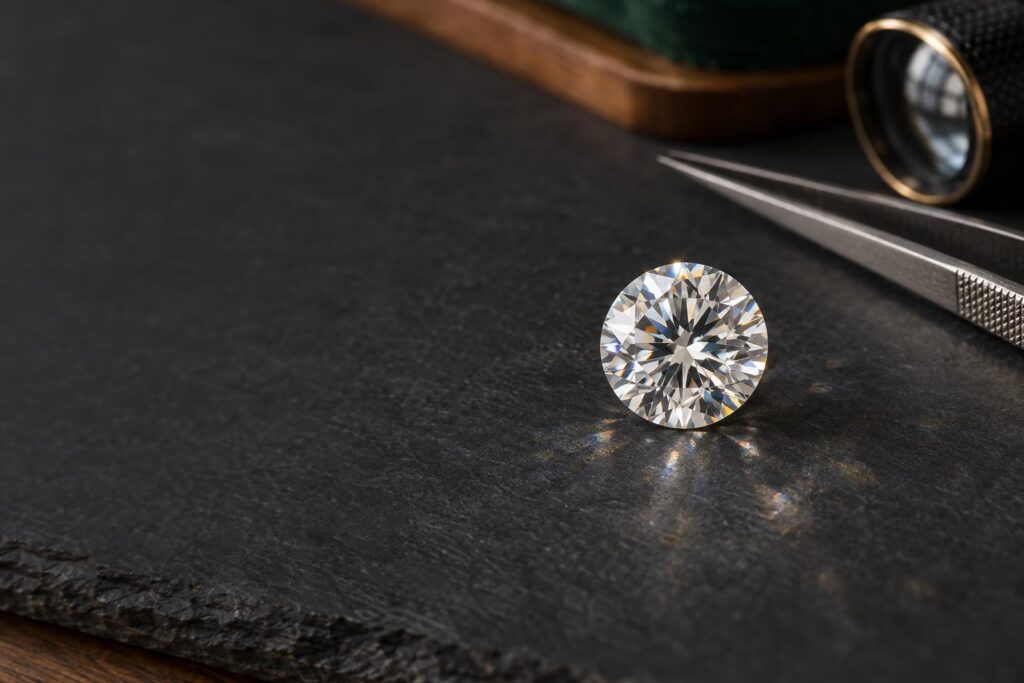
Why diamond has long been chosen for lasting jewellery
Why look closely at diamond before choosing one for a ring you will wear for life? Because what makes it last, and what makes it beautiful, both come from how it is built. Diamond is the only gem made of a single element: carbon. 6
How did it form? Natural diamonds grew deep in the earth under extreme heat and pressure, some as long as three billion years ago. Volcanic activity carried them to the surface in kimberlite pipes, which are columns of volcanic rock. 3 In most mines, the average yield is one part diamond to one million parts rock. 6
What is it, in mineral terms? CIBJO, the international jewellery confederation, defines diamond as a mineral made essentially of carbon that crystallises in the cubic system. Its refractive index, a measure of how strongly it bends light, is 2.42. Its specific gravity, its weight compared with the same volume of water, is about 3.52. 4
Why the 4Cs shape how a diamond looks
Why learn the 4Cs before you compare diamonds? Because they are the shared language for describing quality. The 4Cs are colour, clarity, cut and carat weight. GIA founder Robert M. Shipley coined the phrase in the 1940s, and it became the universal method for judging diamond quality. 2
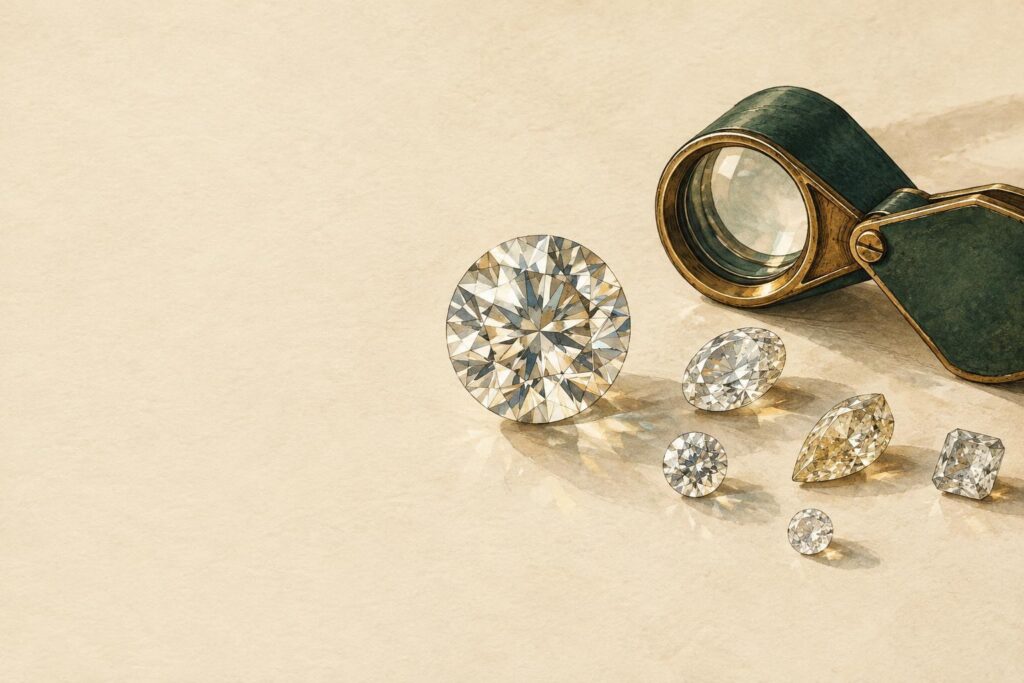
- Colour: GIA’s D-to-Z colour scale, introduced in 1953, sets the standards for judging diamond colour. Grades are set by comparing a stone with reference diamonds called masterstones.
- Clarity: this depends on inclusions (features inside the stone) and blemishes (marks on the surface). Clarity grades assess their number, size, relief and position. 6
- Cut: how a diamond interacts with light, through brightness, fire (flashes of colour) and scintillation (sparkle as it moves).
- Carat: a measure of weight, not size. 2
The colour range in this entry follows the D-to-Z scale, because that is the range its sources describe. Each grade is explained in The 4 Cs of diamonds. The terms brilliance, dispersion, inclusion and carat each have their own glossary page.
Why cut and shape mean different things
Why separate cut from shape? Because they describe different things, and GIA treats them differently. Shape is the outline, such as oval. Cut describes how the diamond’s facets, its small flat polished surfaces, handle light. GIA introduced its cut grading system for round brilliant diamonds in 2006. All other shapes, such as marquise, emerald, pear, oval and heart, are called fancy shapes. 2
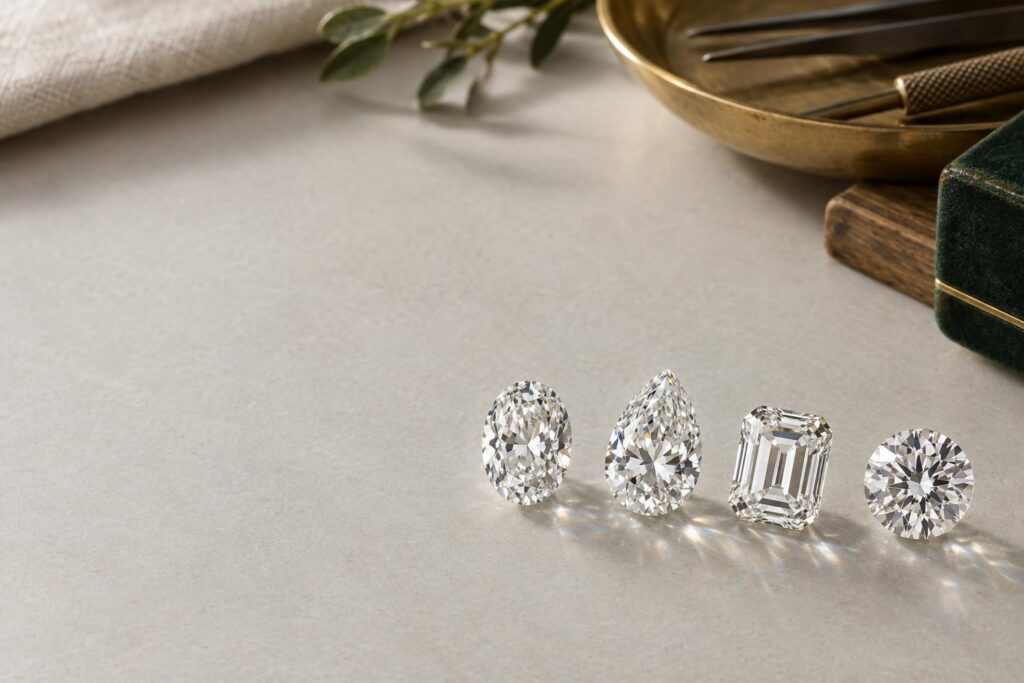
How light moves through a cut stone is covered in diamond cut explained. The look of each outline is compared in choosing a diamond shape.
Why treatments must be disclosed
Why ask whether a diamond has been treated? Because a treatment changes a stone after it formed or grew, so it is part of knowing what you are buying. CIBJO’s diamond standards, which are international industry guidance, state that treatments must be disclosed. 4
How common is it? Most CVD laboratory-grown diamonds receive treatments such as heating or irradiation after growth to change their colour. CVD, or chemical vapour deposition, is a way of growing diamond from a gas. 3 How disclosure works in general is set out in how gemstone treatments should be disclosed.
Why hard is not the same as unbreakable
Why does durability matter for a ring worn every day? Durability is a gem’s ability to withstand wear, heat and chemicals. It has three parts: hardness, toughness and stability. On the Mohs scale, a ranking of scratch resistance from 1 to 10, diamond rates highest at 10. Only a diamond can scratch a diamond. 1
How can such a hard stone still break? Any stone will break if it is hit hard enough in the right place. A hard blow along a cleavage direction, a plane along which the crystal tends to split, can split a diamond while it is being worn. Diamond can also scratch the precious metals used for settings, so a loose diamond can wear through a prong over time. A prong, also called a claw, is a small metal arm that holds the stone. 1
What about heat, chemicals and cleaning? Diamonds resist virtually all acids, but sudden, extreme temperature changes can cause fractures or spread existing ones. They can be cleaned safely with lint-free cloths, commercial jewellery cleaners and household detergents. Avoid harsh methods at home, such as abrasive cleansers, and bear in mind that ultrasonic and steam cleaners can loosen stones in their settings. 1 More on this is in the Mohs scale is not the whole durability story.
Why diamond marks April and long marriages
Why does diamond appear in so many traditions? It is the April birthstone, and it marks the 60th and 75th wedding anniversaries. 6
Why knowing what you are buying matters
Why ask whether a diamond is natural or laboratory-grown? Because the two look alike. A laboratory-grown diamond has essentially the same chemical, physical and optical properties as a natural diamond. It is made by HPHT (high pressure, high temperature) or CVD, and gem-quality lab-grown diamonds were first made in 1971. Traditional gemmological tests and older diamond detectors cannot separate the two, so a professional laboratory or specialist equipment is needed. 3
A simulant is different again: it imitates diamond’s appearance without its composition, properties or structure. Under CIBJO’s terms, words such as "real", "genuine", "precious" and "natural" may describe only natural diamonds. 4 The full comparison is in natural vs lab-grown diamonds.
What does a grading report tell you? An IGI report starts with a unique report ID, then shape, measurements and classification, with the 4Cs at its core. It also rates polish and symmetry and notes fluorescence, which is how a diamond reacts to ultraviolet light. It includes a proportions diagram and a plotted diagram showing where the inclusions are. 5 See how to read a GIA diamond grading report and GIA vs IGI diamond reports.
Why comparing actual stones helps you choose with confidence
Why look beyond the numbers on a report? Because the grades describe parts of a diamond, and you will wear the whole stone. Carat measures weight, not size, and cut describes how the stone handles light. 2 Comparing actual stones side by side, rather than report numbers alone, lets you see how the grades combine in one diamond.
How do you weigh the grades? It depends on what matters to you. If visible size matters most, see diamond carat weight vs visible size. If sparkle matters most, cut is the grade that describes light. If you plan to wear the ring every day, the shape and setting affect how well the stone is protected.
- Is it natural or laboratory-grown, and has it been treated?
- Does it come with a grading report, and from which laboratory?
- Where are the inclusions? A plotted diagram on the report shows their position. 5
- Does the shape have pointed corners, and how will the setting protect them?
- Was it graded loose? Grading a diamond while it is set in jewellery may be inaccurate. 4
How do you know a report belongs to the stone? Checking a report online by its ID or QR code can catch fake or altered reports. 5 That check confirms the report, not the stone in front of you. If the stone has a laser inscription, you can ask a jeweller to confirm it matches the report number.
Why the setting helps protect the diamond
Why does the setting matter for a stone this hard? Because hardness does not protect against every risk. Diamond shapes with pointed corners are often set with prongs to protect those corners from chipping. 1 Since a loose diamond can wear through a prong, having the setting checked regularly can help catch a loose stone early. Setting styles are compared in ring settings explained and four claws vs six claws.
Why this entry is a starting point
This entry describes diamond as a material, so you can weigh its qualities against what matters to you. Inclusion in this guide does not confirm that Ralph Jacobs stocks this gemstone. If you would like to talk through natural and laboratory-grown diamonds, we offer a free consultation, online from any country at bookings.ralphjacobs.org.
Frequently asked questions
Yes. Diamond rates highest on the Mohs scale, but any stone will break if hit hard enough in the right place. A hard blow along a cleavage direction can split a diamond, even while it is being worn. 1
Not with traditional gemmological tests or older diamond detectors. Separating natural from laboratory-grown diamonds needs a professional laboratory or specialist equipment. 3
No. Carat measures weight, not size. 2
Not by itself. Checking a report online by its ID or QR code can catch fake or altered reports. 5 It confirms the report, not the stone. If the stone has a laser inscription, ask a jeweller to confirm it matches the report number.