
Why does a diamond report mention a glow? It can sound like a defect, but fluorescence describes how a stone reacts to light, not damage. On a diamond grading report, it records how strongly the stone reacts to long-wave UV, an invisible part of daylight. A fluorescent diamond is just as structurally sound as one without it 1. In natural diamonds the glow is blue by far most often 4. Other gems glow too. In rubies, chromium causes a red glow that adds to the red colour 6.
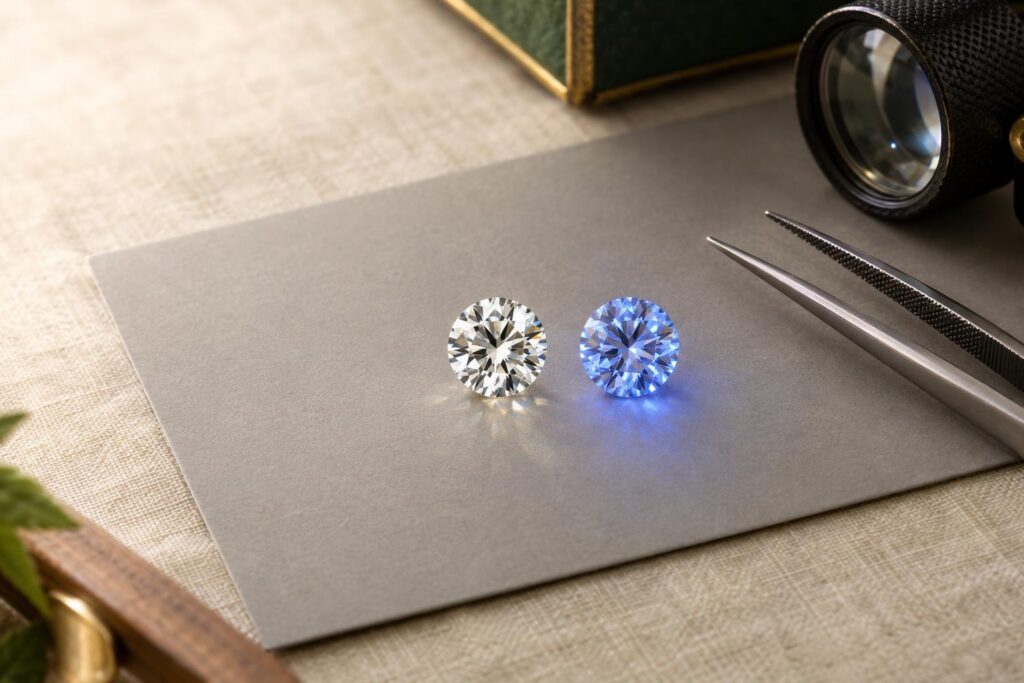
Why might it change how a diamond looks? Blue is the opposite of yellow, so a blue glow can make a slightly yellowish diamond look whiter in daylight. In a GIA study, the average person could not tell fluorescent diamonds from others. In rare cases, extremely strong fluorescence can make a diamond look hazy or oily 1. Haze comes mainly from light scattering off tiny structural defects. Still, strong fluorescence can cause a slight loss of contrast in some stones, and it adds to haze when those defects are present 3.
How can you judge your own diamond? The report entry alone cannot tell you, because each fluorescence grade covers a range of actual strengths. The amount of UV in the light also changes how colourful and bright a stone looks 3. So look at your diamond in daylight and under indoor lighting with little UV. If it looks hazy or dull to you, a jeweller can examine it in person.
Example: Picture two near-colourless diamonds, one graded none and one graded strong blue. Under a lamp with little UV they may look alike. Outdoors in daylight, the strongly fluorescent one may look less yellow 3.