Why tanzanite draws people in
Why do so many people fall for tanzanite? Its blue-violet colour is hard to mistake, and it is found in just one place on earth. 1 If you love that colour, you will also want to know how well it lasts and how scarce it is. This entry covers both.
Tanzanite is a variety of zoisite, a mineral first named in 1805 after Sigmund Zois. 5 The gem itself was named after Tanzania, where it was first found in 1967. 1
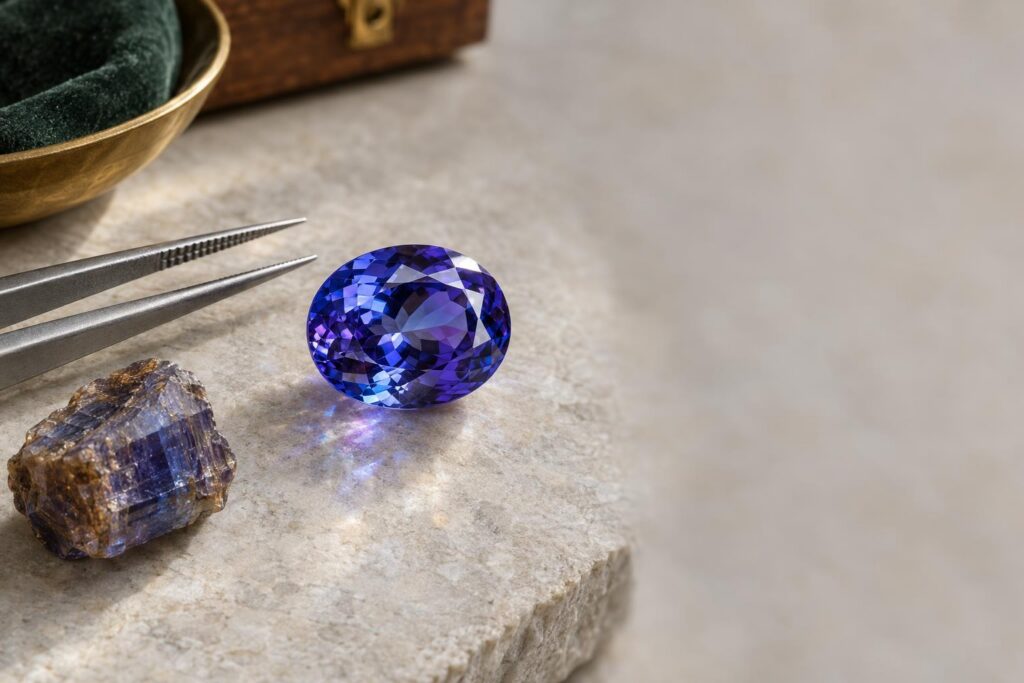
How does it get its colour? Tiny amounts of the element vanadium take the place of some aluminium inside the crystal, and this creates the violetish blue. 5 Its colour ranges from violet blue to bluish violet to violet purple. Its refractive index (how much it bends light) is 1.691 to 1.700, and its specific gravity (its weight compared with water) is 3.35. 1
Why tanzanite’s colour changes as you move it
Why does one tanzanite seem to hold several colours? It shows strong pleochroism, which means a gem shows different colours when you look along different crystal directions. A 1969 description named tanzanite’s three colours as red-violet, deep blue and yellow green. 2
Tanzanite's colour range
Tanzanite runs from violet blue through bluish violet to violet purple. Step through the range to see how the hue shifts.
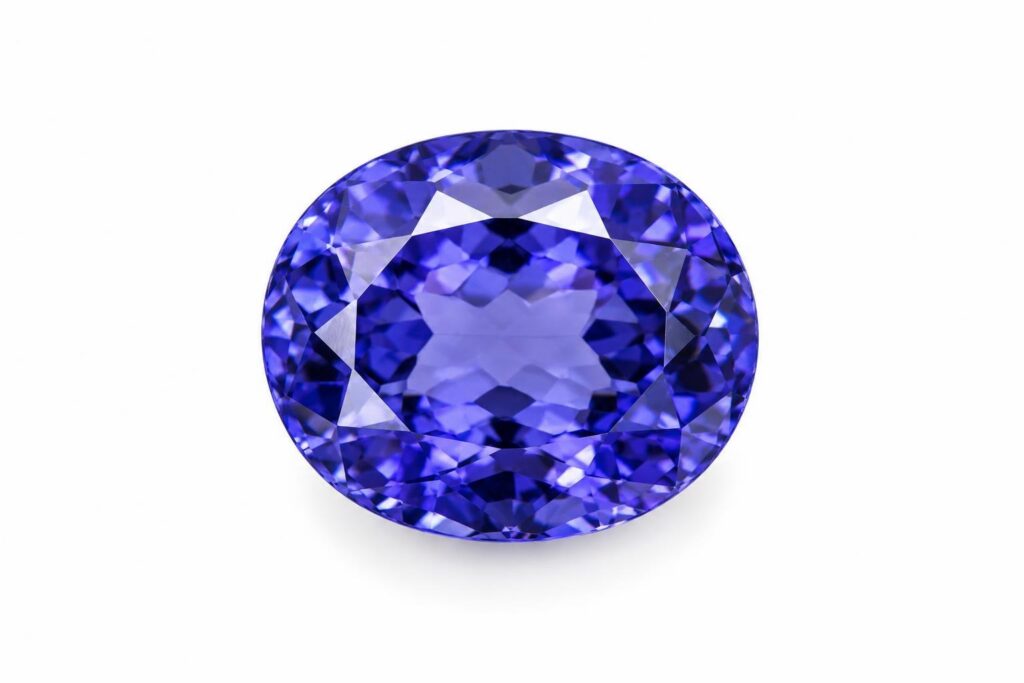
- Violet blue
- This is the bluest end of tanzanite's range. A violetish blue like fine sapphire can be top quality. Cool light brings out the blue.
- Bluish violet
- In the middle of the range, blue and violet sit in balance. The colour you see from the top also depends on the rough crystal, its size and how the cutter orients the stone.
- Violet purple
- At the far end, the stone is mainly violet to purple. A mainly violet hue can also be top quality. Warm light, such as an incandescent bulb, pushes tanzanite this way, and cutting for violet to purple wastes less rough.
Colours on screen are only a guide. A real tanzanite looks different in cool and warm light, and from different angles because of pleochroism. Pictures: AI-generated illustrations, checked for accuracy. They are not photographs of a real piece.
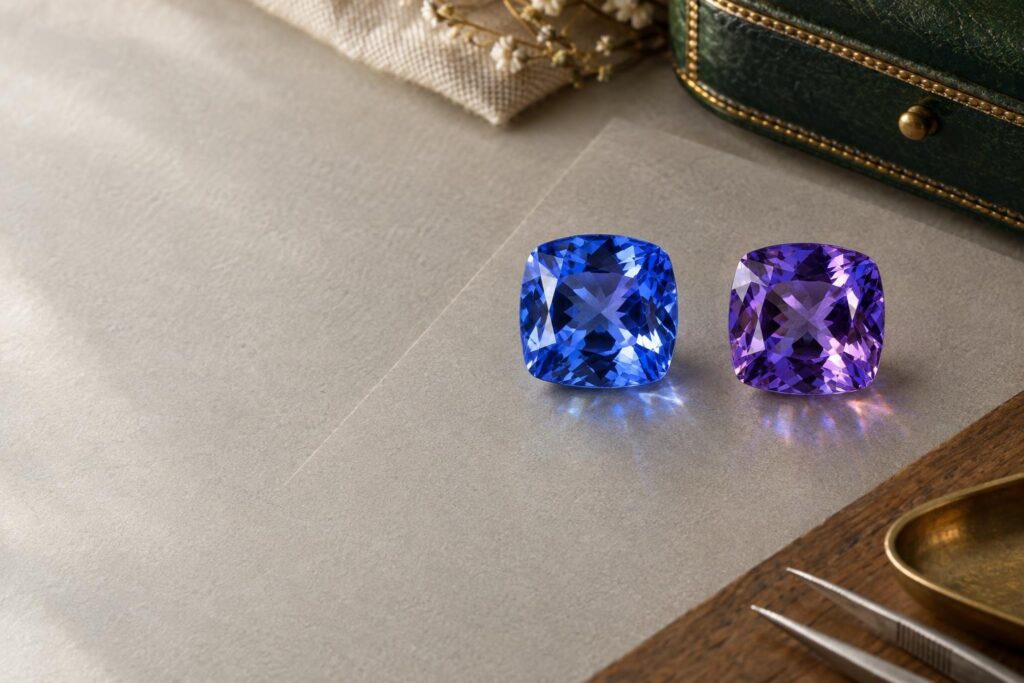
Light changes it too. Cool light brings out the blue, while warm light, such as an incandescent bulb, makes it look more violet to purple. The colour you see from the top also depends on the rough crystal, its size and how the cutter orients the stone. 2
How is tanzanite colour described? Hue is the basic colour, tone is how light or dark it is, and saturation is how strong it is. Our guide to hue, tone and saturation explains these words. Exceptional stones are an intense violetish blue with red flashes from within. Paler colours are easier to find and more affordable than saturated ones. 3
Size and clarity play a part. The finest, deepest colours are usually seen in stones over 5 carats, the unit used to weigh gems. Most cut tanzanites have no inclusions you can see with the eye; inclusions are tiny crystals or breaks inside a gem. Visible inclusions, or fractures that could weaken the stone, lower its value. 3
Why most tanzanite is heated
Why heat a gem at all? Untreated, tanzanite is typically brownish, and most blue tanzanite owes its colour to heating. 3 Naturally blue to violet material is rather rare, so much of the yellowish or greyish rough is heated to about 500–550 °C (932–1,022 °F) to turn it violet or blue. 5
What does this mean for you? Routine heat treatment is stable, with no added durability concerns. 4 The trade assumes most tanzanite has been heated, so heating has little effect on price, and laboratories often find it hard to tell. 3 You can read more in heat treatment in gemstones and how gemstone treatments should be disclosed.
Two other treatments are less common. Coatings are rare, are not permanent and can be scratched in normal wear. Fracture filling, where cracks are filled with another material, is uncommon, and fillers can change in appearance over time. 4
Why tanzanite needs protecting: durability and care
Why does tanzanite need more thought in a ring than some stones? It sits at 6 to 7 on the Mohs scale, which ranks scratch resistance. It also has fair to poor toughness (resistance to chipping and breaking) and cleavage, a tendency to break when struck. 4
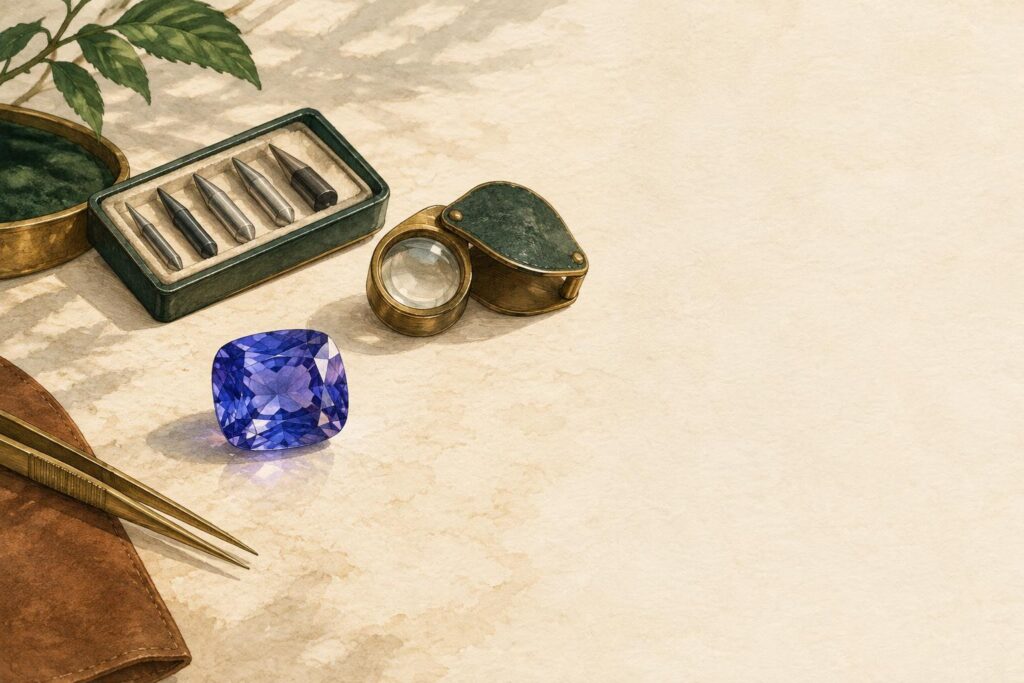
Hardness and toughness are different things, as the Mohs scale is not the whole durability story explains. Tanzanite is not as hard or tough as sapphire. It can still be worn in all types of jewellery if protected from rough wear and hard blows. 4
What should you avoid? Tanzanite is stable in normal wear, but very high heat, sudden temperature changes, and hydrochloric and hydrofluoric acids can harm it. Warm, soapy water is always safe, while ultrasonic and steam cleaners are never recommended. 4
Why a single source matters: where tanzanite is found
Why does origin come up so often with tanzanite? It has only one source: the hills of Merelani in northern Tanzania. 1 Research describes the only known locality as a deposit of about 7 km² (2.7 sq mi). 6
How did it form there? Vanadium built up in stages in rock layers, starting with carbon-rich mudstone. About 1,000 million years ago, these rocks were changed by heat of about 850–1,000 °C, and later movements in the rock were critical to forming the gem. 6
Is it rare? Because it is commercially mined in only one place, tanzanite is rarer than diamond. 1 Zoisite itself occurs in several countries, and one study names Alchuri in Pakistan and Merelani in Tanzania as sources of gem-quality zoisite. 5
Why tanzanite is linked to December
Why might tanzanite mean something to someone born in December? It is a birthstone for that month, alongside zircon, turquoise and blue topaz. It is also the gem for a 24th anniversary. 1 You can read more in our entries on zircon and topaz.
Why the details matter when buying tanzanite
Why look closely before you buy? The colour you see depends on the rough, its size, how it is cut and the light around it. A violetish blue like fine sapphire and a mainly violet hue can both be top quality, and pastel shades are more plentiful and affordable. Viewing a stone in both cool and warm light shows how its colour shifts. 2
Size, cut and clarity are worth checking too. The deepest colours are usually seen in stones over 5 carats, and smaller stones are often less intense. Cutting for violet to purple wastes less rough than cutting for violetish blue. Eye-visible inclusions, or fractures that could affect durability, lower the value. 3
What about treatment? The trade assumes most tanzanite has been heated, and laboratories often find heating hard to detect, so even a report may not settle the question. 3 Coatings and fillers are less stable than heating, so you may wish to ask whether a stone has either. 4
Why the setting matters for tanzanite
Why think about the setting early? Tanzanite needs protecting from rough wear and hard blows, so how a piece will be worn is worth considering. 4 Ring settings explained shows the main ways metal can hold a stone.
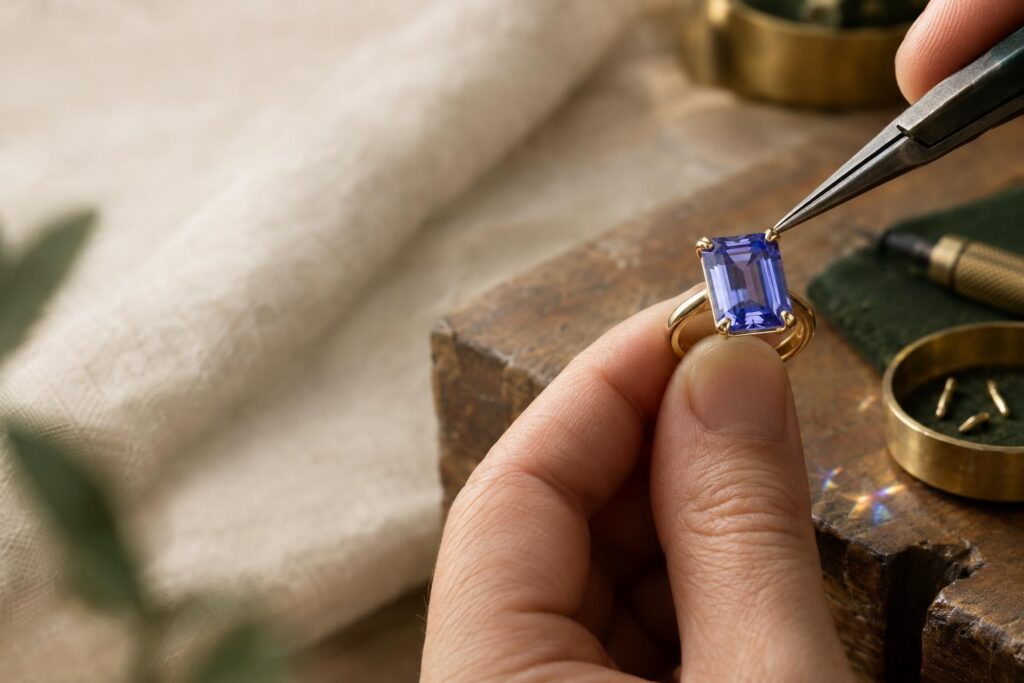
Colour also guides design. Because cool light favours blue and warm light favours violet, it helps to see a stone in the light where it will be worn most. 2 For more on stones in daily wear, see which gemstones suit everyday rings.
Why this entry describes rather than sells
This entry is here to help you weigh tanzanite’s colour, origin and care against how you live. Inclusion in this guide does not confirm that Ralph Jacobs stocks this gemstone. If you would like to talk through a coloured gemstone, we offer a free consultation, online from anywhere at bookings.ralphjacobs.org.
Frequently asked questions
Tanzanite is 6 to 7 on the Mohs scale, with fair to poor toughness and cleavage. It can be worn in all types of jewellery if protected from rough wear and hard blows. 4 How that fits depends on your daily life.
GIA states that tanzanite is rarer than diamond because it is commercially mined in only one place, the Merelani Hills in northern Tanzania. 1
Most is. Untreated tanzanite is typically brownish, and most blue stones owe their colour to heating. The trade assumes heating, and laboratories often find it hard to detect. 3
Lighting changes its colour. Cool light brings out the blue, while warm, incandescent light makes it look more violet to purple. 2