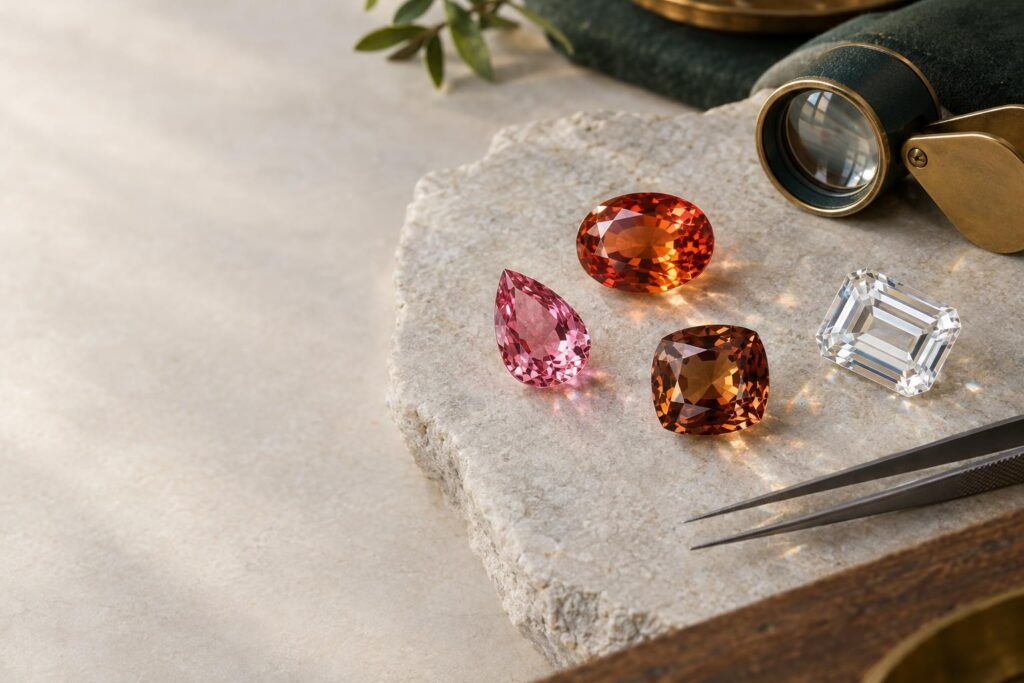
Why it helps to know what topaz is
Why does topaz turn up in blue, pink, orange, brown and even colourless? If you keep seeing it in so many shades, you may wonder whether these are all the same stone. They are: topaz has an exceptionally wide colour range 1. Knowing what it is helps you tell which colours are natural and how well it will wear.
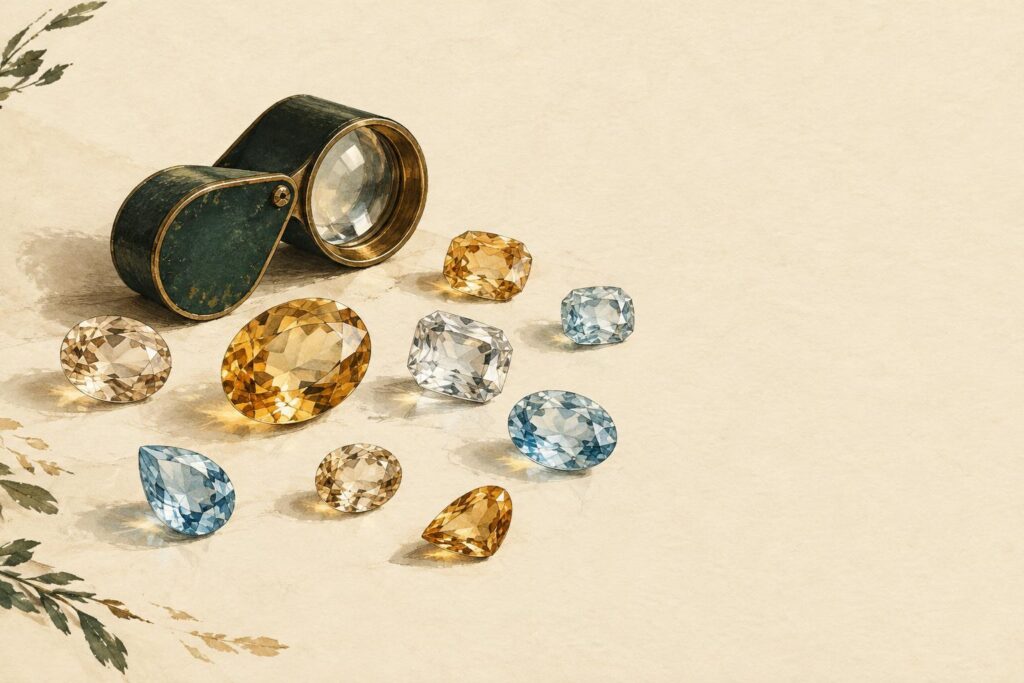
Topaz is a natural mineral built from aluminium, silicon, oxygen, fluorine and hydroxyl, with the formula Al₂SiO₄(F,OH)₂. Its crystals have a glassy shine, which gemmologists call a vitreous lustre 6.
Why is the name a little confusing? It comes from the Greek word topazion, which may refer to Zabargad Island in the Red Sea. That island was known for peridot, which people called topaz in ancient times 6.
Why topaz comes in so many colours
Why can one mineral be almost any colour? Topaz is allochromatic, which means its colour comes from impurity elements or tiny defects in its crystal, not from its basic chemistry. Chromium causes natural pink, red and violet-to-purple colours, while atomic-level flaws can cause yellow, brown and blue 1.
Topaz colours side by side
One mineral, many colours. Switch between these topaz varieties to see how different they look, and what causes each colour.
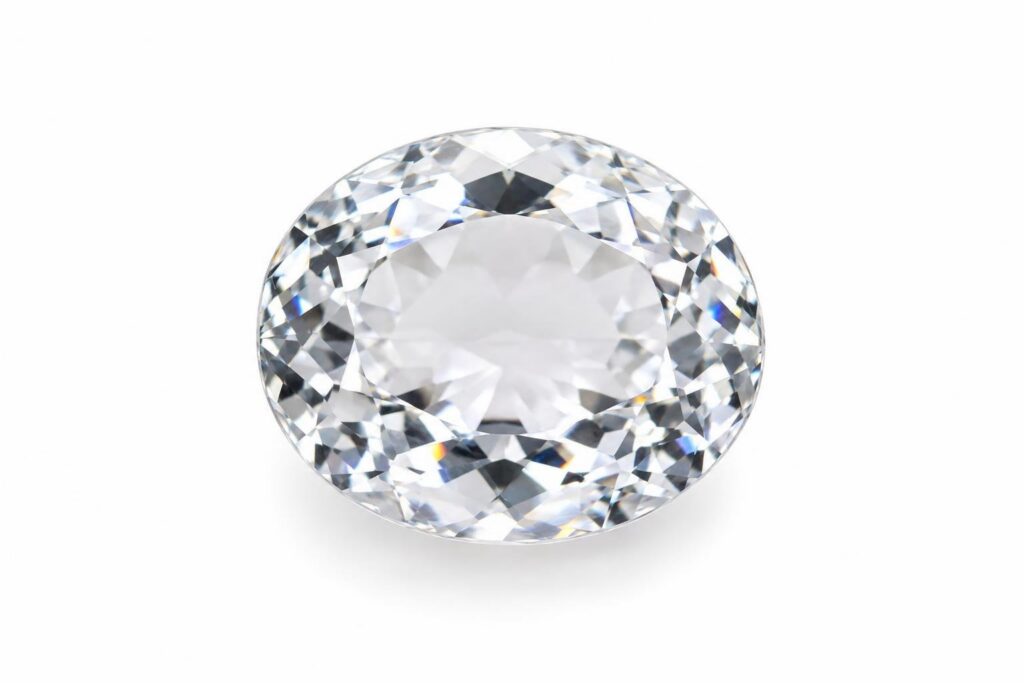
- Colourless topaz
- In nature, topaz is most often colourless. It is plentiful, and it is often treated to turn it blue.
- Blue topaz
- Most blue topaz is treated. Colourless stone may be irradiated and heated to produce the blue, and naturally strong blue is extremely rare. Faceted blue topaz is almost always free of eye-visible inclusions.
- Yellow and brown topaz
- Atomic-level flaws in the crystal can cause yellow and brown colours. Topaz is allochromatic, so its colour comes from impurities or tiny defects, not its basic chemistry.
- Imperial topaz
- Imperial topaz is medium reddish orange to orange-red, one of the gem's most valuable colours. There is no official standard for the name: it is the colour that gives the stone its value.
- Pink topaz
- Chromium causes natural pink, red and violet-to-purple colours in topaz. Rarer colours such as pink show inclusions more often than blue does.
- Bicolour topaz
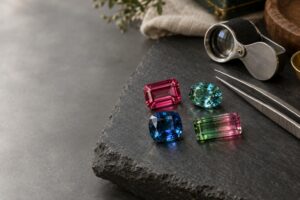
- A cut stone that shows two colours is called bicolour topaz.
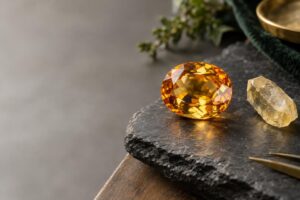
Colours in the pictures are illustrative; real stones vary widely in tone and saturation. Pictures: AI-generated illustrations, checked for accuracy. They are not photographs of a real piece.
In nature, topaz is most often colourless. Red is among the most sought-after colours, yet it makes up less than one-half of 1% of facet-grade material, meaning rough clean enough to cut into a faceted gem. A cut stone that shows two colours is called bicolour topaz 4.
Some colours have their own trade names. Imperial topaz is medium reddish orange to orange-red, one of the gem’s most valuable colours. Sherry topaz is yellowish brown or brownish yellow to orange 1. The rarest topaz colour is a vivid purplish pink 2.
Why does a topaz change as you turn it? Topaz is pleochroic: it can show different colours in different crystal directions 1. It is also often very clean to the eye. Cut topaz is often free of visible inclusions, the tiny crystals or marks trapped inside a gem, especially blue, colourless and yellow stones 4.
Why most blue topaz is treated
Why does treatment matter so much with topaz? Many people know topaz only as a blue gem, but its blue colour is hardly ever natural and is almost always caused by treatment. Colourless topaz is plentiful, and it is often treated to turn it blue 1. Naturally strong blue topaz is extremely rare 4.
How is blue topaz made? It may start out colourless, then be irradiated (exposed to radiation) and heated to produce blue. Strong blue topaz in the trade is considered irradiated, and irradiation is extremely frequent for topaz 5. National regulations around the world control the release of irradiated gems so that they meet safety standards 2.
What other treatments are used? Heating yellowish pink topaz can remove the yellow and strengthen the pink, a process explained in Heat treatment in gemstones. Some colourless topaz is coated with metal oxides to create a range of colours, but the colour stays on the surface 5. These coatings, often marketed as mystic topaz, are not very durable: abrasive cleaners or buffing wheels would remove them 3.
Why ask about treatment before you buy? A treatment can decide both a stone’s colour and how you look after it. Coated topaz, for example, should only be cleaned with mild soapy water 2. Asking the seller which treatments a stone has had gives you the facts to decide. You can read more in How gemstone treatments should be disclosed.
Why a hard stone can still split
Why can a hard gem still break? Hardness and toughness are different things. Topaz rates 8 on the Mohs scale, which ranks scratch resistance, so it resists scratching well. But its toughness, meaning its resistance to breaking and chipping, is poor because of its cleavage 3.
How does cleavage work? Cleavage is a direction in which a crystal tends to split along a flat plane, a little like wood splitting along its grain. Topaz has one perfect cleavage and is brittle 6. A hard blow might split it, and high heat or sudden temperature changes can cause breaks 3. Extreme pressure might also cause it to break 2. For more on this, see The Mohs scale is not the whole durability story.
What about fading? Topaz colour is generally stable to light. Long exposure to heat or sunlight may fade yellow-to-brown, reddish brown or dark brown topaz 3. Blue topaz tends to keep very stable colour, as long as it isn’t exposed to high temperatures 5.
How should you clean it? Use warm, soapy water, and avoid steam and ultrasonic cleaning 3. Coated topaz needs the gentler cleaning described in the treatment section above.
Why imperial topaz points to one region
Why does origin come up mainly with imperial topaz? Because one area stands out. GIA names one area of the world with commercial deposits of imperial topaz: Ouro Prêto, Brazil 1.
How does topaz form in the first place? It grows in veins and cavities in granite and in related rocks called granite pegmatite and rhyolite. Its crystals can reach 1.2 m (about 4 ft) long 6.
Why colour comes first when buying topaz
Why look at colour before anything else? Colour is the most important quality factor for topaz. There is no official standard for imperial topaz, and it is the colour, not the word imperial, that gives a stone its value 2. For how colour is judged, see Hue, tone and saturation in gemstones.
How do dealers decide what counts as imperial? Many insist a stone must show a reddish pleochroic colour to earn the name. This often appears at the ends of pears and ovals 4.
What about clarity and names? Faceted blue topaz is almost always free of eye-visible inclusions, while rarer colours like imperial and pink show them more often. Names can also mislead: topaz quartz is citrine and smoky topaz is brown quartz, so neither is topaz 2.
- Has this stone been irradiated, heated or coated?
- Is there a laboratory report, and what does it say about treatment?
- How should this stone be cleaned and worn?
Why the setting matters for rings and pendants
Why does the setting matter so much? Because of its cleavage, topaz needs special care during cutting, polishing and mounting. Cutters orient faceted topaz so the cleavage sits at about 15 degrees to the table, the large flat facet on top of the stone 3.
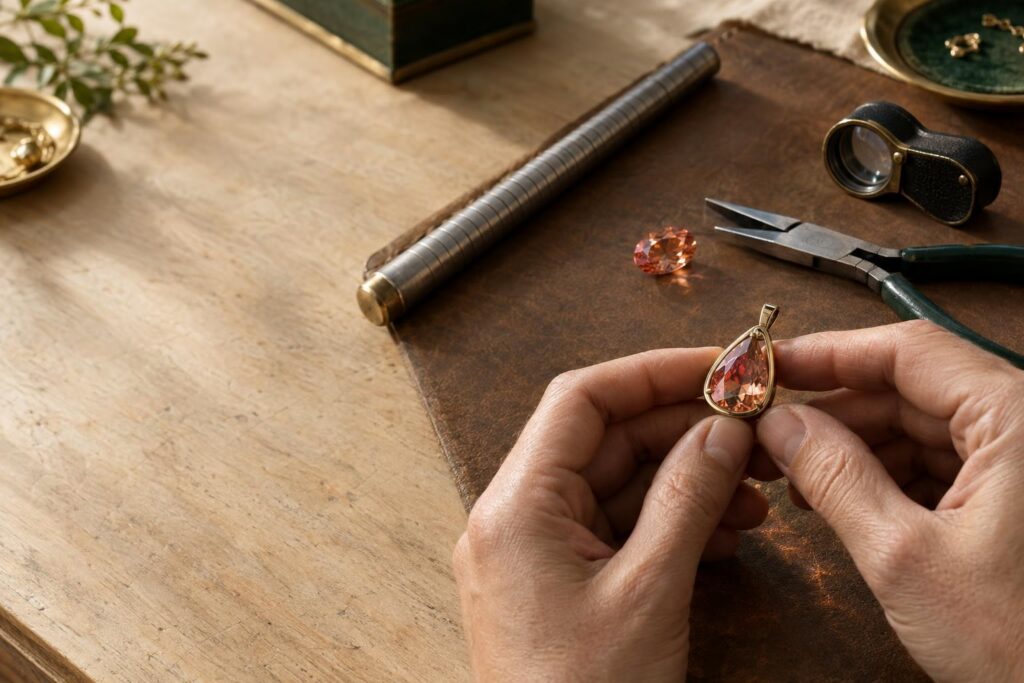
How do jewellers protect it? For valuable topaz, they prefer protective mountings, meaning settings that surround and shield more of the stone. They also use it in pieces with less wear, such as pendants and pins 3. If you are weighing a topaz ring against a pendant, that difference in wear is the relevant fact. Ring settings explained shows how different settings hold a stone.
What shapes suit topaz? Its crystals are usually long and column-shaped, so topaz is often cut as long ovals or pears 4.
Why this entry is here
This entry explains topaz so you can understand any stone you see. Inclusion in this guide does not confirm that Ralph Jacobs stocks this gemstone. We can source a wide range of coloured gemstones, and if you’d like to talk one through, we offer a free consultation online at bookings.ralphjacobs.org.
Frequently asked questions
Topaz rates 8 on the Mohs scale, so it resists scratching, but its toughness is poor because of cleavage. A hard blow might split it. Jewellers prefer protective mountings for valuable topaz, or lower-wear pieces such as pendants and pins 3.
No. Smoky topaz is brown quartz, and topaz quartz is citrine, so neither is topaz. It helps to check the mineral name, not only the trade name 2.