
The decision in brief
- If it matters to you that the stone is a diamond, natural and laboratory-grown diamonds are both carbon in the same crystal structure, while moissanite is silicon carbide, a different material.
- If the stone's origin carries meaning for you, most natural diamonds formed more than a billion years ago deep in the earth, while a laboratory-grown diamond grows in a few weeks.
- If scratch resistance matters most, both kinds of diamond are 10 on the Mohs scale and diamond is the hardest material on earth; moissanite is 9¼.
- If resistance to chipping matters, GIA rates diamond's toughness as good to excellent and moissanite's as excellent.
- If you care how the sparkle looks, moissanite's dispersion is more than double diamond's and its facet edges can look doubled, so see the stones side by side.
- If you want to know exactly what you own, ask for the stone to be named in writing and whether it has an independent laboratory report, because natural and laboratory-grown diamonds may be impossible to tell apart by eye.
- If sourcing matters to you, ask how a seller documents its stones; the Kimberley Process regulates trade in rough diamonds only.
Editorial guidance — context changes what is right for you.
Start with the wearer and the ring
Start with the person who will wear the ring, not with the stone in the tray. Think about how they use their hands, whether the ring will be worn every day, and what kind of sparkle they enjoy: bright and white, or full of coloured flashes.
Then think about meaning. For some people, a stone that formed deep in the earth over a very long time is part of the story. For others, a stone grown in a laboratory, or a different material with its own look, fits just as well. These are different priorities, and only the wearer can rank them.
Quick checklist
- Will the ring be worn every day, and does the wearer use their hands a lot at work or in sport?
- Does the wearer prefer bright white sparkle or strong flashes of colour?
- Does the stone's origin, ancient and from the earth or modern and from a laboratory, matter to the wearer?
- Is it important to the wearer that the stone is a diamond, or is the look enough?
- How important is an independent laboratory report?
- Are questions about where the stone comes from important to the wearer?
The criteria that matter
What the stone is made of
Natural and laboratory-grown diamonds are carbon in the same crystal structure. Moissanite is silicon carbide, a different material that imitates diamond.
Why natural vs laboratory-grown diamonds differ: a clear comparisonSparkle style
All diamonds share a dispersion of 0.044, while moissanite's is 0.104. Moissanite is doubly refractive, so its facet edges can look doubled.
Why does a diamond sparkle? Brilliance, fire and scintillationHardness and toughness
Diamond is 10 on the Mohs scale and the hardest material on earth; moissanite is 9¼. GIA rates diamond's toughness good to excellent, and moissanite's excellent.
Why the Mohs scale is not the whole gemstone durability storyOrigin and rarity
Most natural diamonds formed more than a billion years ago, and only a small share of kimberlite pipes are worth mining. Laboratory-grown diamonds grow in weeks, and jewellery moissanite is synthetic.
DiamondDisclosure and reports
Natural and laboratory-grown diamonds can't be told apart by eye or by traditional gem tests; a professional laboratory can. Ask for written naming and an independent report.
Why a GIA report matters: how to read a GIA diamond reportSourcing questions
The Kimberley Process regulates trade in rough diamonds to stop conflict diamonds, and it covers rough diamonds only. Ask about the sourcing of any stone you consider.
Compare your options
| Area | What changes visibly | When to prioritise | Reasonable compromise |
|---|---|---|---|
| What it is made of | Natural and laboratory-grown diamonds are carbon in the same crystal structure. Moissanite is silicon carbide, unrelated to diamond at the atomic level. | If it matters to you that the stone is a diamond. | Moissanite is a different material with its own optical properties. A laboratory-grown diamond can look the same as a natural one, so it depends on clear naming. |
| Sparkle style | All diamonds have a dispersion of 0.044. Moissanite's is 0.104, and it is doubly refractive, so its facet edges can look doubled. | If you have a clear preference for how a stone sparkles. | Moissanite's optics differ from diamond's, which may or may not suit your taste. |
| Hardness and toughness | Diamonds: Mohs 10, toughness good to excellent. Moissanite: Mohs 9¼, toughness excellent. | If the ring will be worn every day or during hands-on work. | Diamond is the hardest material on earth. Moissanite is less hard, but GIA rates its toughness as excellent. |
| Age and rarity | Most natural diamonds formed more than a billion years ago, and only a small share of kimberlite pipes are worth mining. Laboratory-grown diamonds grow in weeks; jewellery moissanite is synthetic. | If the stone's origin story carries meaning for you. | For some people a natural diamond's ancient origin is part of its meaning. Laboratory-grown diamond and jewellery moissanite have a modern, laboratory origin. |
| Telling them apart | By eye, natural and laboratory-grown diamonds may be impossible to tell apart. Thermal probes read moissanite as diamond. | Whenever you want to be sure what you own. | You rely on written naming and on testing by a professional laboratory or advanced identification devices rather than on your own eyes. |
| Sourcing | The Kimberley Process regulates trade in rough diamonds to stop conflict diamonds. It covers rough diamonds only. | If where the stone comes from matters to you. | The sources in this guide do not cover how laboratory-grown diamonds or moissanite are sourced, so you need to ask. |
PLACEHOLDER — replace with the real basis of this comparison and the date the figures were checked. · Region: South Africa · as of July 14, 2026
A practical decision process
- Write down what matters most to the wearer: looks, everyday wear, origin story or sourcing.
- Note how often the ring will be worn and how active the wearer's hands are.
- Compare what each stone is made of: carbon formed in the earth, carbon grown in a laboratory, or silicon carbide.
- Look at the stones side by side in different light, watching the coloured flashes and looking for doubled facet edges in moissanite.
- Weigh hardness (scratch resistance) and toughness (chip resistance) against the wearer's daily life.
- Ask for the stone to be named in writing, and ask whether it has an independent laboratory report.
- Ask the seller how its natural diamonds are sourced, and what it can tell you about its other stones.
- Ask a jeweller to compare price and resale for like-for-like stones, as this guide gives no prices and no resale comparison.
- Match the facts to the priorities you wrote down, and make your choice.
Numbers indicate order, not saved progress.
Common buying mistakes
- Treating moissanite as a type of diamond Moissanite is silicon carbide, unrelated to diamond at the atomic level, and its optical properties and density differ. Ask for every stone to be named for what it is.
- Trusting a simple diamond tester Thermal probes read moissanite as diamond, and traditional tests and older detectors cannot separate natural from laboratory-grown diamonds. Ask whether a professional laboratory has examined the stone. Why a GIA report matters: how to read a GIA diamond report
- Judging durability by hardness alone Hardness is scratch resistance; toughness is resistance to chipping or breaking. They are different qualities, so look at both. Why the Mohs scale is not the whole gemstone durability story
- Comparing stones of different materials by carat weight Carat is weight, and moissanite is less dense than diamond, so a moissanite of the same size and shape weighs less. Compare by millimetre size. Carat to Millimetre Estimator
- Treating the Kimberley Process as a check on a jeweller The scheme regulates trade in rough diamonds to stop conflict diamonds, and it covers rough diamonds only. Ask each seller how it documents its supply.
- Buying without written naming of natural or laboratory-grown The two may be impossible to tell apart by eye, and telling them apart takes a professional laboratory or advanced identification devices. Get the stone named on your receipt and ask about a report. Why natural vs laboratory-grown diamonds differ: a clear comparison
- Expecting every stone to sparkle the same way Moissanite has more than double the dispersion of diamond and shows doubled facet edges. See the stones side by side before you choose. Why does a diamond sparkle? Brilliance, fire and scintillation
Questions to ask
About what the stone is
- Is this a natural diamond, a laboratory-grown diamond or moissanite, and will that be written on my receipt?
- Does it come with an independent laboratory report, and from which laboratory?
- For a laboratory-grown diamond, was it grown by HPHT or CVD?
About looks and wear
- Can I see these stones side by side in daylight and in indoor light?
- Can you show me the doubled facet edges in a moissanite?
- Which settings could suit this stone for everyday wear?
About sourcing, price and resale
- How do you document where your natural diamonds come from?
- What can you tell me about where your laboratory-grown diamonds and moissanite are made?
- How do price and resale compare for these stones where I am buying?
Frequently asked questions
Is moissanite a type of diamond?
No, which is why its optics differ. Moissanite is silicon carbide, while diamond is carbon. It bends light more strongly, has more than double diamond’s dispersion, and is doubly refractive, so its facet edges can look doubled. GIA calls it a simulant: a material that imitates diamond.
Can you tell a natural diamond from a laboratory-grown diamond by eye?
Usually not, because they share nearly the same chemical, optical and physical properties. By eye they may be impossible to tell apart. A professional laboratory with advanced instruments can detect their very different growth histories.
Is moissanite hard and tough enough for an everyday ring?
It helps to separate two qualities. Hardness is scratch resistance: moissanite is 9¼ on the Mohs scale and diamond is 10. Toughness is resistance to chipping or breaking: GIA rates moissanite’s as excellent and diamond’s as good to excellent. Which matters more depends on how the ring will be worn.
Will a diamond tester spot moissanite?
Not always, which is why testing needs care. Moissanite handles heat so much like diamond that thermal probes read it as diamond. Even so, simulants are easy to identify by their optical and physical characteristics. Moissanite, for example, is doubly refractive, while diamond is singly refractive.
What does the Kimberley Process cover?
It helps to know what the scheme covers. The Kimberley Process is an international certification scheme that regulates trade in rough diamonds to stop conflict diamonds. It covers rough diamonds only, so ask any seller how they document their supply.
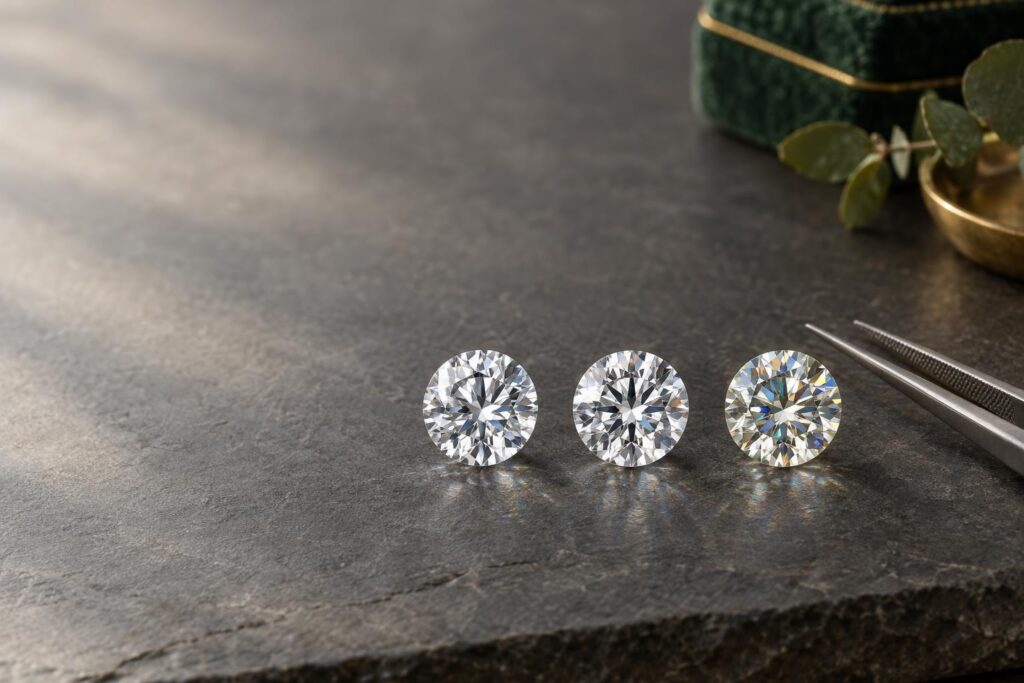
Why these three stones look alike but are different materials
Why does it matter what a stone is made of, if all three can look alike in a ring? Because the look is only part of what you are choosing. Moissanite is much closer to diamond in appearance and weight than any earlier imitation 4. Natural and laboratory-grown diamonds may be impossible to tell apart by eye 1. Yet the three differ in material, age and properties, and this guide compares those differences.
How is a natural diamond defined? It is essentially pure carbon, crystallised in what gemmologists call the cubic system 2. Diamond is the only gem made of a single element 3.
How is a laboratory-grown diamond different? It has the same crystal structure of tightly bonded carbon atoms, which gives it nearly the same chemical, optical and physical properties as a natural diamond. It is grown by one of two main methods: HPHT (high pressure, high temperature) or CVD, which builds the crystal at near-vacuum pressure 1. You can read more in CVD vs HPHT lab-grown diamonds.
What about moissanite? It is not a diamond at all. Moissanite for jewellery is synthetic silicon carbide, made to be near-colourless 4. GIA calls it a simulant: a material that imitates diamond but is completely unrelated to it at the atomic level 1.
Why the sparkle looks different from stone to stone
Why might two stones of the same size catch the light differently? Sparkle is usually described by three things: brilliance, the brightness of light returned to your eye; fire; and scintillation, the sparkle you see as the stone moves. Fire is how much light is visibly split into colours. It shows as small flashes of colour that change as you move, not as one rainbow 5.
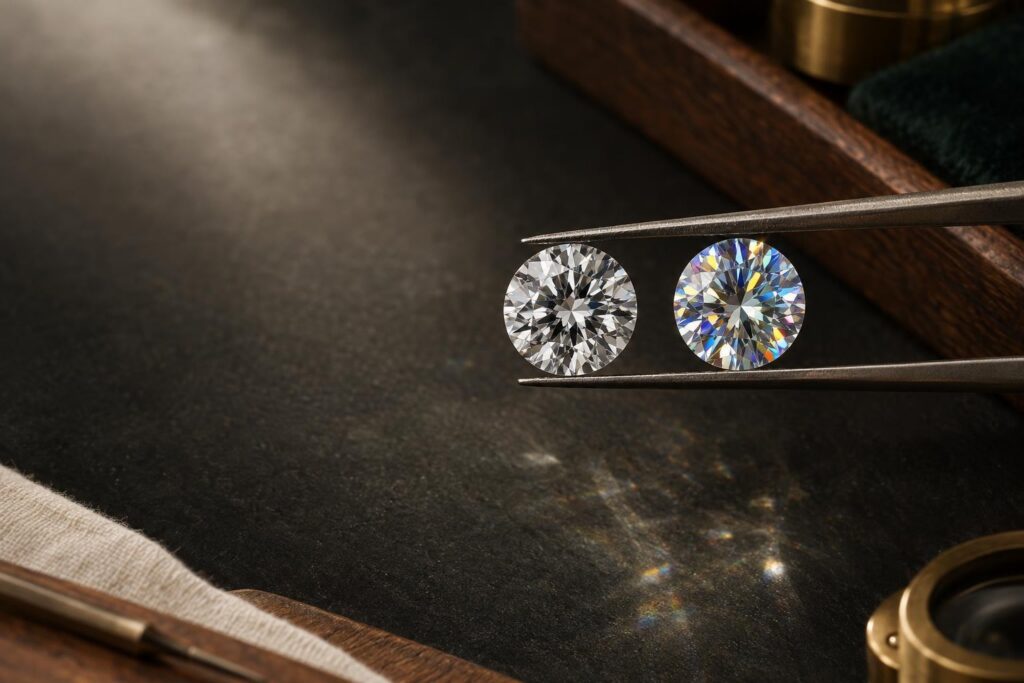
How does the material change this? Two numbers help. The refractive index measures how strongly a stone bends light. Dispersion measures how much that bending differs between blue and red light, and every diamond has the same value of 0.044 5. Moissanite’s dispersion is 0.104, more than double. Its refractive index is 2.648 to 2.691, against 2.417 for diamond 4.
What does that mean when you look at a ring? Moissanite is doubly refractive, meaning light splits in two inside it. So its facets, the flat polished faces of a stone, can show doubled edges, while diamond is singly refractive 4. A laboratory-grown diamond has nearly the same optical properties as a natural one, and by eye the two may be impossible to tell apart 1. For more, see brilliance, fire and scintillation explained.
Why hardness and toughness both matter in a ring you wear daily
Why look at two qualities, not one? Because hardness and toughness describe different kinds of damage. Hardness is resistance to scratching, measured on the Mohs scale. Toughness is resistance to chipping or breaking.
How do the three compare on hardness? Diamond is 10 on the Mohs scale. It is the hardest material on earth, 58 times harder than anything else in nature 3. A laboratory-grown diamond has essentially the same physical properties as a natural one 2.
And moissanite? It is 9¼ on the Mohs scale. On toughness, GIA’s comparison rates synthetic moissanite as excellent and diamond as good to excellent 4.
What does this mean for you? For what the Mohs numbers do and don’t tell you, see the Mohs scale is not the whole durability story. The setting is a separate choice, covered in ring settings explained.
Why age, rarity and origin carry meaning for some people
Why does origin matter to some buyers and not to others? For some, a stone’s meaning lies in where it came from and how long it took to form. Most natural diamonds formed more than a billion years ago, about 160 km (100 miles) below the surface 3. Volcanic activity carried them up through kimberlite pipes, which are deep channels of volcanic rock 2.
How rare are they? Only about 5% of kimberlite pipes hold enough diamond to be worth mining 2. Even in working mines, there is on average about 1 part diamond per million parts of rock 3.
What about the other two? A laboratory-grown diamond grows in a few weeks, while a natural diamond grows over millions of years 2. Henri Moissan found natural silicon carbide in the Canyon Diablo meteorite, and since then it has reportedly been found only in tiny amounts. Moissanite in jewellery is synthetic 4.
Why does sourcing come up with natural diamonds? Conflict diamonds are rough diamonds used by rebel movements or their allies to fund armed conflicts against legitimate governments. The Kimberley Process is an international certification scheme that regulates trade in rough diamonds to stop them 6. The sources in this guide do not cover how laboratory-grown diamonds or moissanite are sourced, so it is worth asking the seller about any stone.
Why your eyes can’t confirm what you are buying
Why ask for paperwork when you can see the stone yourself? Because looks alone can mislead. Traditional gem tests and older diamond detectors cannot tell natural and laboratory-grown diamonds apart; that takes a professional laboratory or advanced devices 2. Moissanite handles heat so much like diamond that thermal probes read it as diamond 4.
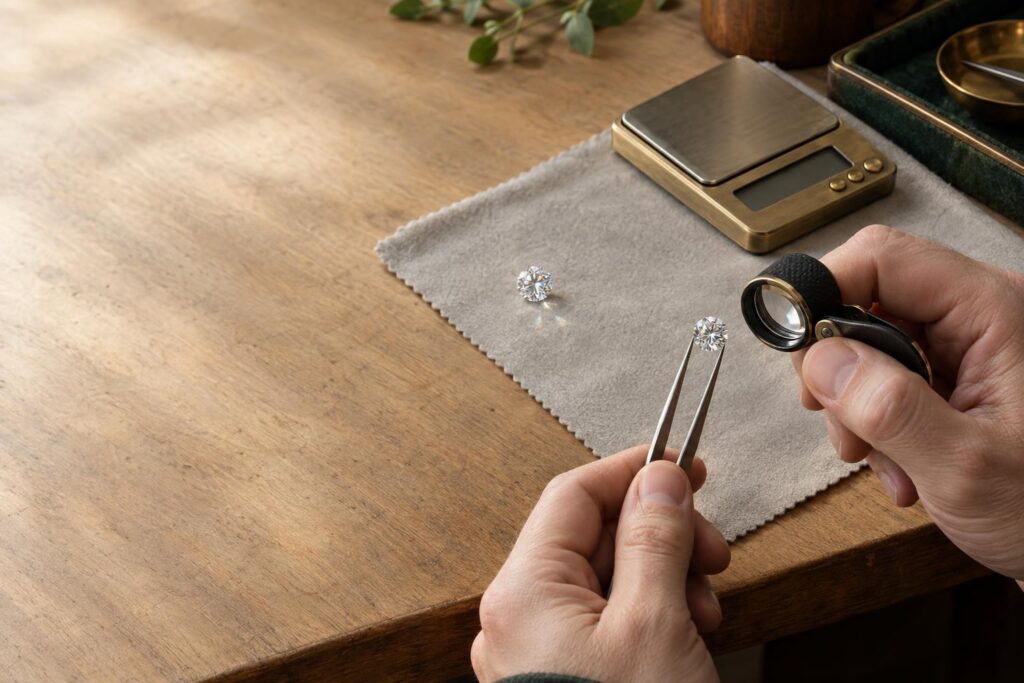
How do experts tell them apart? Simulants such as moissanite are easy to identify by their optical and physical characteristics. Laboratories with advanced instruments can also detect the very different growth histories of natural and laboratory-grown diamonds 1.
What can you do? Ask for the stone to be named in writing, so you have a record of what you were sold. Then ask whether a professional laboratory has examined it and issued an independent report. How to read a GIA diamond grading report and GIA vs IGI diamond reports explain what these documents show.
The downsides: when each stone may not be the right choice
Why look at the downsides? Every option here has trade-offs, and seeing them early can help prevent surprises later.
Natural diamond: most contain traces of other elements, especially nitrogen, which gives a yellow colour. They usually contain inclusions, which are tiny features inside the stone 2. If sourcing matters to you, ask how a seller documents its natural diamonds.
Laboratory-grown diamond: it does not share a natural diamond’s ancient, deep-earth origin, because laboratory-grown diamonds are young 1. Traditional gem tests can’t tell it from a natural diamond, so you rely on clear naming and on testing by a professional laboratory or advanced devices 2.
Moissanite: it is not a diamond, and it is less hard than diamond. It is doubly refractive, so its facet edges can look doubled, and its dispersion is more than double diamond’s 4. Buying a simulant can be a great option, as long as it is an informed decision 1.
Price and resale: there can be significant price differences between natural and laboratory-grown diamonds 2, but the sources here give no figures and do not compare resale. Ask a jeweller to compare like-for-like stones where you buy.
Why a few tools can help you compare
Why use tools? They turn weights and numbers into something you can picture. Carat is a unit of weight for gemstones, not a measure of size. Diamond’s specific gravity, its weight compared with the same volume of water, is 3.52 3. Moissanite’s is 3.22, so a moissanite of the same size and shape weighs less than a diamond 4.
- Carat to Millimetre Estimator: see roughly how a weight translates into a stone’s width.
- Engagement Ring Budget Planner: plan the complete ring, not only the stone.
- Ring Size Converter: convert between the ring sizing systems used in different countries before you order.
Sources and methodology
This guide draws on GIA’s gem encyclopedia and educational pages, research published in Gems & Gemology, and the Kimberley Process’s own FAQ. It gives no prices. Its sources note that prices differ between these stones but give no figures, and they do not compare resale. Workshop experience was not used for any comparison.
- Simulants, Moissanite and Lab-Grown Diamonds
- Is There a Difference Between Natural and Laboratory-Grown Diamonds?
- Diamond (GIA gem encyclopedia page)
- Synthetic Moissanite: A New Diamond Substitute
- Modeling the Appearance of the Round Brilliant Cut Diamond: An Analysis of Fire, and More About Brilliance
- FAQ – Kimberley Process