
The decision in brief
- If you have a fixed date, such as a planned proposal, ask how long the ring will take before you commit. A complex custom design takes longer than a simple one, so ask your jeweller how long it will take.
- If no existing design matches what the wearer wants, custom design opens up choices of style, metal, finish and stones.
- If a long list of choices feels overwhelming, setting fairly specific limits before you shop, and asking a jeweller to help narrow the options, may make it easier.
- If you find it hard to picture a ring from a drawing, ask whether you will see photo-realistic images and a wax model before you approve it.
- If you like an existing design but want small changes, or want to use your own stone, ask what that involves. It is a very different job from creating a whole new design.
- If the wearer works with their hands, lower, less ornate or more secure settings are less likely to knock or catch, whichever path you take.
- If you are unsure of the ring size, find it before you meet a designer, because sizing a ring down is much easier than sizing it up.
Editorial guidance — context changes what is right for you.
Start with the wearer and the ring
Start with the person who will wear the ring, not with the path. Think about their hands, their work and how often they will wear it. Lower, less ornate or more secure settings are less likely to knock or catch, and that matters with either path.
Then think about your own situation as the buyer. Is there a date you need to meet? Will you choose together or alone? How much time can you give to looking at designs and approving them? Write your answers down, so you have something concrete to bring to a jeweller.
Quick checklist
- The ring size, and which country's sizing system it is in
- The wearer's daily activities and whether the ring may knock or catch
- The stone shape the wearer prefers, because shape helps decide the overall design
- The metal colour and finish (polished, matte or textured) they like
- Any date the ring must be ready by
- How comfortable you are approving a ring from pictures rather than holding it
- Whether you have your own stone to use
- A clear limit for the complete ring, not only the stone
The criteria that matter
Time
Complex custom designs or matched stones take longer than simple designs, so ask your jeweller how long it will take. For an existing design, ask how long setting the stone and sizing will take.
Why a proposal planning timeline works backwards from the dateDesign freedom
Custom design opens up the style, metal, finish and stones. An existing design is a starting point that can sometimes take small changes or your own stone.
Why the setting matters: how to choose an engagement ring settingHow many decisions you make
Custom design brings many choices, and a designer also weighs materials, durability and how the ring will be made. Fairly specific limits help the jeweller find the right ring, and a good jeweller helps narrow your choices.
Why order matters: how to choose an engagement ring in six stepsApproval steps
Custom rings are usually approved several times while they are made, often from photo-realistic images and then a wax model. Ask how many steps there are and what you sign off at each.
Why does the custom jewellery process have so many stages?Seeing the ring before you commit
A custom ring doesn't exist when you order it, so you judge it from pictures and models. For an existing design, ask whether you can see a finished example.
Why the setting matters: ring settings explainedCompare your options
| Area | What changes visibly | When to prioritise | Reasonable compromise |
|---|---|---|---|
| Time | Custom: complex designs or matched stones take longer than simple designs; ask your jeweller how long it will take. Existing design: ask how long setting your stone and sizing will take. | When the ring must be ready by a set date. | Complex designs and matched stones add time, so check timing against your date. |
| Design freedom | Custom: style, metal, finish and stones are open, from classic to vintage or modern. Existing design: you start from a finished design, sometimes with small changes or your own stone. | When no existing design matches what the wearer wants. | More options mean more choices to work through; limits and a jeweller's help can narrow them. |
| Decisions and expertise | Custom: many choices, often starting from only a rough idea, with a designer weighing materials, durability and how the ring is made. Existing design: the design work has already been done. | When you want a say in the details. | Your ideas still need to work with the dimensions a ring needs for durability. |
| Approval steps | Custom: approval usually comes several times, often with photo-realistic images and a wax model. Existing design: ask what you approve before the stone is set or the ring is sized. | When you want to shape the ring as it develops. | A custom design may go through many versions before it is signed off. |
| Seeing before you commit | Custom: the ring doesn't exist yet, so you judge it from pictures and models. Existing design: ask whether you can see a finished example. | When seeing the real ring before you commit matters most. | The further you are from the workbench, the greater the chance of error, so ask what you will see at each stage. |
A practical decision process
- Write down the wearer's daily activities, preferred stone shape, metal colour and ring size, noting which sizing system the size is in.
- Note any date the ring must be ready by and set a clear limit for the complete ring.
- Look at existing designs and note what you like and what you would change.
- Decide whether your changes are small adjustments or a design from scratch, and ask whether a semi-mount could hold your chosen or own stone.
- Ask the jeweller how long each option will take, and compare that with your date.
- Ask how many approval steps there are, whether you will see photo-realistic images or a wax model, and what you sign off at each.
- Check whether the setting you like can be resized later, and what care it will need over time.
- Weigh time, freedom, decisions, approvals and what you can see before committing against your notes, and choose the path that fits your situation.
Numbers indicate order, not saved progress.
Common buying mistakes
- Ordering a custom ring without asking how long it will take Complex designs or matched stones take longer than simple designs. Ask for the timing before you commit, especially if there is a date in mind. Why a proposal planning timeline works backwards from the date
- Shopping without any limits The range of engagement ring choices can feel dizzying. Fairly specific limits before you shop help the jeweller find the right ring. Why salary rules don’t fit: how to set an engagement ring budget
- Guessing the ring size Sizing a ring down is much easier than sizing it up. Find the size, and note which country's sizing system it uses, before you meet a designer. Why ring sizes differ by country: how to read a conversion chart
- Approving a custom ring from a single sketch A wax model shows dimension in a way a drawing can't, and custom buyers can expect photo-realistic images before approving. Ask what you will see before each approval. Why does the custom jewellery process have so many stages?
- Choosing a design without thinking about daily wear Lower, less ornate or more secure settings are less likely to knock or catch. Match the setting to how the ring will be worn. Why the setting matters: how to choose an engagement ring setting
- Not asking about resizing Some settings, such as tension-set rings, can be very difficult or impossible to resize. Ask before you approve the design. Why can’t every ring be resized? How ring resizing works
- Thinking custom always means starting from nothing Often a customer likes an existing design but wants small changes or to use their own stone. That is a very different job from creating a whole new design, so ask what your changes involve.
Questions to ask
Time and process
- How long will this design take to make, from approval to finished ring?
- Is this a simple design, or will matching stones add time?
- Can this existing design be adjusted, or would my changes mean starting from scratch?
Approvals and seeing the ring
- How many times will I approve the design, and at which stages?
- Will I see photo-realistic images, a wax model, or both?
- What exactly am I signing off at each approval?
- Can I see a finished ring or sample of this design?
Fit, wear and aftercare
- Can this setting be resized later if needed?
- Will this setting knock or catch in the wearer's daily life?
- What care will this setting need over time, such as re-tipping or tightening?
Frequently asked questions
How long does a custom engagement ring take?
It depends on the design. A complex design, or one where stones must be matched, takes longer than a simple design. Ask your jeweller how long it will take before you commit.
Will I see a custom ring before it's made?
Not as a finished ring, because it doesn’t exist yet. Custom buyers expect photo-realistic images before approving. Jewellers usually ask for approval several times while the ring is made, especially at the wax stage. A wax model shows dimension in a way a drawing can’t.
Can I change an existing design or use my own stone?
Often a customer likes an existing design but wants small changes, or wants to use their own stone. Setting a stone in a semi-mount is a very different job from creating a whole new design. Ask the jeweller what your changes involve.
Can any ring be resized later?
Not always. Sizing a ring down is much easier than sizing it up, and some settings, such as tension-set rings, can be very difficult or impossible to resize. Ask about resizing before you approve any design.
Why do jewellers make a wax model?
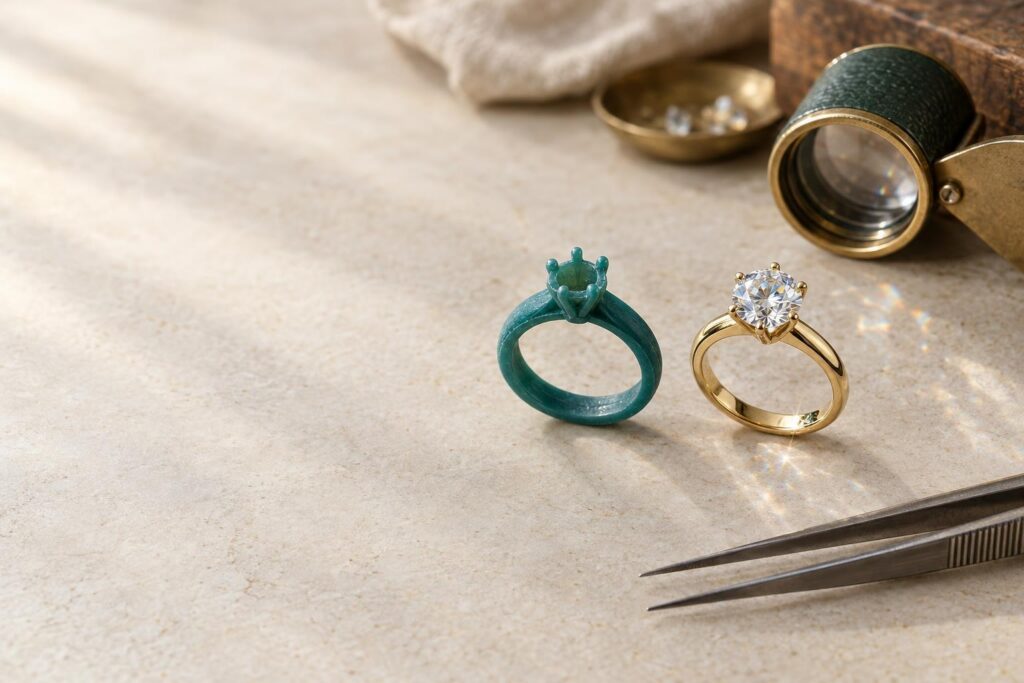
A wax model shows the ring’s shape in three dimensions, which a drawing can’t. In lost-wax casting, a wax pattern is encased in plaster and burned out, and metal is poured into the space it leaves. So the wax shape becomes the metal ring.
Why this choice feels so hard
Why do so many people get stuck between a custom ring and a ready-made design? Partly because engagement ring buyers face a dizzying range of choices. 3 This guide sets out what each path involves, so you can weigh them against your own situation.
How do the two paths differ? A ready-made design is a ring the jeweller has already designed. A custom ring is designed for you, so it doesn’t exist yet when you order it. That is why much of custom selling means selling from pictures, such as hand sketches, digital sketches or CAD images. 5 CAD (computer-aided design) is software that builds a 3D model of the ring on screen.
What part of the ring are you shaping? Whichever path you take, the setting matters. The setting is the metal mounting: the parts that hold the stone, plus the band. It secures the stone and shapes the ring’s look, how it handles light and how well it wears. 4 You can read more in Ring Settings Explained: A Visual Guide.
Why time is often the deciding factor
Why ask about time before anything else? Because a custom ring is made to your design, and that takes time. A complex design, or one where stones must be matched, takes longer than a simple design such as a three-stone ring. 1 Ask your jeweller how long your ring will take.
How does this affect you? If you have a date in mind, such as a planned proposal, ask the jeweller how long the ring will take before you commit. For an existing design, ask how long setting your stone and sizing the ring will take. The proposal planning timeline can help you work backwards from a date.
Why more freedom also means more decisions
Why can design freedom feel heavy? Because more options mean more choices to make. For a custom ring, the style options are close to endless: classic, edgy, vintage, modern and more. You also choose the metal, the finish (polished, matte or textured) and whether to use colourless diamonds, coloured diamonds or coloured gemstones. 1
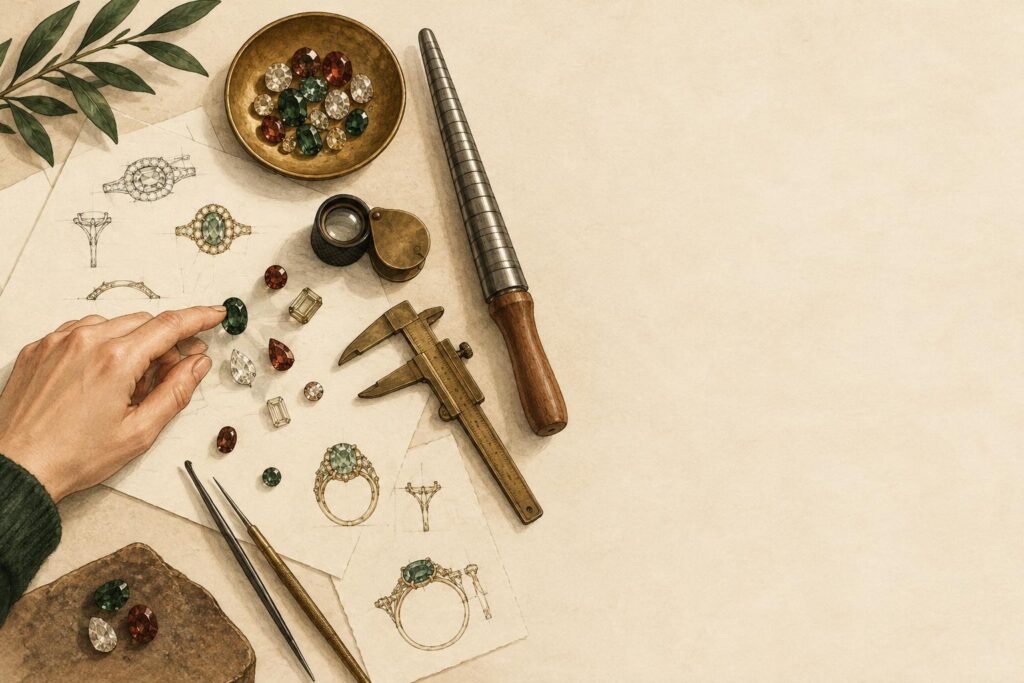
Is every choice down to taste alone? No. Designers must understand materials, how pieces are made, the dimensions needed for durability and how jewellery sits on the body. 5 So a custom design is shared work between your ideas and the designer’s knowledge.
How do people manage all those choices? Customers often roughly know what they want but have few specific details in mind. 2 Fairly specific limits before you shop help the jeweller find the right ring, and a good jeweller helps narrow your choices. Think about daily life too: lower, less ornate or more secure settings are less likely to knock or catch. 3
What will you be asked first? Expect questions about stone shape, because the shape helps decide the overall design. 1 See Choosing a Diamond Shape if you are unsure.
Why approval steps decide how certain you feel
Why do approvals matter so much with a custom ring? Because you are buying something you can’t hold yet. Many customers aren’t comfortable ordering from a drawing, which is one reason custom design can be a hard decision. 2
How do jewellers close that gap? Because CAD is so widely used, custom buyers expect photo-realistic images of their ring before they approve it. A design may go through many versions before the client approves it. 5
What happens after the images? Jewellers usually ask you to approve the piece several times while it’s being made, especially at the wax stage. A wax model is a copy of the ring in wax, and it shows dimension in a way a drawing can’t. 2 At Ralph Jacobs, you approve the design render, stone, size and engraving in writing before we start, and renders are a visual guide, not an exact photo; a free consultation is the place to ask how that works.
How a custom ring goes from picture to metal
Why does it help to know the making steps? Because they explain why CAD images and wax models come up when you approve a design. A designer’s skill turns any 2D image into a 3D model, using CAD or traditional hand carving or fabrication. 5
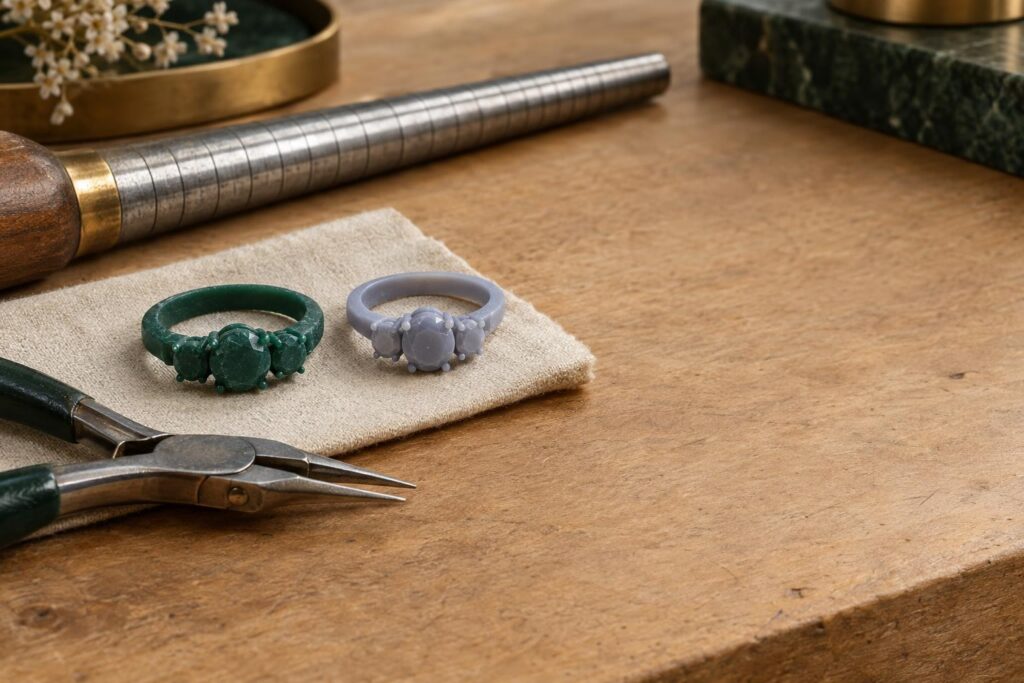
How is the metal shaped? Lost-wax casting is widely used for jewellery. A wax pattern is encased in plaster, the wax is burned out, and metal is poured into the space it leaves. In a digital workflow, the pattern is 3D-printed from the CAD design rather than carved from wax by hand. Cast parts are then filed, ground or sandblasted to reach their final shape and finish. 6 For the full journey, see How the Custom Jewellery Process Works.
Why a middle path is often possible
Why choose strictly between the two? Often a customer likes an existing design but wants small changes, or wants to use their own stone. Creating a design from scratch is very different from setting a stone in a ready-made semi-mount, which is a finished mounting with the centre stone left out. 2 A trained jeweller can help you explore options from classic designs to custom styles. 4
The downsides: when each path may not suit you
Why look at the downsides before you choose? Because each path has trade-offs. Knowing them helps you pick the one you can live with.
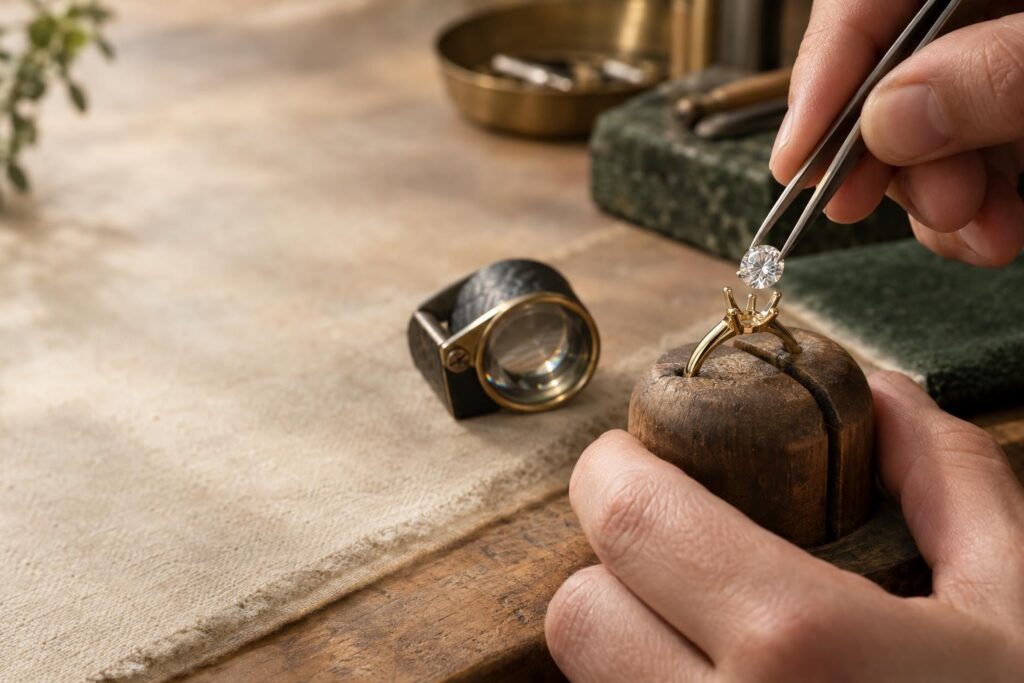
When might custom not suit you? The further you are from the workbench, the greater the chance of error. 2 A design may also go through many versions before it is approved. 5 If you have little time, or find pictures hard to judge, that is worth weighing.
When might an existing design not suit you? When no design matches what the wearer wants, or one detail matters a lot. Often a customer likes an existing line but wants small design changes. 2 If that is you, ask whether the design can be adjusted before you buy.
What applies to both? Sizing a ring down is much easier than sizing it up. 3 So know the ring size before you meet a designer. 1 To compare a size across countries’ sizing systems, use the Ring Size Converter.
Some settings, such as tension-set rings, can be very difficult, sometimes impossible, to resize. Most settings also need occasional care, such as re-tipping prongs or tightening stones. 4 Prongs, also called claws, are the small metal tips that grip the stone, and re-tipping rebuilds their worn ends. Why can’t every ring be resized? explains more.
Tools that can help
Why use tools before you meet a jeweller? Fairly specific limits before you shop help the jeweller find the right ring. 3 These tools can help you work out some of those limits.
- The Ring Size Converter compares sizes across countries’ systems, so you can check the size you have.
- The Engagement Ring Budget Planner helps you set a limit for the complete ring, not only the stone.
- The Carat to Millimetre Estimator gives a rough idea of how a carat weight, the unit used to weigh diamonds, relates to the stone’s width.
Sources and methodology
This guide draws on GIA guidance on custom rings, settings and buying, a JCK trade article on custom design, a GIA Gems & Gemology article on CAD in jewellery design, and a technical overview of lost-wax casting from a 3D printer maker. It compares the two paths on time, design freedom, decisions, approvals and what you can see before committing, and leaves the choice to the reader.
- A Guy’s Guide to Custom Engagement Rings
- “Thanks, But I’ll Do It Myself!” The Case for Custom Design
- How to Purchase a Diamond Engagement Ring
- Complete Guide to Engagement Ring Settings: Types vs. Styles
- Generative Artificial Intelligence as a Tool for Jewelry Design
- Lost-Wax Casting: Technique, Process, and Applications