
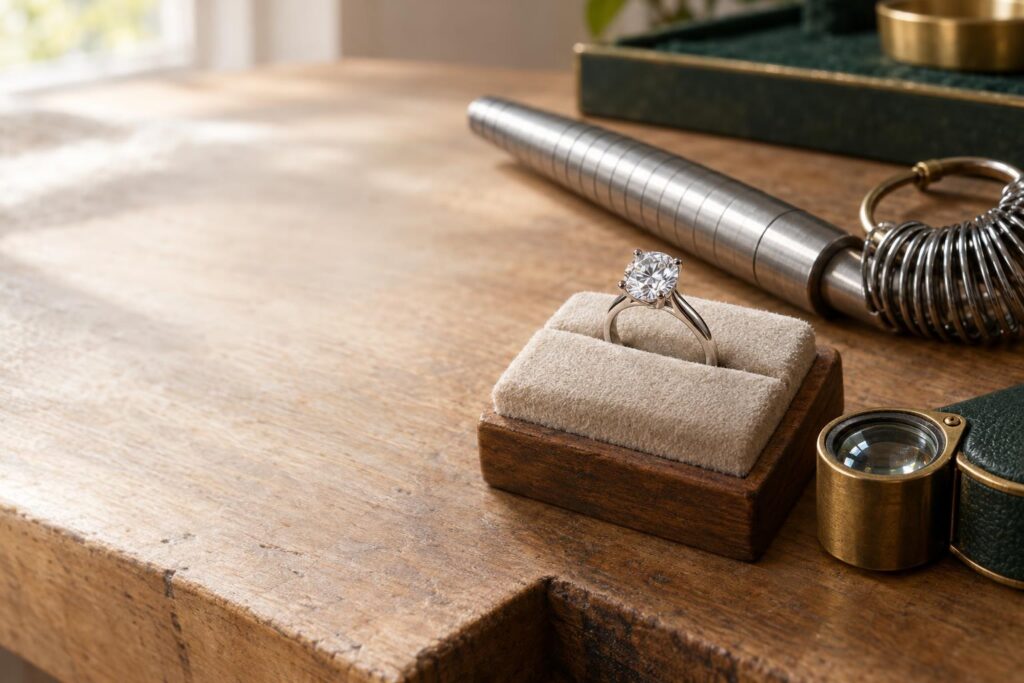
Why plan your proposal backwards from the date?
You want to propose well, but you may have no idea what to do first. The ring, the ring size and the moment all depend on each other, so the order of steps matters.
Why start with a date at all? Begin by choosing where and when you want to propose, because a place and a date give you an end goal to plan for 1. From there, you can work out which steps need the earliest start.
How far ahead should each step begin? Published guidance gives a time range for researching a ring, and says complex custom rings take longer to make than simple ones. For sizing, resizing and proposal bookings, there is no fixed figure, so this guide shows where to ask your jeweller or venue instead.
- Choose the date and place first, so you have an end goal to plan for.
- Researching and buying a ring usually takes at least a few weeks, and longer if you design your own 1.
- A complex custom ring, or one with matched stones, takes longer to make than a straightforward one, so ask your jeweller how long it will take 2.
- Rings with pavé diamonds or other details on the band need more resizing work than solitaires, so leave a buffer 3.
Why the date and place come first
Why decide this before you look at a single ring? Because the date becomes the deadline for everything else. Start by choosing where and when you want to propose 1.

How does a fixed date help? If you’re proposing on a special day, you’ll need to know when a jeweller can deliver a custom ring 2. With a date in hand, you can ask that question early and plan around the answer.
What about the place? For a proposal abroad, a placeholder ring (a temporary stand-in for the final ring) avoids the risks of travelling with an expensive ring 5. That choice affects which ring you need by the date. Our guide on when to start buying an engagement ring goes deeper.
Why proposal arrangements can run alongside the ring
Why not leave the arrangements until the ring is ready? Give yourself time both to make arrangements and to research and shop for a ring 1. The guidance doesn’t say they must happen in order. Our reading is that you can treat them as side-by-side tasks, so one doesn’t have to wait for the other.
How far ahead should you book? The sources set no lead time for venues, travel or other bookings, and these vary from place to place. Ask each venue, restaurant or travel provider how far ahead they need a booking, and mark the earliest date on your plan.
What can wait? Details that depend on the ring, such as how you’ll carry it or where you’ll keep it safe, can be settled once you know when it will arrive.
Why researching the ring needs weeks, not days
Why can’t the ring be chosen in an afternoon? Researching and buying an engagement ring usually takes at least a few weeks, and longer if you design your own 1. Picking the right ring takes time and research 5.
How do you use that time well? For a diamond, start with the 4Cs: colour, clarity, cut and carat weight (how much the diamond weighs). Created by GIA, the 4Cs are the global standard for judging diamond quality and comparing one diamond with another 3.
What will you need to decide? The 4Cs have the greatest impact on a diamond’s price, and you will have to prioritise among them and make trade-offs 1. Our guide to the 4Cs of diamonds explains each grade, and setting a budget without salary rules helps with the number.
Prioritising the 4Cs also helps you narrow your search quickly and work within your budget 3. That matters when the date is fixed.
If you design a ring, what will the jeweller ask? Expect questions about diamond shape, which helps decide the overall design, and about metal and finish, such as platinum or gold, polished or matte 2.
Look at diamonds under everyday lighting, not only under the jeweller’s spotlights 3. If a stone comes with a GIA report, that report gives an unbiased assessment of its quality 1. See how to read a GIA diamond grading report for what it shows.
Why the ring size needs settling early
Why can’t sizing wait until the end? For a custom ring, you need the wearer’s ring size before you meet a jewellery designer 2. A ring that is too small can be uncomfortable, and one that is too large may slip off or be lost 6.
When should you measure? For a custom design, that means before the first meeting. If you’re choosing a finished ring, sizing is the next step once you’ve chosen a diamond and a style 3.
How is a finger measured? Have a jeweller measure the finger with finger gauges, a set of sizing rings 4.
Why not use string or paper? Both are inaccurate and ignore the size needed to slip over the knuckle 4. Finger size can also vary slightly with temperature or time of day 6.
What if the ring is a surprise? You can borrow a ring the wearer already wears on their ring finger, and a jeweller can measure it on a ring mandrel, which is a tapered sizing rod 4. Our guide to finding a ring size secretly covers more ways.
Ring sizes are written differently around the world. National systems use different numbers or letters, so the international standard ISO 8653 gives a shared reference 6. The Ring Size Converter helps you compare systems.
Why custom-making lead times shape the whole plan
Why does making time matter so much? The making time sits between your order and your date, so it affects how early you need to order. If you’re proposing on a special day, you’ll need to know when the jeweller can deliver 2.
How long does making take? It depends on the design: a complex ring, or one where stones must be matched, takes longer than a straightforward one 2. Ask your jeweller how long your ring will take.
What does that mean for your plan? Research, ordering, making and delivery are separate stages. GIA’s few-weeks figure for researching and buying doesn’t say whether making time is included, so don’t assume it is. Ask the jeweller for a delivery date when you order, then check it against your proposal date. See how the custom jewellery process works for each stage.
If you’d like help mapping your own dates, we offer a free consultation, online from anywhere at bookings.ralphjacobs.org. For our made-to-order pieces, the typical lead time is given in your quote, and the quoted lead time is the one that applies.
Why you need a buffer for resizing or delays
Why leave spare time? Finger size can vary slightly, so even careful sizing can be a little off 6. A buffer gives room for a resize or a short delay before your date, though no buffer can cover every possible delay.
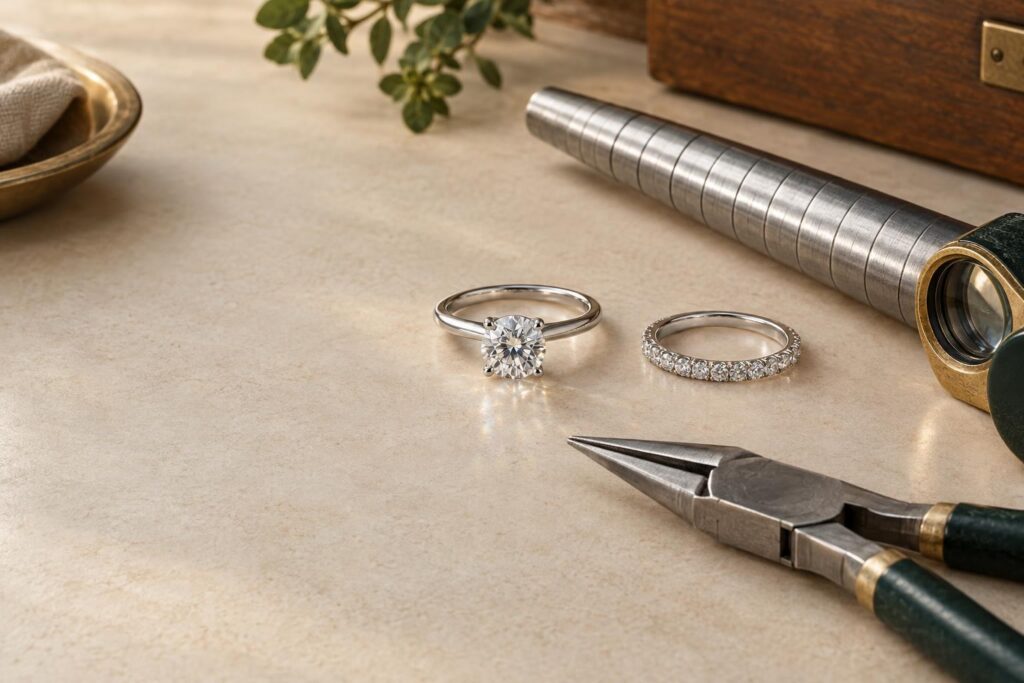
How much buffer do you need? The sources give no fixed figure. Ask your jeweller how long a resize usually takes for the style you choose, and add that time to your plan.
Why does style matter? Most rings can be resized by a small amount easily, but bigger changes may be harder, depending on the design 3.
Which styles need more work? Solitaires (rings with a single gemstone) are easy to resize, while rings with pavé diamonds (many small stones set close together) or other details on the band need more work 3.
Channel-set rings (stones held between two metal walls) generally can’t be resized easily, and eternity rings, with stones all the way round, can be very hard to resize 4.
What can you do about it? If you’re unsure of the size, err larger: removing metal from a ring that is too big is easier than adding metal to one that is too small 4. Read why not every ring can be resized for how a resize works.
Your proposal planning timeline, step by step
Why put it all in one list? Seeing the order in one place shows which step to start first, and which steps can run side by side.
- Step 1: Choose the date and place. This gives every other step an end goal.
- Step 2: Research the ring and start proposal bookings side by side. Researching and buying a ring usually takes at least a few weeks, and longer if you design your own 1.
- Step 3: Find the ring size. A jeweller can measure the finger with finger gauges, or measure a borrowed ring on a mandrel 4.
- Step 4: Order the ring and ask for a delivery date. Ask how long making will take; complex designs take longer 2.
- Step 5: Leave a buffer for resizing or delays, based on what your jeweller tells you.
- Step 6: Settle the final details: how you’ll carry the ring and keep it safe until the moment.
How do you find your start date? Count back from the proposal date: first your buffer, then the jeweller’s delivery date, then your research weeks. Tasks that run side by side, such as bookings and research, don’t add extra weeks. If that start date has already passed, the next section covers your options.
When a backwards timeline isn’t the right fit
Why might this plan not work for you? Sometimes timing the proposal with the ring just can’t be done 5. The date may be close, or a custom ring may still be in the workshop.
How do people handle that? A placeholder ring works if you’re waiting for a custom ring to be made, or want to choose the ring together after the proposal 5. Our guide to buying a ring as a surprise or choosing together sets out both sides.
What are the trade-offs? A placeholder is only a temporary stand-in, so think about how long it needs to last; sterling silver, for example, scratches more easily 5. If a fixed date starts to make choices feel rushed, moving the date is one option.
Frequently asked questions
Choose where and when you want to propose. Picking a place and a date gives you an end goal to plan for, and every other step can be timed back from it 1.
Give yourself time both to make arrangements and to research and shop for a ring 1. Our reading is that the two can run side by side. Ask the venue how far ahead it needs a booking.