
Why salary rules don’t fit real life
Why does setting a ring budget feel so hard? Often someone has told you to spend a set number of months’ salary, and that number doesn’t match your bills, savings or plans. This guide shows where that idea came from and how to build a budget from your own life instead.
Why does it matter? A ring is one part of your wider finances, next to your savings, any debts and the plans you share. Below, you’ll see how to set a figure that fits, and how to split it between the stone, the metal and the design.
Why question a rule that everyone seems to repeat? Because the best-known version came from advertising. In the 1980s, a diamond industry advertising campaign aimed to "increase the standard for how much should be spent on an engagement ring." One slogan asked, "Isn’t two months’ salary a small price to pay for something that lasts forever?" 1
How did the idea take hold? Researchers note that industry advertising has fuelled the belief that spending a lot signals commitment or helps a marriage succeed. 1
What does the research say? One study surveyed over 3,000 people in the US who had ever been married. After allowing for demographic and relationship factors, the authors found that marriage duration was "inversely associated" with spending on the ring and the wedding. In plain words, higher spending went with shorter marriages in their data. 1
Why does that matter to you? The study shows a link, not proof of cause, and it surveyed people in one country. It also found that, among women, spending more on the ring was linked to higher odds of saying wedding debt caused stress in their marriage. The authors add that a large body of research suggests financial stress is a factor that increases divorce. 1
Why start from your own finances?
Why start with your money rather than a formula? Starting from your own numbers lets you include your savings, debts and plans, which a salary figure leaves out. The aim is a figure you can still live with after the ring is on.
How do you find that figure? Work through these questions in order:
- What do you have? Look at your savings and what you could add each month without cutting essentials.
- What must stay untouched? Keep money aside for bills, emergencies and any debt repayments.
- What else is coming? A wedding, a home, study or travel may all draw on the same savings.
- What feels comfortable? Choose a figure you would still be happy with if nothing else changed.
- Who decides? If you’re choosing together, talk about the figure openly. If it’s a surprise, base it on your own finances.
What can help? The Engagement Ring Budget Planner can help you work through the numbers. If you need time to save, When to Start Buying an Engagement Ring and The Proposal Planning Timeline show how the ring fits into a wider plan.
Why priorities decide where an engagement ring budget goes
Why decide what matters before you shop? Because every budget means trade-offs. Your budget will determine your choices, and the goal is the best quality you can afford, with trade-offs. 3
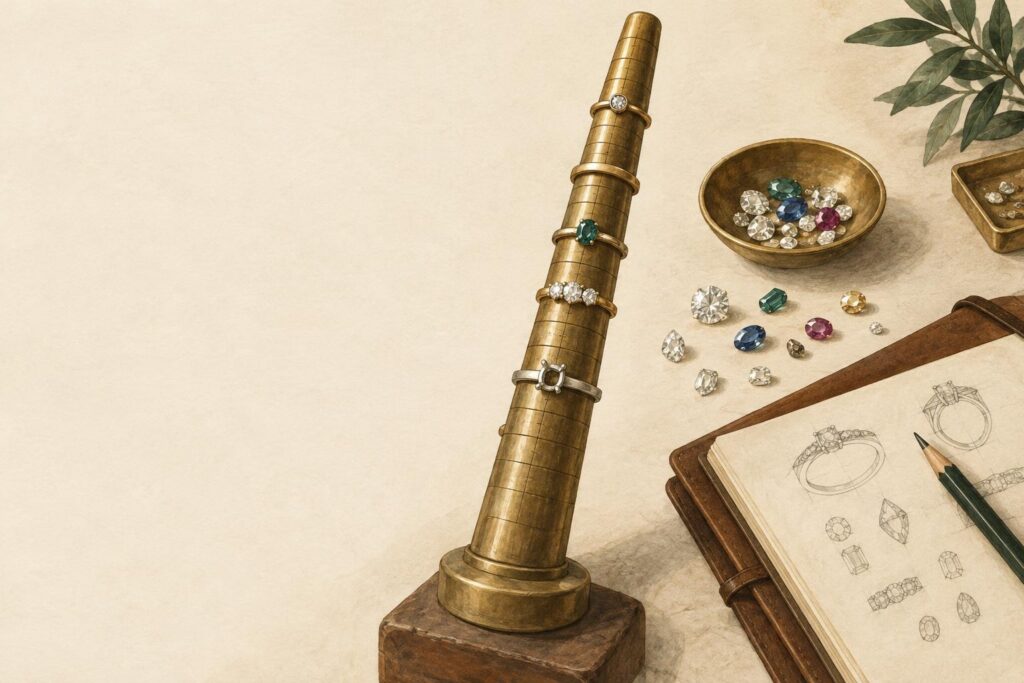
How do you set priorities? Knowing your preferences is the first step in deciding what matters most and where you’ll compromise. Which quality matters most depends on your taste, your budget and what you and your partner think is most important. 3
What should you ask? Is a larger-looking stone more important than a higher grade? Does the colour of the metal matter? Will the ring be worn every day, including during work with the hands? Your answers guide the split that follows.
Why the stone, metal and design each need a share
Why split the budget at all? Because the figure you set has to cover the whole ring: the stone, the metal and the setting. Here is how each part can affect cost.
The stone: why knowing what you can see matters
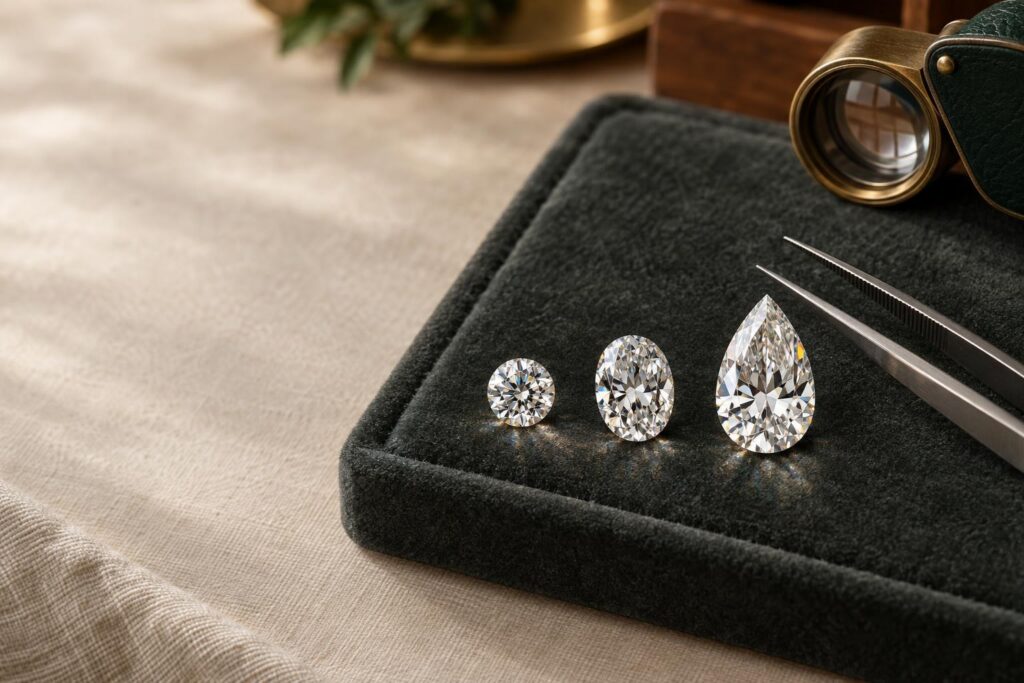
Why look closely at the stone? Knowing which qualities you can actually see helps you decide where to spend. Diamonds are graded on the 4Cs: colour, clarity, cut and carat weight, the global standard created by GIA. Prioritising them helps you know which C to spend more on and which to compromise on. 2 See what each grade really changes.
How can you save without seeing a difference? Colour is graded with letters, and once a diamond is set and worn, it’s harder to see the difference between D and G colour. Inclusions are tiny features inside a diamond, and they are one of the things clarity grades describe. You’re unlikely to see the inclusions of a diamond graded VS2 or SI1, two clarity grades, and stones whose inclusions show only under 10× magnification make up most of what shops sell. 3
What about size? The carat is the unit of weight for diamonds, and it is the same gram weight everywhere in the world. Half a carat, three-quarters of a carat and one carat are seen as "magic sizes". A 0.99 ct diamond looks almost the same as a 1.00 ct diamond, but the price difference can be significant. 4 For more, see carat weight vs visible size.
Shape matters too. Round brilliant diamonds tend to cost the most of all shapes, so a fancy shape (any shape other than round) can be a way to save. 2 Elongated shapes such as ovals and marquise tend to look bigger for their carat weight. 3 Compare them in Choosing a Diamond Shape.
Why consider the type of stone? A laboratory-grown diamond has the same crystal structure as a natural diamond and nearly the same chemical, optical and physical properties. Lab-grown diamonds come in many high-quality options at a "reduced price point". Moissanite is a different material, a simulant, so it is not a diamond. 6 The differences are set out in Natural Diamond, Lab-Grown Diamond or Moissanite?.
The metal: why purity changes cost and care
Why does the metal affect the budget? Because purity and type change both cost and upkeep. Gold with a higher gold content, such as 18ct (18K) rather than 9ct, has a richer colour, is heavier and softer, and costs more. 2 Here "ct" means karat, a measure of gold purity, not diamond weight. See 9ct vs 14ct vs 18ct gold.
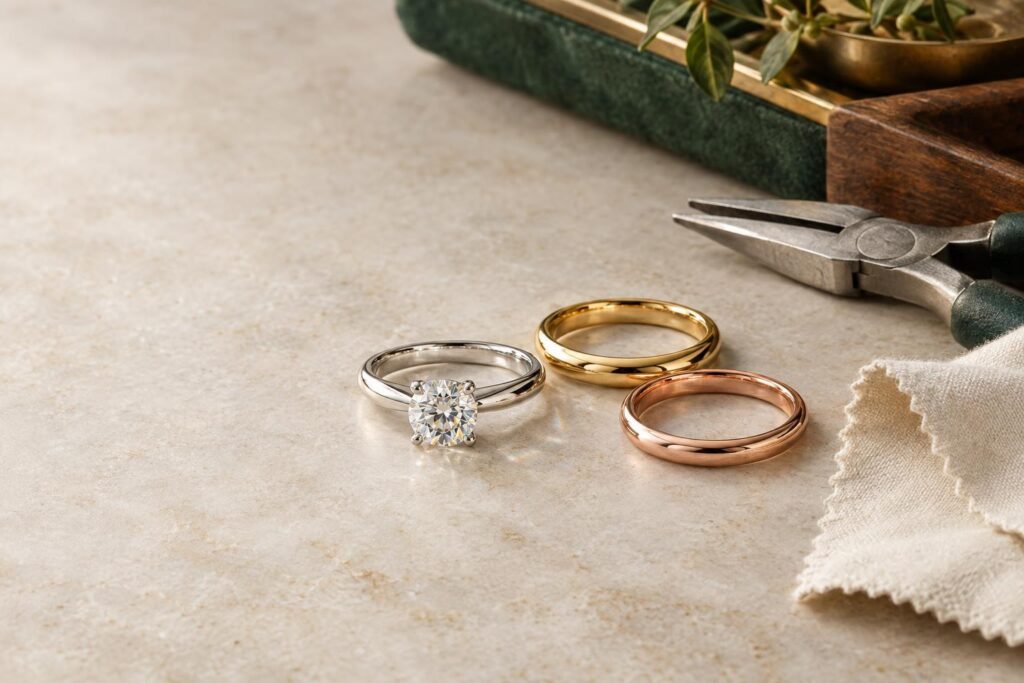
How do white metals compare? White gold is usually plated with rhodium, a thin coating of bright white metal, which wears away and needs replating. Replating is easy and relatively inexpensive. Platinum is generally more expensive than gold but more durable. 2 It is also denser and stronger than gold, and its prongs (the small metal claws that hold a stone) are less likely to break. 5 Read more in White Gold vs Platinum.
The design: why the setting changes how the stone looks
Why does the setting matter to the budget? Because the design can change how large and bright the stone looks. A cluster setting groups small diamonds together and can maximise sparkle at a relatively affordable price, because smaller diamonds cost less than large ones. A halo, a ring of small stones around the centre stone, can make the centre stone look larger. 2
A narrow band, or a bezel (a metal rim that wraps around the stone), can also make a stone look bigger. 3 Whatever the design, prongs can be damaged or work loose, so they should be checked regularly. 5 See How to Choose an Engagement Ring Setting.
Why how you pay is part of your budget
Why think about payment before you choose? Because debt can follow the ring into the marriage. In the study above, among women, spending more on the ring was linked to higher odds of reporting that wedding debt caused stress in their marriage. 1
How can you pay? Broadly, you can save first and pay in full, or spread the cost over time through a payment plan or credit. Terms differ between providers, so it helps to ask some plain questions before you agree to anything.
- What is the total I will repay, including any interest or fees?
- What is the monthly amount, and for how many months?
- What happens if I miss a payment?
- Do the repayments fit the budget I set, rather than the budget stretching to fit the repayments?
The downsides of budgeting this way
Why look at the limits? Because no method is perfect, and a fair plan shows its weak spots. Setting a budget from your own finances means making choices that a simple rule hides.
- Trade-offs are part of it. Your budget will determine your choices, and the goal is the best quality you can afford, with trade-offs. 3
- Some metals need upkeep. White gold’s rhodium plating wears away over time, so it needs occasional replating, and prongs should be checked regularly. 5
- Other stones are not diamonds. Moissanite and other simulants are unrelated to diamond at the atomic level, and labs can tell lab-grown and natural diamonds apart with advanced instruments. If a natural diamond matters to you, that difference counts. 6
- The research has limits. The study found an association in one country’s survey, not proof of cause. 1 It does not show that a cheaper ring makes a marriage last.
- You make the decisions yourself. A salary rule hands you a number. This approach asks you to weigh your own priorities and, if you’re choosing together, to talk them through.
Which of these matters most depends on your situation and what you value.
Why comparing options before you commit helps
Why look at more than one stone? Because seeing options side by side shows you what your budget can do. An educated jeweller will encourage you to compare several diamonds within your budget. 2
If you’d like to compare options with someone, we offer a free consultation, booked online from any country at bookings.ralphjacobs.org, or on WhatsApp or in our showroom. For payment details, see our payments policy for your country at ralphjacobs.org/payments/.
When you’re ready to turn your budget into a choice, Choosing an Engagement Ring in Six Steps walks through the next decisions.
Frequently asked questions
The sources behind this guide give no fixed amount. The two-months’-salary idea came from a diamond industry advertising campaign in the 1980s. 1 This guide describes another approach: building a figure from your own savings, debts and plans.
One US survey of over 3,000 ever-married people found the opposite link: marriage duration was inversely associated with spending on the ring and wedding. 1 It shows an association, not proof that spending causes the outcome.
Laboratory-grown diamonds come in many high-quality options at a reduced price point, with nearly the same chemical, optical and physical properties as natural diamonds. 6 Whether that suits you depends on what matters to you in a stone.