Why alexandrite seems to change colour
Why would one gemstone look green by a window and red beside a candle? That is the quiet wonder of alexandrite. It is also the first thing to understand if you want to judge one.
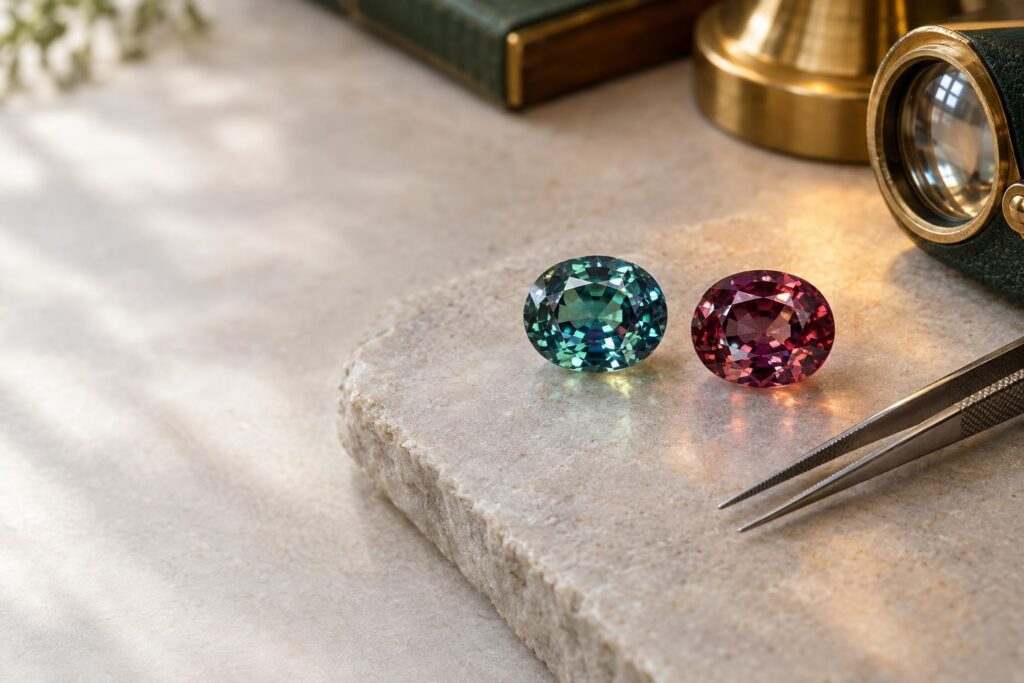
Alexandrite is a variety of the mineral chrysoberyl. A variety is one colour or type within a mineral. It can look green in daylight and brownish or purplish red under a lamp or candle flame. The change is so striking that it is often called ‘the alexandrite effect’, or ’emerald by day, ruby by night’. 1
Scientists describe alexandrites as remarkable and rare gemstones. 2 This entry explains what causes the change and how its strength is judged. It also explains why a strong change on its own does not prove a stone is natural. 4
Why the colour change happens
Why should you care about the cause? Because it shows why the effect is so unusual. Alexandrite contains traces of chromium inside its chrysoberyl crystal. The chromium absorbs strongly at the wavelength of yellow light. 2

Your eyes play a part too. Normally, your brain keeps colours looking much the same under different lights. In alexandrite, the balance between green and red signals shifts far more than for ordinary objects. That shift overrides the brain’s correction, so you see a real change of colour. 2
The change is not the same as pleochroism, which means showing different colours from different viewing directions. Alexandrite is strongly pleochroic, showing green, orange and purple-red. Its colour change, though, comes from the mineral’s unusual way of absorbing light. 1
Why the strength of the change decides quality
Why can two alexandrites of the same size look so different? Colour change is the most important quality factor. Professionals judge how much the colour changes, and the quality of the red and green under different lights. 4
One alexandrite, three kinds of light
Switch between the lights to see how the same stone changes colour.
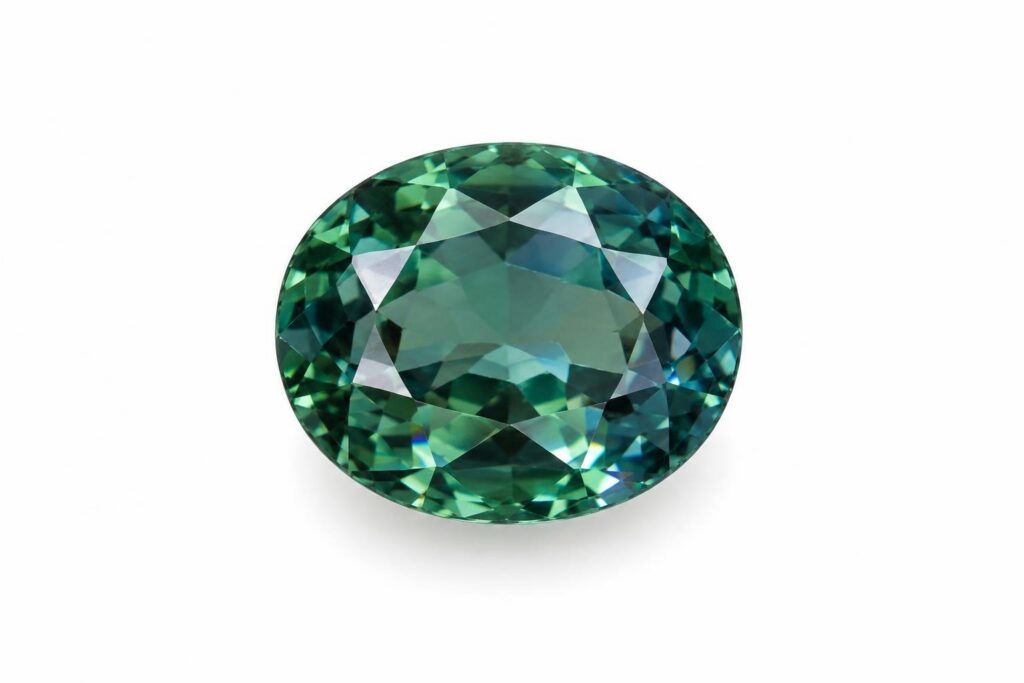
- Green in daylight
- In daylight, alexandrite looks green. In a fine stone the colour runs from green to bluish green. This is the 'emerald by day' side of the alexandrite effect.
- Fluorescent light like daylight
- Fluorescent light that is like daylight shows the same stone as a medium-dark vivid green, much as daylight does.
- Lamp or candle light
- Under incandescent light, the warm light of a tungsten lamp or a candle, the stone looks brownish or purplish red. In a fine stone the colour runs from red to purplish red. This is the 'ruby by night' side of the effect.
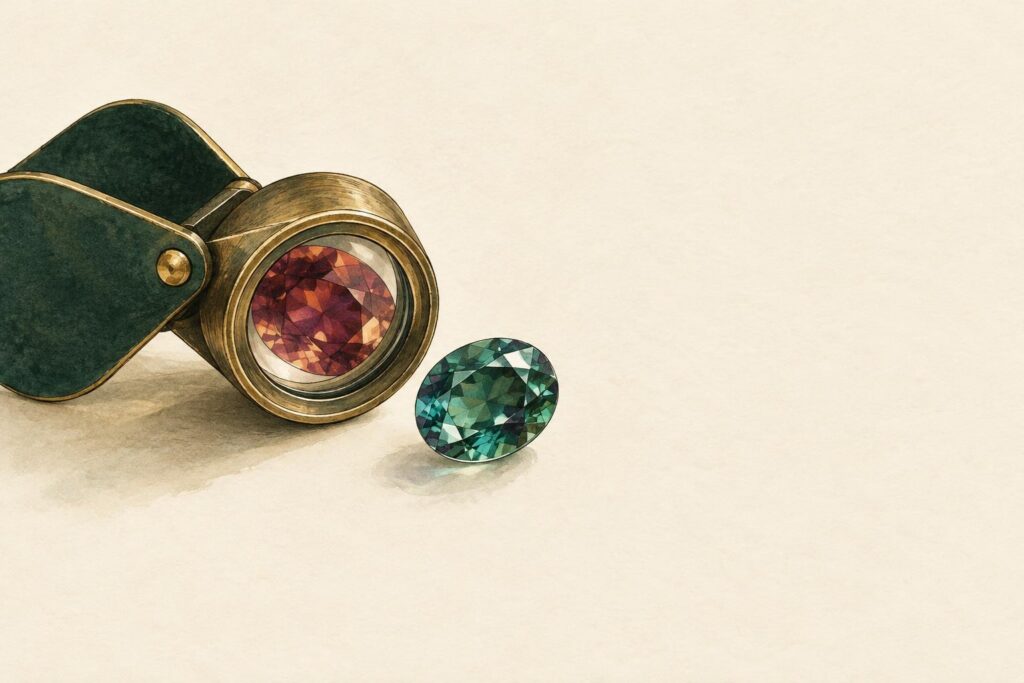
The pictures show an idealised, fine-quality change. Real stones vary, and many show a weaker or less clean shift. Pictures: AI-generated illustrations, checked for accuracy. They are not photographs of a real piece.
Incandescent light is the warm light from a tungsten lamp or a candle. Under it, fine alexandrite turns red to purplish red, and in daylight it is green to bluish green. Its colours have moderately strong to strong saturation, which means intensity or purity of colour. 3 For more on these terms, see hue, tone and saturation in gemstones.
One trade description puts it in more detail. In daylight, or fluorescent light like daylight, alexandrite is a medium-dark vivid green. Under a candle or incandescent lamp, it becomes a medium-dark vivid red or purplish red. 6
Tone, meaning lightness or darkness, matters too. Stones that are too light lack colour intensity, and stones that are too dark lack brightness and can look almost black. Stones with low saturation look brownish, and some show a change that lacks strength. 3
Clarity matters as well. Alexandrite tends to have few inclusions, which are tiny features trapped inside a gem. Value rises dramatically for clean stones with a good change and strong colours. Cat’s-eye alexandrite, which adds a line of light across the stone to the colour change, is extremely rare. 3
Why treatment is rarely the main question
Why ask about treatments at all? Because a treatment can change how you should clean a stone. Alexandrites are usually not treated, but they might have fractures, which are small cracks. Fracture-filled stones should only be cleaned with warm, soapy water. 5
Fracture filling means placing a material into cracks that reach the surface. You can ask a seller whether a stone has been treated. An independent laboratory report names any treatments it can detect. 4 See how gemstone treatments should be disclosed for more.
Why alexandrite suits everyday wear
Why does durability matter for a coloured stone? A ring meets daily knocks, so how its stone resists scratches and chips matters. Alexandrite is 8.5 on the Mohs scale, a 1-to-10 ranking of scratch resistance. It has excellent toughness, meaning resistance to chipping, and no cleavage, which is a tendency to split when struck. 5
Alexandrite is a good choice for rings and everyday wear. It is stable in normal wear and resists heat, light and common chemicals. Warm, soapy water is always safe, and ultrasonic and steam cleaners are usually safe. 5 Hardness is only part of the picture, as the Mohs scale is not the whole durability story explains.
Why origin can shape the colour
Why does origin come up with alexandrite? It is tied to the stone’s history and, reportedly, to its colour. Alexandrite was first discovered around 1830 in Russia and named after the future Tsar Alexander II. It was later found in Brazil and Sri Lanka. 2
Top Russian stones are reportedly closer to a pure green-to-red change. Brazilian stones go from bluish green to purplish red. 6 Origin is a matter of expert opinion: a GIA report can give an opinion on geographic origin. 4
Why a laboratory report matters when you buy
Why does alexandrite call for extra care when you buy? Supply is low, and fine-colour material is extremely rare. 3 It is scarce, especially in larger sizes. 1
Laboratory-grown alexandrite exists too. It is grown by people rather than formed in the earth. It is usually sold with the maker’s name plus the word ‘created’. The term ‘alexandrite sapphire’ generally means a laboratory-grown sapphire with a colour-change effect. 4
Other stones can imitate the effect. The most common imitation is synthetic corundum, the mineral family of sapphire and ruby. Its change looks more bluish in fluorescent light and more purplish in incandescent light. 6
Some natural sapphires change colour, but they do not go from green to red. Gemmologists replaced the older term ‘alexandrite-like’ with the broader term ‘colour change’. 6
Price can be a clue. An inexpensive gem with a strong red-green change is likely to be a synthetic or a simulant, which is an imitation. For a significant purchase, an independent laboratory report can confirm that an alexandrite is natural. GIA evaluates alexandrite but does not grade it; its report states whether a stone is natural or laboratory-grown. 4 For the wider picture, see how coloured gemstones are evaluated.
Why cut and matching shape a design
Why does the cutter’s work matter so much? Alexandrite shows different colours from different directions. Cutters orient the gem to show the strongest change through the crown, the upper part of the stone. Most cut alexandrites weigh less than one carat, the unit used to weigh gems, and larger sizes are rare. 3
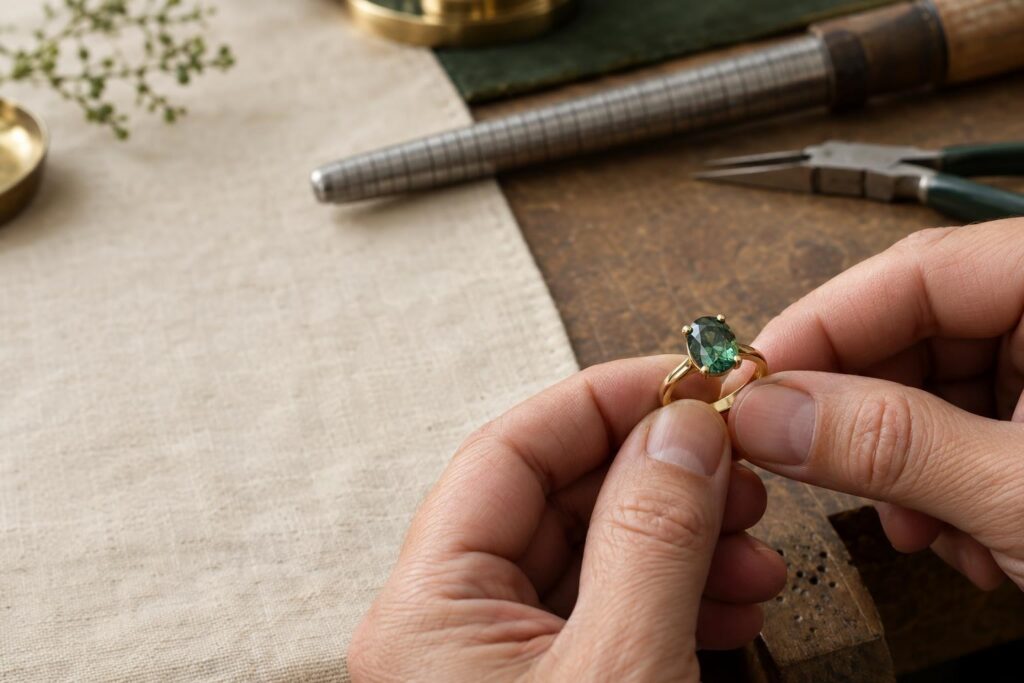
Matching alexandrites for pairs or suites, such as earrings, is very difficult. 4 Because the colours are judged under different lights, it helps to see a stone in both daylight and lamplight. To compare how different settings hold a stone, see ring settings explained.
Why this entry is a starting point
Why read about a stone before you see one? Knowing the right questions helps you weigh any alexandrite on its facts. Inclusion in this guide does not confirm that Ralph Jacobs stocks this gemstone.
Frequently asked questions
An inexpensive gem with a strong red-green change is likely to be a synthetic or an imitation. For a significant purchase, an independent laboratory report can confirm that an alexandrite is natural. 4
Alexandrite is 8.5 on the Mohs scale, with excellent toughness and no cleavage. That makes it a good choice for rings and everyday wear. Fracture-filled stones need gentler cleaning, with warm, soapy water only. 5
The term generally means a laboratory-grown sapphire with a colour-change effect. It is not natural alexandrite, which is a variety of chrysoberyl. 4