
Why does your stone change colour when you turn it? One possible cause is pleochroism, a normal property of many gems rather than a flaw. Its name comes from Greek words for "many" and "colour". Doubly refractive gems split light into two rays that travel at different speeds. Each ray can be absorbed differently, so the colour changes with direction, most clearly in deeply coloured stones 1.
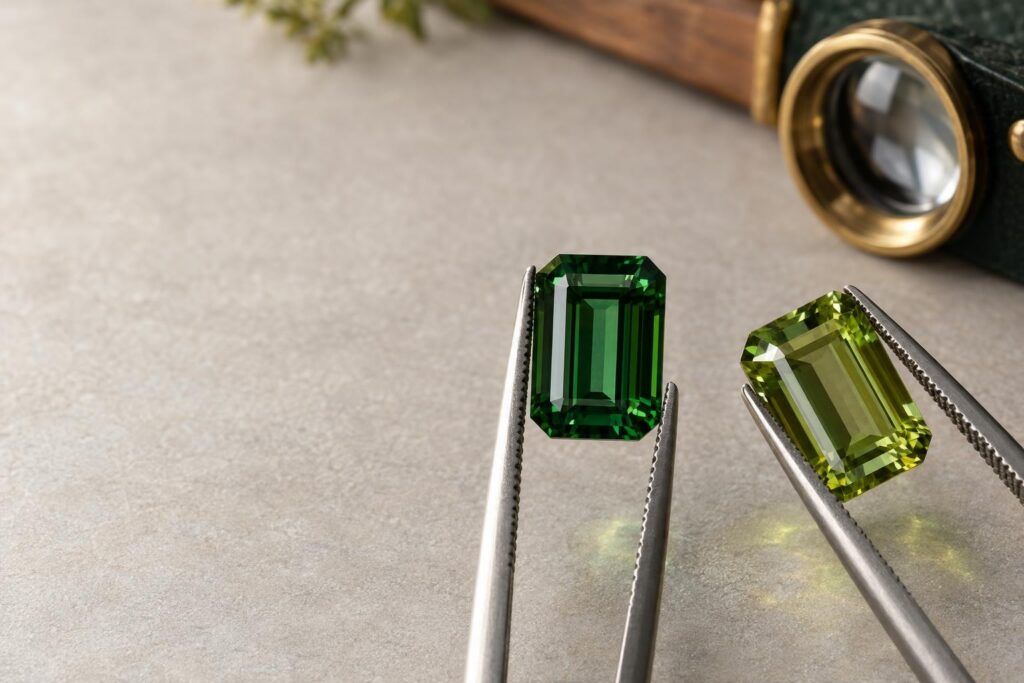
How many colours can you see? Tourmaline and zircon can show two. Iolite and tanzanite can show three, but only two from any one direction. Cutters orient stones with this in mind: light tourmaline is cut with the table, the large flat top facet, at right angles to the crystal’s main axis for the richest colour 1. Tanzanite usually shows a mix of blue and violet, and the cutting direction sets its face-up colour 2.
Does it mean your stone is fake? Not on its own. Diamond, spinel and garnet show no pleochroism at all, so its absence proves nothing either. Gemmologists check it with a dichroscope, a small tool that splits a colour into its parts. Through it, most natural corundum (sapphire and ruby) shows little or no colour change through the table, while laboratory-grown corundum made by the Verneuil method usually does. That is a clue seen with a tool, not a naked-eye test. Colour zoning, meaning uneven colour bands, can also be mistaken for pleochroism 1. A jeweller or gemmologist can check what is causing the colour shift in your stone.
Example: You tilt a tanzanite ring under a lamp. From one angle it looks blue, and from another it looks violet. That shift is pleochroism at work, not a defect.