
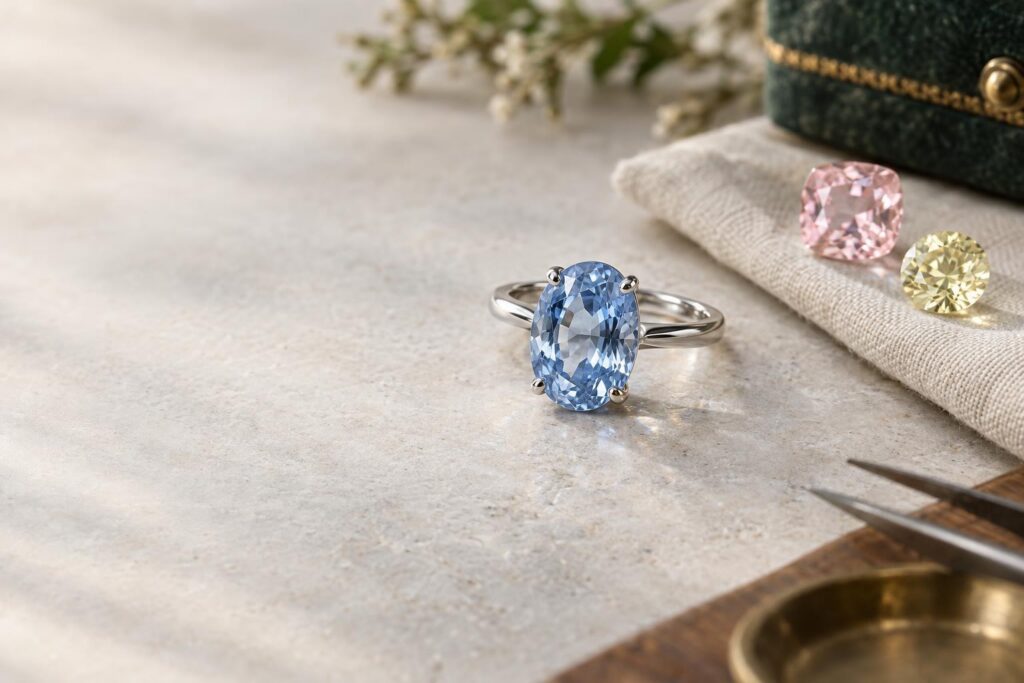
Why a light-coloured sapphire needs a closer look
Why does colour matter so much when you choose a pale sapphire? Colour has the greatest influence on a sapphire’s value, and ‘too light’ is among the traits of less valuable blue stones 1. If you’re picturing a soft blue, a blush pink or a pale yellow stone, it helps to know what separates a gentle colour from a faded one.
Sapphire is a variety of corundum, a mineral species. Red corundum is called ruby, and every other colour, including colourless, is sapphire 1. So a pale pink or straw-yellow stone is just as much a sapphire as a deep blue one.
The sections below start with colour, then look at treatment, setting metal and daily wear. Here are the key points first.
- Preferred sapphires have strong to vivid saturation, and in general, the more intense and even the colour, the more valuable the stone 1.
- A large amount of sapphire has been treated by heat or lattice diffusion 2. Some sapphires have been heated at low temperatures to lighten their colour 4.
- A diamond’s facets reflect the colour of the metal around it, and white metals are a popular choice to highlight a gemstone’s colour 5.
- Sapphire is 9 on the Mohs scale of scratch resistance, with excellent toughness for rings worn every day 6.
Why some pale sapphires look soft and others look washed out
Why can two pale sapphires look so different, even when both are called blue? Gemmologists, the experts who study gems, split colour into three parts. Hue is the basic colour, such as blue, pink or yellow. Tone is how light or dark it is. Saturation is how strong or pure the colour looks. Our guide to hue, tone and saturation covers each one in more depth.
Pale sapphire colours compared
Pale sapphires come in several hues, and some look soft while others look faded. Switch between them to compare.
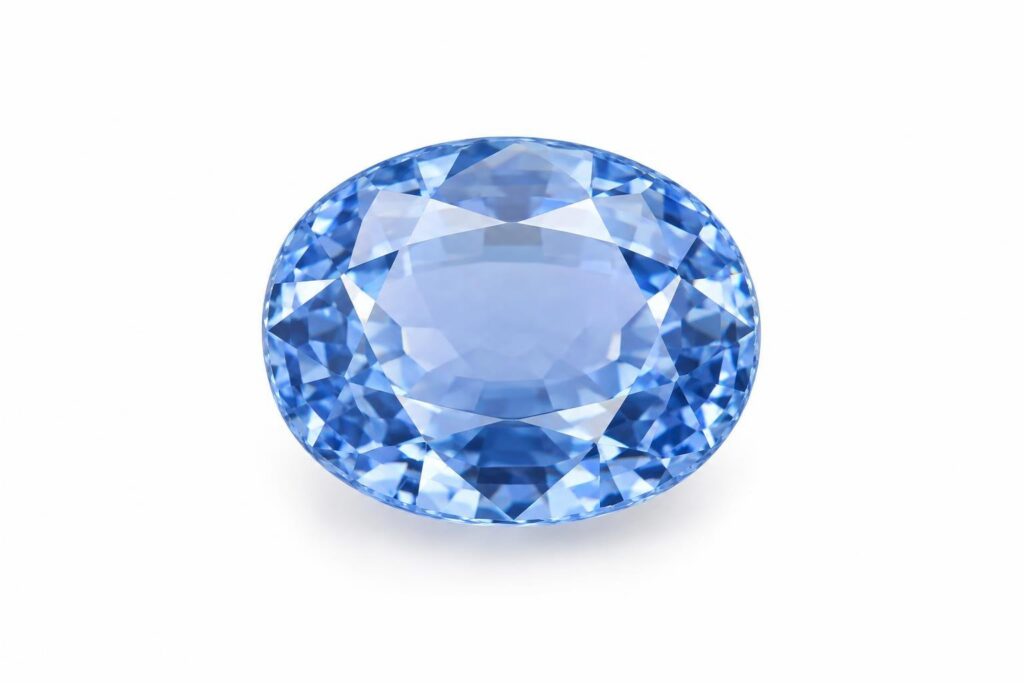
- Soft blue
- A gentle blue is one of the colours you might picture for a pale sapphire. Saturation should be as strong as possible without darkening the colour and losing brightness.
- Blush pink
- Sapphire is corundum in any colour except red, so a pale pink stone is just as much a sapphire as a blue one.
- Pale yellow
- A pale yellow stone is also a sapphire. Less saturated yellows, such as straw yellow, are more affordable than vivid colours.
- Greyish blue
- Less saturated colours, such as greyish blue, are more affordable than vivid colours. Being greyish is among the traits of less valuable blue sapphires.
- Vivid blue
- For comparison, preferred sapphires have strong to vivid saturation. Colour has the greatest influence on a sapphire's value.
Screen colours are only approximate, and a picture cannot show treatment. Always judge a stone in person. Pictures: AI-generated illustrations, checked for accuracy. They are not photographs of a real piece.
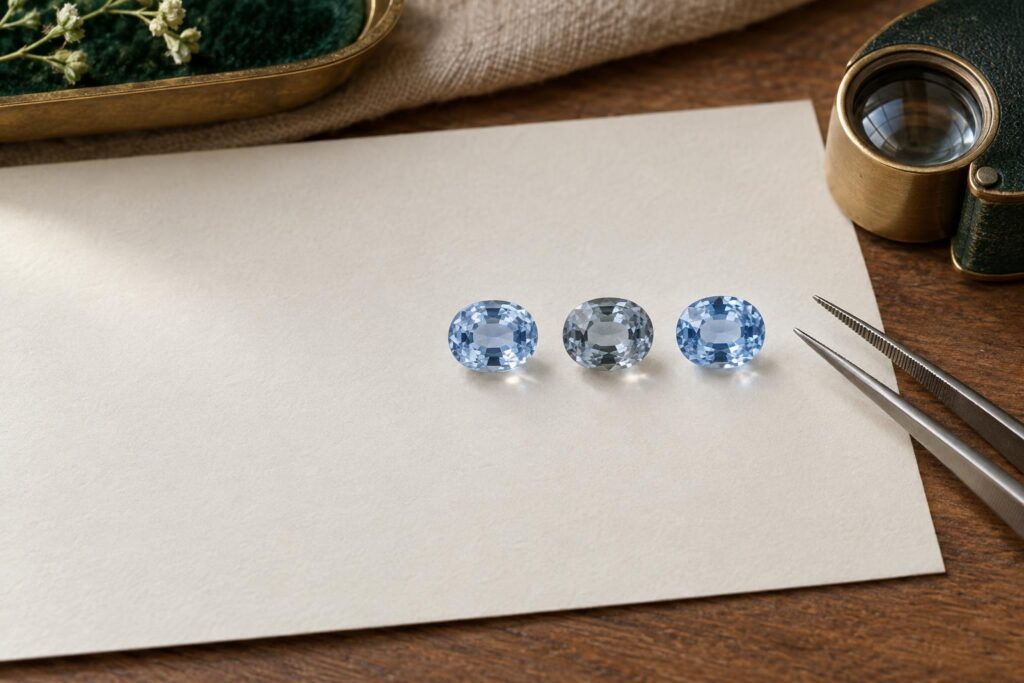
How tone and saturation work together
Why does saturation matter in a pale stone? Saturation should be as strong as possible without darkening the colour and losing brightness. Less saturated colours, such as greyish blue or straw yellow, are more affordable than vivid colours 2.
Less valuable blue sapphires might be greyish, too light or too dark. In general, the more intense and even the colour, the more valuable the stone 1. If a soft colour is what you love, these are the trade-offs to weigh: a paler, less saturated stone is more affordable, while value follows strong, even colour.
What this means for pink, padparadscha and yellow
Why does this matter beyond blue? Pale shades are part of how several sapphire colours are described. Pink sapphires range from light red (pink) to light purple, and padparadscha from light to medium pinkish orange to orange-pink 1.
For yellow, straw yellow is among the less saturated colours that are more affordable than vivid ones 2. If budget matters to you, that is a relevant fact. If strong colour matters more, it points the other way.
How the cut shapes a pale stone
Why look closely at the cut? A good cut should reflect light back evenly across the entire gem 2.
Cutters also weigh up colour zoning (bands or patches of uneven colour), pleochroism (different colours seen from different directions) and how light or dark the rough crystal is. Colour zoning is common, and blue sapphire often shows angular zones of blue and lighter blue 1. Because pleochroism means colour can change with direction, seeing a stone from more than one angle shows you how its colour shifts.
Why you should ask whether a pale sapphire has been treated
Why ask about treatment if you like how the stone looks? Corundum is very often treated, and probably has been for more than 1,000 years 3. A large amount of sapphire, both blue and fancy colours (any colour other than blue), has been treated by heat or by lattice diffusion 2. Knowing the treatment also guides how you clean the stone, covered further down.
How heat can lighten a sapphire
Why would anyone heat a stone to make it paler? In blue sapphire, iron and titanium together produce the colour, and heating changes their condition. Heat treatment runs at about 800 to 1,900°C. Below about 1,000 to 1,100°C, heating tends to lighten blue, which can be used on sapphires that are too dark 3.
Research on sapphires from Madagascar found that some had been heated below 1,350°C to lighten their colour, which the trade calls ‘sweetening’. Low-temperature heating does not dissolve microcrystals such as rutile silk, the fine needle-like inclusions (features inside a gem) in these stones, while high-temperature heating does. In that study, the lighter blue stones had lower iron content than the deeper blues 4.
What lattice diffusion is
Why does diffusion need special care? Lattice diffusion uses heat and chemicals to push an element into a gemstone to change its colour artificially 2. Gem-A describes diffusion that adds colour to white sapphires that don’t improve with heating, where the colour reaches only a short distance below the surface 3.
How deep the colour goes matters for wear. In diffusion-treated stones whose colour doesn’t go deep, surface damage or re-cutting can remove the colour 6.
What to ask about treatment
Why ask for a report? Heating is an accepted treatment for sapphire, and for fine-quality stones, lab confirmation of no heat adds to rarity and value. So if you’re in doubt, get a lab report 2.
Our guides to how gemstone treatments should be disclosed and heat treatment in gemstones explain what a seller should tell you.
Why the setting metal can change how a pale sapphire looks
Why think about metal when you’re choosing a stone? A gem’s facets (its flat, polished faces) act like tiny mirrors. They reflect what is close to them, especially the colour of the mounting and claws, the small metal arms that hold the stone 5.
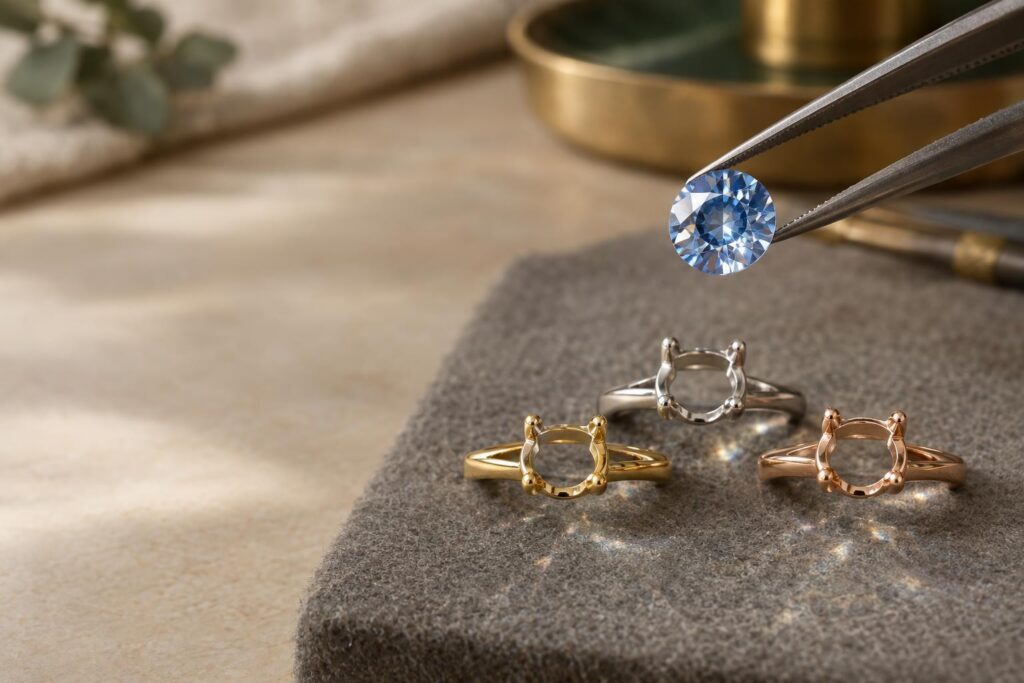
- For a centre diamond, yellow gold produces yellowish reflections.
- White gold produces whitish or colourless reflections.
- Rose gold produces pinkish reflections 5.
These examples are written about diamonds, not sapphires. To see how a pale sapphire looks in each metal, you can ask to view it against each one.
Why do many people pick white metal for coloured stones? White metals are a popular choice to highlight a gemstone’s colour. Cooler gems, such as blue or purple sapphire, pair well with cooler metals like white gold, and warmer gems pair well with yellow and rose gold 5.
Designers often use claws in a different metal colour from the band to change the look. White gold is usually rhodium-plated (coated with a thin layer of a bright white metal), and the rhodium can wear away over time 5. If you’re weighing white metals, see white gold vs platinum.
Why sapphire suits a ring worn every day
Why does durability matter in an engagement ring? If you plan to wear yours every day, it needs to cope with scratches and knocks. Corundum, which includes sapphire, is 9 on the Mohs scale, which ranks scratch resistance. Diamond is only one number higher, but the scale is deceptive: diamond is many times harder than corundum 6.
Why isn’t hardness the whole story? A stone also needs toughness, its resistance to chipping and breaking. Corundum has excellent toughness and no cleavage (a tendency to split along a flat plane), which makes it a great choice for rings worn every day 6. Read more on why the Mohs scale is not the whole durability story.
How treatment affects care
Why does treatment change cleaning? Untreated and even heat-treated sapphire is very durable. Warm soapy water is always safe. Ultrasonic and steam cleaners are usually safe for untreated, heat-treated and lattice-diffusion-treated stones 6.
Stones that have had fracture filling (cracks filled with another material), cavity filling or dye are different. Clean them with a damp cloth only, as even lemon juice can damage them 6. Ask your jeweller which treatment your stone has, and see our Jewellery Care and Safety Guide before cleaning it at home.
When a light-coloured sapphire may not be the right choice
Why look at the downsides? A pale sapphire suits some priorities better than others. Here are the facts that may weigh against it, depending on what matters to you.
- If strong colour or value matters most, preferred sapphires have strong to vivid saturation, and too light is among the traits of less valuable blue stones 1.
- If you want an untreated stone, a large amount of sapphire has been treated. Ask for a lab report when in doubt, and for fine-quality stones, lab confirmation of no heat adds to rarity and value 2.
- If a stone is diffusion-treated and its colour doesn’t go deep, surface damage or re-cutting can remove that colour 6.
- If you love yellow gold, bear in mind that cooler gems such as blue sapphire pair well with cooler metals, and warmer gems with yellow and rose gold. If you choose white gold, its rhodium plating can wear away over time 5.
None of these rules a pale sapphire out. They are the facts to weigh against what you love about the colour.
What to check before you choose a light-coloured sapphire
Why use a checklist? It turns the facts above into questions you can ask any jeweller, wherever you buy.
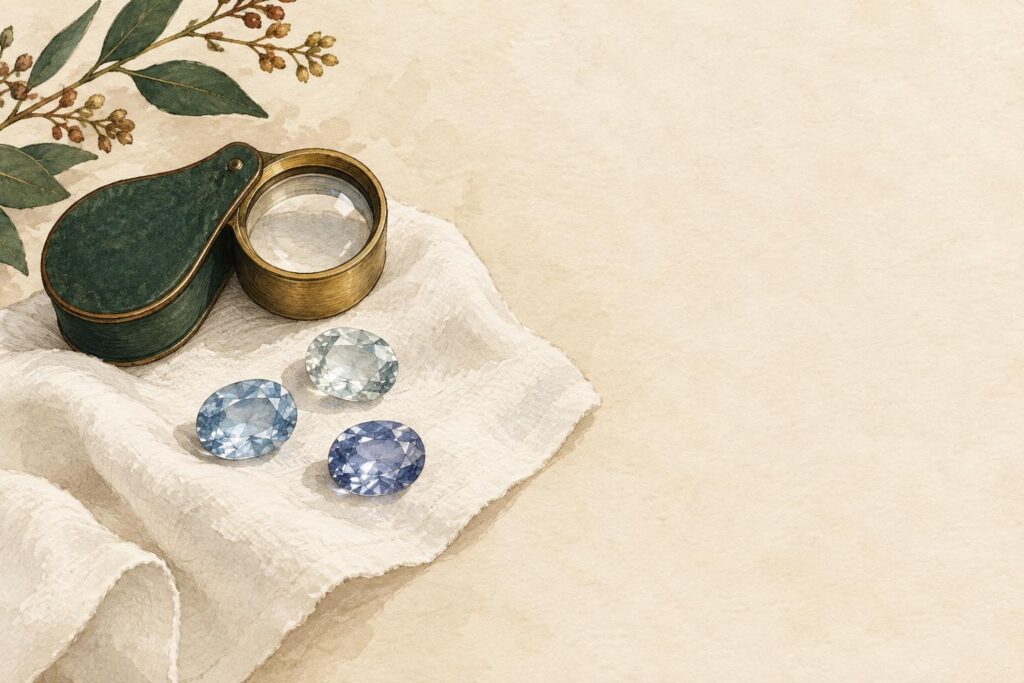
- Look for colour zoning, which is common in sapphire. Is the colour even, or are there lighter zones 1?
- Compare it with other pale stones. Does the colour look clear or greyish?
- Ask whether the stone has been treated, and how: heat, low-temperature heat, diffusion or filling.
- Ask whether a lab report is available.
- See the stone against the metal you’re considering, including the claws.
- Ask how to clean the stone, given any treatment.
For more detail, see our guides on how to buy a sapphire, how coloured gemstones are evaluated and which gemstones suit everyday rings.
If you’d like to compare pale sapphires and metals with a jeweller, Ralph Jacobs offers a free consultation, online from any country at bookings.ralphjacobs.org, or at our showroom in Secunda. We can source a wide range of coloured gemstones as centre stones, so it’s a chance to talk through colour, treatment and setting together.
Frequently asked questions
Sapphire is 9 on the Mohs scale, with excellent toughness and no cleavage. That makes it a great choice for rings worn every day, and untreated and heat-treated sapphire is very durable 6.
It depends on the look you want. Cooler gems, such as blue or purple sapphire, pair well with cooler metals like white gold, and warmer gems with yellow and rose gold. White metals are a popular choice to highlight a gemstone’s colour 5.
Yes. Sapphire is the mineral corundum in any colour except red, which is called ruby. That includes pink, yellow and even colourless stones 1.