
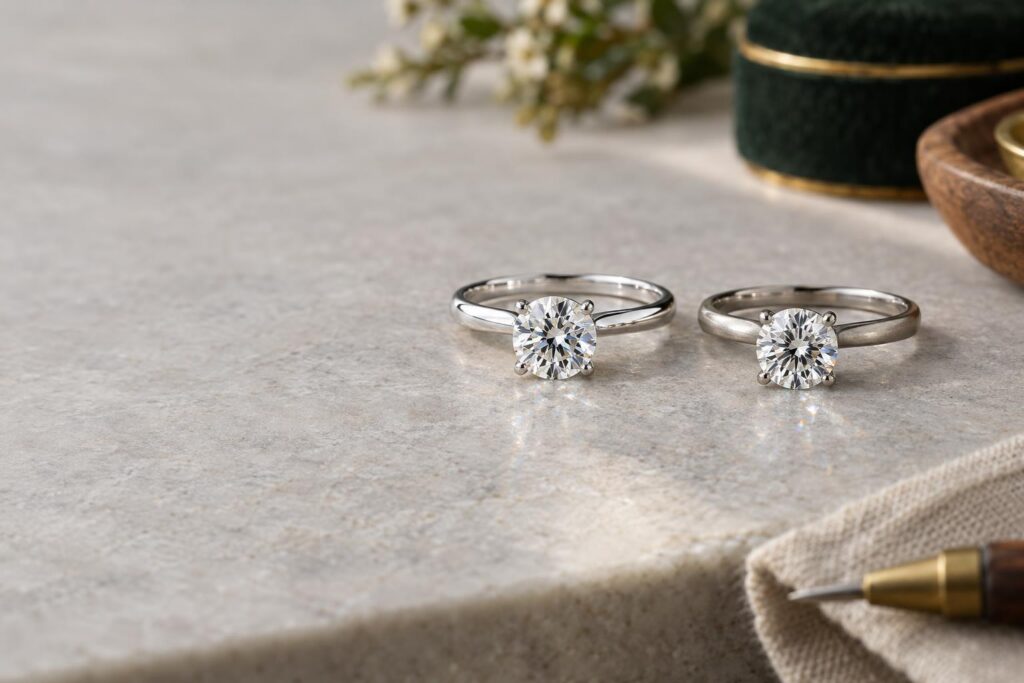
The decision in brief
- If you know you react to nickel, ask for the full alloy of any white gold. Platinum is often chosen by people with sensitive skin.
- If you would rather not plan for replating, note that platinum keeps its natural white colour, while rhodium-plated white gold needs replating from time to time.
- If you like a ring you can feel, platinum is denser, so the same design weighs more. If you prefer a light ring, white gold weighs less.
- If keeping as much metal as possible over the years matters to you, note that in laboratory wear tests, the platinum alloys lost two to three times less volume per surface area than the white gold alloys.
- If stone security is high on your list, note that platinum claws are less likely to break, while white gold claws need checking from time to time.
- If no single factor stands out for you, try the same design in both metals, ask what each stamp means, and rank the factors before you decide.
Editorial guidance — context changes what is right for you.
Start with the wearer and the ring
Start with the person wearing the ring, not the metal on the tray. Think about a normal week: typing, lifting, cooking, sport or caring for others. Notice how often the ring will knock or rub against things.
Then think about the ring itself. Will it hold a stone in claws, and how fine is the design? If you are buying for someone else, find out quietly whether they have ever reacted to a metal.
Quick checklist
- Any known reaction to nickel or other metals
- How often the ring will knock or rub against things
- Whether you are happy to have a plated ring replated from time to time
- Whether you prefer a ring you can feel or one that feels light
- Whether the design holds a stone in claws, and how fine it is
- How much it matters that the metal wears as little as possible over the years
The criteria that matter
Skin sensitivity
Some white gold is alloyed with nickel, and nickel allergy is commonly seen with jewellery. Platinum is often chosen by people with sensitive skin.
Upkeep tolerance
Most white gold is rhodium plated, and the plating wears away, so plated white gold needs replating from time to time. Platinum keeps its natural white colour.
Why white gold vs platinum differ in colour, wear and weightWeight feel
Platinum is denser than gold, so the same design weighs more in platinum.
Why white gold vs platinum differ in colour, wear and weightAttitude to wear
In laboratory wear tests, the platinum alloys lost two to three times less volume per surface area than the white gold alloys. Every alloy tested still lost some metal.
Stone security
Platinum is stronger and less brittle than gold alloy, so its claws are less likely to break. White gold claws can be damaged or come loose.
Why claw count matters: 4 claw vs 6 claw ring settingCompare your options
| Area | What changes visibly | When to prioritise | Reasonable compromise |
|---|---|---|---|
| Skin sensitivity | White gold is often whitened with nickel or palladium. Platinum is often chosen by people with sensitive skin. | If you or the wearer have reacted to nickel | White gold contains other metals besides its whitener, so ask for the full alloy. Palladium can also add a red tint. |
| Upkeep | Most white gold is rhodium plated and needs replating as the plating wears. Platinum keeps its natural white colour. | If you would rather not plan for replating | Platinum keeps its natural colour but weighs more for the same design. |
| Weight | Platinum is denser, so the same design weighs more than in white gold. | If you have a clear preference for a substantial or a light ring | Weight feel is personal; trying both on shows you the difference. |
| Wear over time | In laboratory tests, platinum alloys lost two to three times less volume per surface area than white gold alloys. | If keeping as much metal as possible over the years matters to you | Every alloy tested lost metal steadily with testing time; neither metal is wear-proof. |
| Stone security | Platinum claws are less likely to break. Delicate designs are often made in platinum. | If stone security is high on your list | White gold claws can be damaged or come loose, so they need checking from time to time. |
A practical decision process
- Write down how you use your hands in a normal week.
- Note any past skin reaction to metal, for you or the wearer.
- Decide how you feel about having a plated ring replated from time to time.
- Try on the same design in white gold and platinum to compare the weight.
- Compare the claws and setting style in each metal, especially for fine designs.
- Ask for the full alloy of the white gold and whether it is rhodium plated.
- Check the purity stamp inside each ring, for example 750 for 18ct gold, and ask what it means.
- Rank the five factors and see which metal leads on your top two.
Numbers indicate order, not saved progress.
Common buying mistakes
- Choosing on first-day colour alone Most white gold is rhodium plated, which hides the metal's natural colour. A difference can show as the plating wears. Compare upkeep and feel, not only looks. Why white gold vs platinum differ in colour, wear and weight
- Not asking what the white gold is alloyed with Some white gold contains nickel, and nickel allergy is commonly seen with jewellery. Ask for the full alloy before you buy, especially if the wearer has reacted to metal before.
- Forgetting that plating needs renewing Rhodium plating wears away gradually. If you choose plated white gold, plan for replating from time to time. Why white gold vs platinum differ in colour, wear and weight
- Assuming a harder metal will wear less In laboratory wear tests, higher hardness did not predict lower metal loss. Ask how a metal wears, not only how hard it is.
- Overlooking claw strength on a fine design White gold claws can be damaged or come loose. Ask how the claws are made and how often they should be checked. Why claw count matters: 4 claw vs 6 claw ring setting
- Not reading the metal stamp A stamp such as 750 gives the gold content per 1,000 parts. It does not say what makes up the rest, so ask about the full alloy too. Why 375, 585 and 750 gold marks matter, and what they mean
- Expecting either metal never to wear In laboratory tests, every alloy lost metal steadily as testing went on. Think about how the ring will age, not a promise that it won't change.
Questions to ask
About the metal
- What is this white gold alloyed with: nickel, palladium or both?
- Is this white gold rhodium plated, and how white is the metal underneath?
- What does the stamp inside this ring mean, and what makes up the rest of the alloy?
- How much does this design weigh in each metal?
About wear and the setting
- How do the claws on this design compare in white gold and platinum?
- How often should I have the claws checked?
- How often might this white gold ring need replating?
- Can I try the same design on in both metals?
Frequently asked questions
Is platinum better than white gold?
You may hear that. Jewellers favour platinum for its durability and weight, and it keeps its natural white colour. White gold is lighter, though. Which suits you depends on your skin, your habits and how much upkeep you accept. Each metal leads on different factors.
Why does white gold sometimes look yellowish?
Most white gold is rhodium plated. As the plating wears, a poorer colour match with the metal underneath can show, and palladium can add a red tint. That is why plated white gold needs replating from time to time. One study proposed a grade for white gold that needs no plating.
Will platinum feel heavier on my finger?
Yes, for the same design. Platinum is denser than gold, so the same size holds more weight. Whether that feels good is personal, and trying both metals on lets you feel the difference.
Can a white gold ring cause a skin reaction?
It can if the alloy contains nickel and the wearer is allergic to nickel. Nickel allergy is commonly seen with jewellery and develops after repeated contact. Ask for the full alloy of any white gold before you buy.
Does platinum wear away?
Yes. In laboratory tests, platinum alloys lost two to three times less volume per surface area than white gold alloys. But every alloy tested lost metal steadily as testing went on, so neither metal is wear-proof.
Why the right metal depends on your priorities
You want a ring that still looks and feels right after years of daily wear. Why can’t anyone simply name the better metal? Because white gold and platinum each lead on different things, and only you know which of those things matter most. This guide gives you the facts and a simple way to match them to your life, without picking for you.

How can two different metals both look white? White gold is gold mixed, or alloyed, with other metals such as nickel or palladium, copper and zinc, and it is often plated with rhodium 1. Rhodium plating is a thin coating on the surface. Platinum is a shiny, silvery-white metal on its own, and it is used widely in jewellery 6.
Below are five questions: skin sensitivity, upkeep, weight, wear and stone security. Each section gives the facts, then an if-then pointer you can match to your own life. For more material detail, see White Gold vs Platinum: A Clear Comparison.
Why skin sensitivity can narrow the choice
Why start with skin? Because a reaction can make even a beautiful ring hard to wear. Nickel allergy is a type of skin reaction, called allergic contact dermatitis, caused by direct contact with nickel. It is commonly seen with jewellery, and it develops after repeated exposure 3.
How does this link to white gold? Nickel and palladium are the main metals used to whiten gold 5. If you are allergic to nickel, avoid white gold alloyed with nickel 1. Platinum is often chosen by people with sensitive skin 2.
What can you do? If you know you react to nickel, ask for the full list of metals in any white gold you consider. Avoiding repeated contact is the most effective treatment for nickel allergy, so the alloy is worth confirming before you buy 3.
Why your tolerance for upkeep matters
Why think about upkeep now? Because the two metals ask for different care over the years. Most commercial white gold is rhodium plated, which hides the metal’s own colour 5. That plating wears away gradually, so a plated white gold ring needs replating from time to time 1.
How much does the colour underneath matter? When plating wears, a poorer colour match between the rhodium and the metal below can show. Palladium whitens gold but also adds a red tint. One study proposed colour grades for white gold: "Good White" needs no plating, a middle grade makes plating optional, and "Off White" will definitely need plating 5.
What about platinum? Platinum doesn’t tarnish and keeps its natural white colour 2. If you are happy to have a ring replated now and then, the routine of plated white gold may suit you. If you would rather not plan for replating, platinum’s natural colour is the fact to weigh. Either way, you can ask how white a white gold alloy is under its plating.
Why weight changes how a ring feels
Why does weight matter? Because you feel the ring on your finger every day. Platinum is denser than gold 1. Density is how much mass fits into a given space, and platinum’s is 21.5 g/cm³, or grams per cubic centimetre 6.
How does that show in a ring? Because platinum is denser 1, the same design weighs more in platinum than in white gold. Jewellers favour platinum partly for its significant weight 2. If you like a ring you can feel, that weight may appeal. If you prefer a light ring, white gold’s lower weight is the fact to note. Weight feel is personal, and trying both on lets you compare.
Why wear matters over decades
Why think about wear? Because you want the ring to keep its shape and detail for many years. A peer-reviewed study compared two 950 platinum alloys with four white gold alloys, two in 585 and two in 750 gold, using standard industrial abrasion, corrosion and polish tests 4. These numbers give the parts of pure metal per 1,000, so 750 gold is 750 parts pure gold per 1,000 1.
How did they compare? The platinum alloys lost two to three times less volume per surface area than the gold alloys. The 750 gold-palladium white gold lost the most, and loss rose steadily with testing time for every alloy. Harder alloys did not reliably lose less, and only the 585 nickel white gold showed significant corrosion 4.
What does this mean for you? These were laboratory tests, so they don’t give a wear rate for a ring on your hand. If keeping as much metal as possible over the years matters to you, the platinum alloys’ lower loss is the relevant fact. If it matters less, other factors may lead. Either way, every alloy tested lost some metal, so neither is wear-proof.
Why stone security depends on the metal holding it
Why does the metal affect the stone? Because the claws, the small metal tips that grip the stone, are what keep it in the ring. Platinum is stronger and less brittle than gold alloy, so platinum claws are less likely to break 1. Delicate designs are often made in platinum because it holds stones securely 2.
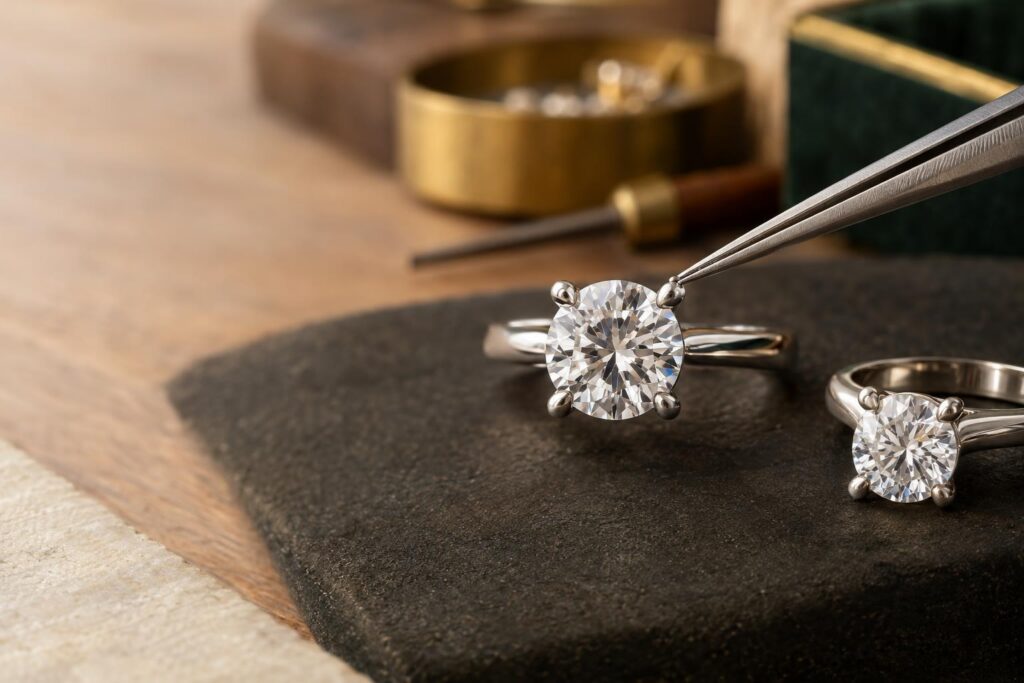
How about white gold? Claws on white gold can be damaged or come loose, so have them checked periodically 1. If stone security is high on your list, this difference in claw strength is the fact to weigh. You can learn more in Four Claws vs Six Claws: Which Solitaire Setting? and How to Choose an Engagement Ring Setting.
The downsides of each metal, and when each isn’t the right fit
Why look at the downsides? Because every metal has trade-offs, and seeing them now avoids surprises later. You may hear that platinum is simply better than white gold. Jewellers do favour platinum for its durability, malleability (how easily it can be shaped without breaking) and significant weight 2. But the facts show trade-offs on both sides.
- On rhodium-plated white gold, the plating wears away, and a poorer colour match with the metal underneath can show 5.
- Some white gold is alloyed with nickel 1, and nickel allergy is commonly seen with jewellery 3.
- Its claws can be damaged or come loose, so they need checking periodically 1.
- In laboratory wear tests, the white gold alloys lost more metal than the platinum alloys 4.
Platinum has trade-offs too. Because it is denser, it weighs more for the same design, which matters if you prefer a light ring. It is not wear-proof either: in the tests, metal loss rose steadily with time for every alloy, platinum included 4.
When might white gold not fit? If you react to nickel and can’t confirm the full alloy, or you don’t want to plan for replating a plated ring. When might platinum not fit? If a light ring matters most to you. If none of these apply strongly, either metal may suit, and the choice comes down to the factor you care about most.
Why the metal stamp and a few tools help you compare
Why check the stamp inside a ring? Because it shows the declared purity, or fineness, of the metal. In gold, ct (also written K) describes purity: 18ct (18K) gold is 750 parts pure gold per 1,000. Platinum may be marked with Pt or Plat and its parts per thousand, for example Pt950 1. Marking practice differs between countries, so ask what a stamp means if you are unsure.
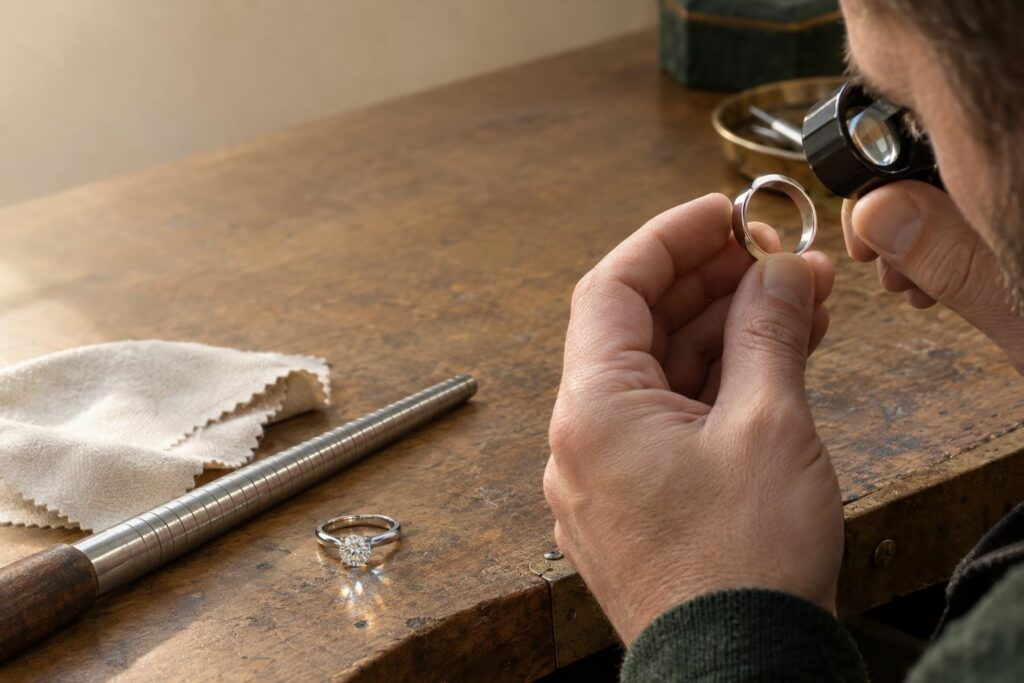
A purity stamp doesn’t tell you what makes up the rest of the alloy, so ask about that too. Gold ct is not the same as carat weight, which measures how heavy a diamond is. Gold at 22ct cannot be whitened at all 5.
Read What 375, 585 and 750 Gold Marks Mean to decode a stamp, and 9ct vs 14ct vs 18ct Gold to see how purity changes gold. The Engagement Ring Budget Planner helps you plan the whole ring, and the Ring Size Converter helps you check a size across countries. If you’d like to talk through both metals with a jeweller, we offer a free consultation, online from anywhere at bookings.ralphjacobs.org.
Sources and methodology
This guide is built from GIA articles on white metals and platinum, a medical review of nickel allergy, a peer-reviewed laboratory wear study of platinum and white gold alloys, a study on white gold colour, and the Royal Society of Chemistry’s platinum data. It reports what those sources say and leaves the choice of metal to you.
- Choosing Between White Gold, Platinum, Palladium, and Silver
- Platinum: A Metal Fit for Kings
- Nickel Allergy (StatPearls)
- Wear Resistance of Platinum and Gold Alloys: A Comparative Study
- White Gold Alloys: Colour Measurement and Grading
- Platinum – Element information, properties and uses