
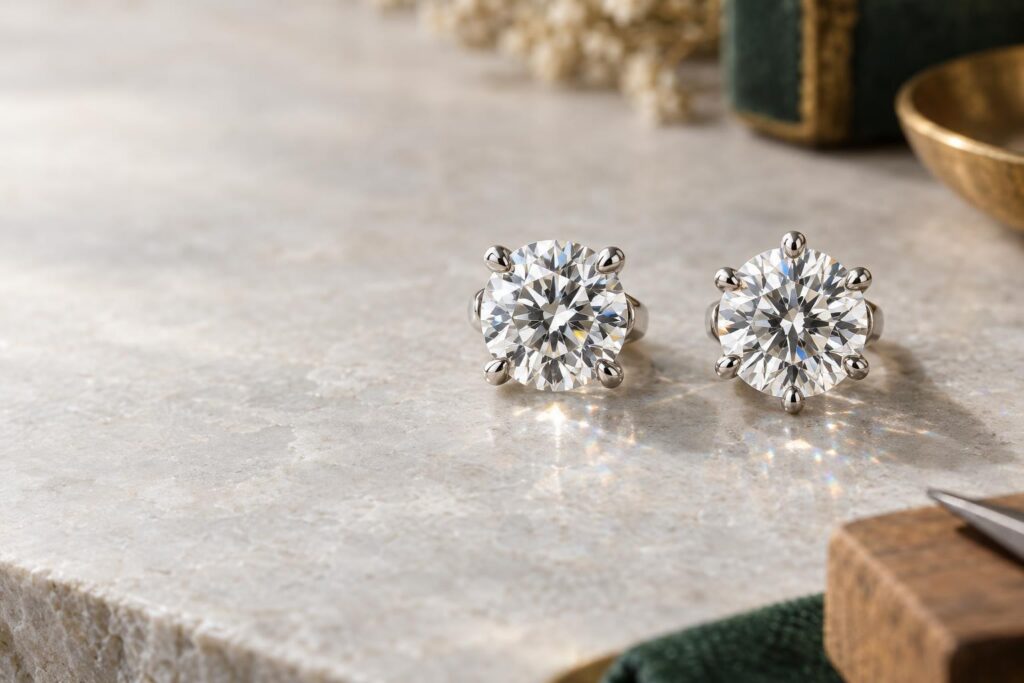
Why the 4 claw vs 6 claw ring setting choice matters
You are choosing a solitaire, and you want the diamond to stay put and look its best. Claws play a part in both: they show off the diamond and protect it from damage and loss 1.
A claw, also called a prong, is a narrow metal support, usually used in groups of four to six 3. A solitaire is a ring with one centre stone. Its head, the part that holds the diamond, uses claws so the diamond can catch the most light 4.
Here is the trade-off in one line: fewer claws show more of the stone, while extra claws add security 2. The rest of this article looks at what that means for security, looks, shape and care.
Why six claws hold a diamond more securely
Why look at security first? Because losing the centre stone is the outcome you most want to avoid. A six-claw setting can offer more protection than a four-claw setting 3.
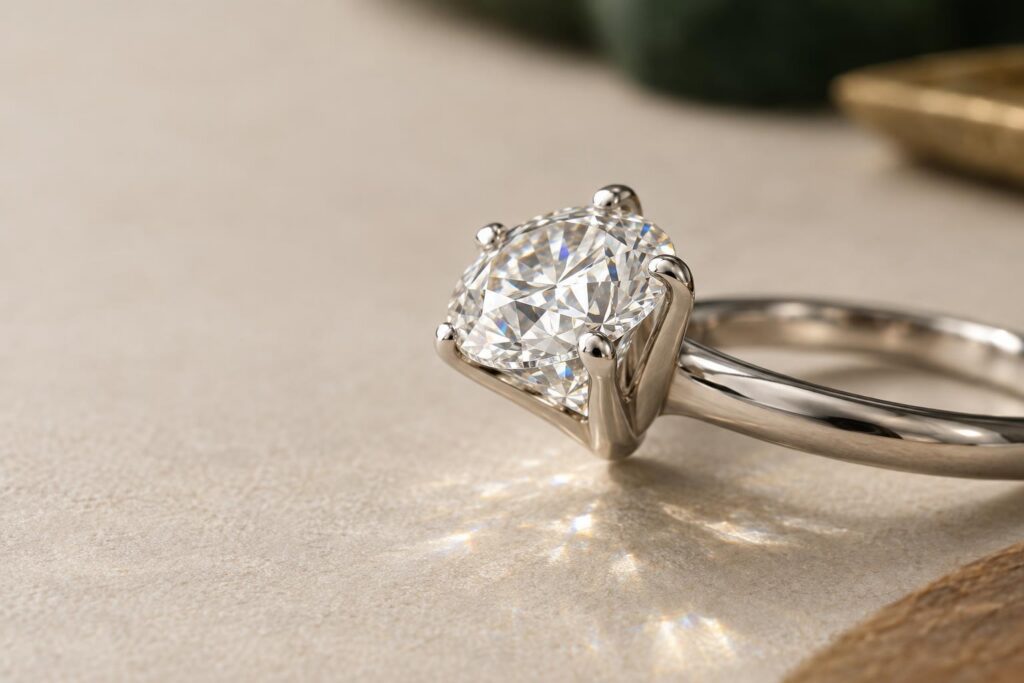
If a claw is sheared off in a four-claw setting, the centre stone can easily fall out. If one breaks in a six-claw setting, the stone will probably stay in place 1. The two extra claws may also give the girdle, the thin outer edge of the diamond, a little extra protection in daily wear 3.
That does not make four claws unsafe. Four claws can still give adequate protection and hold a diamond securely 3. The trade-off, says GIA, is a less secure hold than six and less protection for the girdle 1.
Stone size plays a part too. Most round brilliant diamond rings use four or six claws, depending on stone size, and the larger the stone, the more claws it needs 2.
Why claw count changes how your diamond looks
Why would a few small claws change the look of a ring? GIA’s answer is about metal. Four claws mean less metal on the diamond, so the centre stone is the star of the show 1.
Claws also shape the outline you see. On a round diamond, four claws may make the stone look slightly squarer, while six claws tend to bring out its round shape 2. Which outline you prefer is a matter of taste.
Size matters here as well. A carat (ct) is the unit used to weigh diamonds, and diamonds under 0.50 ct can be overshadowed by six claws 1. To see how weight relates to the size you actually notice, read Diamond carat weight vs visible size.
Do four claws let in more light?
You may have heard that four claws let more light into a diamond, so it sparkles more. The idea makes sense at first, because claw settings are designed to let maximum light into the stone 2.
GIA calls this a myth. A diamond’s sparkle is set by the quality of its cut, not by the number of claws 1. Sparkle includes brilliance, the white light a diamond returns to your eye.
If sparkle matters most to you, the relevant fact is that cut decides it. Read Diamond cut explained to see how.
Why the shape of your diamond changes the choice
Why does shape matter? Because claws do more than hold a stone. On a round diamond, claw count changes its outline, and on pointed shapes the form of the claw helps protect the corners 2.
Four claws, six claws and V-claws compared
Switch between settings to see how claw count and claw shape change the way a solitaire diamond looks.
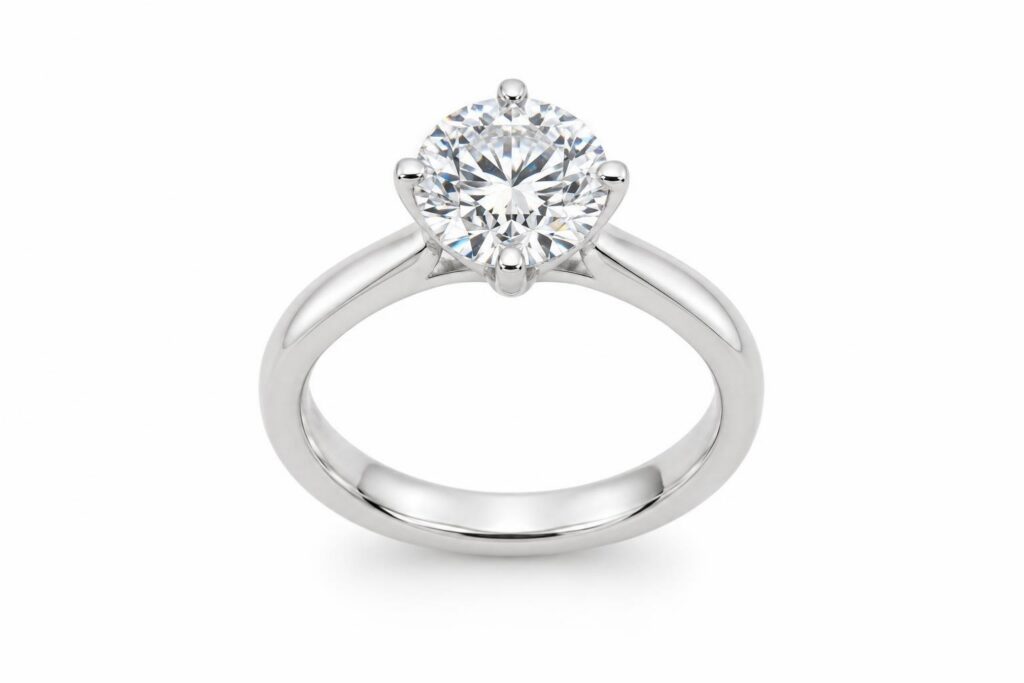
- Four claws on a round diamond
- Four claws put less metal on the diamond, so the centre stone is the star of the show. On a round diamond they may make the stone look slightly squarer.
- Six claws on a round diamond
- Six claws tend to bring out a round diamond's round shape. They add security too: if one claw breaks, the stone will probably stay in place. The extra metal can overshadow diamonds under 0.50 ct.
- Four claws on a princess cut
- Four claws can give a diamond a more squarish look, which makes them a good choice for princess and cushion diamonds.
- V-shaped claw on a pointed stone
- If a diamond has points, V-shaped claws help protect them from chipping.
The pictures show claw count and claw shape only. They cannot show how secure a setting is, and real rings vary in claw thickness and head height. Pictures: AI-generated illustrations, checked for accuracy. They are not photographs of a real piece.
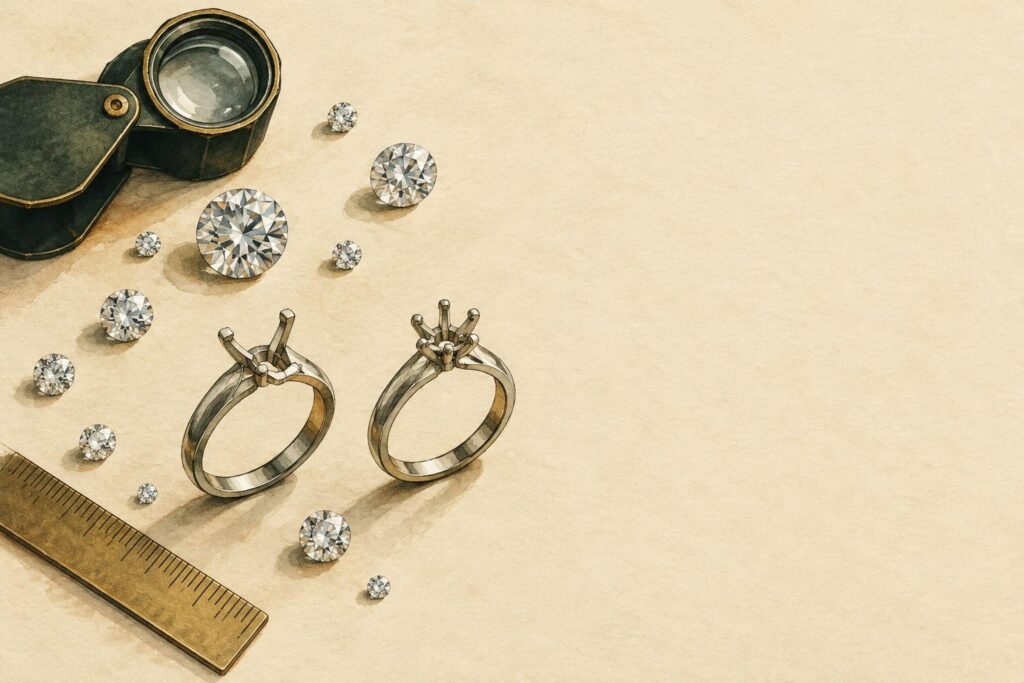
Compare shapes in more depth in Choosing a diamond shape.
Round diamonds
Why think about round separately? Because the four-or-six choice changes how round it looks. Six claws can make a round diamond or gemstone look rounder 1. Four claws, by contrast, may make it look slightly squarer 2.
Square and rectangular diamonds
Why might a square shape suit four claws? Four claws can give a diamond a more squarish look, which makes them a good choice for princess, cushion and other square or rectangular diamonds 1. A princess cut is a square or rectangular shape with pointed corners. A cushion is square or rectangular with rounded corners.
Pointed shapes
Why do points need special care? Because they can chip. V-shaped claws, which wrap around a point, protect the corners on heart, princess, pear and marquise cuts and reduce the risk of chipping 2.
GIA also gives advice for single shapes. A claw-set pear should have a V-shaped claw at its point to protect it from damage 5.
Small hearts are a special case. A heart shape is hard to make out in diamonds under 0.50 ct, and a bezel or three-claw setting preserves the shape better 5. A bezel is a thin rim of metal that surrounds the stone.
Why claws need checking, whatever the number
Why check claws at all? Because they are small pieces of metal doing a big job. Claws can shift and loosen over time, and exercise, gardening, catching on clothing and knocks all take their toll 3.
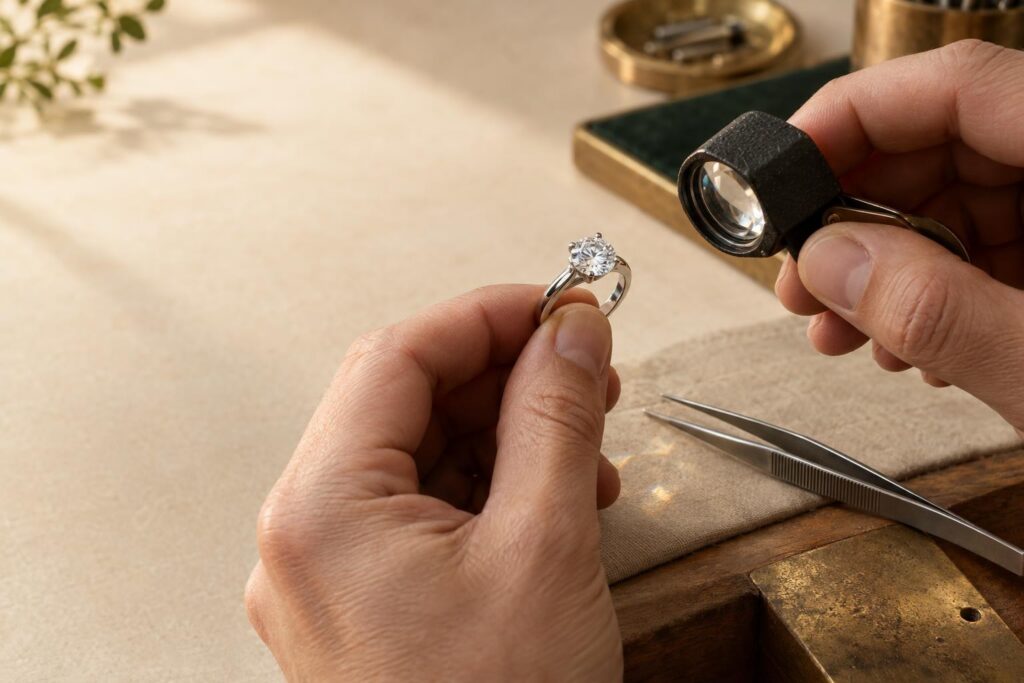
Have the claws checked every six months, or at least once a year 3.
You can also look for warning signs yourself. If the stone moves when you gently push it, it is loose. Gaps between the diamond and the setting are another sign, and a 10× loupe, a small jeweller’s magnifying glass, helps you see them 3.
Worn claws can be repaired. They may need re-tipping, which means rebuilding the worn tips by adding metal 2.
Claws also have raised edges that can catch on fabric. Basket settings, which join the claws with horizontal supports, help stop them bending or spreading over time 2. For more on how a claw-set ring is built, see Ring settings explained.
Why cleaning around the claws matters
Why does a clean setting change the look? Diamonds attract grease, and oil from your fingers sticks to the surface and dulls brilliance and fire, the flashes of colour a diamond gives off 6.
A simple routine works. Soak the ring in water with a few drops of mild dish soap once or twice a week. Then use an unused soft toothbrush, kept only for jewellery, to reach hard-to-reach places like the back of the diamond 6.
Some settings need a lighter touch. Don’t scrub fragile settings, such as older claws on antique jewellery, hard 6.
Never use chlorine bleach or abrasives. Chlorine can damage metals alloyed with gold, and abrasives can scratch metal 6.
Ultrasonic cleaners can shake stones loose from their mountings, so have a jeweller check for loose stones before using one 6. The cleaning guidance used here does not compare four-claw and six-claw settings.
The downsides of four claws and six claws
Why look at the downsides? Because every setting gives something up, and knowing what helps you choose with open eyes.
With four claws, if one is sheared off, the centre stone can easily fall out, and the girdle gets less protection 1. On a round diamond, four claws may also make the stone look slightly squarer, which matters if you want a clearly round outline 2.
With six claws, there is more metal on the stone, and diamonds under 0.50 ct can be overshadowed 1.
Both styles share some downsides. Claws of any number can shift and loosen over time 3. They can also catch on fabric and may need re-tipping 2.
Sometimes neither is the right choice. For a heart diamond under 0.50 ct, GIA mentions that a bezel or three-claw setting preserves the shape better 5. For pointed shapes, the form of the claw matters too, because V-shaped claws help protect the points 2.
Weighing four claws against six for your solitaire
Why hand the decision back to you? Because the facts point in different directions, and only you know which matters more for your ring.
If security in daily wear matters most to you, the relevant fact is that six claws are more likely to hold the diamond in place if a claw breaks 3. If you want to see as much diamond as possible, four claws mean less metal on the stone 1.
If your diamond is round, six claws tend to bring out its round shape 2. If it is under 0.50 ct, six claws can overshadow it 1.
If your diamond is square or rectangular, four claws can give it a more squarish look 1. If it has points, V-shaped claws help protect them from chipping 2.
If sparkle is your main concern, the relevant fact is that the quality of the cut sets it, not the number of claws 1.
If you would like to compare both styles around your own stone, we offer a free consultation, online from any country at bookings.ralphjacobs.org, or at our Secunda showroom. For the wider decision, see How to choose an engagement ring setting.
Frequently asked questions
Diamonds under 0.50 ct can be overshadowed by six claws, while four claws put less metal on the stone. Six claws can also make a round diamond look rounder 1.
GIA calls this a myth. A diamond’s sparkle is set by the quality of its cut, not by the number of claws holding it 1.
Every six months, or at least once a year. Between checks, gently push the stone: if it moves, it is loose. Gaps between the stone and the setting are another warning sign 3.