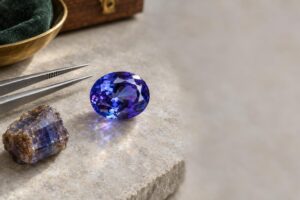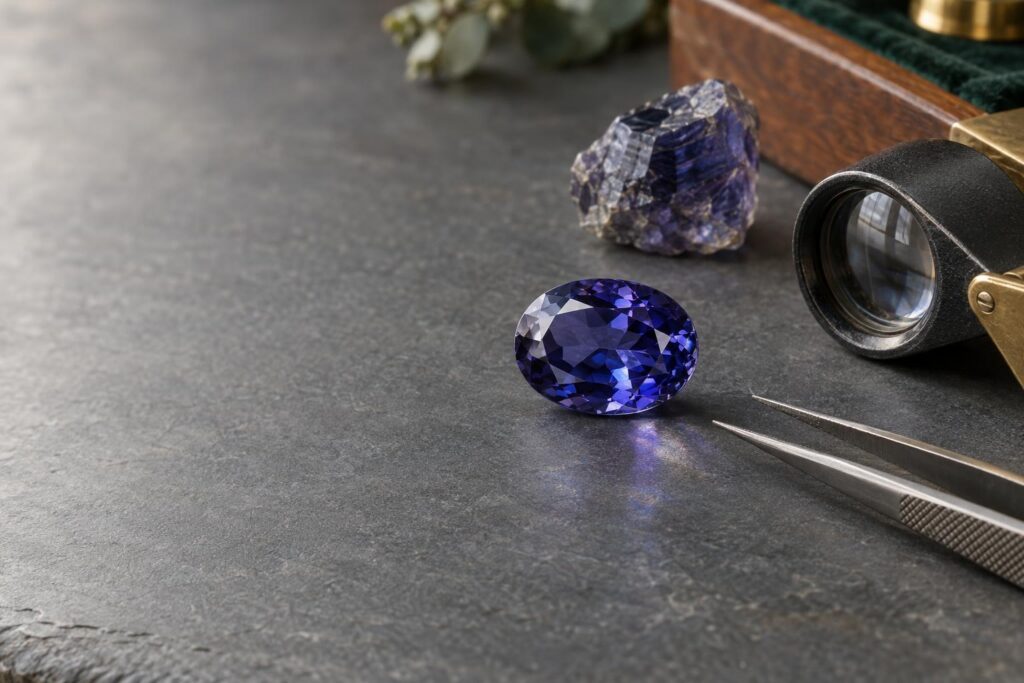
Why iolite draws people looking for blue-violet depth
If you want a blue-violet stone, iolite offers deep colour along with a surprise: it changes colour as you turn it. Knowing why that happens, and how tough the stone is, helps you judge where it fits in your jewellery. Its most desirable colours run from violetish blue to a fine blue 2.
What is iolite? Mineralogists call it cordierite, a silicate of aluminium, iron and magnesium 1. Its chemical formula is Mg2Al4Si5O18, and the name iolite comes from the Greek word "ios", meaning violet 2. The mineral name honours the French geologist Pierre Louis Antoine Cordier, and its crystal structure is somewhat like that of beryl 6.
Why iolite’s pleochroism makes it change colour
Why does iolite look different from each side? It has strong pleochroism, which means a stone shows different colours when you look at it from different directions. Turn an iolite and you can see three distinct colours along three directions in the crystal 2. Mindat lists cordierite’s optical type as biaxial and gives its three pleochroic colours as pale yellow or green, violet or blue-violet, and light blue 6.
One iolite, three colours
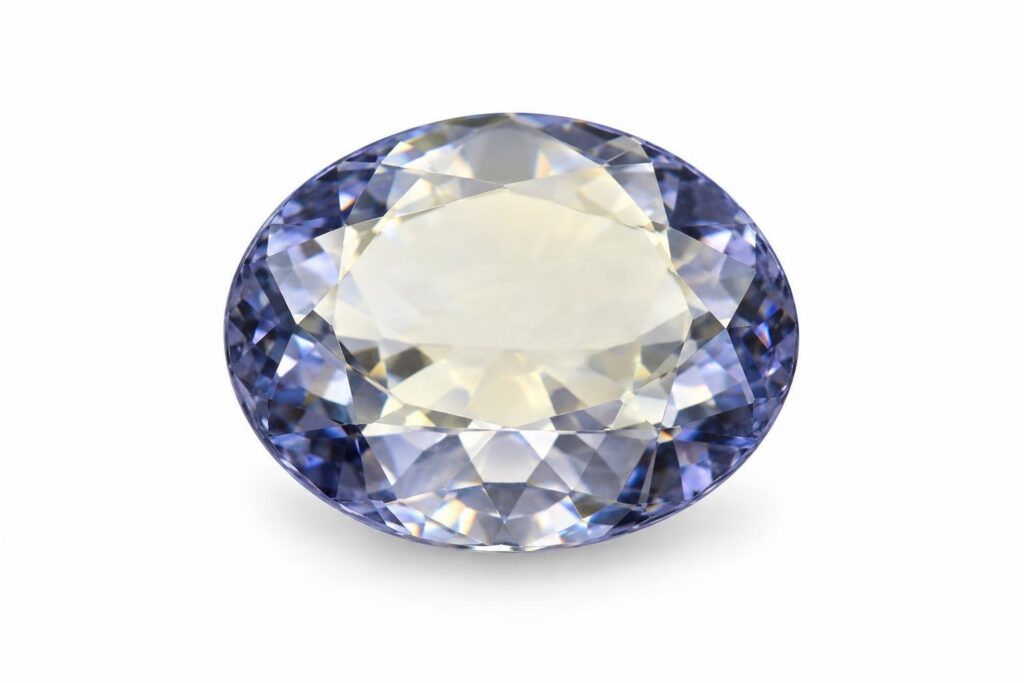
Iolite shows different colours along three directions in the crystal. Here is what a bluish iolite shows as you look at it from each direction.
- First direction
- Looked at along one direction, a bluish iolite can appear colourless to yellow. The effect is strong enough to see with the naked eye.
- Second direction
- Turn the same stone and it shows blue-grey, the second of its three colours.
- Third direction
- Along the third direction, the stone shows dark violet. This is the richest of the three colours in a bluish iolite.
The pictures show one stone turned to three positions. In a real iolite the colours blend as you tilt it, and the exact shades vary from stone to stone. Pictures: AI-generated illustrations, checked for accuracy. They are not photographs of a real piece.
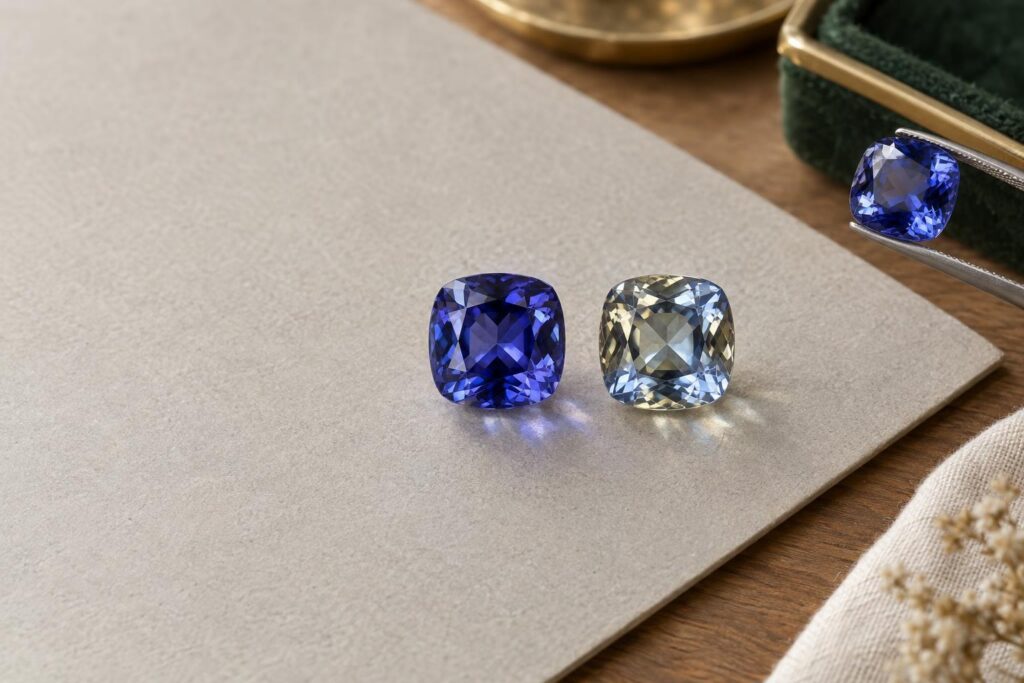
How does this look in practice? In iolite the effect is visible to the naked eye, and the violetish blue colour comes from iron. Violet iolites show light violet, dark violet and yellow-brown. Bluish iolites show colourless to yellow, blue-grey and dark violet. From some angles a bluish stone can look completely colourless or yellow, and a violetish one can look brown 1.
This shifting colour once led to a misleading trade name. Strongly pleochroic iolite has been incorrectly called "water sapphire", because it can look blue to violet one way and pale yellow to colourless another 2. You can read more about the effect in our pleochroism glossary entry.
Why the cutter’s angle decides the colour you see
Why does cutting matter so much? The colour you see depends on the direction you look through the stone. A cutter must orient iolite carefully so the best colour shows through the table, the large flat facet on top 3. This strong pleochroism makes iolite tricky to cut for the best colour 1.
Cleavage adds a second challenge. Cleavage is a natural plane of weakness along which a crystal can split cleanly. Iolite’s cleavage in one direction means it needs special care during cutting, polishing and mounting 5.
Why treatment is rarely a question with iolite
Why ask about treatments at all? Knowing what is usual for a stone tells you what to ask about. Iolite is not typically treated 2. For the general principles, see how gemstone treatments should be disclosed.
Why is iolite left alone? The deep blue of some iolites may share its cause with sapphire’s blue, a process called iron-titanium charge transfer. But iolite can’t be heat-treated as sapphire can, because it has a low melting point 1. Coatings and dyes are generally not a concern 5.
Still, "not typically treated" is not the same as "never treated". If this matters to you, you can ask the seller what is known about the treatment of a particular stone.
Why iolite needs thought in daily wear
Why look beyond hardness? Hardness is resistance to scratching, while toughness is resistance to chipping and breaking. Iolite is 7 to 7.5 on the Mohs scale, the scale gemmologists use for scratch resistance 2.
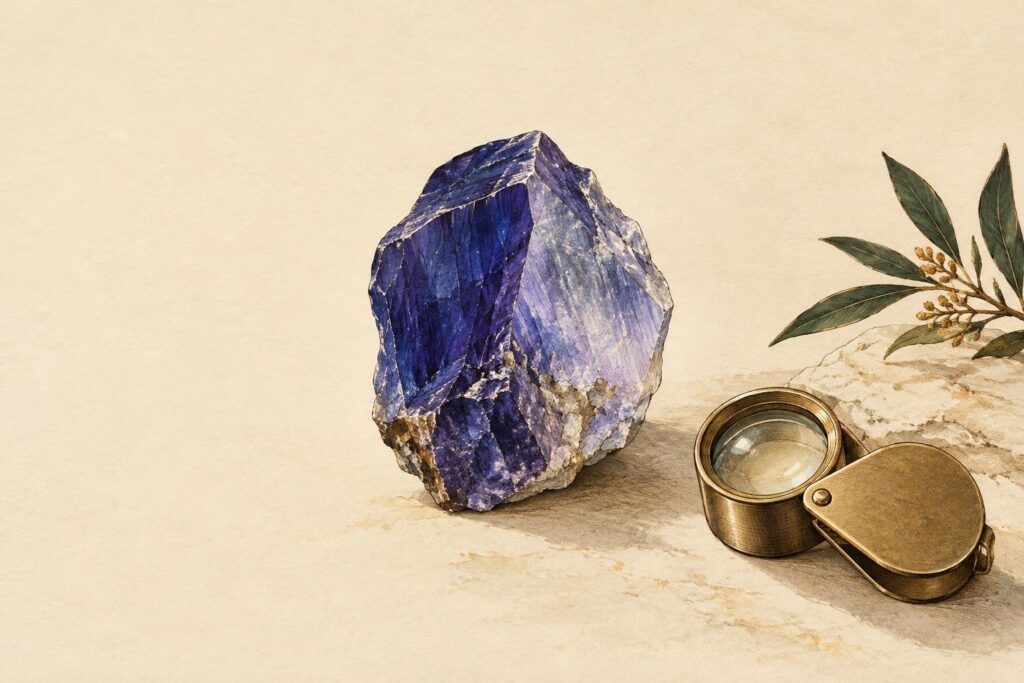
How does cleavage change the picture? Iolite shows why the two qualities differ: its cleavage in one direction means its toughness is only fair. That makes it vulnerable in rings exposed to rough daily wear 1. A hard blow might split it, and extreme pressure or sharp temperature changes might break it 5.
Sources describe this cleavage in different words. GIA’s buyer’s guide calls it perfect in one direction 3. Mindat lists it as fair on one plane and poor on the other two 6. Both point to one main direction of weakness. For more on why hardness is only part of durability, see the Mohs scale is not the whole durability story.
What does this mean for care? Iolite’s colour is stable, but high heat or sudden temperature changes can cause breaks. Avoid steam and ultrasonic cleaners; warm, soapy water with a soft toothbrush is safe 5.
What to look at when buying iolite: colour, clarity and size
Why start with colour? With iolite, colour shapes how a stone is valued. Vivid violet to blue are the most valued colours, while commercial-quality iolite often looks greyish 3. To learn how colour is judged, see hue, tone and saturation in gemstones.
How clear is iolite? It is usually transparent with relatively few inclusions, the tiny internal features found in many gems. That is why it is most often faceted, meaning cut with flat, polished surfaces. Fashioned iolites range from 1 to 10 carats, and fine stones over five carats are rare 4. A carat is the unit used to weigh gemstones.
Some iolites show special effects caused by their inclusions 4.
How iolite compares with tanzanite and sapphire
Why do these three stones come up together? All three can show violet-to-blue colour, so iolite is a possible alternative to tanzanite or sapphire 3. Fine iolite colour can sometimes rival either stone. When tanzanite was first found, gemmologists even suspected it might be cordierite 1.
How do they differ? Unlike tanzanite, iolite is rarely treated. Unlike sapphire, it can’t be heat-treated, because of its low melting point 1. If you are weighing these stones, durability, treatment and colour are the facts to compare. Our guide on how to buy a sapphire covers sapphire in depth.
Why setting choice matters for iolite
Why think about the setting early? A setting decides how exposed a stone is to knocks. Jewellers prefer protective settings for iolite, or pieces that get less wear, such as pendants and earrings 5. Iolite can be used in many types of jewellery. Besides faceted stones, it is cut as cabochons (smooth, domed stones), carvings and beads 4.
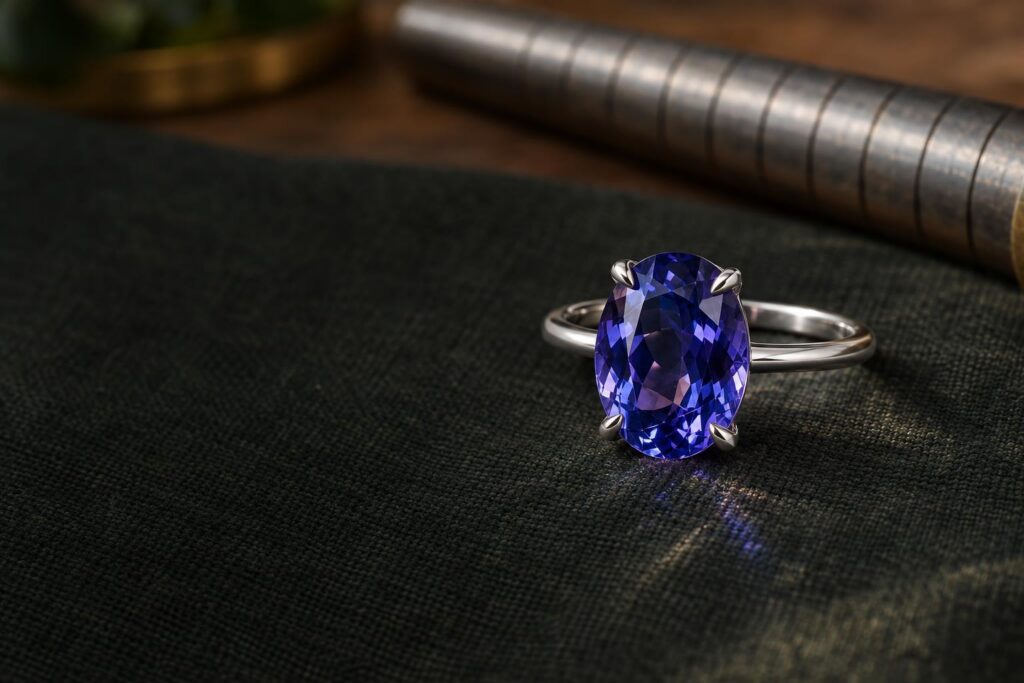
If you are considering iolite for a ring, the relevant facts are its fair toughness and its cleavage, which leave it vulnerable to rough daily wear 1. You can see how different settings hold and protect a stone in ring settings explained. How other gems compare for daily wear is covered in which gemstones suit everyday rings.
Why this entry is here
This encyclopedia describes gemstones so you can understand them before you choose. Inclusion in this guide does not confirm that Ralph Jacobs stocks this gemstone. If you would like to talk through a coloured gemstone for a piece, we offer a free consultation, online from anywhere at bookings.ralphjacobs.org.
Frequently asked questions
Iolite is not typically treated, and it can’t be heat-treated like sapphire because of its low melting point 1. If treatment matters to you, ask the seller what is known about the treatment of a particular stone.