
Why does the table matter? Gems are usually cut so that you look through the table to see how light has been collected and returned 4. The table is the flat top facet (a facet is a small, flat polished surface). It helps gather light from above, then reflects it back to you or sends it into the stone 1.
The parts of a diamond
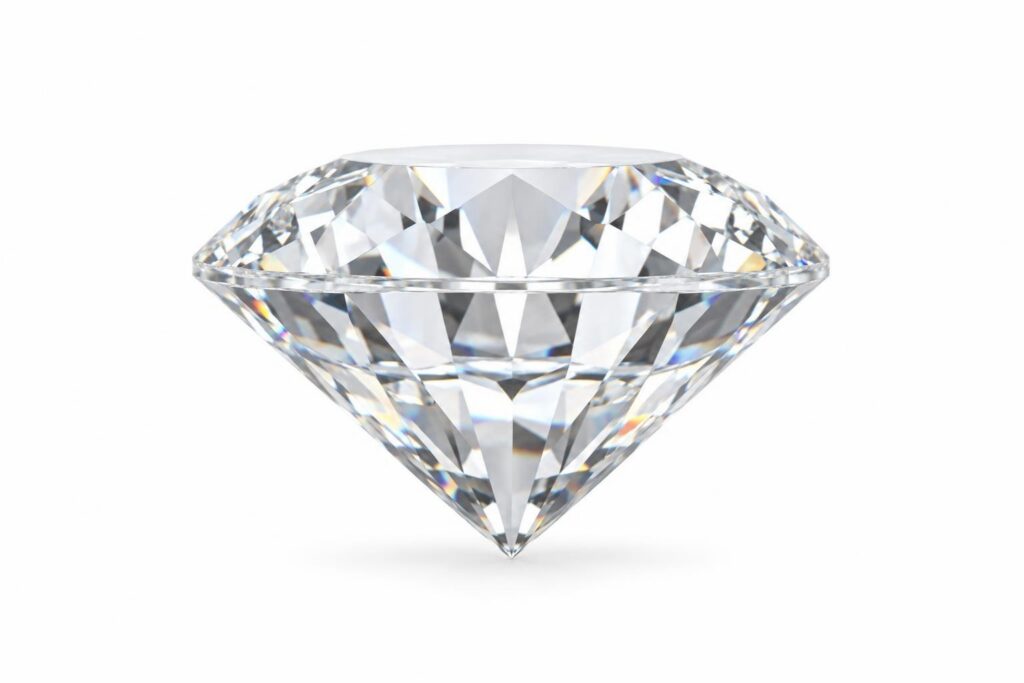
- Table
- The large flat facet on top. Most light enters the stone here.
- Crown
- The upper part, between the table and the girdle. Its angled facets help split light into flashes of colour (fire).
- Girdle
- The thin outer edge at the widest point. The setting usually grips the stone here.
- Pavilion
- The lower part, below the girdle. Its angle decides how much light reflects back up through the top.
- Culet
- The point, or tiny facet, at the very bottom of the pavilion.
- Total depth
- The height from the table to the culet, compared with the diameter. It is one of the measurements behind the cut grade.
Pictures: one AI-generated illustration of a diamond, adjusted for each grade. They show how the grades differ; they are not a grading of any stone.
How is table size measured? Gem specs give it as a table percentage. This compares the table’s width with the width of the girdle, the thin outer edge of the stone. For a round brilliant, the average table size is divided by the average girdle diameter, then multiplied by 100 1. A diamond with GIA’s Excellent cut grade has a table between 52% and 62%, but other proportions are important too 2.
Does table percentage affect beauty? It can, but it works together with other parts of the cut. Table size, crown angle and pavilion angle (the slope of the lower, pointed part) work together to create the stone’s look 5. The crown is the upper part of the stone, between the girdle and the table. In GIA research, one sample diamond with a large table, a shallow crown height and its particular pavilion angle showed a look called a fisheye 3. Proportions are only one factor in a diamond’s cut grade, as Diamond Cut Explained shows 2.
Example: Picture a round diamond whose report lists a 70% table. In GIA research, a sample diamond with a 70% table had low scores for brightness and fire (flashes of colour), plus a fisheye that grew more obvious when tilted 3. That figure sits above the 52% to 62% range GIA gives for an Excellent-grade diamond 2. See How to Read a GIA Diamond Grading Report to find the table percentage on a report.