
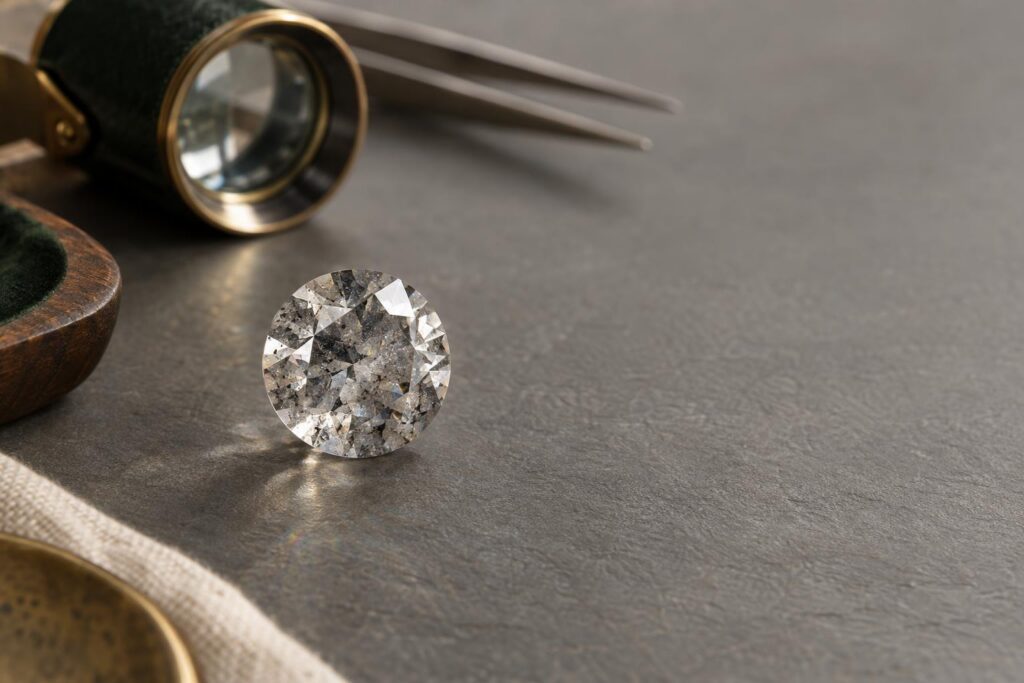
Why the speckles matter when you choose a salt and pepper diamond
You’ve seen a salt and pepper diamond and liked its speckled, smoky look. Before you buy one, it helps to know what those specks are. Obvious inclusions may affect transparency and brilliance, and some can make a cut diamond more vulnerable to damage 2.
The name describes the look: darker specks (the pepper) and lighter, hazy areas (the salt). Both are inclusions, which are features inside a diamond. Small crystals can become trapped in a diamond while it forms 5. In a salt and pepper diamond, these features are the look rather than something to hide.
- GIA research found that black colour in natural diamonds can come from graphite, crystals of other minerals and clouds of tiny pinpoints 1.
- Clarity graders weigh the size, number, location, relief and nature of inclusions 2.
- A diamond with many inclusions near the girdle or points is more prone to chipping or breaking 3.
- The cut or the setting can sometimes hide inclusions 6.
Why do dark and light specks form inside a diamond?
Why start here? Because knowing what each speck is helps you understand what you see in a photo or under a loupe, the small magnifying glass jewellers use. A diamond grows as a crystal. Small crystals can get trapped inside it, and the crystal can develop irregularities in its atomic structure as it grows 5.
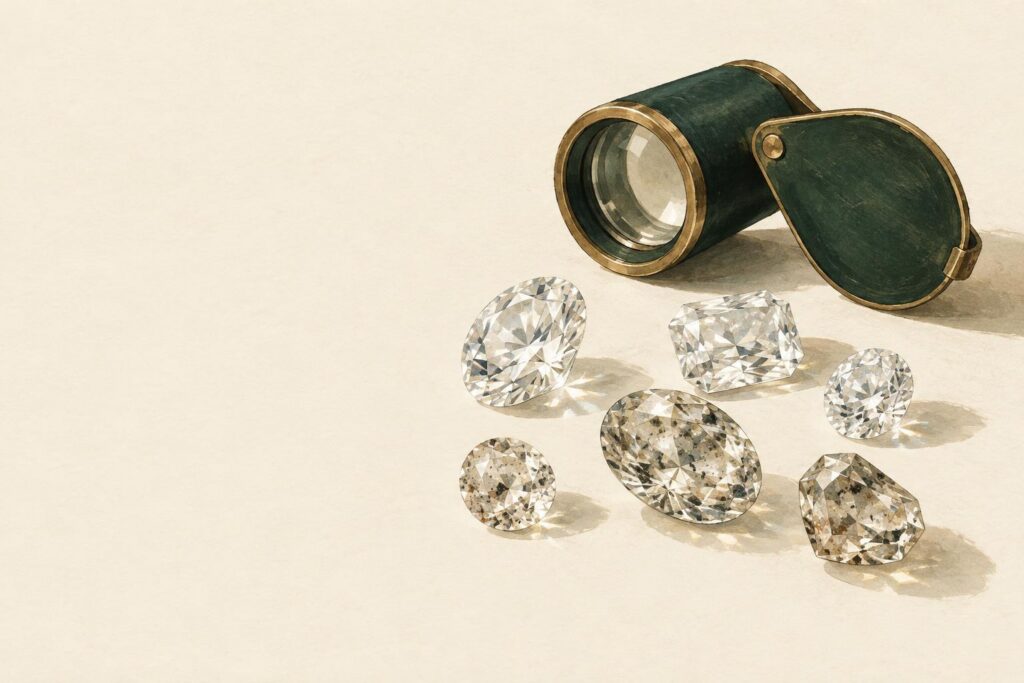
Dark specks can come from several kinds of inclusion. In the fancy white diamonds GIA studied, dark, obvious inclusions were generally graphitized inclusions or graphitized stress fractures. Graphitized means turned into graphite, a black form of carbon. Some black diamonds studied held magnetite, hematite and native iron (iron in metal form) instead, and in others the graphite often appeared as needles 1.
Clouds also play a part in the hazy look. A cloud is generally described as a cluster of tiny pinpoint inclusions. Clouds vary in density, and so in how see-through they are. Even at 10× magnification, you can’t make out the shape of each pinpoint 1.
Fancy white and fancy black diamonds, whose colour comes from inclusions, range from transparent, to translucent (letting some light through), to opaque (letting no light through) 1. Research on these stones did not single out salt and pepper diamonds. Treat it as a guide to the same kinds of inclusions, not a description of every stone.
Why the usual clarity grades tell only part of the story
Why does this matter? If a salt and pepper stone comes with a clarity grade, knowing what the grade measures helps you read it fairly. GIA’s clarity scale has 11 grades, from Flawless to I3 2. For how clarity fits with cut, colour and carat, see The 4 Cs of diamonds.
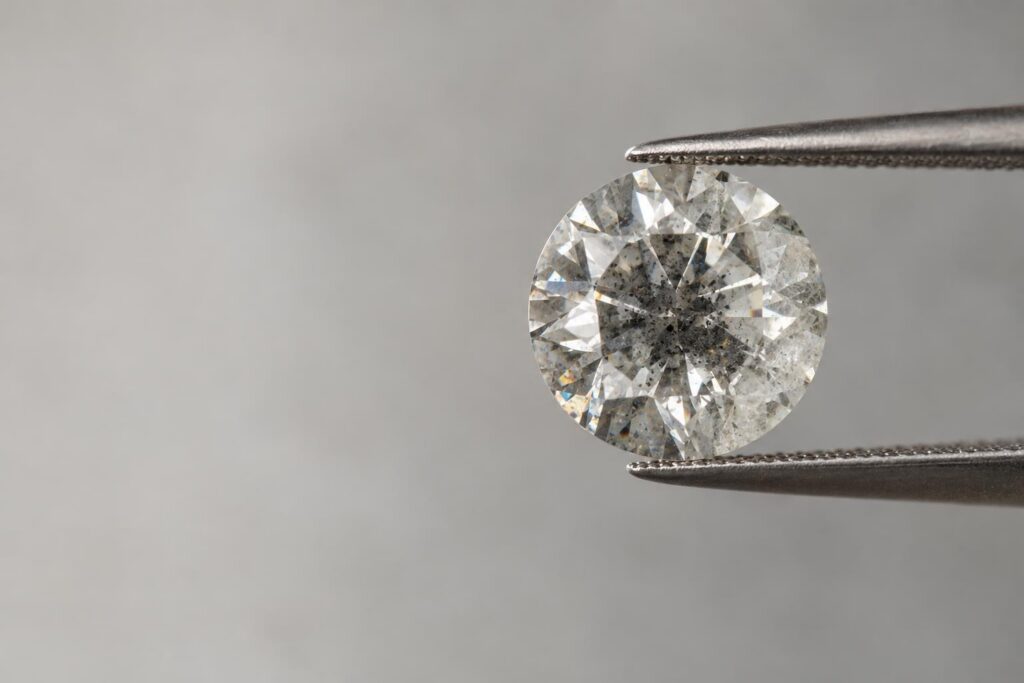
Graders weigh five factors: the size, number, location, relief and nature of the inclusions. Relief means contrast. The more an inclusion differs in brightness, darkness or colour from the diamond, the easier it is to see. Location matters too. The closer an inclusion is to the centre of the table, the flat top facet, the bigger its effect 2.
Stones with obvious inclusions fall into the Included grades, I1 to I3. Their inclusions are obvious at 10× magnification and often visible to the naked eye 6. They may also affect transparency and brilliance, the white light a diamond returns to your eye 5.
GIA researchers studying fancy black and fancy white diamonds described them as stones where colour and clarity converge 1. A clarity grade describes the inclusions. Whether you like the pattern they make is a matter of taste, and only you can judge that.
Why durability depends on where the inclusions sit
Why think about durability? Because a salt and pepper diamond is defined by its inclusions, and some inclusions affect how a diamond wears. Durability has three parts. Hardness resists scratches, toughness resists breaking and chipping, and stability resists chemicals and sudden temperature change. Diamond is very stable and extremely hard, but only somewhat tough 3.
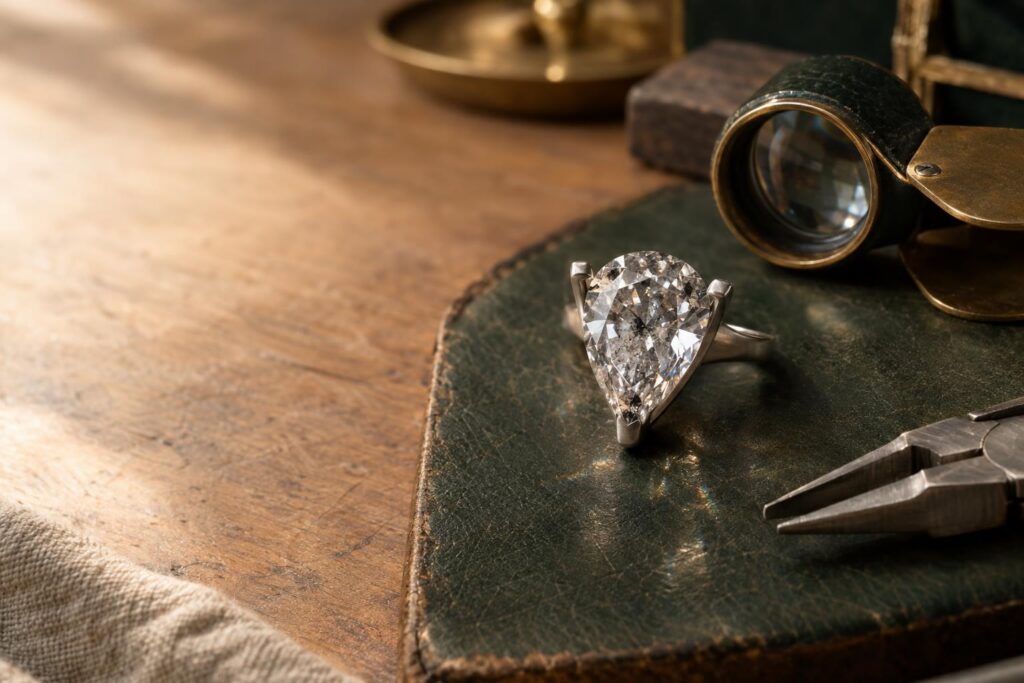
Hardness and toughness are not the same thing. A diamond can break more easily in certain directions, and a hard blow can cleave it (split it along a flat plane) or fracture it 4. You can read more in The Mohs scale is not the whole durability story.
Where the inclusions sit matters. Certain inclusions, especially near the girdle, the thin outer edge of the diamond, can make it more vulnerable to damage. If a stone is hit right on a feather (a small break inside the stone) or another inclusion that reaches the surface, it might chip. Very deep feathers can also be a durability concern 2.
Points and corners need the same attention, as on pear, marquise and princess shapes. A diamond with many inclusions near the girdle or points is more prone to chipping or breaking 3. Sudden, extreme temperature changes can also create fractures, or make existing ones spread 4.
How a setting can help protect weak spots
Why does the setting matter? It decides which parts of the stone are exposed to knocks. Vulnerable points or corners are better protected by bezels, partial bezels or V-shaped prongs 3. A bezel is a thin metal rim around the stone’s edge. A V-shaped prong is a claw that wraps over a point.
The cut or the setting can sometimes hide inclusions too 6. To compare the options, see Ring settings explained.
Why photos and videos need a careful look
Why be careful with images? Hazy or cloudy features from nano-inclusions, which are extremely small inclusions, can be difficult to photograph 1. So it can help to see more than one image, or the stone in person, before you decide.
Here’s what to look for when you study photos and videos:
- Where the dark inclusions sit and how strongly they contrast. The closer an inclusion is to the centre of the table, the bigger its effect, and the more it differs from the diamond, the more visible it is 2.
- What sits near the edge and points. Many inclusions close to the girdle or points make a diamond more prone to chipping 3.
- How see-through the stone is. Ask the seller to describe its transparency, since cloudy features may not show clearly in a photo 1.
- Whether there is an independent laboratory report. Ask. If there is one, How to read a GIA diamond grading report explains what it records.
- The size you want. If you’re after 1.00 carat (ct, the unit used to weigh gemstones) or more, the Carat to Millimetre Estimator gives a sense of a stone’s width.
When a salt and pepper diamond may not be the right choice
Why look at the downsides? Because the features that create the look are inclusions. Inclusions in Included-grade diamonds may affect brilliance and structural integrity as well as appearance 6. Some people will weigh this more heavily than others.
- If maximum sparkle matters most to you. Inclusions in Included-grade diamonds may affect transparency and brilliance 2.
- If the ring will take hard knocks. I2 and I3 diamonds generally have more prominent inclusions that can affect durability 6.
- If you want a pointed shape left exposed. A stone hit right on an inclusion near a point is likely to chip 3.
- If you can only buy from photos. Hazy or cloudy features can be difficult to photograph 1.
None of these rules a salt and pepper diamond out. They are facts to weigh against what drew you to it. Where the inclusions sit, and how the setting covers the edge and points, are the facts most closely tied to how the stone wears.
Why it helps to talk it through before you decide
Why talk to a jeweller? Because the facts above apply stone by stone: graders look at each inclusion’s size, number, location, relief and nature 2. Ralph Jacobs sells salt-and-pepper diamonds as part of its fancy coloured diamond range. We offer a free consultation, booked online from any country at bookings.ralphjacobs.org, or by WhatsApp or at our Secunda showroom.
For the wider decision, including shape and setting, see Choosing a diamond for an engagement ring.
Frequently asked questions
Diamond is extremely hard but only somewhat tough, so a hard knock can chip it. Many inclusions near the girdle or points add risk. Bezels, partial bezels or V-shaped prongs can better protect exposed points 3.
Diamonds with inclusions that are obvious at 10× magnification fall into GIA’s Included grades, I1 to I3 2. A grade describes the inclusions. Whether you like the pattern they make is your own choice.
Hazy or cloudy features from tiny inclusions can be difficult to photograph 1. Seeing more than one image, or the stone in person, gives you more to go on.
They are inclusions. GIA research found black colour in natural diamonds can come from graphite, crystals of other minerals and clouds. Some black diamonds studied held magnetite, hematite or native iron instead 1.