Why one gem name covers so many colours
If you have seen tourmaline in pink, green, blue and even two colours at once, you may wonder if these are really the same stone. Knowing why it varies so much helps you judge quality and understand how a stone will wear. Tourmaline has one of the widest colour ranges of any gem, in shades of virtually every hue 1.
How is that possible? Tourmaline is not one mineral but a family. Scientists class it as a borosilicate mineral supergroup, a set of minerals built around boron and silicon 4. Its members are closely related species with the same crystal structure but different chemical and physical properties 1.
Every tourmaline contains silicon, aluminium and boron, plus a mix of other elements. These include sodium, lithium, calcium, magnesium, manganese, iron, chromium, vanadium, fluorine and sometimes copper. Small amounts of some of them tint the crystal. Iron, and possibly titanium, cause green and blue, while manganese produces reds and pinks, and possibly yellows 1.
Most gem tourmalines are elbaites, the species with the widest colour range 1. Iron tourmaline, called schorl, is black, and magnesium tourmaline, called dravite, is brown.
Why tourmaline colours have their own names
Why do sellers use so many names for one gem? Each name describes a colour, or a source of colour, quickly. You will often see these terms:
Tourmaline colour names, side by side
Sellers use a handful of names to describe tourmaline quickly. Switch between them to see what each one means.
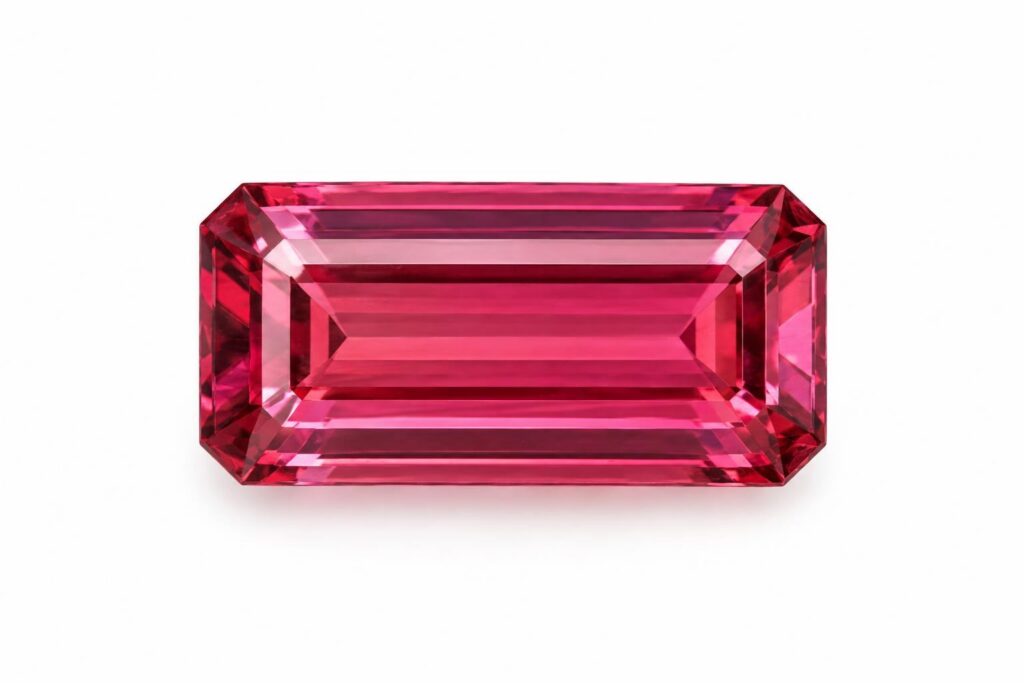
- Rubellite
- Rubellite is pink to red tourmaline, though some in the trade say pink stones should not count.
- Parti-coloured tourmaline
- A parti-coloured stone shows more than one colour, often green and pink.
- Watermelon tourmaline
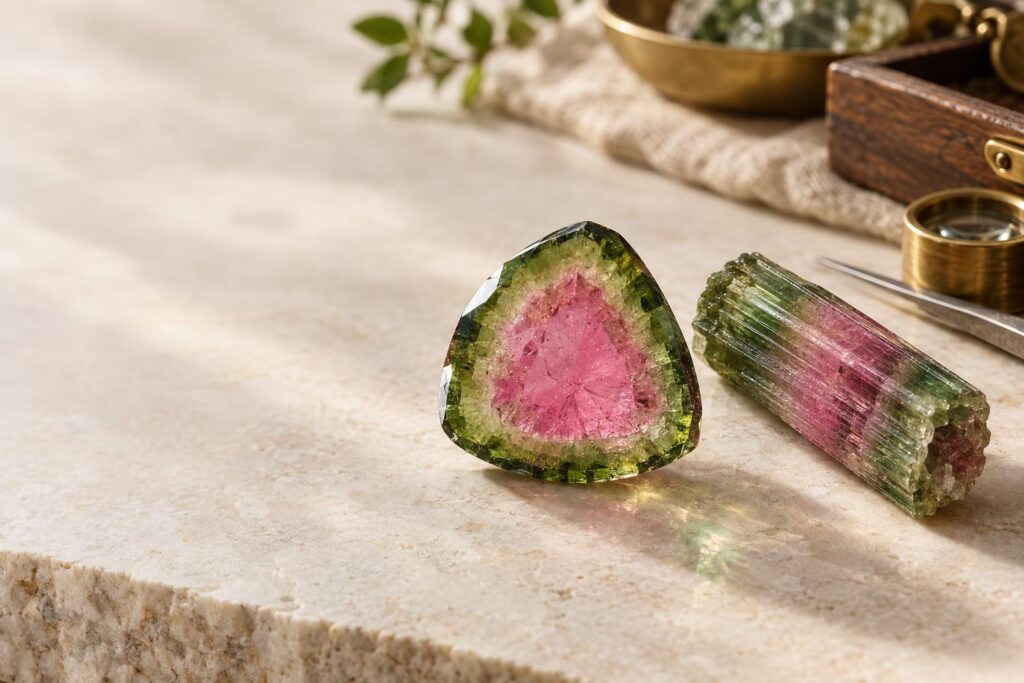
- Watermelon tourmaline is pink in the centre and green outside, and is usually cut in slices.
- Chrome tourmaline
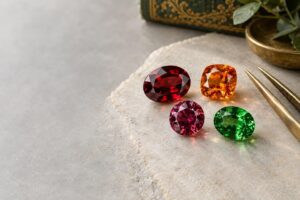
- Chrome tourmaline is an intense green. Despite its name, it is coloured mostly by vanadium.
- Indicolite
- Indicolite is dark violetish blue, blue or greenish blue tourmaline.
- Paraíba tourmaline
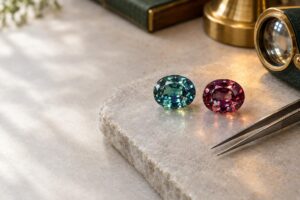
- Paraíba tourmaline gets its colour from copper. Bright blue to green copper-bearing tourmaline is known from Brazil, Nigeria and Mozambique.
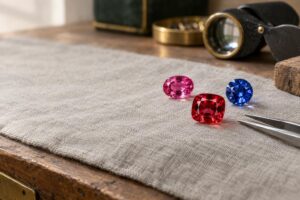
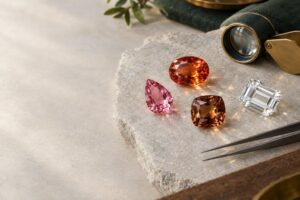
Colours vary within each name, and these pictures show one typical stone for each. Real stones also differ in tone and saturation. Pictures: AI-generated illustrations, checked for accuracy. They are not photographs of a real piece.
- Rubellite: pink to red tourmaline, though some in the trade say pink stones should not count.
- Indicolite: dark violetish blue, blue or greenish blue tourmaline.
- Parti-coloured tourmaline: a stone with more than one colour, often green and pink.
- Watermelon tourmaline: pink in the centre and green outside, and usually cut in slices 1.
Two names point to the element behind the colour. Chrome tourmaline is an intense green, coloured mostly by vanadium despite its name 1. Paraíba tourmaline gets its colour from copper, which colours no other tourmaline 2.
How can one crystal show two colours? The trace elements change while the crystal grows, which creates bicolour, watermelon and multicoloured zones 2. Some crystals are pink at one end and green at the other, and others have colour in rings around a centre 2.
Tourmaline also changes colour with the direction you look into it. This is called pleochroism, and tourmaline shows it strongly 2. A few stones show a cat’s-eye, a bright line of light caused by thin, tube-like inclusions (tiny features trapped inside a gem). That eye is softer than a chrysoberyl cat’s-eye 1.
Why you should ask about tourmaline treatments
Why does treatment matter? A treatment can change a tourmaline’s colour, and the change may not be visible. The two most important treatments are heating and irradiation (exposing a stone to radiation) 3. Pink tourmalines can be irradiated to deepen their colour, while many blue and green stones are heated at low temperature to improve or lighten it 4.
How stable are these changes? Heat-treatment changes are stable and cannot be detected, but colour from irradiation can fade with heat or bright light 3. Heating a stone with fluid inclusions tends to burst them. The cracks this leaves can then be hidden with oils or resins, a treatment called fracture filling 4.
What can you check? Fracture filling is generally the only one of these treatments that leaves visible evidence, and the others are often undetectable 4. So even a laboratory may not be able to show every treatment a tourmaline has had. It is fair to ask a seller what is known about a stone’s treatment. Read more in How Gemstone Treatments Should Be Disclosed.
Why tourmaline needs some care in daily wear
How well does tourmaline wear? It resists scratches fairly well, but it is not especially tough. It ranks 7 to 7.5 on the Mohs scale, which measures scratch resistance. Its toughness, meaning its resistance to chipping and breaking, is rated Fair 3. Hardness and toughness are different things, as The Mohs Scale Is Not the Whole Durability Story explains.
What can harm it? Tourmaline is generally stable to light and is not affected by chemicals, but heat can damage it. High heat can change its colour. A sudden change in temperature, called thermal shock, can cause fractures. Clean it with warm soapy water; ultrasonic and steam cleaners are not recommended 3.
Why the origin of a tourmaline can be hard to prove
Why can origin be hard to prove? Copper-bearing Paraíba-type tourmaline shows why. Bright blue to green copper-bearing tourmaline is known from Brazil, Nigeria and Mozambique. Saturated blue to green stones from Nigeria and Mozambique cannot be told apart from Brazilian material with standard gemmological testing 5.
Quantitative chemical analysis can tell the three countries apart. One such method is LA-ICP-MS, a laser-based test that measures trace elements 5. If origin matters to you, it is worth asking how a stone’s origin was determined.
Why quality depends on the colour you are looking at
Which tourmaline is best? There is no single answer, because each colour is judged a little differently. For pink and red stones, colour is the main value factor, and they often have inclusions you can see with the eye. Green tourmalines, by contrast, are expected to be free of eye-visible inclusions 2.
What does fine green tourmaline look like? The most valued stones are transparent, bright and clean, with attractive bluish green hues, and stones that look good from both viewing directions are worth the most. Dark-toned stones are more common, and some look almost black from certain angles 2.
Cutters use pleochroism to help. They turn the rough crystal so that dark material looks lighter, or pale material looks deeper. For Paraíba tourmaline, colour matters more than size. Tourmaline grows in long crystals, which give many narrow, non-standard sizes, and price per carat (the unit used to weigh gems) generally rises above five carats 2.
Will you come across laboratory-grown tourmaline? No synthetic gem tourmaline exists 4. Questions about a tourmaline’s history are therefore about treatment and origin. Which factors matter most depends on what you want: a certain colour, clarity, size or a two-colour look. How Coloured Gemstones Are Evaluated explains the wider picture.
Why the setting matters for a tourmaline
Why think about the setting early? Tourmaline’s toughness is rated Fair, and high heat or sudden temperature changes can damage it 3. These facts are worth raising with a jeweller before any setting, resizing or repair work. Tourmaline’s long crystals also give many narrow, non-standard stone sizes, which may need a setting made to the stone’s own measurements 2.
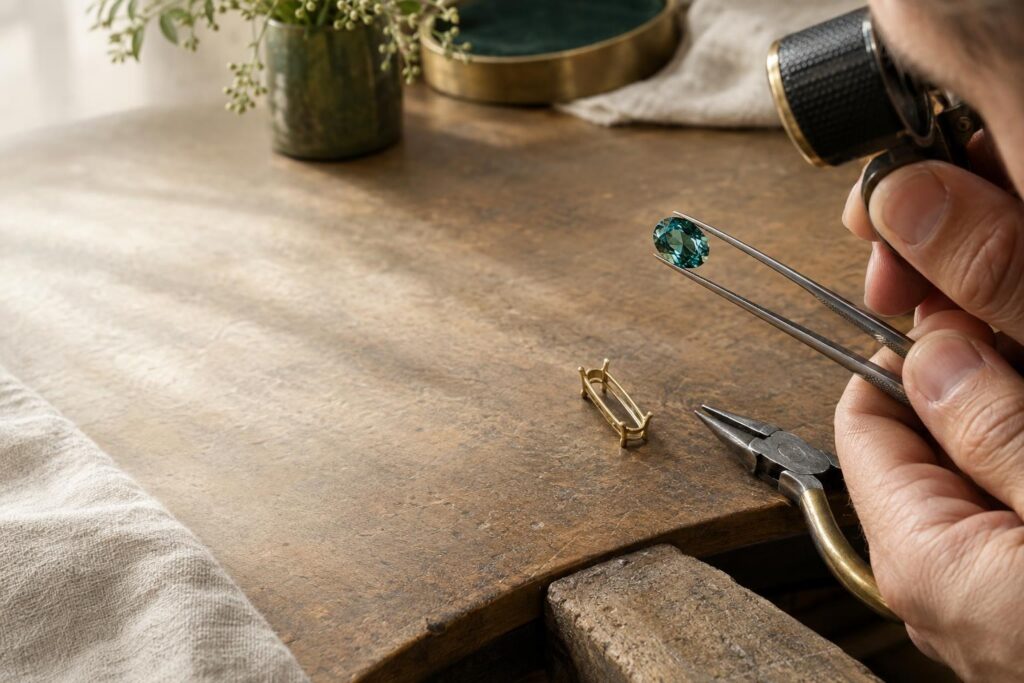
Ring Settings Explained: A Visual Guide shows how each style holds a stone. Which Gemstones Suit Everyday Rings? compares how different gems cope with daily wear.
Why this entry does not confirm availability
This entry describes tourmaline in general, not any stone for sale. Inclusion in this guide does not confirm that Ralph Jacobs stocks this gemstone. We can source a wide range of coloured gemstones, and you can ask about tourmaline in a free consultation, booked online from anywhere at bookings.ralphjacobs.org.
Frequently asked questions
Tourmaline is a family of related minerals with a complex chemistry. Small amounts of different elements tint it. Iron, and possibly titanium, cause green and blue, while manganese produces reds and pinks, and possibly yellows 1.
It ranks 7 to 7.5 on the Mohs scale, so it resists scratches fairly well, but its toughness is rated Fair. Heat can change its colour, and sudden temperature changes can cause fractures 3. How well it suits you depends on how you wear it.
No synthetic gem tourmaline exists. Some tourmalines are heated or irradiated to change their colour, and these treatments are often undetectable 4. So it is worth asking what is known about a stone’s treatment.
Each colour is judged differently. Colour is the main value factor for pink and red stones, green stones are expected to be free of eye-visible inclusions, and for Paraíba tourmaline colour matters more than size 2. Which matters most is your decision.