Why garnet is a family, not a single stone
Why does garnet surprise so many people? If you picture garnet as a dark red stone, you are seeing only one small part of the story. Garnet is a group of closely related minerals, which is why it occurs in almost every colour. All garnets share essentially the same crystal structure, the way their atoms are stacked, but their chemical make-up differs. There are more than twenty garnet species (distinct minerals, each with its own chemistry), and five matter most as gems: pyrope, almandine, spessartine, grossular and andradite. Many garnets are chemical mixtures of two or more species. 1
How do gemmologists sort out all these mixtures? A study published in 1985 noted that older systems could not handle some garnet types found after those systems were made. Based on chemical analysis of more than 500 gem garnets, it proposed eight gem species: grossular, andradite, pyrope, pyrope-almandine, almandine, almandine-spessartine, spessartine and pyrope-spessartine. Refractive index (how much a stone bends light), colour and absorption spectrum (the pattern of light a stone absorbs) can place a garnet in a species, and often a variety. A variety is a name for a particular colour or type within a species. 4
Why garnet gemstone types differ so much in colour
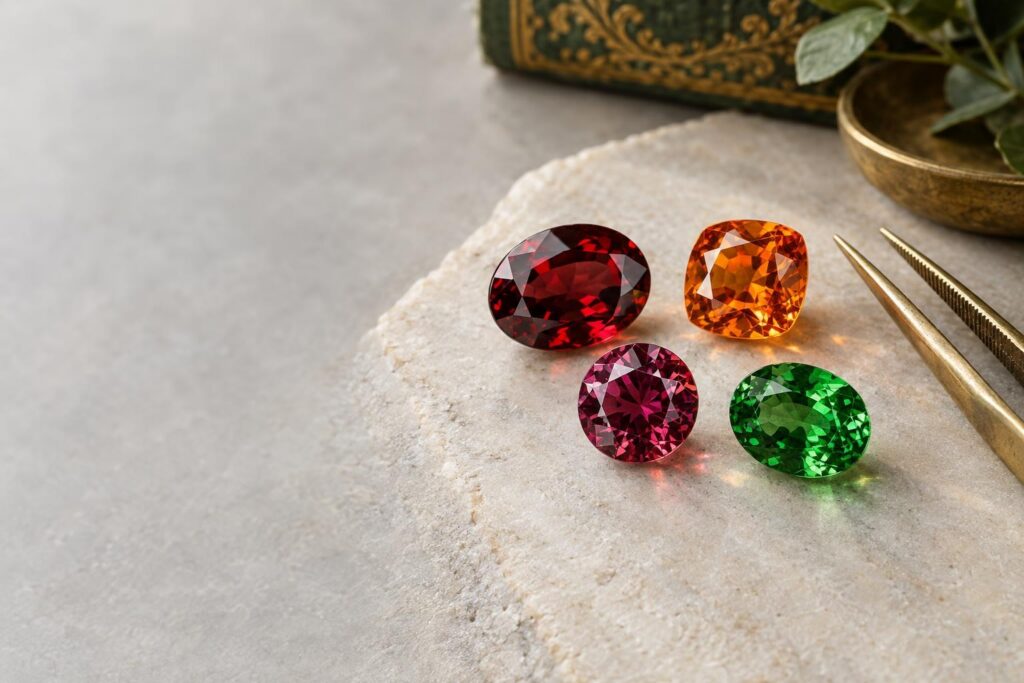
Why does it matter which garnet you are looking at? Because each species has its own colour range. Pyrope and almandine range from purple to orangy red. Spessartine comes in oranges, and andradite is yellow to yellowish green. Grossular may have the widest colour range of any garnet species, from colourless, yellow, reddish orange and orangy red through to strong, vibrant green. 2
Garnet types by colour
Garnet is a group of related minerals, so it comes in almost every colour. Switch between the main types to see how different they look.
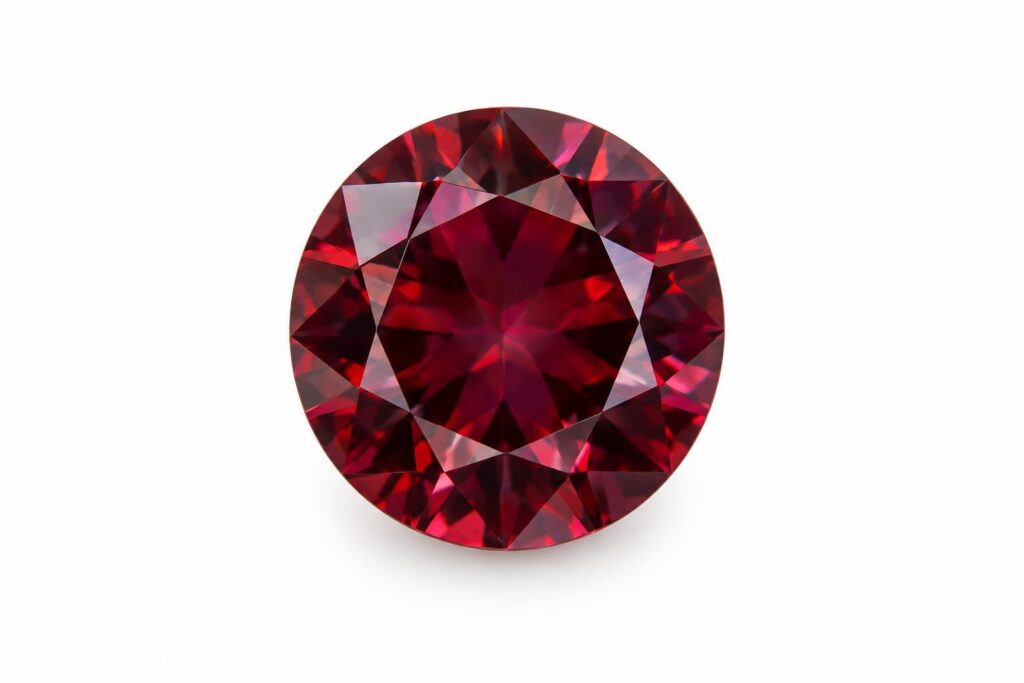
- Pyrope and almandine
- These two species range from purple to orangy red. They are the garnets most people picture when they think of the stone.
- Rhodolite
- Rhodolite is a purplish-red mix of pyrope and almandine. It is one of several garnets that carry their own variety name.
- Spessartine
- Spessartine comes in oranges. It shows that garnet is far more than a dark red stone.
- Hessonite
- Hessonite is a variety of grossular. Its colour runs from orange to brownish red.
- Tsavorite
- Tsavorite is a green variety of grossular. It is rarer than red garnet, because it needs unusual rock chemistry and special conditions to form.
- Demantoid
- Demantoid is a brilliant green andradite. Andradite as a species runs from yellow to yellowish green.
Colours are simplified. Each type has a range, so individual stones can look lighter, darker or different in tone from these pictures. Pictures: AI-generated illustrations, checked for accuracy. They are not photographs of a real piece.
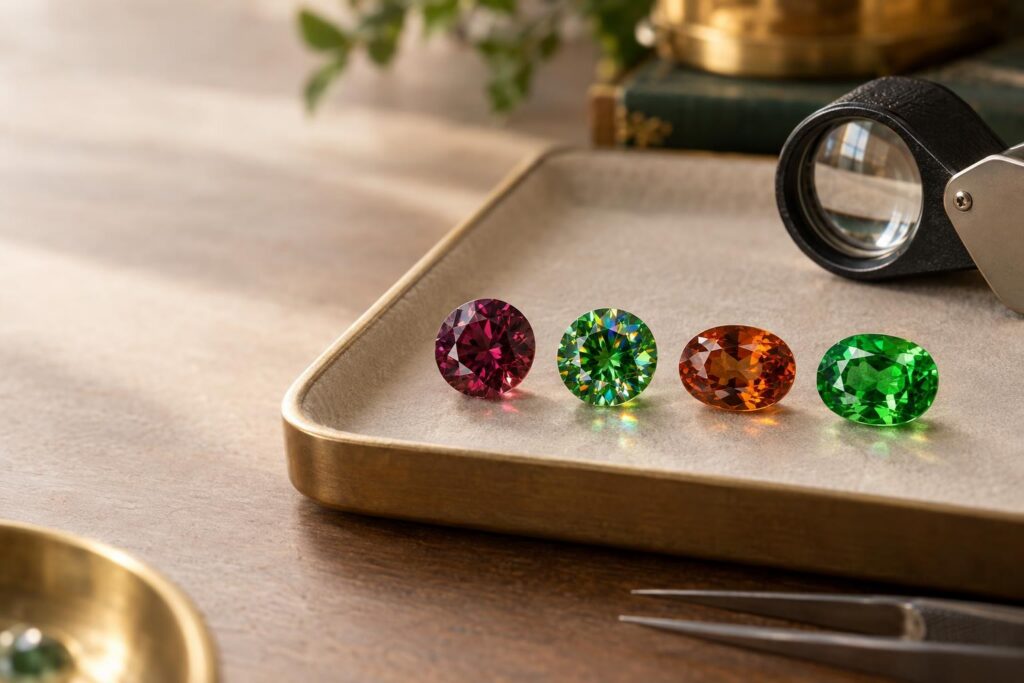
How do variety names fit in? Several well-known garnets carry their own names. Rhodolite is a purplish-red mix of pyrope and almandine. Demantoid is a brilliant green andradite. Tsavorite (green) and hessonite (orange to brownish red) are both varieties of grossular. 2
Demantoid is also known as a rare and famous green garnet. Uvarovite is another green garnet, but its crystals are usually too small to cut, so it is sometimes set as clusters. 1
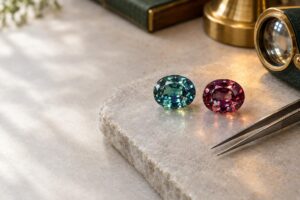
Can a garnet really be blue? Some garnets change colour with the light, as alexandrite does. Garnets from Madagascar, a blend of pyrope and spessartine, shift from blue-green in daylight to purple under incandescent light (the warm light of a traditional bulb). This colour change comes mainly from a fairly high level of the element vanadium. These stones were the first "blue" garnets sold commercially. 5
Why treatments are still worth asking about
Why ask about treatment at all? A treatment can change how a stone should be cleaned and worn. Fracture filling means filling small cracks that reach the surface so they show less. Garnets are rarely fracture-filled, and a filled stone should be cleaned only with warm, soapy water. 3
The sources used for this entry do not describe other treatments for garnet. If you want to know whether a particular stone has been treated, you can ask the seller what their answer is based on. You can read more in How Gemstone Treatments Should Be Disclosed.
Why garnet’s hardness depends on the type
Why does hardness matter for a stone you wear? Hardness is resistance to scratching. Garnet ranges from 6.5 to 7.5 on the Mohs scale, a scale of scratch resistance, depending on type. Almandine, pyrope, spessartine and tsavorite sit on the harder side, while demantoid is a little softer. The steps on the Mohs scale are not evenly spaced, so the gap between two numbers is not always the same size. 3
How is toughness different? Toughness is resistance to chipping and breaking, which is a separate quality from hardness. Garnets have fair to good toughness and are durable enough for any jewellery style with proper care. They should not take hard knocks or rough wear. Light and chemicals do not affect them, though hydrofluoric acid can attack them. 3
What does that mean for cleaning? Warm, soapy water is always safe. Ultrasonic cleaners are usually safe, except for stones with fractures, and steam cleaning is not recommended. 3 For more on why hardness is only part of the picture, see The Mohs Scale Is Not the Whole Durability Story.
Why garnet is found all over the world
Why is red garnet so familiar? Red garnet is one of the most common and widespread gems, found in metamorphic rocks (rocks changed by heat and pressure) on every continent. Green tsavorite is rarer, because it needs unusual rock chemistry and special conditions to form. 1 The sources used here do not say how reliably the origin of a single garnet can be traced, so it is fair to ask what supports any origin claim.
Why quality looks different from one garnet to the next
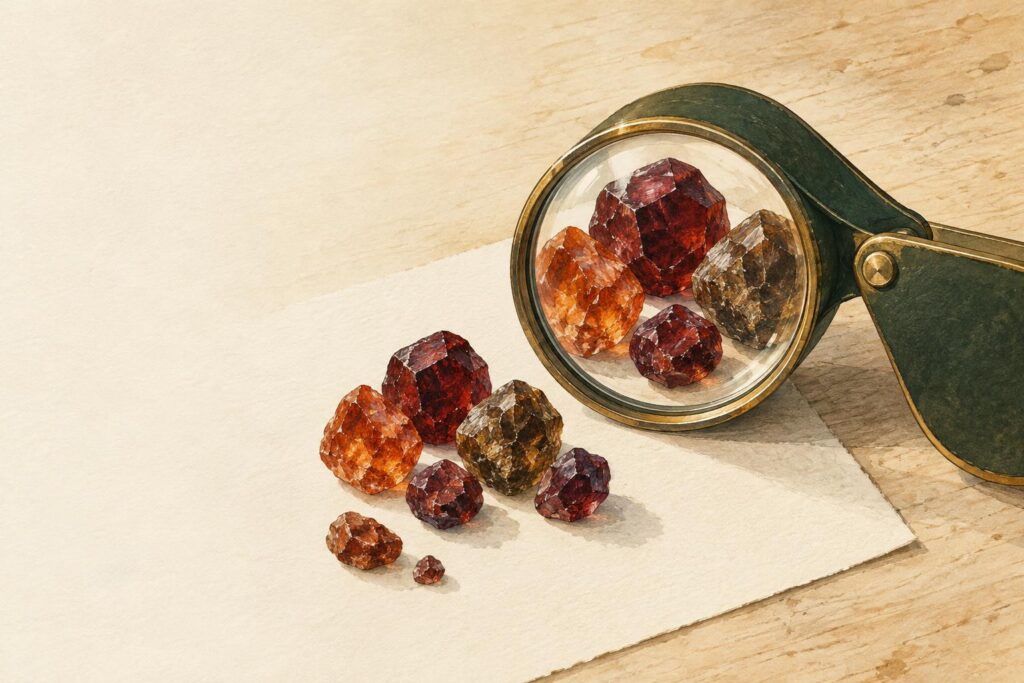
Why can’t one rule judge every garnet? Each type has its own typical traits. Red garnets such as almandine, pyrope and rhodolite usually have no inclusions (tiny internal features) visible to the eye. Spessartine and hessonite often do. Demantoid can have inclusions known as "horsetails", which can raise its value. 2
How does cutting differ? Many red garnets are cut to standard shapes and sizes. Demantoid is often cut to exact proportions to show off its fire, or dispersion: the flashes of rainbow colour a stone gives off. Grossular is usually translucent, so it is popular for cabochons (smooth, domed stones without facets), beads and carvings. 2
What about size? Demantoid and tsavorite are more often found in small sizes, so their value rises sharply as size increases. Almandine is common in large sizes, so its value does not jump with size in the same way. 2 For colour terms used in grading, see Hue, Tone and Saturation in Gemstones and How Coloured Gemstones Are Evaluated.
Why the setting depends on the garnet
Why think about the setting early? Garnet is durable enough for any jewellery style with proper care, yet it should not take hard knocks or rough wear. 3 That makes it worth considering how exposed the stone will be in daily wear.
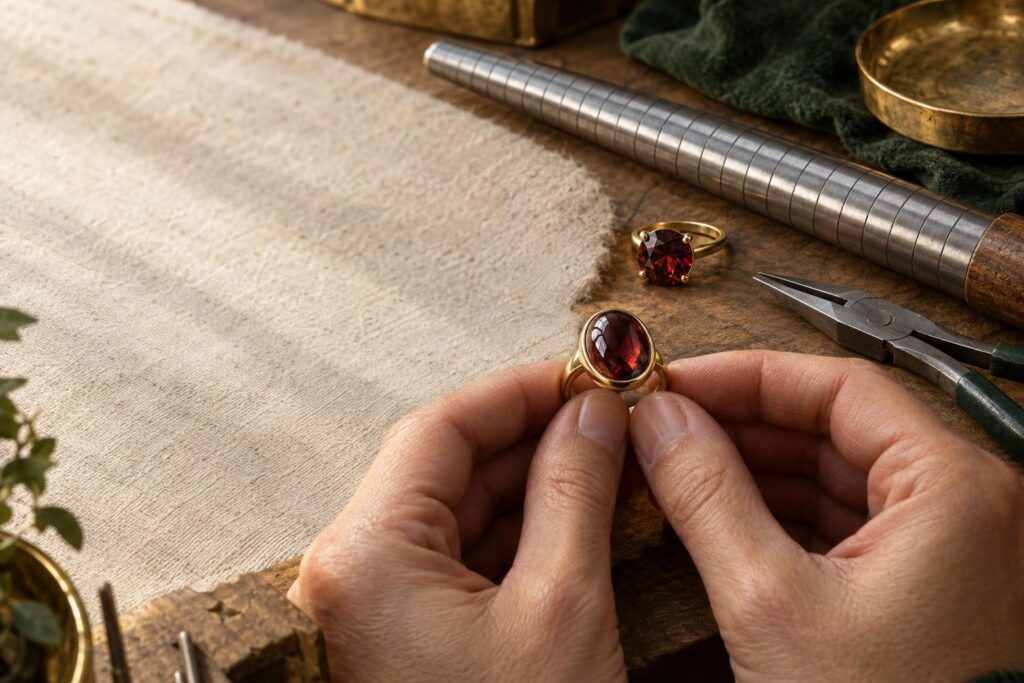
How does the type of garnet shape the design? Many red garnets are cut to standard shapes and sizes, while translucent grossular is popular for cabochons, beads and carvings. 2 Uvarovite crystals are usually too small to cut, so it is sometimes set as clusters. 1 Ring Settings Explained: A Visual Guide shows how different settings hold and protect a stone.
Why this entry is here
This entry is here to help you understand garnet, whatever you decide. Inclusion in this guide does not confirm that Ralph Jacobs stocks this gemstone. If you would like to talk through a garnet or another coloured gemstone, we offer a free consultation, booked online from anywhere at bookings.ralphjacobs.org.
Frequently asked questions
No. Garnet is a group of related minerals, so it occurs in almost every colour. Besides red, there are greens, oranges, pinkish oranges, deep purplish reds and even some blues. 1
Garnet ranges from 6.5 to 7.5 on the Mohs scale and has fair to good toughness. With proper care it is durable enough for any jewellery style, but it should not take hard knocks or rough wear. 3
Some garnets from Madagascar change from blue-green in daylight to purple under incandescent light. The change comes mainly from vanadium, and these were the first "blue" garnets sold commercially. 5
Garnets are rarely fracture-filled. A filled stone should be cleaned only with warm, soapy water, so it is worth asking whether a garnet has been filled. 3