
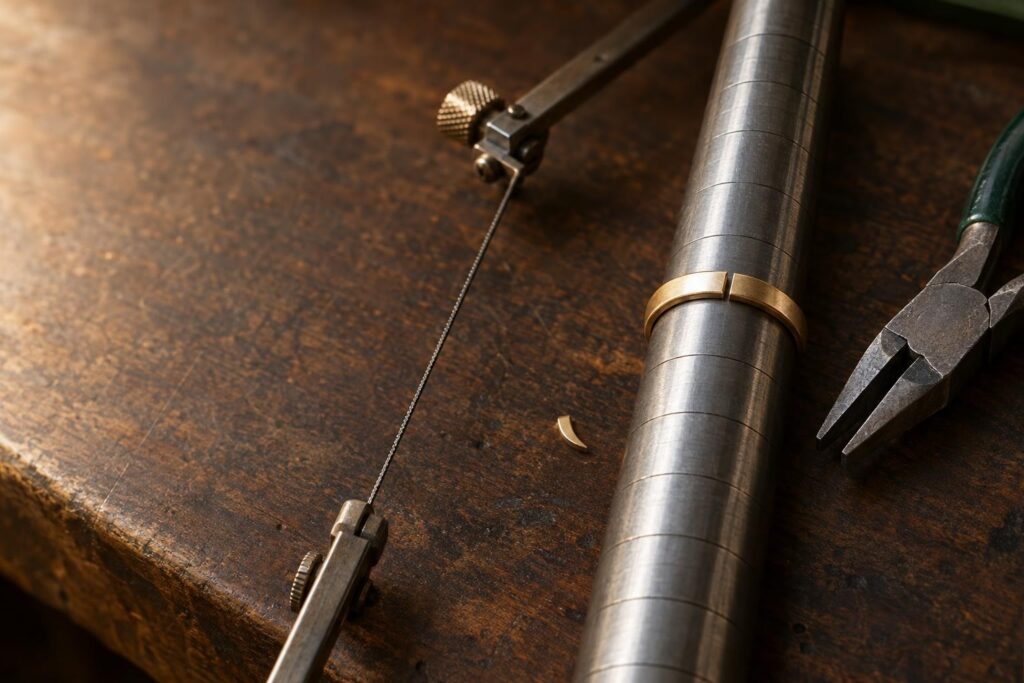
Why it helps to know how ring resizing works
Why read this before you hand over your ring? Resizing normally means cutting the ring and adding or removing metal of the same alloy, so the work changes the ring itself. 5
Not every ring is resized the same way. GIA publishes separate benchmarks for sizing rings with no diamonds in the shank (the band) by torch, and for sizing a ring with diamonds in the shank by laser welder. 10 4 A jewellers’ guide adds that heavy rings are harder to size, because the shank is thicker. 6
Our sources don’t give resizing times or prices. They do explain the steps, so you can ask a jeweller how each one applies to your ring.
How ring resizing works at the bench
Why look at the bench work? It shows what will physically happen to your ring. A jewellers’ guide describes three ways to change the size of the shank: cutting a piece out, cutting it open and adding metal, or stretching or compressing a seamless band. 6
Three ways to change a ring's size
Resizing changes the shank itself. Choose a method to see what happens to a plain band.
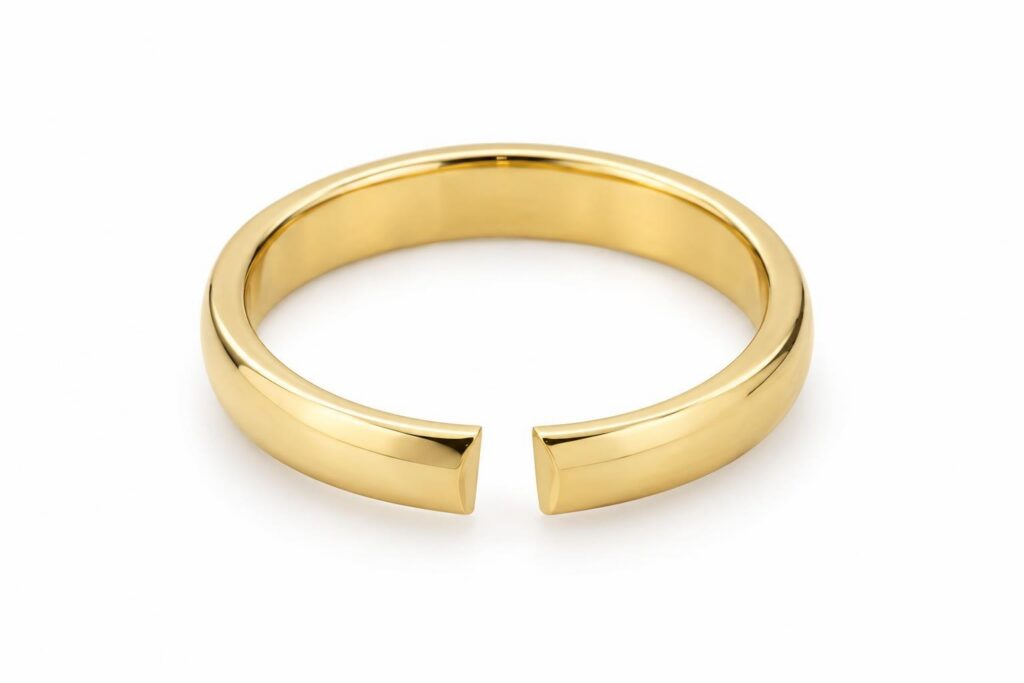
- Making a ring smaller
- To make a ring smaller, the jeweller cuts a piece out of the shank. The ends are then closed together and soldered, which means joined with a filler metal melted into the joint.
- Making a ring larger by cutting
- A ring can also be cut open and metal added to make it larger. The jeweller solders in a piece of metal, and it should be the same alloy as the ring.
- Seamless band, no cutting
- A seamless band, which has no join, can be stretched or compressed instead of being cut. Stretching forces the band wider on a tool, and compressing squeezes it smaller. The band is annealed first, meaning heated to soften the metal, because unannealed metal may crack.
The pictures show plain bands with no stones. A ring with stones in the shank, or a heat-sensitive gem, may need different handling, so ask your jeweller how each step applies to your ring. Pictures: AI-generated illustrations, checked for accuracy. They are not photographs of a real piece.
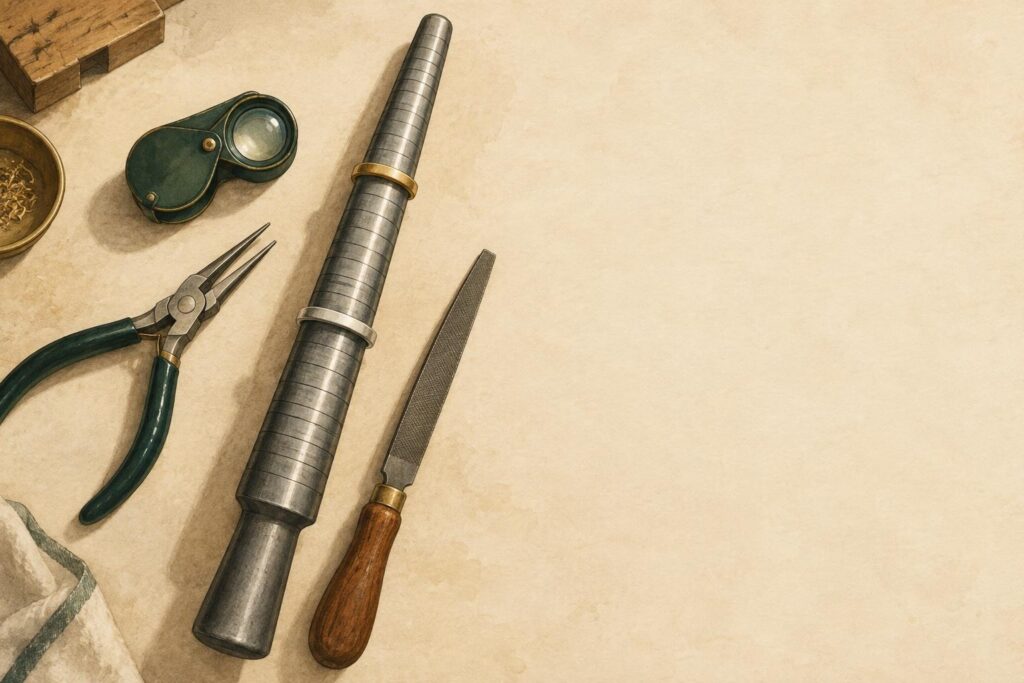
Before sizing, the same guide says the ring should be examined. Any existing damage should be reported to you before work starts. 6
Making a ring smaller
To make a ring smaller, the jeweller cuts a piece out of the shank. The ends are then closed together and soldered, which means joined with a filler metal melted into the joint. 6
In a GIA example of sizing a platinum ring down, the cut ends are bevelled, or cut at an angle. They are adjusted until they fully touch before welding. The ring might not be round at this point, so final rounding happens afterwards. 4
Making a ring larger
To make a ring larger, the jeweller cuts through the shank and opens it. A piece of metal is then soldered into the gap. 6
Why does the added piece matter? An alloy is a particular mix of metals. A testing laboratory explains that resizing normally means adding or removing metal of the same alloy as the ring. 5
Joining the ends
Why does the joining method matter? GIA has separate benchmarks for sizing by torch and by laser welder. 11 4 A torch is a jeweller’s flame, used to melt solder into the joint.
A laser welder is a tool that joins metal with a laser beam. In GIA’s platinum example, the joint is filled and joined using platinum wire and the laser. 4
Finishing and checking
Why does the ring need rounding? It may not be perfectly round once the ends are joined. In GIA’s example, the jeweller taps lightly only on the parts of the ring where no stones are set. If it still isn’t round, a ring stretcher may be needed. 4
You can see bench work in How a ring is made at the bench.
Why a jeweller anneals a ring before stretching it
Why not simply force a plain band larger? A jewellers’ guide says seamless bands, rings with no join, can be stretched or compressed instead of being cut. They are annealed first, because unannealed metal may crack. 6
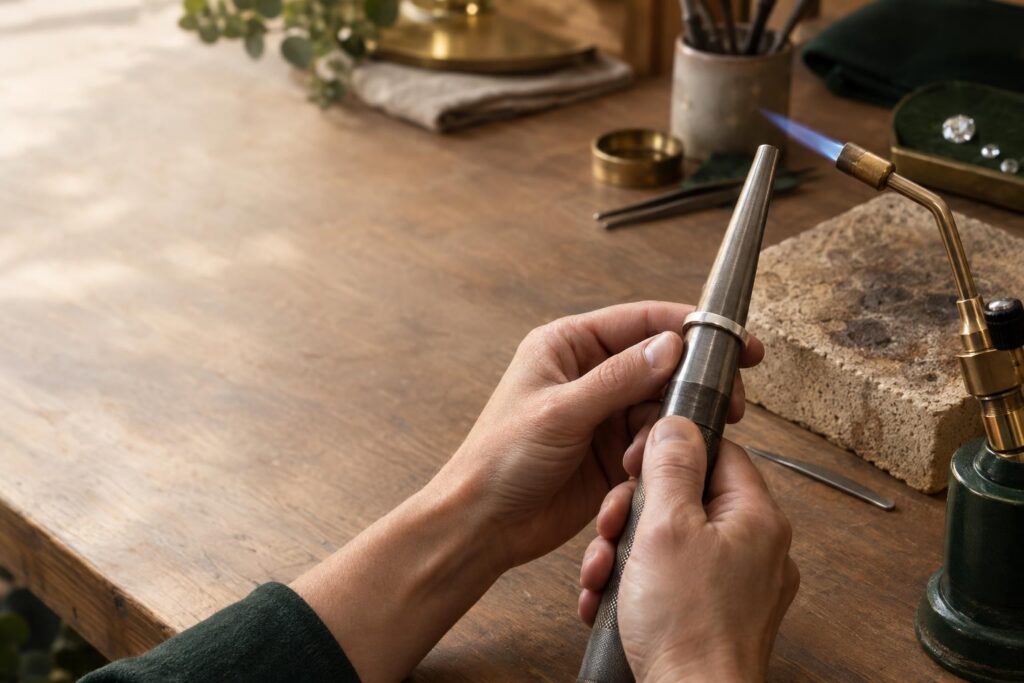
Stretching means making a ring larger without cutting it, by forcing the band wider on a tool. Compressing is the opposite: squeezing the band smaller. Annealing means heating the metal to soften it.
A ring stretcher has other uses too. In GIA’s example, one may be needed to round a ring after its joint is welded. 4 If your band has stones or a join, ask the jeweller which method suits it.
Why stones in the band change how a ring is resized
Why do stones matter so much? Sizing by torch is one way to resize a ring. 11 But too much heat and sudden temperature changes may crack some gems. 2
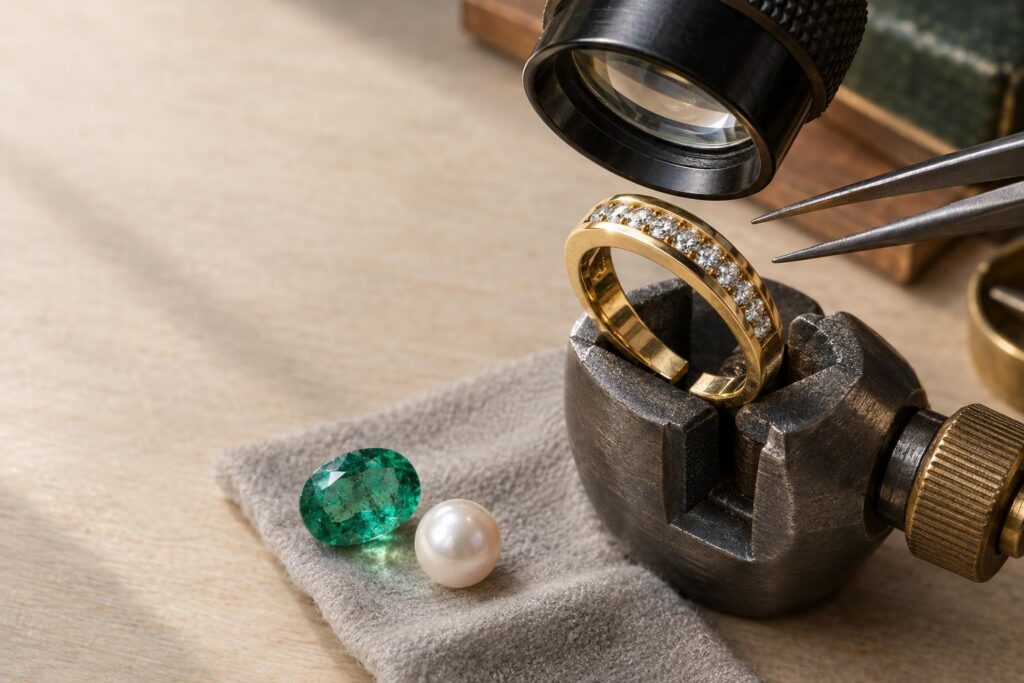
How can heat harm a stone? Some gems are treated, meaning processed to improve their colour or clarity. These treatments can be harmed by heat, so knowing whether a gem is treated is the first step to knowing how to care for it. 2
Fracture filling is one such treatment: a substance fills cracks in the stone. Fillers are often found in diamonds, rubies, sapphires and emeralds, and filled gems should not be exposed to heat. Gems impregnated with wax or plastic should also be kept away from a jeweller’s torch. 1
Emeralds need extra care. Most cut natural emeralds have filled fractures, and heat can make existing fractures bigger. 3
Coloured diamonds can be affected too. The colour of irradiated coloured diamonds, which have been treated with radiation, may be damaged if a jeweller’s torch heats them during repairs. Intense heat may also make heat-treated gems slightly more brittle. 1
Some gems are sensitive to heat whether or not they are treated, including tanzanite, sunstone and moonstone. Heat can make pearls dry out, crack and discolour. Opals can turn white or brown, crack, and lose their play-of-colour, the flashes of colour inside the stone. 2
Can a ring with diamonds set into the band itself be resized? GIA has a separate benchmark for sizing a platinum ring with channel-set diamonds in the shank, using a laser welder. It shows that stones in the band need extra care during the work. 4 Channel setting is one style of setting stones into the band; Ring settings explained shows how it holds its stones.
What if the stones go far around the band? In the GIA example, the ring is tapped into shape only where no stones are set. 4 Our sources don’t describe rings with stones all the way round, often called eternity rings. If your ring has stones far around the band, ask the jeweller whether it can be resized, and how.
Why the metal and thickness of the band affect the work
Why does the band itself matter? It is the part the jeweller cuts, joins and reshapes. Resizing normally means adding or removing metal of the same alloy as the ring. 5
How does thickness come in? A jewellers’ guide notes that heavy rings are harder to size, because the shank is thicker. It also warns that filing must be careful, because metal that is removed can’t be replaced. 6
If you are still choosing a design, Four claws vs six claws explains how a centre stone is held, and White gold vs platinum compares two white metals.
Why some ring materials can’t be resized
Why can’t every ring be cut and joined? Some ring materials don’t behave like the metals jewellers usually size. Tungsten carbide behaves more like a ceramic than a metal: it is very hard but brittle. 5
A testing laboratory gives two reasons it can’t be resized. It is too brittle, and its atomic bonds, which form during sintering (heating a powder into one solid piece), won’t bond with added material. Cutting it is as risky as cutting glass, and heat high enough to make it workable would melt the ring. 5
Why to ask about time and cost for your own ring
Why ask about your own ring rather than a typical figure? Our sources give no resizing times or prices. They do show that the steps differ: GIA publishes separate benchmarks for sizing plain shanks by torch and a shank with diamonds by laser welder. 10 4
A jewellers’ guide describes other steps that depend on the ring. These include examining it and reporting damage before work starts, soldering in a piece of metal when sizing up, and annealing a seamless band before it is stretched or compressed. 6
GIA’s example also rounds the ring after the joint is welded, sometimes with a ring stretcher. 4 Filled gems, and gems impregnated with wax or plastic, should be kept away from heat such as a jeweller’s torch. 1
What can you do? Ask which of these steps your ring needs. Then ask for the time and the cost before you agree.
The downsides: when ring resizing isn’t the right choice
Why look at the limits? Resizing normally means cutting the ring and adding or removing metal of the same alloy. 5 The points below come from our sources, and they are the ones to raise before any work starts.
Stones in the band. Stones set into the shank need extra care: in GIA’s laser-welder example, the ring is tapped into shape only where no stones are set. 4 Rings with stones far around the band are not covered by our sources, so ask whether resizing is possible at all.
Heat-sensitive stones. Some gems can crack under heat or sudden temperature changes, and heat can make pearls dry out, crack and discolour. 2
Treated stones. Fillers, and gems impregnated with wax or plastic, can be damaged by a jeweller’s torch. 1
Filing and heavy bands. Filing must be careful, because metal that is filed away can’t be replaced. Heavy rings are harder to size because the shank is thicker. 6
Some materials. Tungsten carbide can’t be resized, because it is too brittle and won’t bond with added material. 5
If you have not bought the ring yet, see the guide to ring size systems, and how to find a ring size secretly if it’s a surprise. If you already need a change, the Ring Size Converter can help you check your current and wanted size before you ask.
What to ask before a ring is resized
Why ask questions first? A few answers before the work starts tell you what will happen to your ring. They also help you avoid surprises when you collect it.
- Has this ring been sized before, and where are the existing joins?
- Will you examine the ring and tell me about any damage before you start? 6
- Will you cut away from any engraving on the band?
- Will the added metal match my ring’s alloy?
- Has each stone been identified, and do you know whether it is treated? 2
- Will each stone be removed or protected from the heat?
- Will you use a torch or a laser welder, and will you anneal the band if it is stretched?
- Which steps does my ring need, how long will it take, and what will it cost?
If your ring was made by Ralph Jacobs, resizing is done by JewelFix, a trading name of Ralph Jacobs SA (Pty) Ltd, and is always quoted first. JewelFix works only on jewellery we made, and some rings can’t be resized. Eligible rings may qualify for the 60 Day Ring Resize Labour Benefit; see our resizing policy for your country at ralphjacobs.org/resizing/. To talk it through, you can book a free consultation online at bookings.ralphjacobs.org.
Frequently asked questions
Sometimes. GIA has a separate benchmark for sizing a platinum ring with channel-set diamonds in the band, using a laser welder and tapping only where no stones are set. 4 Our sources don’t cover rings with stones all the way round, so ask the jeweller first.
Heating metal to soften it is called annealing. A jewellers’ guide explains that seamless bands are annealed before they are stretched or compressed, because unannealed metal may crack. 6
Heat from a jeweller’s torch can harm some stones. Filled gems, and gems impregnated with wax or plastic, should not be exposed to it, and irradiated coloured diamonds may lose colour if heated by a torch during repairs. 1 Ask how each stone will be protected.
No. A testing laboratory explains that tungsten carbide is too brittle, and its bonds won’t join with added material. Cutting it is as risky as cutting glass, and heat high enough to make it workable would melt the ring. 5
Our sources don’t give a limit. A jewellers’ guide warns that filing must be careful, because metal that is removed can’t be replaced. Ask the jeweller to examine the ring and report any damage before work starts. 6