

Why natural vs laboratory-grown diamonds are closer than you think
Choosing between a natural and a laboratory-grown diamond can feel like picking a side. It helps to start with the key fact. A laboratory-grown diamond has essentially the same chemical, physical and optical properties as a natural one 1.
So the questions that separate them are about origin, and what follows from it: grading, price, resale and the claims made about each. This guide compares them one by one, so you can weigh them against your own values.
- By eye, the two can be impossible to tell apart, but laboratories can separate them by their growth history 2.
- Natural diamonds formed deep in the Earth billions of years ago, and they cost more because they are rarer 5.
- Both are graded on the same 4Cs, the four qualities used to describe a diamond 6.
- Industry guidance says you must be told clearly which one you are buying 4.
- Which matters more depends on what you value, not on which one is "better".
Why both are diamond, and what that means for you
Why does this fact come first? Because a lab-grown diamond is not the same as a stone that only looks like diamond. A lab-grown diamond has the same crystal structure as a natural one. That gives it nearly the same chemical, optical and physical properties 2.
A simulant is different. It is a material that imitates diamond without being diamond. Glass, moissanite and cubic zirconia are simulants, and they are completely unrelated to diamonds at the atomic level 2.
Why do names matter so much here? CIBJO, the World Jewellery Confederation, says buyers must get complete and clear information on whether a diamond is natural or lab-grown. It prefers the term "laboratory-grown" for consumers. It also says words such as natural, real, genuine or precious must not describe a lab-grown diamond 4. In practice, a seller should always tell you which kind you are looking at.
Why origin is the main difference: how each one forms
Why does origin matter if the material is the same? Because laboratories tell the two apart by their very different growth histories 2. Whether origin matters to you is a personal question. Here is how each one comes to exist.
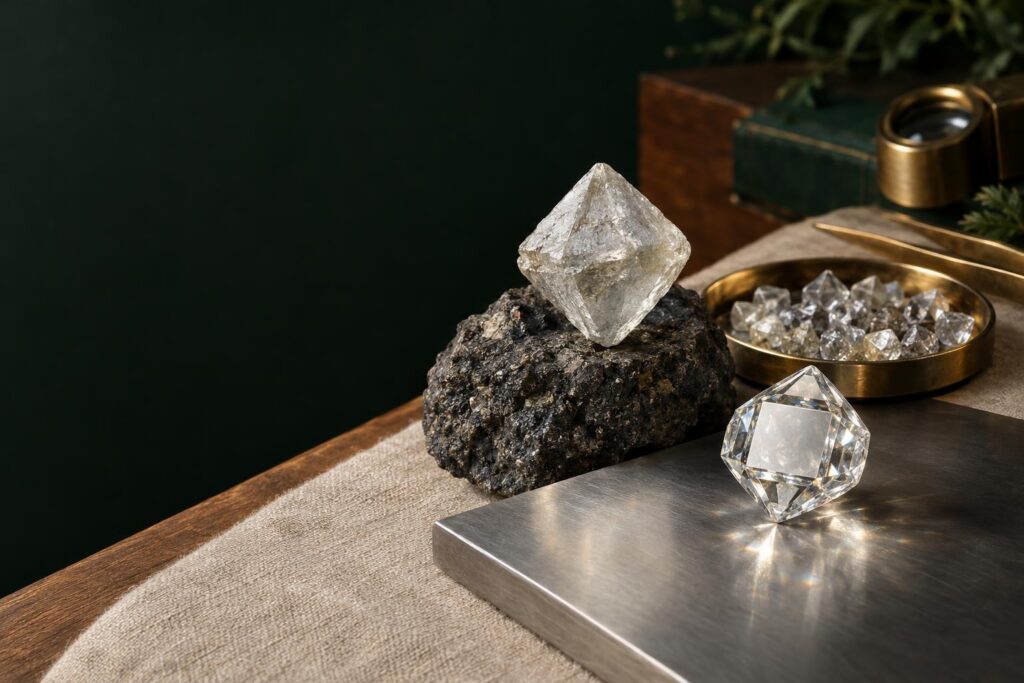
Why natural diamonds are so old
Natural diamonds formed deep in the earth under extreme pressure and high temperature, as long as three billion years ago. Volcanic activity brought them to the surface in rock formations called kimberlite pipes. Only about five percent of these pipes have enough diamond to be worth mining 1.
Natural diamonds formed millions to billions of years ago, while lab-grown diamonds are young 2. If great age is part of what a diamond means to you, this is the key difference.
Why most lab-grown diamonds grow in under a month
Two main methods are used. HPHT (high pressure, high temperature) copies the conditions that form natural diamonds. It uses 1,300 to 1,600°C and 5 to 6 GPa (gigapascals, a unit of pressure). That is about the same as 150 to 190 km (93 to 118 miles) underground 2.
CVD (chemical vapour deposition) breaks down a carbon-rich gas such as methane and deposits the carbon onto small diamond seeds. Either method usually takes less than a month for most sizes 1. CVD happens at near-vacuum pressure and 700 to 1,200°C 2. You can read more in CVD vs HPHT lab-grown diamonds.
Diamonds were first grown in laboratories in the 1950s, and the first gem-quality lab-grown diamonds were made in the 1970s. Colourless ones reached the jewellery market in commercial quantities in the mid-2010s 2.
Why you may not see a difference: appearance
Why ask about appearance? Because if looks matter to you, this is the fact to know. By eye, the difference between natural and lab-grown can be impossible to see 2. Each stone still has its own grades, though. To compare fairly, look at stones with similar grades, as explained in the grading section below. To learn what creates sparkle, see brilliance, fire and scintillation explained.
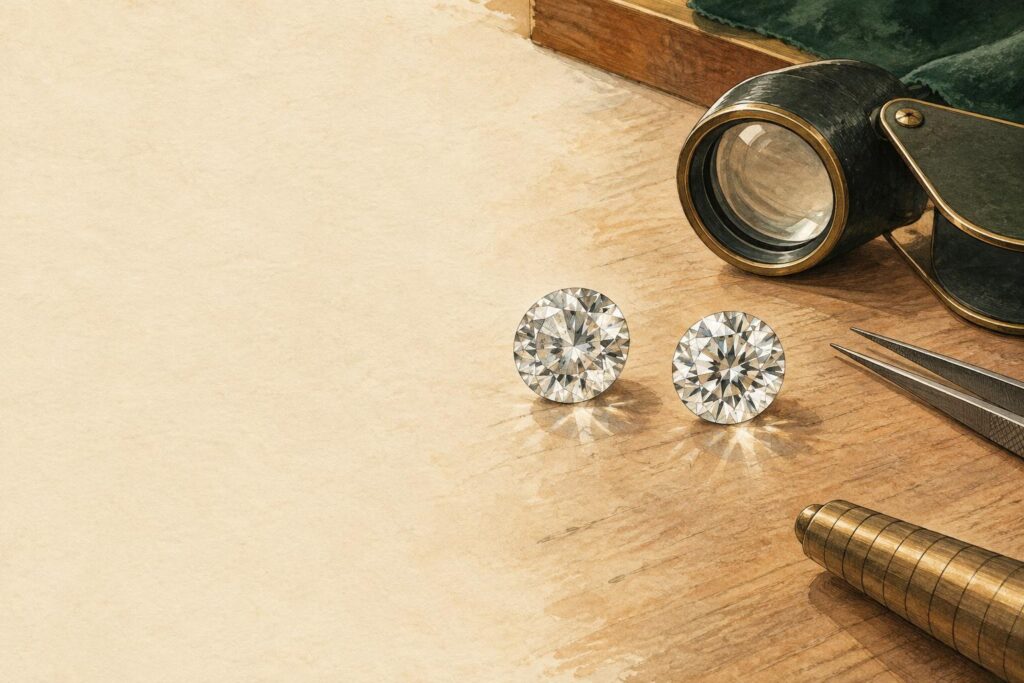
Small differences can lie inside the stone. Most natural diamonds contain traces of nitrogen, which gives a yellow colour, or, rarely, boron, which gives a blue colour. They usually also have inclusions: tiny crystals or marks trapped inside the stone 1. The sources used here do not say how visible these usually are.
Clarity matters for lab-grown stones too. IGI grades lab-grown diamonds for clarity on the same core principles as natural ones 6. So for either kind, the clarity grade on the report is the place to check.
Most CVD diamonds get extra heat or irradiation treatments after growth to change their colour 1. Here, a treatment means extra processing after growth to change a stone’s colour. Natural diamonds can be treated too, and laboratories check natural diamonds for treatments or enhancements 5. So don’t assume either kind is untreated. Check the report for any treatment comment, and see how gemstone treatments should be disclosed.
Why durability works the same way for both
Why does durability matter? An everyday ring can get knocked. A lab-grown diamond has essentially the same physical properties as a natural one 1. So the same setting and care questions apply to both.
For how hardness (resistance to scratching) fits into durability, see the Mohs scale is not the whole durability story.
Why a grading report tells you more than your eye
Why does a report matter so much here? Because the usual checks cannot show origin. Ordinary gemmological checks (the standard tests a jeweller uses) and old-style "diamond detectors" cannot tell natural from lab-grown. Only a professional laboratory or specialist devices can do it reliably 1.
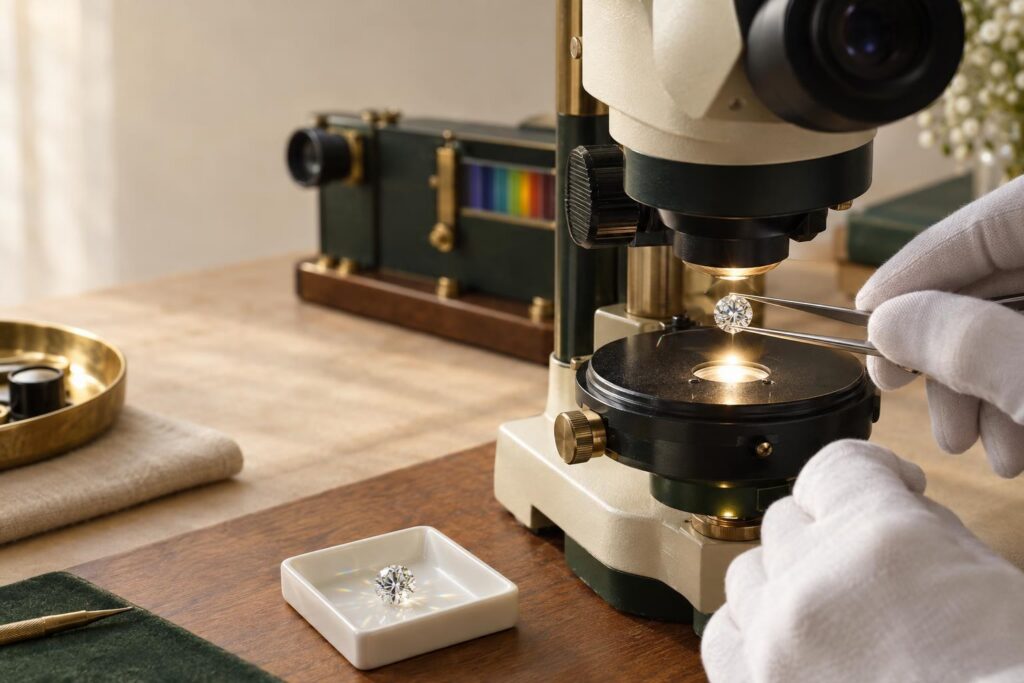
How do laboratories do it? They study growth patterns, optical characteristics and spectroscopic features (how the stone absorbs, gives off or otherwise interacts with light), which may not be visible to the naked eye 6. Tiny irregularities in the crystal, called defects, show whether a diamond is natural or lab-grown 2.
What does a report show? IGI grades lab-grown diamonds on the same core principles as natural ones: cut, colour, clarity and carat weight, the 4Cs. Carat is the unit used to weigh gems. A report may also state the growth method (HPHT or CVD) and disclose treatments where they apply 6. Because both kinds are graded on the same principles, you can compare a natural and a lab-grown stone with similar grades. That makes the comparison more consistent, though other differences between the two stones can remain.
GIA has its own assessment for loose colourless to near-colourless lab-grown diamonds of 0.15 ct or more. It rates these stones as either Premium or Standard, and laser-inscribes "Laboratory-Grown" and the assessment number on the girdle, the thin outer edge of the stone. GIA’s reports for coloured lab-grown diamonds include an assessment of growth type and post-growth treatment 3. So the two laboratories report differently: IGI uses the same 4Cs grades as for natural diamonds 6, while GIA places these lab-grown stones in one of two categories, Premium or Standard 3.
One caution applies to both kinds. A grading report is not an appraisal, which is a statement of value 6. To compare GIA and IGI reports, see GIA vs IGI diamond reports. To learn what each grade means, see the 4 Cs of diamonds.
Why rarity, price and resale point in different directions
Why look at these together? Because they are linked, and they matter most if you might sell the stone one day. Natural diamonds cost more because they are rarer and often have unique inclusions 5. To see how much origin affects price, compare stones with similar grades.
Resale is the price you could get when selling a diamond to someone else, on what is called the secondary market. IGI cautions that, for natural diamonds, it normally takes decades before a buyer can get back the retail price there 5. That describes a long wait, not a promise that the price will be recovered.
What about lab-grown diamonds? Their resale market is smaller and less settled. In trade press reporting, several jewellers said they do not offer buybacks or trade-ins on lab-grown diamonds, while another accepts them only towards a more expensive replacement. The reasons some gave come back to supply: lab-grown diamonds are not rare, and production is not limited by nature 7. Policies differ from seller to seller, and nobody can honestly promise how either kind will hold its value. Questions you can ask before you buy:
- Will the seller buy the stone back, or take it in exchange, and on what terms?
- Is any claim about future value backed by written evidence?
- Is this document a grading report or an appraisal?
- How would a second-hand buyer check the stone’s origin and grades?
To plan around the whole ring rather than the stone alone, try the engagement ring budget planner.
Why ethical, supply-chain and environmental claims need checking
Why does this matter? If how a diamond came to exist is part of its value to you, the claims around it deserve a close look. Under CIBJO guidance, lab-grown diamonds must not be called "eco-friendly" without qualification unless a measurable positive impact can be shown. Any environmental claim must be checked by a credible independent third party 4.
The same guidance does not allow blanket claims that lab-grown diamonds are "ethical", "green", "responsible" or "sustainable" without independent checking. A carbon-neutral claim must say whether it comes from carbon-neutral operations or from buying carbon credits. The same guidance says neither the natural nor the lab-grown sector should run down the other when marketing 4.
Environmental claims are only part of the picture. That guidance also covers supply-chain checks: claims about origin and production conditions must be backed by evidence 4. None of this guide’s sources compares working conditions across the two kinds, so these questions apply to natural and lab-grown diamonds alike:
- Where was this stone mined or grown, and what records show that?
- What does the seller know about the working conditions along the way?
- Who checked any ethical or environmental claim, and are they independent of the seller?
- Is a carbon-neutral claim based on how the stone was made, or on carbon credits bought later?
- Does the claim describe the other kind of diamond fairly?
- Can I see the evidence in writing?
The downsides: when each one may not be the right choice
Why include this? Because every option has trade-offs, and knowing them early helps you avoid surprises later.
When a natural diamond may not suit you
- If budget is tight: natural diamonds cost more because they are rarer and often have unique inclusions 5.
- If you hope to sell later: getting back the retail price normally takes decades, and that is not a promise it will happen 5.
- If you need certainty about origin: ordinary checks cannot tell natural from lab-grown, so you will rely on a professional laboratory or specialist devices 1.
- If proof of where it was mined matters to you: ask the seller what records they can show, as this guide’s sources do not compare supply chains for the two kinds.
When a lab-grown diamond may not suit you
- If an ancient origin is part of what the stone means to you: lab-grown diamonds are young, while natural ones formed millions to billions of years ago 2.
- If you prefer a stone without post-growth treatment: most CVD diamonds are heated or irradiated after growth to change their colour, so check the report 1.
- If you might want to sell or trade it in later: some jewellers do not offer buybacks or trade-ins on lab-grown diamonds, so ask about the seller’s policy first 7.
- If a seller calls it eco-friendly or ethical: independent checking is needed before that claim can be relied on 4.
Why your own values make the decision
Why end here? Because the facts above do not pick a winner. They show where the two differ, and only you know which differences matter.
- If origin and age matter to you, the relevant fact is that natural diamonds formed as long as three billion years ago, while lab-grown ones usually grow in less than a month for most sizes 1.
- If budget or resale matters most, the relevant facts are that natural diamonds cost more because they are rarer, and that recovering their retail price normally takes decades 5.
- If appearance matters most, the relevant fact is that, by eye, the two can be impossible to tell apart 2.
- If proof matters, the relevant step is a laboratory report, which may state the growth method and disclose treatments where they apply 6.
To compare both with moissanite, see natural diamond, lab-grown diamond or moissanite?. For the wider choice, see choosing a diamond for an engagement ring.
Ralph Jacobs sells both loose natural and lab-grown diamonds. If you would like to talk through these facts, we offer a free consultation, online from any country at bookings.ralphjacobs.org, on WhatsApp, or at our showroom.
Frequently asked questions
Not an old-style one. Ordinary gemmological checks and older diamond detectors cannot tell them apart. Only a professional laboratory or specialist devices can do it reliably 1.
Often not to your eye. By eye, the difference can be impossible to see. Laboratories tell them apart by their very different growth histories 2. For a fair comparison, look at stones with similar cut, colour, clarity and carat grades.
Neither comes with a guarantee. Some jewellers do not offer buybacks or trade-ins on lab-grown diamonds, because lab-grown diamonds are not rare and production is not limited by nature 7. For natural diamonds, it normally takes decades before a buyer can get back the retail price on the secondary market 5. That is not a promise, so treat any confident claim about either with care.