Why citrine is the golden member of the quartz family
Why might citrine be the gem you look at first when you want warm golden colour? And is it genuine, durable and easy to tell from similar stones? This entry answers each question. Even fine citrine is modestly priced, and the price per carat (the unit used to weigh gems) does not rise sharply in larger sizes 1.
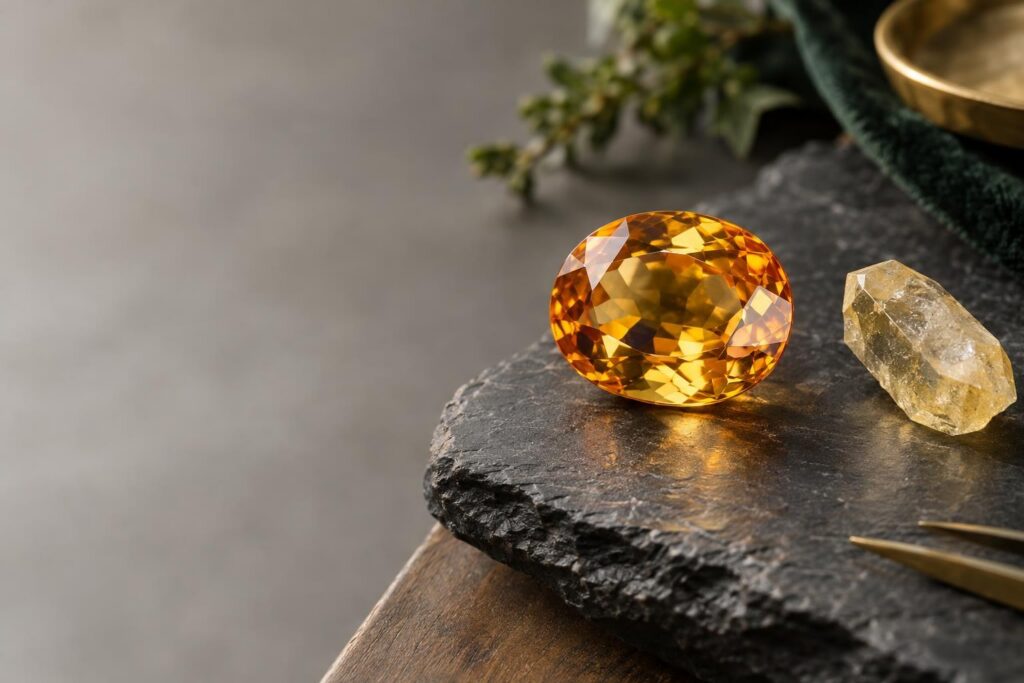
How does a common mineral become a golden gem? Citrine is the transparent, pale yellow to brownish orange variety of quartz 1. Quartz is one of the most abundant minerals in Earth’s crust and the main part of beach sand. Pure quartz is colourless, but small amounts of other atoms can give it vivid colours 5.
What gives citrine its colour? A trace of iron in its crystal structure creates the yellow-to-orange tones 1. The name comes from the French word citron, meaning lemon. Citrine sits alongside amethyst, rock crystal, smoky quartz and rose quartz among the most common quartz varieties 5.
Why citrine’s colour ranges from lemon to deep orange
Why does citrine come in so many shades? Its colour ranges from pale brownish yellow to intense reddish orange 2. Gem-A describes an even wider span, from reddish brown to greenish yellow, through every shade of orange and yellow 4.
The colour range of citrine
Citrine is never just one yellow. Step through the shades the page describes, from greenish yellow to reddish brown, and see which ones are most prized.
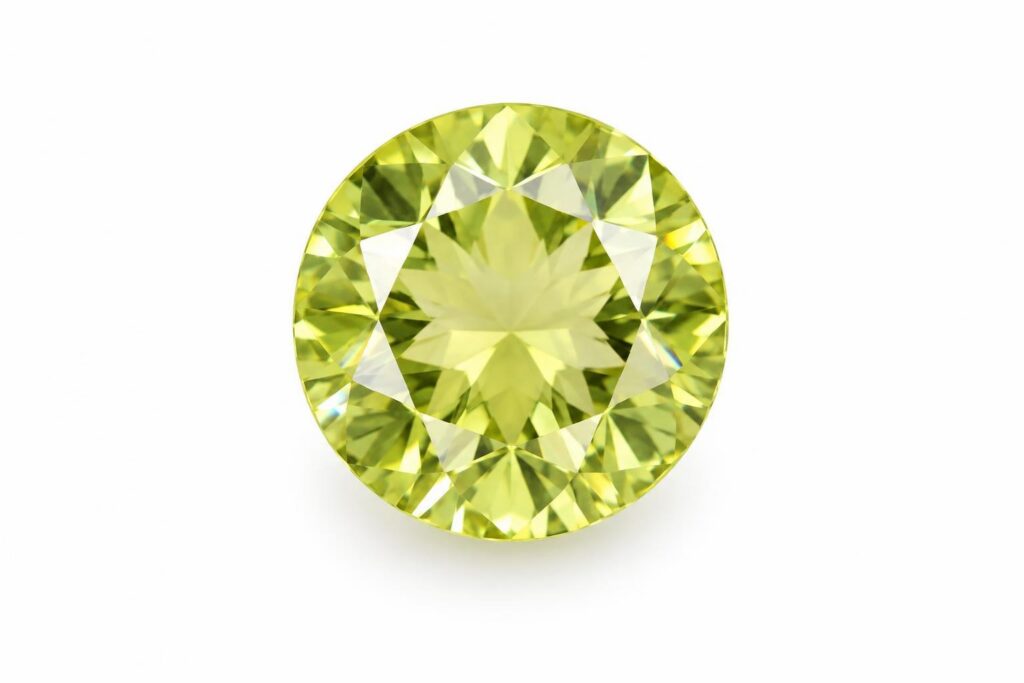
- Greenish yellow
- This is one end of the wider span Gem-A describes, which runs from greenish yellow to reddish brown. Some lime-coloured citrine comes from heating smoky quartz rather than amethyst.
- Pale yellow
- Citrine is the transparent, pale yellow to brownish orange variety of quartz, so the lighter shades sit at the pale end of its range.
- Saturated yellow
- A saturated yellow is among the colours that are prized. Saturation means how strong or pure a colour is, and the best stones are free of brownish tints.
- Orange
- The range passes through every shade of orange and yellow. Orange sits in the middle of the span, between the yellows and the reddish tones.
- Reddish orange
- Citrine can reach an intense reddish orange. A saturated colour from yellow to reddish orange is prized when it is free of brownish tints.
- Reddish brown
- Gem-A describes the span as reaching reddish brown. Brownish tints are not what buyers prize, so this end is less sought after than saturated yellow to reddish orange.
Screen colours vary and these pictures show only a few points along a continuous range, so real stones will fall between them. Pictures: AI-generated illustrations, checked for accuracy. They are not photographs of a real piece.
Which colours are most valued? A saturated yellow to reddish orange, free of brownish tints, is prized 2. Saturation means how strong or pure a colour is, and Hue, tone and saturation in gemstones explains it further. Before modern gemmology, citrine’s tawny colour led people to confuse it with topaz 1.
Why most citrine started life as amethyst
Why should you know where your citrine’s colour came from? Because the answer to "is it genuine?" has two parts. Natural citrine is rare, and most citrine on the market comes from heat-treated amethyst 1.
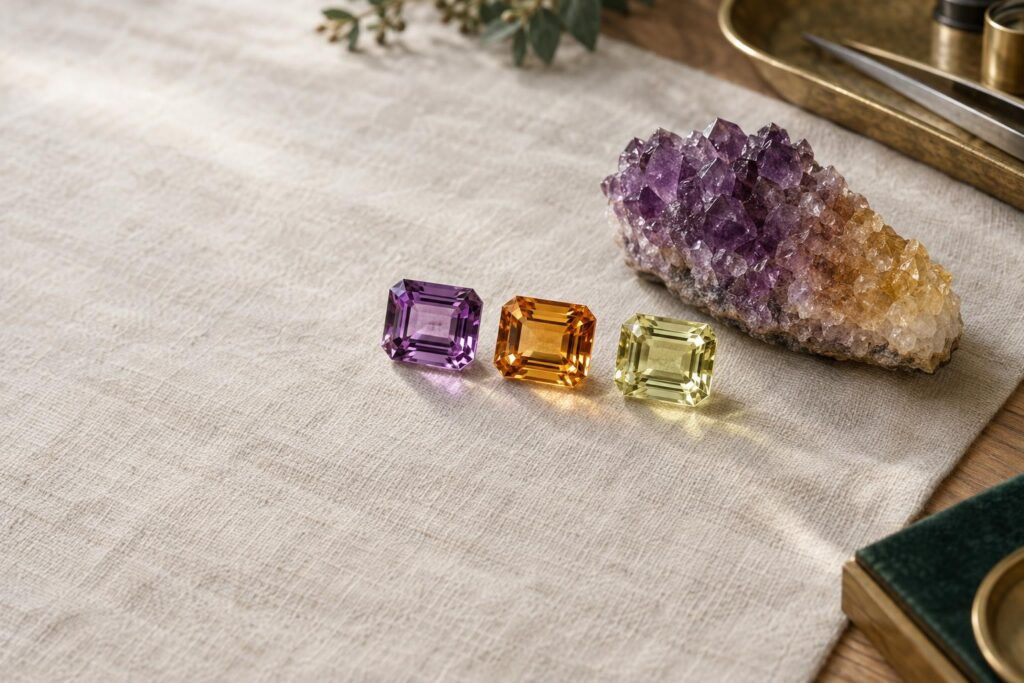
How does purple become gold? Amethyst is typically heated to about 250–500 °C, which turns it from purple to yellow 4. The amethyst’s original hue can decide how rich the yellow becomes. Some lime-coloured citrine comes from heating smoky quartz instead 2. You can read how this process works in Heat treatment in gemstones.
What does that mean when you buy? CIBJO’s Blue Books, a set of international trade guidelines, distinguish citrine from heat-treated amethyst, while noting that both are sold as citrine 4. So you can ask the seller whether a stone is natural citrine or heated amethyst. How gemstone treatments should be disclosed covers what to ask.
How can a gemmologist tell them apart? Heated amethyst keeps amethyst’s colour pattern, which is stronger at the tip of the crystal, while natural citrine is coloured more evenly. Natural citrine is also moderately dichroic, meaning it shows two slightly different colours from different directions. Heated amethyst shows no pleochroism, the general name for this effect 4.
Why citrine needs a little care despite its hardness
Why does a stone rated 7 still need care? Citrine rates 7 on the Mohs scale, a 1-to-10 scale of scratch resistance. It also has good toughness, meaning it resists chipping and breaking. That makes it suitable for all jewellery types, including rings, as long as the wearer understands its limited hardness 3.
How can ordinary dust scratch it? Sand and dust are mostly quartz, the same mineral as citrine, so citrine needs proper care to avoid scratches. The Mohs scale is also not evenly spaced, so the gap between two numbers is not always the same 3. The Mohs scale is not the whole durability story explains why.
What else can harm it? Sudden temperature changes can cause citrine to fracture, and some citrine can fade after long exposure to intense light. Hydrofluoric acid, ammonium fluoride and alkaline solutions can also damage it 3.
How should you clean it? Warm, soapy water is safe. Ultrasonic cleaners are usually safe unless the stone is dyed or has had fracture filling (cracks filled with another material). Steam cleaning is not recommended, because citrine should not be exposed to heat 3.
Why Bolivia is linked to citrine
Why does one country’s name come up with citrine? In Bolivia, amethyst and citrine colours can occur in the same crystal. These two-coloured gems are called ametrine 1.
Why citrine marks November
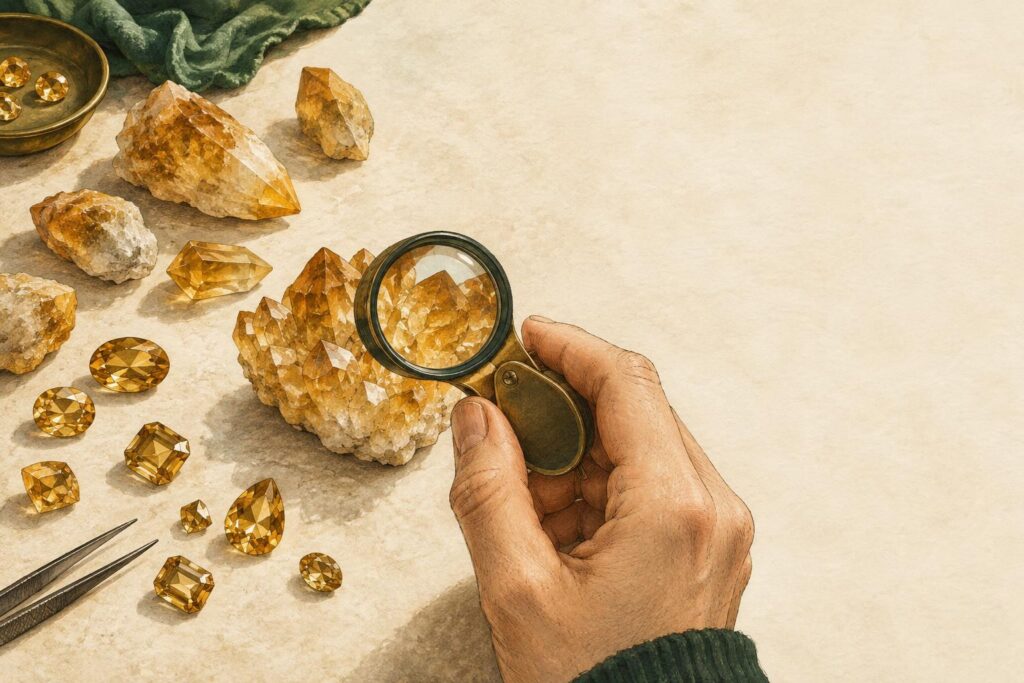
Why might citrine mark a birthday or milestone? Along with topaz, citrine is a birthstone for November, and it is also the gem for the 13th anniversary 1.
Why it helps to know how quality is judged
Why look closely before you choose? Dealers judge citrine on specific features. They look for stones without colour zoning, which is uneven bands or patches of colour. They also look for no visible inclusions, the tiny internal features found in many gems. Much faceted citrine is eye-clean, meaning no inclusions show to the unaided eye 2.
What sizes can you expect? Citrine comes in standard shapes and sizes, and stones of up to 20 carats are readily available in jewellery 2. How coloured gemstones are evaluated explains the wider grading approach.
How can you tell citrine from similar yellow stones? Citrine can be confused with yellow sapphire, heliodor and topaz. Standard gemmological testing tells them apart easily 4.
What separates citrine from topaz? Topaz is a different mineral, rated 8 on the Mohs scale. It has a specific gravity (weight for its size) of 3.53 and a refractive index (how strongly it bends light) of 1.619–1.627 6. Citrine, by comparison, rates 7, with a specific gravity of 2.66 and a refractive index of 1.544–1.553 1.
Are there laboratory-grown and imitation versions? Yes. Simulants, which only imitate citrine, include coated rock crystal and glass. Synthetic (laboratory-grown) citrine has been grown since the 1970s and is hard to identify with traditional testing 4. If origin matters to you, you can ask whether a stone has been tested by a gemmological laboratory.
Why citrine suits so many designs
Why can citrine appear in almost any piece? Its good toughness lets it suit all jewellery types 3. It comes in standard shapes and sizes, and designers also cut it into unusual shapes and carvings 2. How a ring setting holds and shows a stone is covered in Ring settings explained: a visual guide.
Why it helps to ask questions before choosing
Why talk it through? Treatment, origin and testing all came up in this guide, and a conversation is a chance to ask about each one. Inclusion in this guide does not confirm that Ralph Jacobs stocks this gemstone. We can source a wide range of coloured gemstones, and you can book a free consultation online from anywhere at bookings.ralphjacobs.org.
Frequently asked questions
Heated citrine is natural quartz whose colour was changed by heat, and most citrine on the market is heat-treated amethyst. CIBJO guidance distinguishes the two but notes both are sold as citrine, so you can ask the seller which one a stone is 4.
Citrine rates 7 on the Mohs scale and has good toughness, so it suits rings if the wearer understands its limited hardness. Dust and sand can scratch it, and sudden temperature changes can cause it to fracture 3.