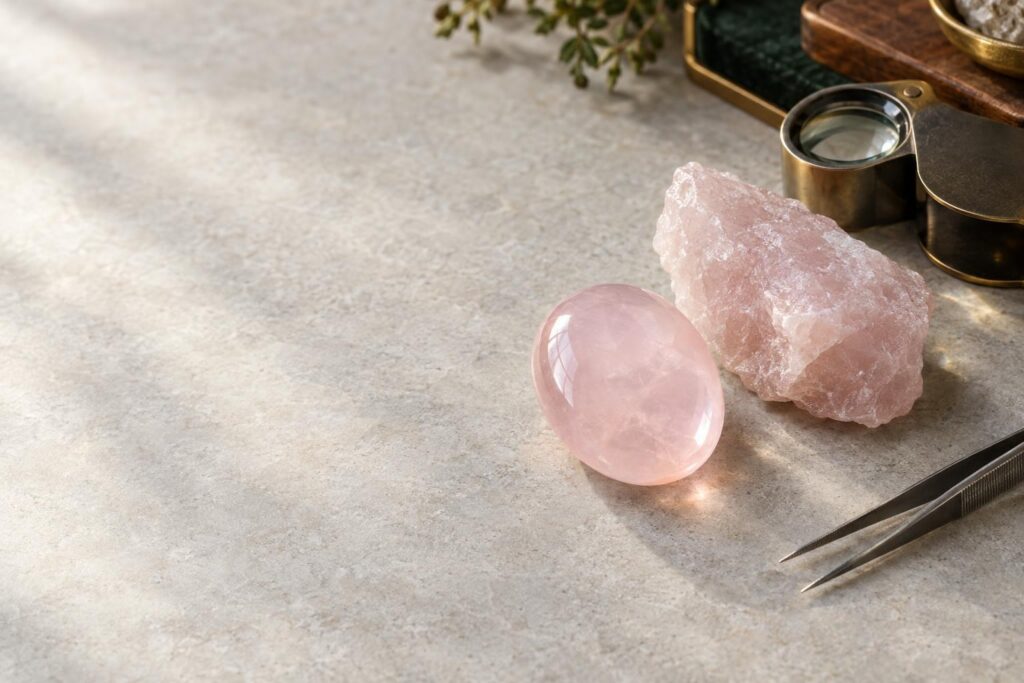
Why rose quartz has such a gentle appeal
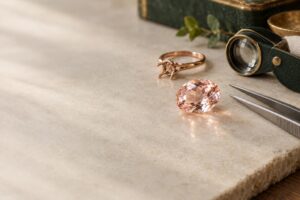
If you love soft pink, rose quartz has probably caught your eye already. Its soft translucence and pale to deep pink shades appeal to gem lovers and crystal collectors alike 3. It also carries a quiet romantic note as the gem for the fifth wedding anniversary 1.
So what exactly is it? Rose quartz is a variety of quartz: the same mineral, given its own name because of its delicate pink colour. Its chemical formula is SiO₂ (silicon dioxide). Its refractive index, a measure of how much it bends light, is 1.544–1.553. Its specific gravity, its weight compared with the same volume of water, is about 2.66 1.
Rose quartz always forms as a mass, so it lacks the regular, flat crystal faces of many gems. It is typically found in pegmatites, a type of rock 2. It has also been popular with carvers for figurines and other small decorative objects 1.
Why rose quartz looks soft and cloudy
Why does rose quartz glow softly instead of sparkling like glass? The answer lies in what makes it pink. Its colour comes from microscopic inclusions, tiny bits of other material trapped inside the stone. In rose quartz these are aligned silicate mineral fibres, similar but not identical to a mineral called dumortierite 2.
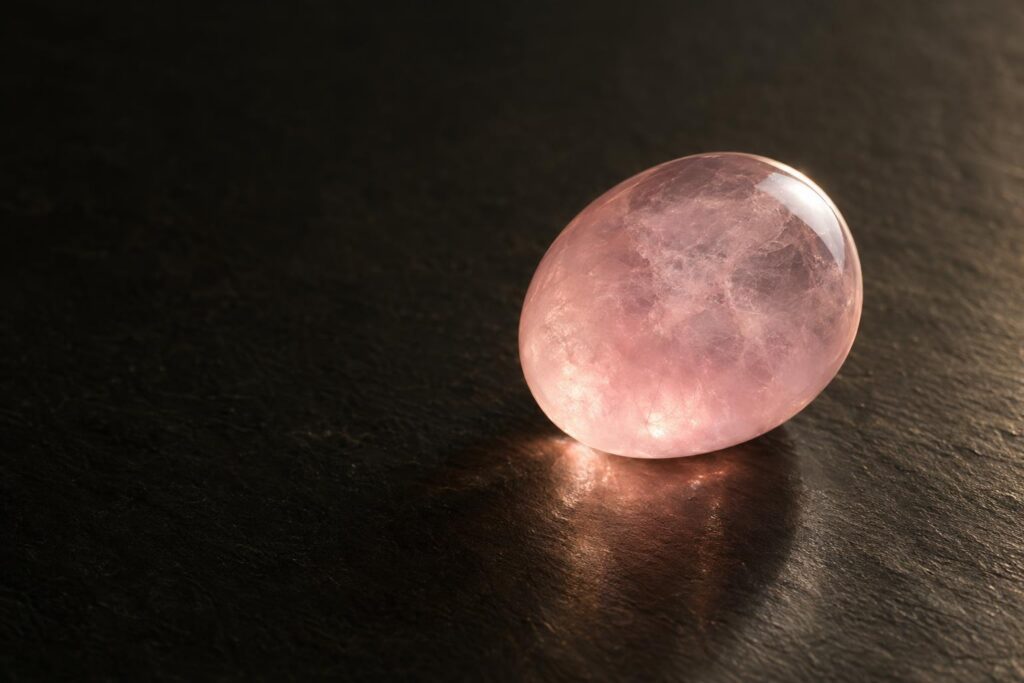
Scientists extracted these pink fibres from rose quartz from 29 localities around the world. They concluded that the fibres cause the colour of rose quartz everywhere. The pink comes from an iron–titanium reaction in the fibres that absorbs some of the light 5.
The same inclusions give rose quartz its cloudy translucence 1. Translucent means light passes through, but you cannot see clearly through the stone. Rose quartz is always slightly to highly cloudy, and its colour varies from bright to pale pink, sometimes with lavender or orange tints 5. Other descriptions give a range from very light pink, almost white, to medium-dark pink 2.
Transparent pink quartz does exist, but it is exceptionally rare and gets its colour by a different mechanism 2. This single-crystal pink quartz lacks the fibres and is nearly free of internal scattering 5.
Why do some stones show a star? When rose quartz contains small, well-oriented inclusions, it can sometimes show asterism, a star of light across the stone. It can also show a cat’s-eye, a single line of light, but the star is more common 1. A correctly oriented cabochon, a smooth domed stone without facets, can show a six-rayed star 2. A star means the fibres are aligned in three directions 5.
Why you should ask about treatment
Why ask? A treatment can change how a stone looks, and knowing about it helps you understand what you are buying. Rose quartz is occasionally treated with radiation to intensify its colour, a process called irradiation 4.
You can ask the seller whether a rose quartz has been irradiated. If a stone is described as untreated, it is fair to ask what that description is based on. The guide on how gemstone treatments should be disclosed explains more.
Why a hard stone still needs gentle handling
Why does rose quartz need care if it is hard? Because resisting scratches and resisting knocks are different things. On the Mohs scale, which ranks scratch resistance from 1 to 10, rose quartz is 7. With this hardness, it can provide a lifetime of wear 4.
Toughness is how well a stone resists chipping and breaking. Quartz is hard but quite brittle, and it can be damaged even by much softer things. It has poor to indistinct cleavage, meaning little tendency to split along flat planes, and it breaks with a curved, shell-like fracture. Massive quartz, which forms as a solid mass as rose quartz does, is described as tough 6. For more on this, see The Mohs Scale Is Not the Whole Durability Story.
How do you clean it safely? Warm, soapy water is always a safe way to clean rose quartz, and ultrasonic and steam cleaners should be avoided 4. Ultrasonic cleaners loosen dirt with fast vibrations in liquid. They can damage quartz that is cracked inside, and quartz with large fluid inclusions may crack when heated 6.
Why light and heat can matter
Will your rose quartz fade? Rose quartz is generally stable when exposed to light and heat 4. The fading GIA mentions elsewhere concerns the rare, transparent crystalline pink quartz, which is a different material from ordinary rose quartz 2.
A study of rose quartz from many localities saw no sun fading in any of its samples. It suggested some reports may come from sun-heated inclusions cracking near the surface. In heating tests, the pink fibres lost their colour within a few hours at 500 °C, or over several days at 430 °C 5.
Mindat notes that coloured quartz can pale in sunlight. The most sensitive is the clear crystalline rose or pink quartz, which should be kept in the dark 6.
Why colour and size go hand in hand
Why can two pieces of rose quartz look so different? Size plays a part. The most appealing colour usually occurs in larger sizes 2. Larger cut gems often show more intense colour, and deep pink shades are popular but rare in small sizes 3. To learn how colour is judged, see Hue, Tone and Saturation in Gemstones.
- Clarity: most rose quartz is translucent, while the finest quality is often transparent and usually faceted 3.
- Star stones: fine examples show a sharp star floating above an even pink body colour 2.
- Treatment: rose quartz is occasionally irradiated to intensify its colour, so you can ask whether a stone has been treated 4.
For a wider view, How Coloured Gemstones Are Evaluated explains the main quality factors.
Why rose quartz is usually cut as cabochons, beads and carvings
Why are most rose quartz pieces smooth rather than faceted? The cut follows the clarity. Translucent material is cut as cabochons or carved, while transparent material is usually faceted 1. Facets are the flat, polished surfaces cut into a gem. Because of its cloudy translucence, rose quartz is generally cut into beads and cabochons 2.
How rose quartz is cut
Most rose quartz is cut smooth rather than faceted, because the cut follows the clarity. Switch between the four to see how translucent and transparent material is handled.
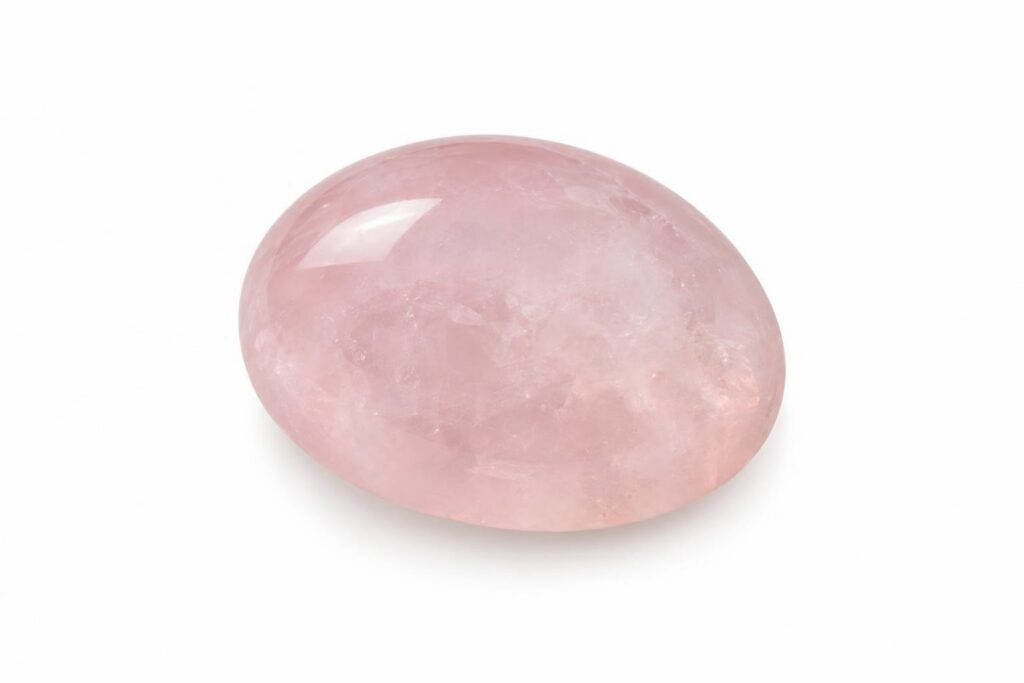
- Cabochon
- Rose quartz is cloudy and translucent, so it is generally cut as a cabochon. Light passes through, but you cannot see clearly into the stone.
- Bead
- Because of its cloudy translucence, rose quartz is also generally cut into beads.
- Carving
- Translucent rose quartz can also be carved, rather than faceted.
- Faceted
- Transparent material is usually faceted. Facets are the flat, polished surfaces cut into a gem. Transparent pink quartz exists, but it is exceptionally rare.
The pictures are simplified examples. The colour and the cloudiness of real rose quartz vary from stone to stone, and transparent faceted pink quartz is far rarer than the cloudy material. Pictures: AI-generated illustrations, checked for accuracy. They are not photographs of a real piece.

If you are thinking of a rose quartz ring, it helps to know how different settings hold a stone. Ring Settings Explained: A Visual Guide shows the main types, and Which Gemstones Suit Everyday Rings? looks at daily wear.
Why it can help to talk it through
If you are drawn to rose quartz for a piece of your own, we can source a wide range of coloured gemstones and design a setting around your choice. You can book a free consultation online from any country at bookings.ralphjacobs.org, or reach us by WhatsApp or at our showroom. Inclusion in this guide does not confirm that Ralph Jacobs stocks this gemstone.