Why amethyst is the gem most people picture as purple
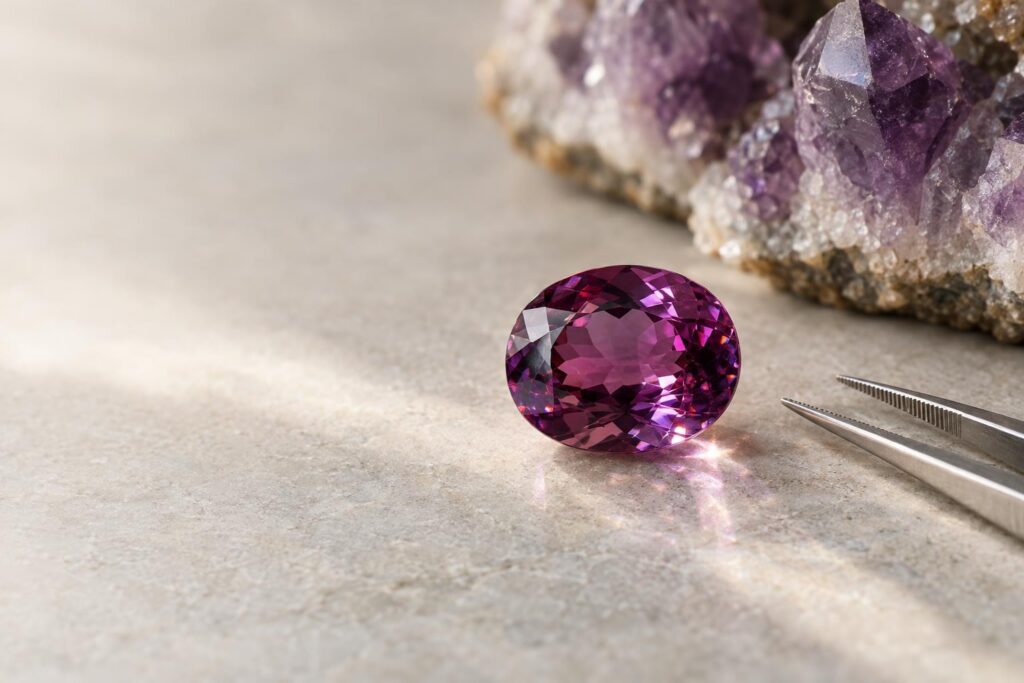
If you love purple, amethyst is probably the first gem that comes to mind. Knowing how it is judged, how it wears and whether it fades helps you choose and enjoy it with confidence. Amethyst is the purple variety of the quartz mineral species. A variety is one colour or type within a single mineral. It is the gem most commonly linked with purple, even though sapphire and tanzanite also come in purple 3.
Why can so many people enjoy a gem once kept for royalty? For centuries amethyst was the most prized variety of quartz, and it was once available only to royalty. Relatively plentiful supplies have since made it far more widely available. Its availability and affordability make it one of the world’s most popular coloured gems 1.
How does clear quartz become purple? Iron is the original impurity inside the crystal. Natural irradiation, meaning exposure to radiation in the earth, changes that iron. The changed iron absorbs light centred in the yellow-green, and what remains looks purple to our eyes 5.
Why colour decides so much of an amethyst’s beauty
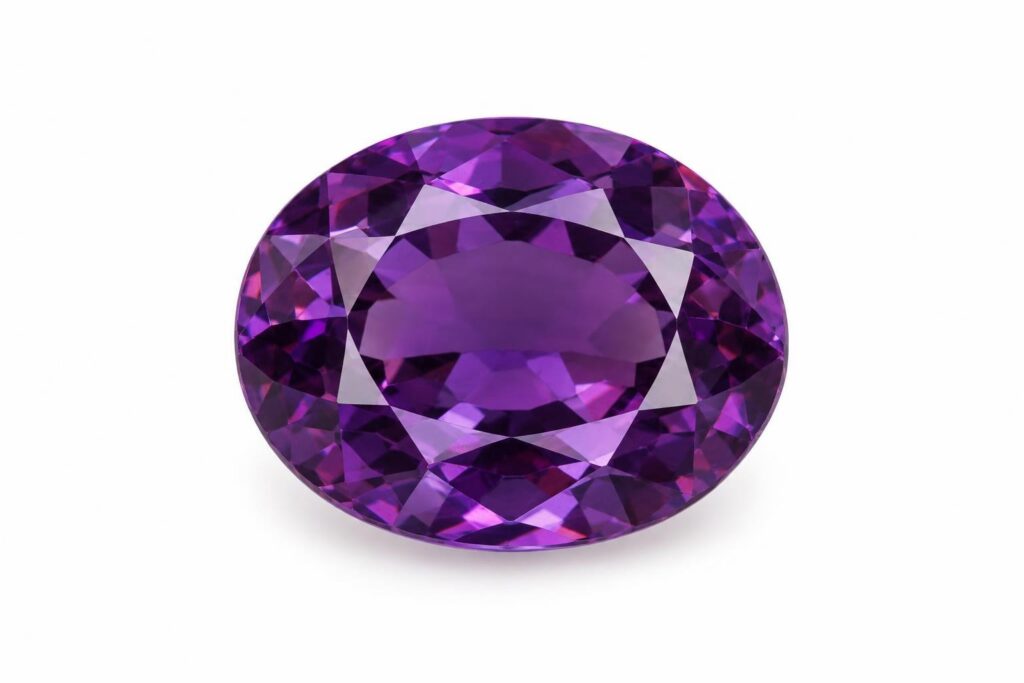
Why look closely at the shade? Two amethysts can look very different side by side. The colour ranges from light lilac to deep royal purple, and from brownish to vivid. Some stones lean cool and bluish, while others are a reddish purple sometimes called raspberry 3.
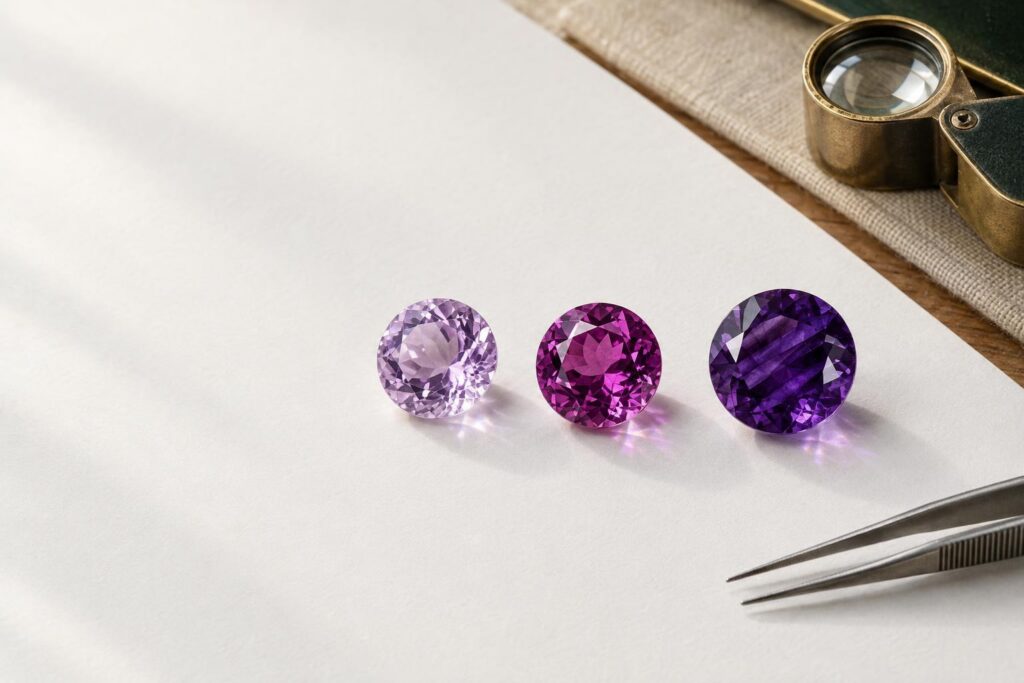
How is colour quality judged? The finest colour is a strong reddish purple or purple with no visible colour zoning. Colour zoning means patches of darker and lighter colour inside one stone. Brownish or bronze tints, or noticeable zoning, lower value dramatically. A stone that is too dark can also look black in dim light 1.
Why is zoning so common? Amethyst often grows with angular zones of darker and lighter colour 3. To learn how gemmologists describe colour in more detail, see hue, tone and saturation in gemstones.
Why you should ask how an amethyst has been treated
Why ask? Some amethyst is changed after mining to alter how it looks. Heat treatment can lighten very dark amethyst. Lower-quality light amethyst, and even light quartz, has been dyed purple. Rarely, cracks that reach the surface are filled to improve how clear the stone looks, a process called fracture filling 1.
How heat changes amethyst colour
Heating can alter amethyst, and the colour shifts in clear stages as the temperature rises. Step through them to see what each stage does to the stone.
- Little change
- In one study, the colour changed little below 360 °C. The stone stays violet.
- Violet begins to fade
- At about 380 °C the violet began fading towards colourless.
- Light green
- At 420 to 440 °C the colour turned light green, known as prasiolite.
- Yellow citrine
- Above 440 °C the colour reached the yellow of citrine. The darker the starting colour, the more it changed.
The temperatures come from a single study, and the colours shown are illustrative. Real results depend on the starting stone. Pictures: AI-generated illustrations, checked for accuracy. They are not photographs of a real piece.
How far can heat change the colour? In one study, the colour changed little below 360 °C. At about 380 °C the violet began fading towards colourless, and at 420 to 440 °C it turned light green, known as prasiolite. Above 440 °C it reached the yellow of citrine, and the darker the starting colour, the more it changed 4.
What should you expect when buying? This guide follows one simple standard wherever you live: every treatment a stone is known to have had should be named. That is why heating, dyeing and fracture filling are all listed here. You can ask the seller, in writing, which treatments a stone has had. To read more, see how gemstone treatments should be disclosed and heat treatment in gemstones.
Why amethyst needs a little thought in daily wear
Why think about hardness? Hardness is a stone’s resistance to scratching, rated on the Mohs scale. Amethyst rates 7 and has good toughness, which is resistance to chipping and breaking. That makes it suitable for all jewellery types, including rings, if the wearer understands the limits of its hardness 2.
How can it be damaged? Sand and dust are made mostly of quartz, the same mineral as amethyst, so everyday grit can scratch it. Sudden temperature changes can cause it to fracture. Hydrofluoric acid, ammonium fluoride and alkaline solutions can also damage it 2. For why hardness is only part of the picture, see the Mohs scale is not the whole durability story.
Does amethyst fade? Some amethyst colour can fade with prolonged exposure to intense light 2. This fits what is known about colour centres, the tiny structures behind many gem colours. Many are unstable to heat and light, although that finding is general rather than specific to amethyst 5.
What is safe for cleaning? Warm soapy water is safe. Ultrasonic cleaners, which clean with vibrations in liquid, are usually safe, except for rare dyed or fracture-filled stones. Steam cleaning is not recommended, and amethyst should not be exposed to heat 2.
Why origin can hint at what you see
Why think about where a stone grew? Gem-quality amethyst is found on every continent and in many different geological settings 6. Zambian material can be a saturated raspberry colour, but it tends to have more inclusions than Brazilian material 1.
Why a few simple checks help you judge an amethyst
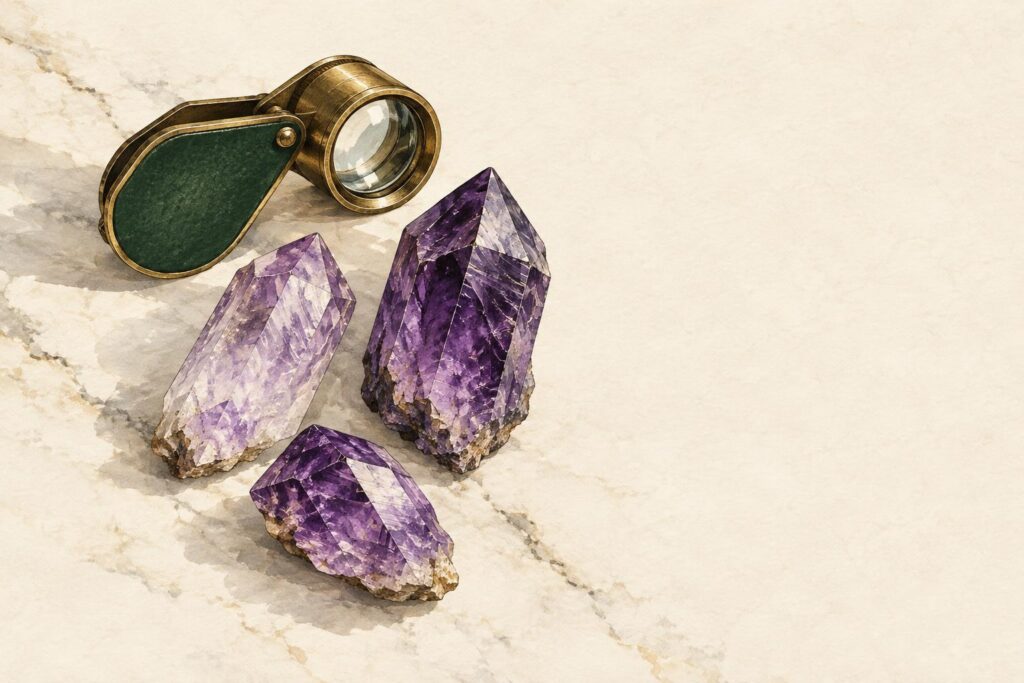
Why look at clarity? Inclusions are tiny features inside a stone, such as crystals or cracks. Much faceted amethyst is eye-clean, meaning you see no inclusions without magnification. Facets are the flat, polished surfaces cut on a stone. Stones with visible inclusions but attractive colour are usually cut as cabochons, which are smooth and domed, or as beads 1.
- Look at the colour in bright light and in dim light.
- Turn the stone face-down on white paper to look for colour zoning.
- Watch for brownish or bronze tints in the purple.
- Ask whether the stone has been heated, dyed or fracture-filled.
- Ask whether the stone is natural or laboratory-grown, since synthetic amethyst is on the market 6.
Why ask about laboratory growth? Synthetic, or laboratory-grown, amethyst exists. Its colour comes from laboratory irradiation rather than natural irradiation 5.
How is it told apart? Synthetic amethyst is grown in a solution, usually potassium carbonate. Classic checks of twinning, colour zoning and inclusions identify only some synthetics, and the best show no inclusions or distinct zoning. Infrared spectroscopy, a laboratory test, can separate natural from synthetic amethyst when a microscope is not enough 6. For the wider picture, see how coloured gemstones are evaluated.
Why the cut and setting shape how amethyst is worn
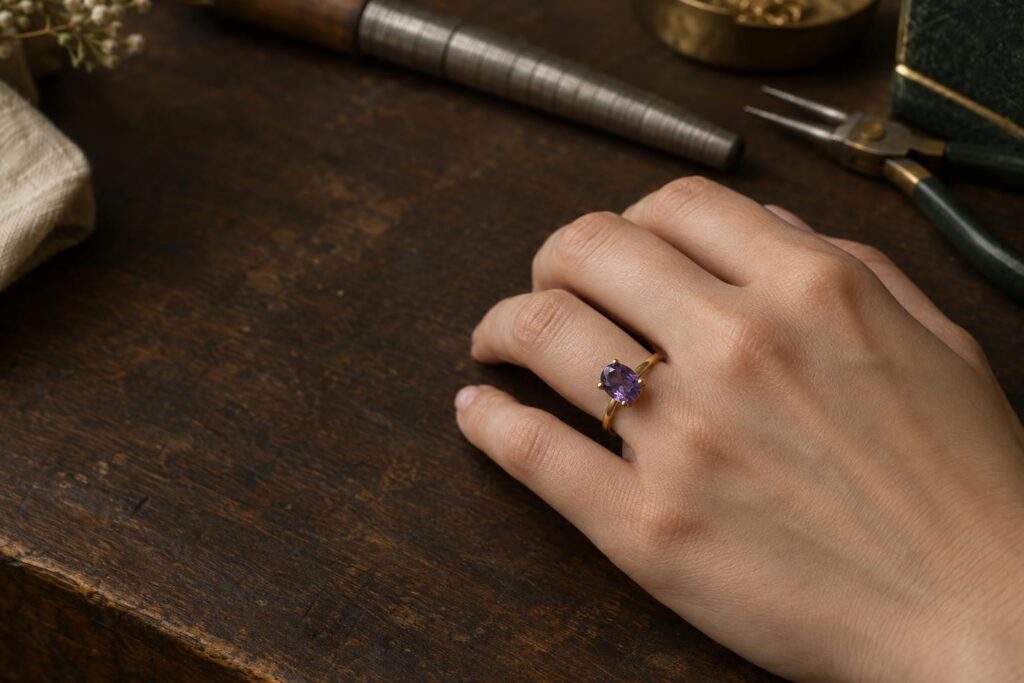
Why does design matter for a stone rated 7? Amethyst suits all jewellery types, including rings, when the wearer understands the limits of its hardness 2. The cut often follows the stone’s clarity: much faceted amethyst is eye-clean, while stones with visible inclusions but attractive colour are usually cut as cabochons or beads 1. For how different settings hold a stone, see ring settings explained and which gemstones suit everyday rings.
Why this entry is a starting point
This entry describes amethyst in general rather than any single stone. Inclusion in this guide does not confirm that Ralph Jacobs stocks this gemstone. We can source a wide range of coloured gemstones, and a free consultation, booked online at bookings.ralphjacobs.org, is a chance to ask questions about amethyst.
Frequently asked questions
Amethyst rates 7 on the Mohs scale and has good toughness, so it suits rings if the wearer understands the limits of its hardness. Sand and dust are mostly quartz and can scratch it, and sudden temperature changes can cause it to fracture 2.
The finest colour is a strong reddish purple or purple with no visible colour zoning. Brownish or bronze tints and noticeable zoning lower value, and very dark stones can look black in dim light. Placing the stone face-down on white makes zoning easier to see 1.
Heat can lighten very dark amethyst. Light amethyst, and even light quartz, has been dyed purple, and rarely surface-reaching cracks are filled 1. This guide names every known treatment, and you can ask the seller in writing which treatments a stone has had.