Why does a grey stone flash blue and gold?
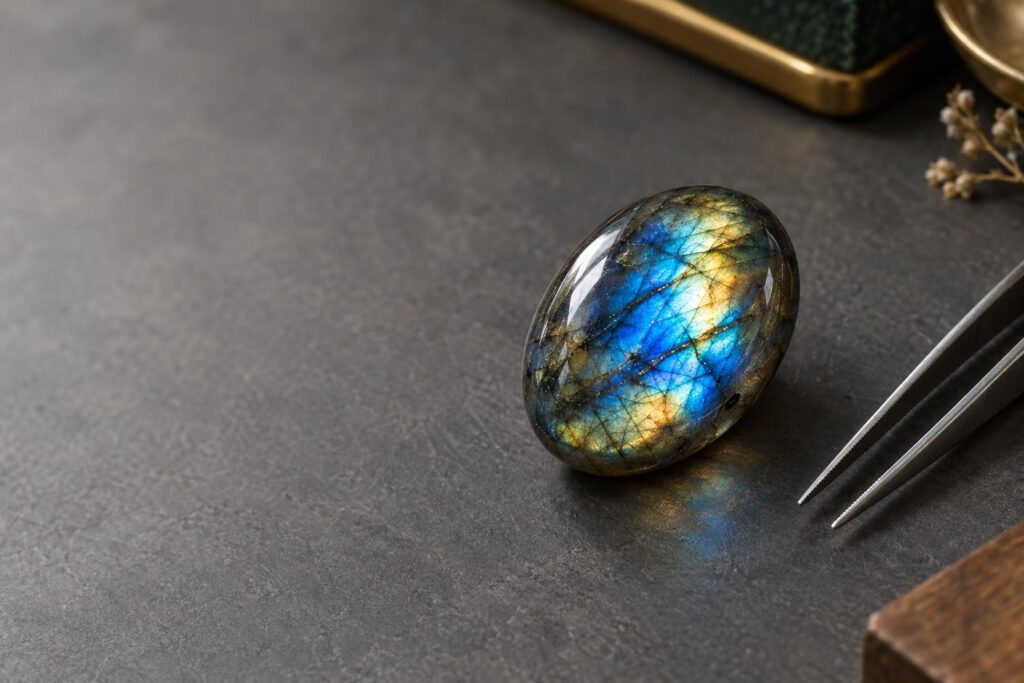
You tilt a dark grey stone, and a sweep of blue light crosses its face. Turn it again, and the blue can give way to green, gold, orange or even violet 1. This moving colour is called labradorescence. Knowing how it forms helps you judge a piece and wear it well.
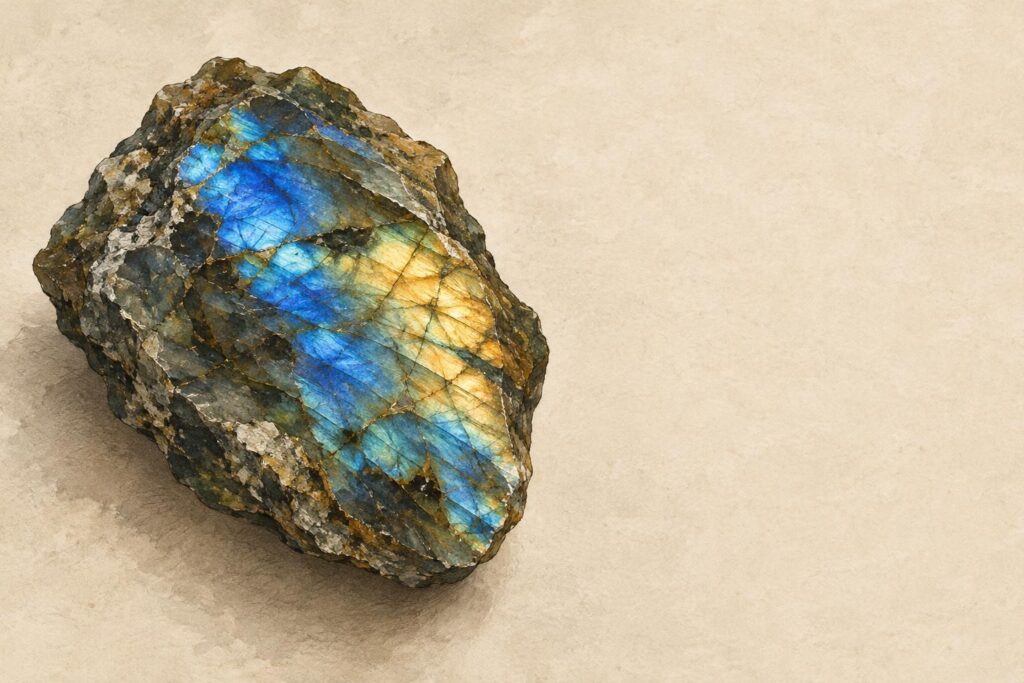
So what is labradorite? It is a plagioclase feldspar. That is a mineral series that runs from albite, which is rich in sodium, to anorthite, which is rich in calcium. Labradorite sits in the middle, at roughly 50–70% anorthite 3. It is named after the Labrador peninsula in Canada, where it was first found 6.
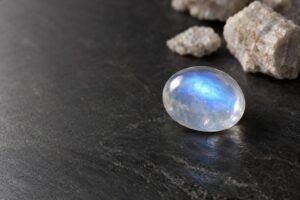
Labradorite belongs to the feldspar family, like moonstone. Moonstone has two cleavage directions, a trait it shares with the other feldspar minerals 2. Cleavage affects how a stone is set and worn, as the sections below explain.
Why does the colour move as you turn it?
Why does the colour seem to float inside the stone? Labradorite holds extremely thin layers stacked inside the crystal. They form as the mineral cools, and they are just the right size to reflect certain colours of light 1.
How thin are these layers? Each repeat in the stack measures about 150 to 300 nanometres (nm), which researchers describe as sub-micron. This layered texture is called the Bøggild intergrowth, after Ove Balthasar Bøggild, who also coined the word labradorescence 3.
How do layers make colour? Light reflects off a stack of evenly spaced layers, and the reflections combine to strengthen some colours. Scientists call this interference. The thicker the layers, the longer the wavelength reflected, so colours run from dark blue through to red 4.
Why does one stone flash gold and another blue? The layer spacing grows steadily with the stone’s calcium content, so its chemistry helps set its colour. All labradorite that shows this flash is found in igneous rocks, formed from molten material, that cooled extremely slowly 3.
Gemmologists also call the effect a schiller. It shows as lustrous, metallic tints, often blue and green and sometimes the full spectrum 6. The flashes usually play against a dark grey or black background 1.
Why do some labradorites carry other names? Spectrolite is a labradorite variety from Finland, prized for rich, full-spectrum colour and stronger flash. Rainbow moonstone is a transparent variety of labradorite, and is not strictly a moonstone 1. The name spectrolite is also used for labradorite with exceptional colour 5.
Why ask about treatments?
Why ask about treatments at all? Knowing a stone’s history is part of judging it. The sources behind this entry do not describe any common treatment for labradorite. That is not the same as saying a stone is untreated. If it matters to you, ask the seller what is known about your stone, and read how gemstone treatments should be disclosed.
Why does labradorite need gentle wear?
Why does a stone this striking need care? Labradorite rates 6 to 6.5 on the Mohs scale, which measures scratch resistance. It is also brittle and has perfect cleavage 6. Cleavage is a direction of atomic weakness inside a crystal that makes it more likely to break 2.
How does that show in daily wear? Labradorite breaks along cleavage, so it can break on impact. Geology.com notes that it is not a good choice for jewellery likely to take knocks. It also scratches much more easily than diamond, ruby, sapphire and emerald 5.
What about heat and cleaning? GIA’s care guide for moonstone, a related feldspar, notes that it has poor toughness. It warns that high heat or sudden temperature change can cause breaks. It names warm soapy water as the only recommended cleaner, and never recommends ultrasonic or steam cleaners 2. The sources here give no separate care guide for labradorite itself. Read more on why hardness is not the whole durability story.
Why does a Canadian place name sit on this stone?
Why Labrador? Labradorite is named after its type locality, Paul’s Island in Labrador, Canada 3. A type locality is the place where a mineral was first found and described. Spectrolite, a variety known for full-spectrum colour, comes from Finland 1. These places are not a full list of where labradorite is found.
Why viewing angle matters when you judge the flash
Why look at a stone from more than one angle? In iridescent gems, the effect is often strongest at certain viewing angles 1. In labradorite, the flash is seen mostly in one crystal direction, because most of the layers lie roughly parallel to one plane 4.
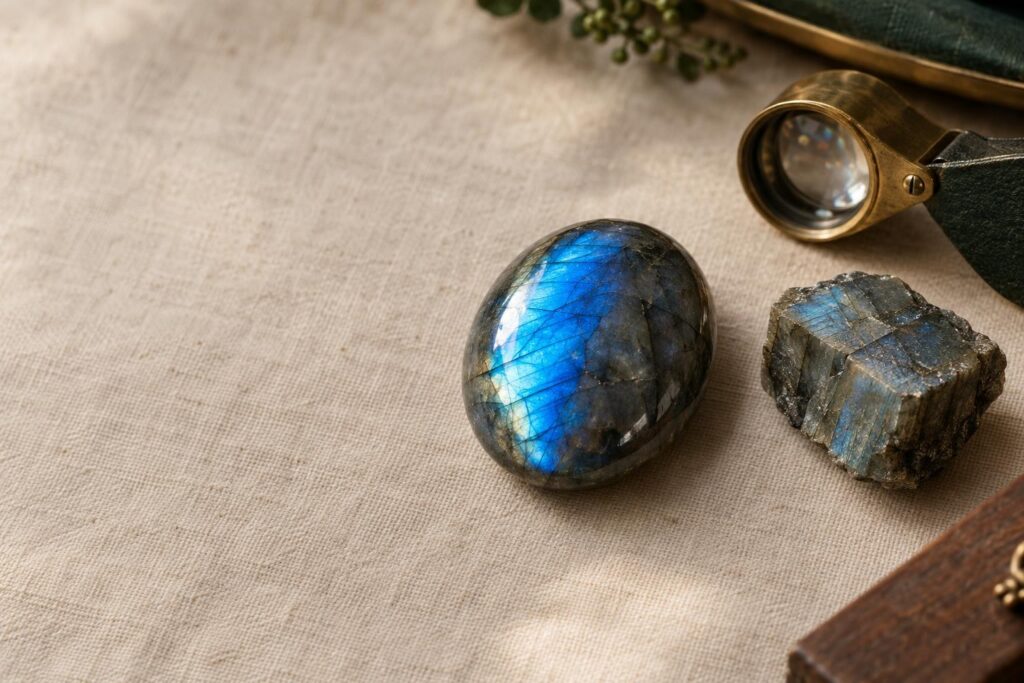
How does cutting use this? Flashing labradorite is most often cut as a cabochon, a smooth, domed, polished stone. The flash shows best when the flat base runs parallel to the layers. Cut at another angle, the layers tilt, and the flash looks off-centre when you look straight down 5.
What else shapes a strong flash? The quality, colour and brightness of the flash vary from stone to stone, and even within one stone. Many labradorite specimens show no flash at all 5. Where the flash is broken by non-flashing parts, the boundaries always show dark blue. In those parts, the layers shrink until they reflect only ultraviolet (UV) light 4.
- Looking straight down, is the flash centred, or does it appear only when you tilt the stone?
- As you turn it, how much of the face lights up, and in which colours?
- Where are the dull or dark patches, and how much do they matter to you?
- What is known about any treatment, and is it written down?
For more on judging colour, see how coloured gemstones are evaluated.
Why the setting matters for labradorite
Why think about the setting first? For moonstone, makers usually choose pendants, earrings and pins over rings, because rings take more knocks 2. Labradorite shares feldspar cleavage, which is why the same question comes up for it.
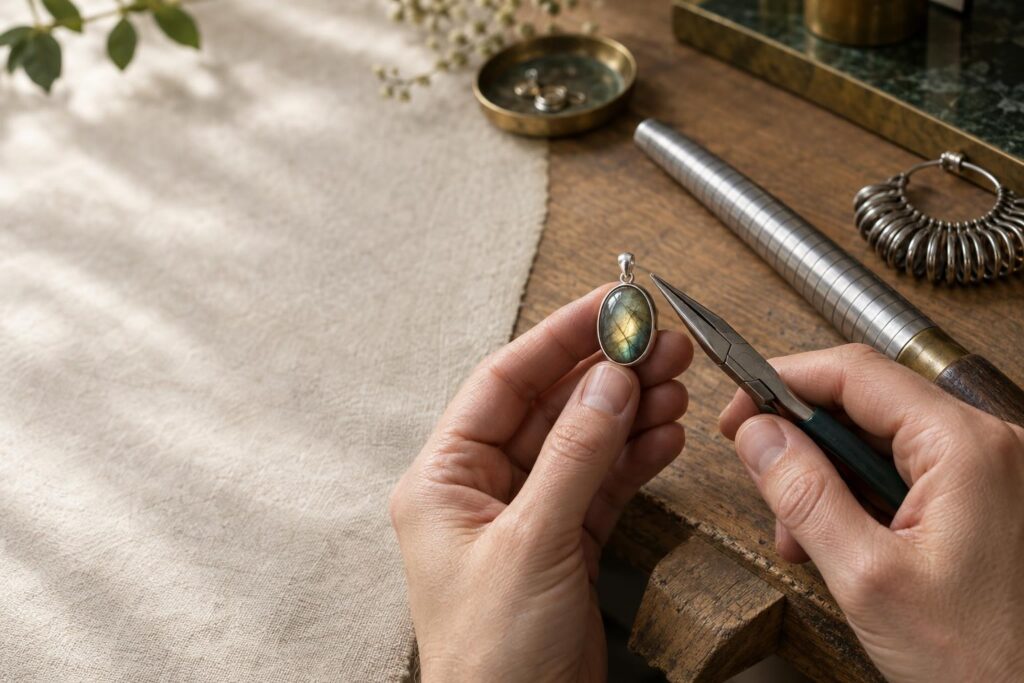
If you are thinking of a ring, weigh the cleavage and hardness facts above against how often your hands meet hard surfaces. The cut also shapes the design, because the flash shows best when the cabochon’s base sits parallel to the layers 5. See ring settings explained and which gemstones suit everyday rings.
Why this stone is in our guide
Understanding a gem helps you enjoy it, whether or not you buy it. Inclusion in this guide does not confirm that Ralph Jacobs stocks this gemstone. We can source a wide range of coloured gemstones, and we offer a free consultation, online from any country at bookings.ralphjacobs.org. For care and safety advice, see ralphjacobs.org/care/.
Frequently asked questions
Its colour comes from thin internal layers that mostly lie in one direction in the crystal 4. You see the flash when light reflects off them towards your eye, so turning the stone brings the colour in and out.
Rainbow moonstone is a transparent variety of labradorite, and it is not strictly a moonstone 1.
GIA’s guide for moonstone, a related feldspar, names warm soapy water as the only recommended cleaner and never recommends ultrasonic or steam cleaners 2. The sources here give no separate cleaning guide for labradorite.