
Why is rose gold pink when pure gold is yellow? Knowing this helps when you choose a ring colour, because the pink comes from a metal hidden in the mix. Gold and copper are the only two metals that show a colour of their own: gold looks yellow and copper looks reddish 1. There is no such thing as naturally occurring rose gold. It is made by adding copper to molten gold, which creates an alloy, a mix of metals 5.
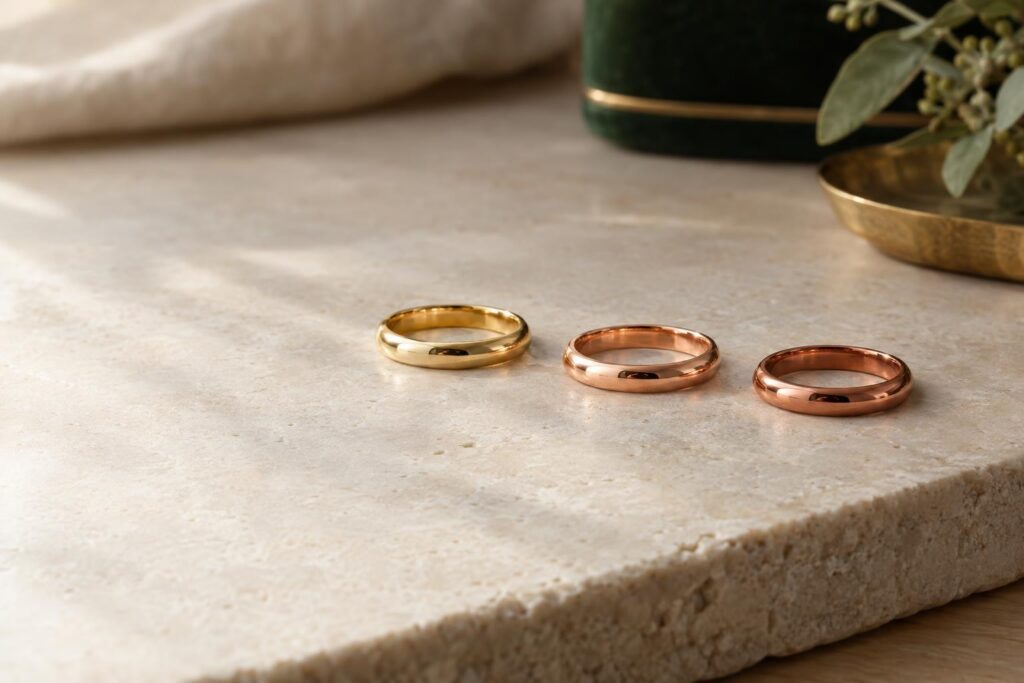
How does copper turn gold pink? Metals reflect light, but in gold and copper the reflection gets weaker towards the blue end of the light spectrum. Less blue light bounces back, so gold looks yellow and copper looks reddish 1. Add copper to gold and the mix takes on a pink tone, and more copper gives a stronger pink 4.
What does this mean for your ring? Gold purity is measured in ct (or K), which is not the same as the carat weight of a diamond. 24ct is pure gold, while a typical 14ct (14K) rose gold is 58.3% gold, 9.2% silver and 32.5% copper, though this is not the only way to make it 3. Copper and silver are harder than pure gold, so they make the piece stronger, and the copper can develop a patina, a thin surface layer, over time 4. See 9ct vs 14ct vs 18ct gold for how purity affects wear.
Example: Two rings can both be called rose gold yet have very different mixes. A typical 9ct rose gold is 37.5% gold and 42.5% copper, while a typical 22ct rose gold is 91.7% gold and 8.4% copper 3. Because the ratio of copper to gold sets how strong the pink is, the two can look like different shades 4.