
Why does a bezel setting matter? Bezels resist chips and everyday wear well, because the metal protects the stone all the way around. The metal rises from the base and wraps around the girdle, the thin outer edge of the stone, forming a smooth, protective border 1. When the rim encloses the whole edge, only the top surface stays exposed. There are also fewer places for dirt to collect, so a bezel-set stone is easy to clean 4.
How a bezel setting is made
Step through the stages from a plain strip of metal to a stone held all the way round by its rim.
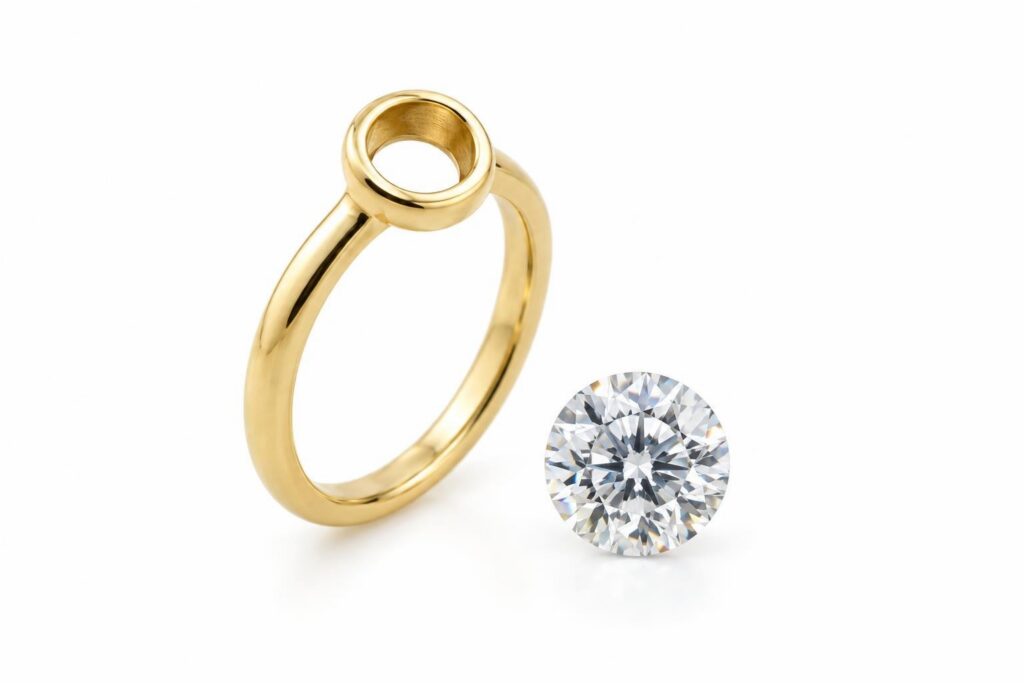
- Shaping the rim
- The jeweller shapes a rim of metal to fit the stone.
- Soldering to the mounting
- The rim is then soldered onto the mounting.
- Cutting the bearing
- The setter cuts a small seat inside the rim, called the bearing, so the stone sits level.
- Closing the metal over the stone
- The metal is pushed over the stone and rubbed. The rim then wraps around the girdle, so only the top surface of the stone stays exposed.
The pictures show a round stone in yellow gold for clarity. Bezel rims can be shaped to fit other stones and metals, and the final rubbing step is simplified. Pictures: AI-generated illustrations, checked for accuracy. They are not photographs of a real piece.
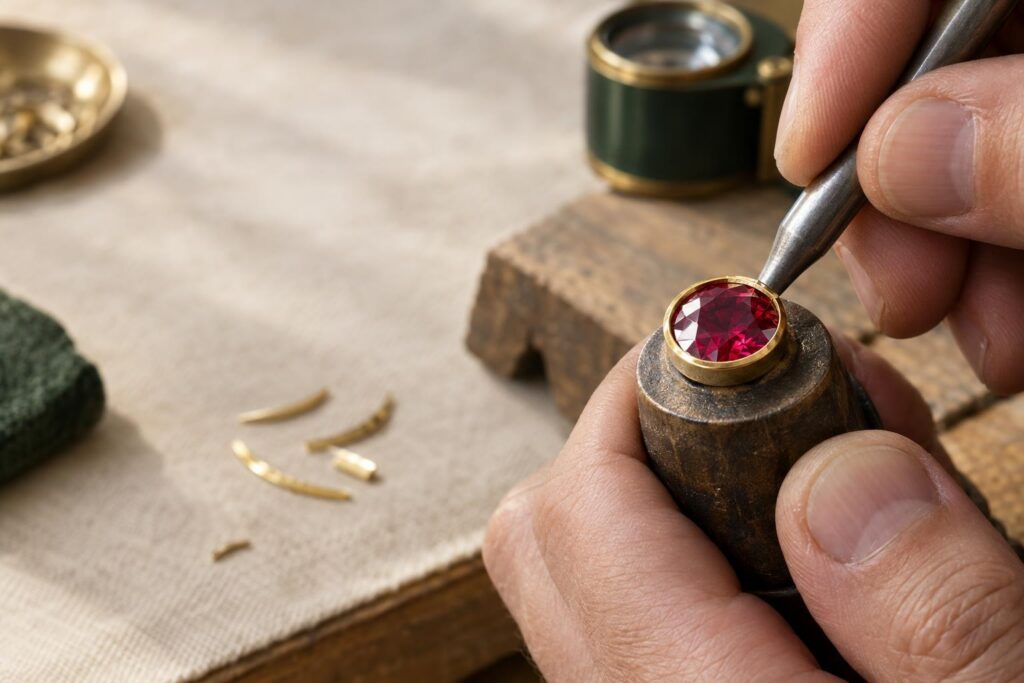
How is it made? The jeweller shapes a rim of metal to fit the stone, then solders it onto the mounting 2. The setter cuts a small seat inside the rim, called the bearing, so the stone sits level 3. The metal is then pushed over the stone and rubbed smooth until it follows the stone’s shape 5. A full bezel circles the whole edge, while a partial bezel leaves parts of the stone open but still adds security 1.
What are the trade-offs? Bezels are especially useful for less durable stones, or stones that tend to chip or crack, such as emerald 2. The main drawback is that the metal hides the stone’s sides. Less light gets in, so brilliance, the white light a stone reflects back, can be reduced. A half bezel is a compromise between protection and brilliance 4. To compare it with other styles, see Ring Settings Explained.
Example: Picture two rings with the same stone: one held by four claws (small metal arms, also called prongs), the other in a full bezel. Brush both across a wool jumper. The claws can catch the threads, while the bezel’s smooth rim is less likely to snag. Side by side, the claw-set stone may look a little brighter, because claws cover less of the edge and let slightly more light in 1.