
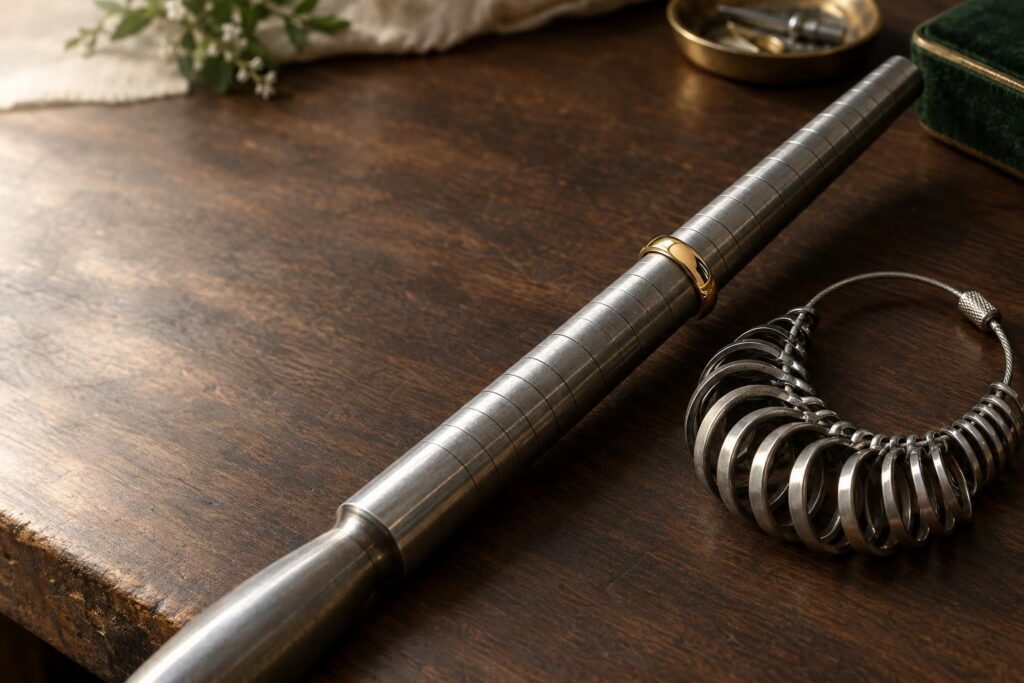
Why ring sizes get mixed up between countries
Why does it matter which system a ring size is written in? Because the same finger can carry a letter in one country and a number in another. Different countries use different scales to measure ring size 1. If you read a size in the wrong system, you can order a ring that doesn’t fit.
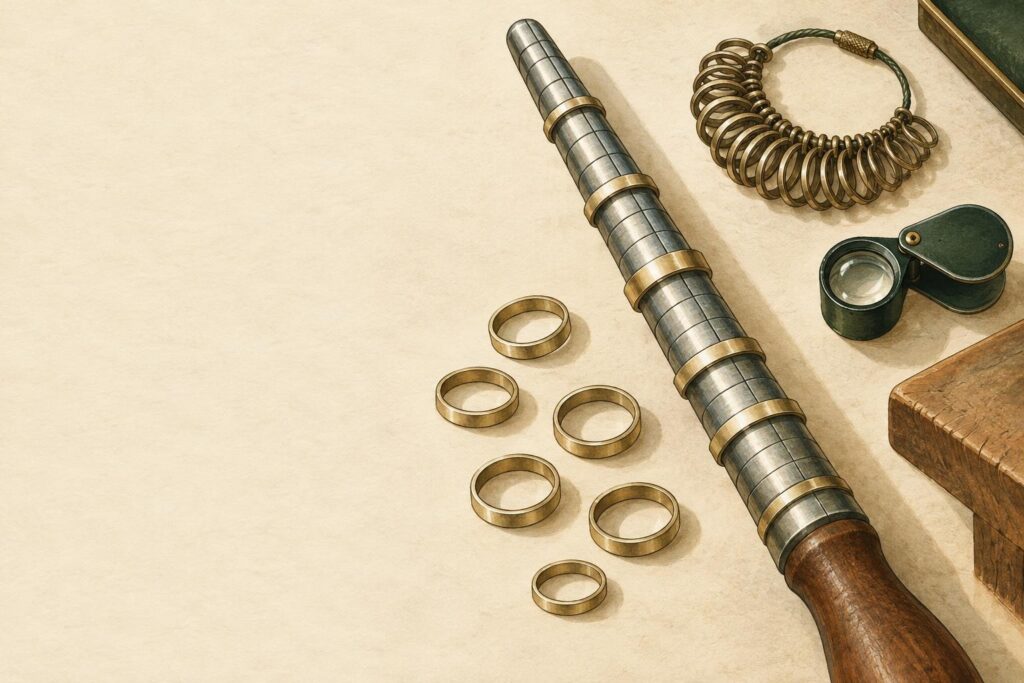
How do you move between the systems? A ring size conversion chart lays them side by side. GIA’s international chart, for example, lists inside diameter and inside circumference in millimetres, US and Canada numbers, UK, Europe and Australia letters, and Swiss and Asian sizes 1.
What should you check first? The system your size came from, and the system the ring uses. The sections below explain what each system measures, how to read a chart, and which numbers to trust when two charts don’t agree.
Why the millimetre measurements matter most
Why start with millimetres? Letters and numbers are only labels. On GIA’s chart, every size row also has an inside diameter and an inside circumference in millimetres 1. A millimetre figure describes the ring itself, so you can use it to compare sizes from different systems directly.
Inside diameter and inside circumference
Why do two millimetre figures appear for one size? Inside diameter is the distance straight across the inside of the ring. Inside circumference is the distance all the way around the inside. GIA’s chart gives 17.3 mm inside diameter and 54.3 mm inside circumference for the same size 1. So if a seller gives one millimetre figure, check which it is. Read 54.3 mm as a diameter and you would be describing a far larger ring.
Letters: UK, Europe and Australia
Why might a size look like a letter? On GIA’s chart, the UK, Europe and Australia share one letter column. The letters also come in half steps, such as F, F.5 and G 1. That shared heading is how GIA groups its chart. It doesn’t tell you which system a particular seller in Europe uses, so always check the listing itself.
Numbers: US and Canada
Why might a size look like a number? The US and Canada use numbers, in quarter steps such as 3, 3.25 and 3.5. On GIA’s chart, one letter step usually lines up with about half a US size, though not at every step 1. Because the two scales step differently, a letter and a number won’t always match one to one.
How to use a ring size conversion chart reliably
Why does the method matter? A small slip, like reading the wrong column, can move you to a different size. Here is a simple way to work through a chart.
- Write down the exact size and the system it came from, such as "UK N" or "US 7", not just "N" or "7".
- Find that size in its own column. GIA’s chart, for example, has separate columns for each system and for millimetres 1.
- Read across the same row to the system the ring uses.
- Note the millimetre figures on that row, and whether each is a diameter or a circumference.
- If your size falls between two steps in the other system, write down both and their millimetre values rather than rounding.
- Cross-check with the Ring Size Converter, then confirm against the seller’s own chart (see the next section).
What does a row look like? On GIA’s chart, US 7 equals UK N, which is 17.3 mm inside diameter and 54.3 mm inside circumference. US 8 equals UK P, at 18.1 mm and 56.9 mm 1. So moving from US 7 to US 8 adds about 2.6 mm to the inside circumference.
Why the seller’s own chart should have the final say
Why look beyond a general chart? The ring will be made to the seller’s measurement for that size, not to another chart’s label. The examples in this article come from GIA’s chart. You can’t assume another chart’s letters line up with GIA’s row for row.
How can that happen when standards exist? There is a written method for measuring and naming ring sizes. British Standard BS 6820 was replaced by BS EN 28653, and ISO 8653 is listed as its identical international equivalent 2. But a listing may not say which chart or standard it follows. A general chart or a converter cannot tell you which measurement the seller’s ring is made to; the seller’s own chart can.
What can you do before ordering? Compare millimetres, not labels.
- Find the seller’s own size chart for the ring you like.
- Note the inside circumference in millimetres for the size you plan to order.
- Compare it with the millimetre measurement of your finger or of a ring that fits well.
- If the seller gives no millimetre figure, ask for one before you order.
- If the labels and the millimetres seem to disagree, ask the seller which one their ring is made to.
Why half sizes matter more than they look
Why worry about a step as small as a quarter? On GIA’s chart, each quarter US size adds about 0.2 to 0.3 mm to the inside diameter 1. That is small, but it is the difference between two rows on the chart.
How do you keep that detail when converting? Carry the quarter or half step across with the size. US 7 and US 7.25 sit on different rows, so dropping the 0.25 means reading a different size.
What do jewellers use to measure? Fingers are measured with finger gauges, also called ring sizers, which are a graded series of metal bands. An existing ring is measured on a ring mandrel, a tapered rod marked with sizes 1.
Why band width changes the size you need
Why can two rings of the same size feel different? The width of the band plays a part. Rings with wide shanks (the shank is the band part of the ring) usually need to be a bit larger, because they fit more snugly 1.
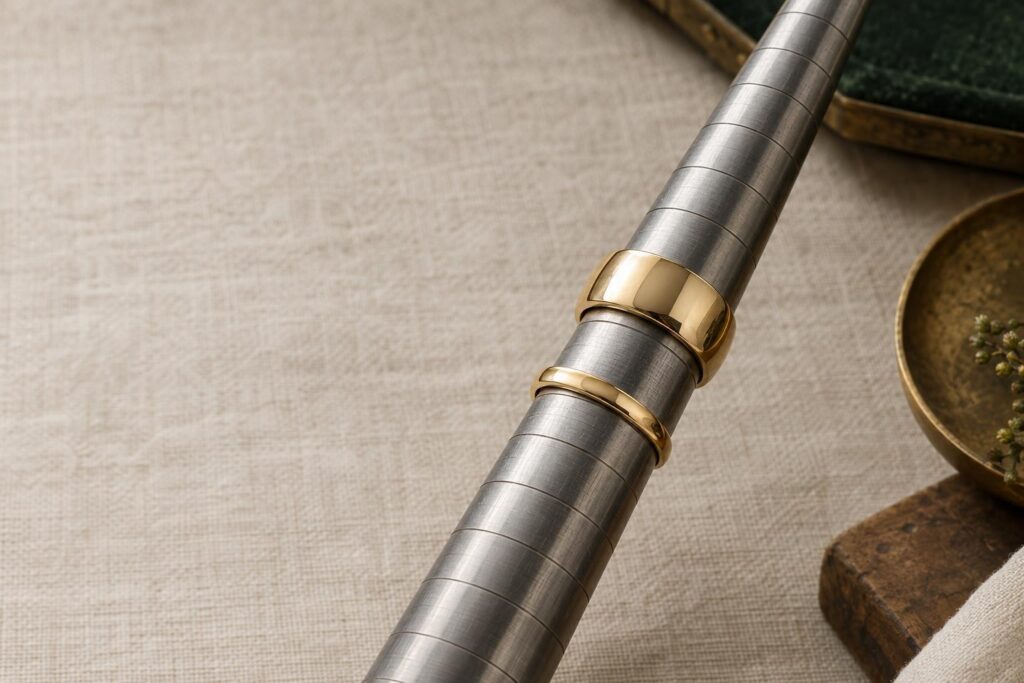
How does this affect rings worn together? Bridal sets, such as an engagement ring worn with a wedding band, need special consideration when they are wider than 4 or 5 mm together. When an unusually wide ring is measured on a mandrel, take the measurement from the centre of the band 1.
What does that mean for converting? A chart row doesn’t show band width. If the ring you like has a wide band, treat the converted size as a starting point to discuss with the seller or a jeweller.
How to get a starting size you can trust
Why check the starting size first? A conversion can only be as accurate as the measurement you begin with. Avoid measuring with string or paper, because string can stretch and paper can shrink and curl in heat and humidity 1.
How else can a measurement go wrong? Neither string nor paper allows for the knuckle, which for most people is larger than the rest of the finger 1. A ring has to pass over the knuckle, so a measurement that ignores it can mislead you.
What else should you note? Your finger changes. Fingers shrink in the cold and swell in the heat, and humidity, altitude and time of day can change their size too. For right-handed people, the left ring finger is usually a little smaller than the right 1. So note which hand and finger a size came from.
If you’d like help checking a size, Ralph Jacobs offers a free consultation, online at bookings.ralphjacobs.org from any country. We also offer an adjustable ring sizer for checking your size at home, free when you request it with an order.
When a ring size conversion chart isn’t enough
Why talk about the limits? A chart is a useful tool, but it can’t do everything. Knowing where it falls short can help prevent a wrong order.
- It can’t correct the size you start with. String can stretch and paper can shrink or curl, and neither allows for the knuckle 1.
- It may not match the seller’s chart. Compare the seller’s millimetre figures with your own.
- It doesn’t show band width. Wide shanks usually need to be a bit larger.
- It can’t follow your finger as it changes with heat, cold and time of day.
- It can’t undo a mistake. Read how ring resizing works before relying on a resize to fix a wrong conversion.
If any of these apply to you, a measurement taken with a jeweller’s finger gauge, in millimetres, gives you a firmer number to compare with the seller’s chart. If the ring is a surprise, How to find a ring size secretly covers other ways to get a size.
Frequently asked questions
On GIA’s chart, the UK, Europe and Australia share one letter column 1. Even so, a seller’s own chart may not match GIA’s row for row. Check the seller’s millimetre figure for your letter before you order.
On GIA’s chart, US 7 equals UK N, which is 17.3 mm inside diameter and 54.3 mm inside circumference 1. Other charts may differ, so confirm the millimetre figure on the seller’s own chart.
Rings with wide shanks usually need to be a bit larger, because they fit more snugly 1. If the band you like is wide, ask the seller or a jeweller about the size before you order.
It is better not to. String can stretch, and paper can shrink and curl in heat and humidity. Neither method allows for the knuckle, which for most people is larger than the rest of the finger 1.
Write down both neighbouring sizes and their millimetre values. Compare them with the seller’s own chart, think about the ring’s band width, and ask the seller or a jeweller before you order.