
Why look closely at the small stones on a ring? They change how the whole ring looks, and they are not always made of the same material. Accent stones add sparkle and interest without taking attention away from the main stone 3. Small diamonds used this way are called melee. They weigh less than 1/5 carat and are often cut round. They can circle the centre stone in a halo setting, run along the band, or sit close together in a pavé setting 1.
Where accent stones sit on a ring
Small stones can be placed in different ways around the main stone. Switch between the three to see how each one changes the look of the ring.
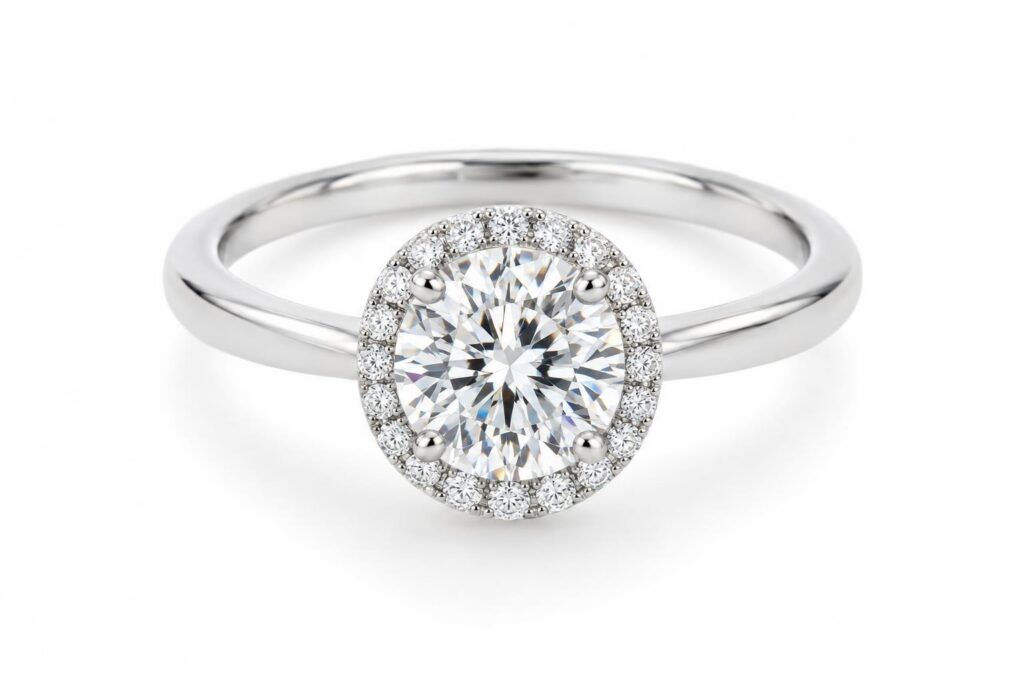
- Halo setting
- Small stones circle the centre stone. They add sparkle and interest without taking attention away from the main stone.
- Stones along the band
- Small stones run along the band, adding sparkle and interest while the centre stone stays the focus.
- Pavé setting
- Small stones sit close together in a pavé setting, so the surface sparkles with the stones packed tightly side by side.
The pictures cannot show what the accent stones are made of. Pictures: AI-generated illustrations, checked for accuracy. They are not photographs of a real piece.
What can accent stones be made of? A laboratory-grown diamond is made by a technological process, yet it has essentially the same chemical, physical and optical properties as a natural diamond 4. Moissanite is a laboratory-made silicon carbide used to imitate diamond. Its facet edges (the lines where its flat polished surfaces meet) look doubled under magnification 5. Small crystals are quicker and cheaper to grow, so melee-size laboratory-grown diamonds and imitations are common. Because melee are sold in large parcels, these can be mixed in with natural diamonds and missed 3. Melee usually come without a grading report, so it is worth asking what your accent stones are 1. Our guide to natural and laboratory-grown diamonds and moissanite compares the three.
Why does the match to the centre stone matter? For an even look, side stones can sit within one or two colour grades of the centre stone, with cut and clarity that match or complement it, while coloured side stones create contrast instead 2.
Example: Picture a ring with a round centre diamond circled by a ring of tiny sparkling stones. Those tiny stones are accent stones, and in a halo like this they can draw attention to the centre stone and make it look larger 1.