
Why does pavé matter when you choose a ring? It shapes both how the ring looks and how much care it needs. Pavé, said "pah-vey", comes from the French for "to pave" 2. The small stones usually sit together in a honeycomb pattern, like bricks in a paved road 1. Pavé is often used along the band or in a halo (a ring of small stones around a centre stone) 3.
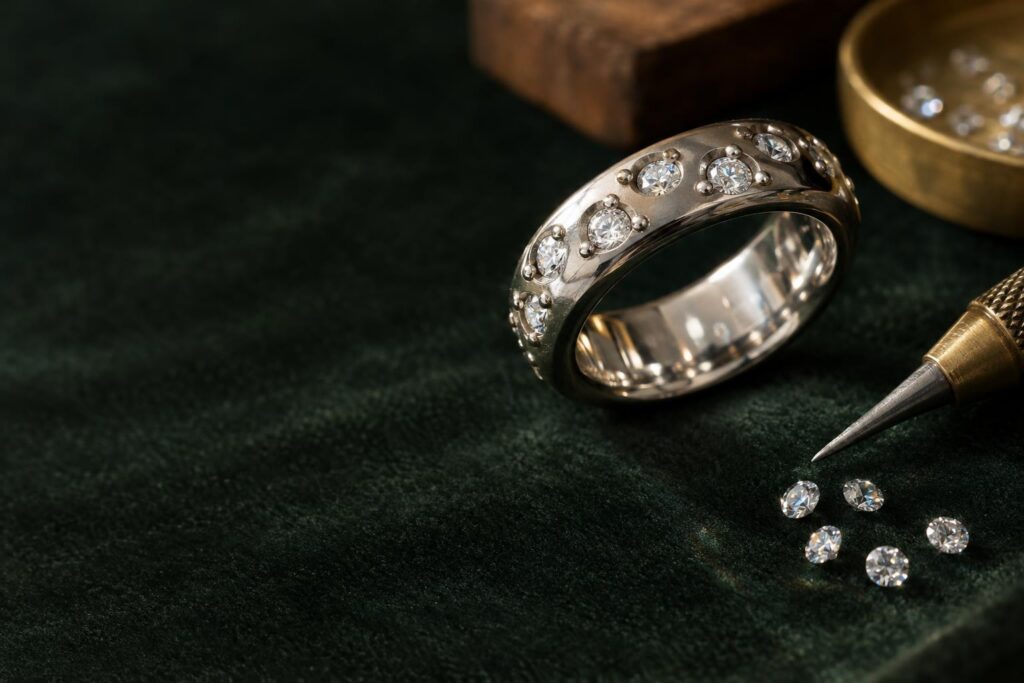
How are such tiny stones held? Pavé is a type of bead setting. Each stone sits in a small hollow in the metal, and tiny beads of metal at the stone’s girdle (its thin outer edge) hold it in place 1. A setter raises these beads by hand, and pavé usually has three or more rows of stones 4. The stones are often melee diamonds, the name for very small accent diamonds 2.
What does this mean once you wear it? If you are very active, the small stones can be at risk of falling out, so the piece should be handled with care 1. Pavé collects dirt more easily and may need cleaning more often. It may also need occasional checks to keep the stones secure. Ultrasonic cleaners can knock out stones that are already loose, so check our Jewellery Care and Safety Guide before cleaning at home. A pavé band can be harder to resize, because adjusting the ring may disturb the small stones 3. You can read more in why not every ring can be resized, or compare pavé with other styles in ring settings explained.
Example: Picture an engagement ring with one centre diamond and a slim band lined with rows of tiny diamonds across the top. Those small stones, packed close and held by little beads of metal, form a pavé band.